Table of Contents
- What Is Numerical Aperture in Light Microscopy?
- How Resolution Depends on Wavelength and Numerical Aperture
- Magnification, Useful Magnification, and Empty Magnification
- Illumination, Contrast, and the Role of the Condenser
- Digital Sampling, Pixels, and the Nyquist Criterion
- Matching Objectives, Condensers, and Immersion Media
- Practical Trade-offs and Common Misconceptions
- Frequently Asked Questions
- Final Thoughts on Balancing NA, Resolution, and Magnification
Numerical Aperture, Resolution, and Magnification Explained
Understanding how microscopes actually create detail is the foundation for making smart choices about objectives, illumination, and cameras. Three terms dominate this conversation—numerical aperture (NA), resolution, and magnification. They are related but not interchangeable. This article clarifies what each means, how they interact, and how you can balance them to achieve crisp, information-rich images without falling into the trap of empty magnification or poor contrast.

Artist: Anaqreon
Whether you are a student exploring optical principles, an instructor preparing demonstrations, or a hobbyist fine-tuning a setup, the sections below walk through the physics in plain language with enough rigor to stay technically correct. Along the way, we’ll also connect the dots between objective labeling, condenser settings, illumination coherence, and digital pixel sampling—so that the full optical train makes sense end-to-end.
What Is Numerical Aperture in Light Microscopy?
Numerical aperture (NA) quantifies a lens’s ability to gather light and resolve fine specimen detail at a fixed wavelength. It is defined as:
NA = n · sin(θ)
Here, n is the refractive index of the immersion medium between the objective front lens and the specimen (for example, ~1.000 for air, ~1.33 for water, ~1.515 for standard immersion oil), and θ is half the angular aperture: the largest half-angle of light that can enter the objective from the specimen.

Artist: Thebiologyprimer
Key implications of NA:
- Light-gathering power: Higher NA lenses collect more diffracted light from fine specimen features. This improves resolution and brightness for the same exposure conditions.
- Resolution potential: NA, together with wavelength, sets the smallest resolvable feature size in the lateral plane. See How Resolution Depends on Wavelength and Numerical Aperture.
- Depth of field and working distance: As NA increases, depth of field decreases and working distance (the distance from the objective front element to the specimen when in focus) often decreases. This is a real trade-off when imaging thick or uneven samples. Details in Practical Trade-offs and Common Misconceptions.
- Immersion media matter: Changing the immersion medium changes n and can increase NA beyond what is possible in air. Oil-immersion objectives commonly reach NA ≥ 1.25; some specialized designs achieve even higher NA values.
Objective barrels typically list magnification and NA together—such as “40×/0.65” or “100×/1.30 Oil.” When choosing between objectives of equal magnification, the one with the higher NA has greater resolving power. Conversely, a higher magnification lens with a lower NA may show a larger image but not more detail.
It is important to distinguish NA from f-number used in photography. While related concepts, NA is adapted for object space and refractive index in microscopy, whereas f-number (f/#) is the focal length divided by the entrance pupil diameter in image space. In microscopy, NA is the more directly useful parameter for predicting fine detail and brightness at the specimen plane.
How Resolution Depends on Wavelength and Numerical Aperture
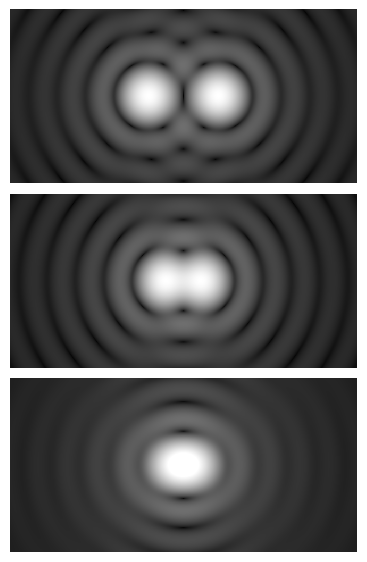
Resolution is the ability to distinguish two closely spaced points as separate. In optical microscopy, resolution is fundamentally limited by diffraction. A common criterion for lateral (x–y) resolution in incoherent widefield imaging uses the approximate relationship:
d ≈ 0.61 · λ / NA
Artist: Spencer Bliven
where λ is the relevant wavelength of light and d is the smallest center-to-center separation of two features that can be resolved as distinct under typical contrast criteria. The equation shows two practical levers for resolution:
- Decrease wavelength: Blue or green light gives smaller d than red light for the same NA. In fluorescence, use the emission wavelength to estimate achievable resolution in the detection path.
- Increase NA: Higher NA objectives decrease d, enabling finer spatial detail.
Along the optical axis (z-direction), axial resolution is poorer than lateral resolution for the same NA. While exact expressions depend on illumination and imaging modality, axial resolution commonly scales less favorably and worsens rapidly as NA decreases. A qualitative rule: thicker optical sections result from lower NA and longer wavelengths. Confocal, deconvolution, and other techniques can improve effective axial resolution, but those are beyond the scope here.
Resolution is not contrast and not magnification
Resolution should not be conflated with contrast or magnification. You can have high resolution potential but low contrast if your illumination or specimen preparation does not reveal phase or absorption differences. Likewise, magnifying a blurred feature simply produces a larger blur. We elaborate on both points in Magnification, Useful Magnification, and Empty Magnification and in Illumination, Contrast, and the Role of the Condenser.
Objective NA and condenser NA together influence detail
In transmitted brightfield, the objective and condenser operate as a pair. The condenser shapes illumination’s angular distribution and affects spatial frequencies that reach the specimen. Using a condenser NA that meaningfully supports the objective’s NA helps reveal fine detail. Setting the condenser aperture too small increases contrast but sacrifices resolution; opening it too wide can flood the image with glare and reduce contrast. A balanced setting is discussed in Illumination, Contrast, and the Role of the Condenser.
Magnification, Useful Magnification, and Empty Magnification
Magnification tells you how large the image of the specimen appears, but by itself it does not increase the amount of information captured. It can be set by the combination of the objective, the tube lens (in infinity-corrected systems), intermediate optics, eyepieces, and the camera’s pixel size. In many practical microscope configurations, the objective’s marked magnification is a useful shorthand for discussing the overall scale of the image at the camera or eyepiece, but remember that different cameras and tube lenses can change the effective total magnification at the sensor.
What matters for detail is whether the magnification is sufficient to support the resolution delivered by the objective’s NA. This leads to two important concepts:
- Useful magnification: The range of magnification that adequately displays the resolution provided by the objective (and optics) without wasting pixels or screen real estate.
- Empty magnification: Magnification beyond the point where additional image size does not reveal additional detail because the optical resolution has already been reached.
A classic rule of thumb for visual observation suggests that useful total magnification is roughly 500× to 1000× per millimeter of objective numerical aperture. That is, an objective of NA 0.65 might usefully support about 325× to 650× total magnification for visual work. Digital imaging places more precise constraints based on pixel sampling and Nyquist, covered in Digital Sampling, Pixels, and the Nyquist Criterion.
Field of view and magnification
Field of view (FOV) depends on the objective, tube lens, and the sensor or eyepiece field number. Increasing magnification reduces the observable area for a given sensor size. For a camera, the specimen-space pixel size is the camera pixel size divided by the overall system magnification to the sensor plane. This influences both FOV and sampling density. You can learn how to estimate these relationships in Digital Sampling, Pixels, and the Nyquist Criterion.
Resolution-limited detail vs. display-limited visibility
Even if the optics resolve fine detail, your ability to see it depends on display conditions—monitor size, zoom level, viewing distance, and the viewer’s eyesight. For consistent analysis, it is generally better to reason in terms of spatial frequency (line pairs per millimeter), NA, and pixel sampling than in terms of arbitrary screen zoom. This helps avoid conflating visual enlargement with genuine optical information content.
Illumination, Contrast, and the Role of the Condenser
Resolution depends on NA and wavelength, but whether fine features are visible depends heavily on illumination and contrast. In transmitted-light microscopy, the condenser controls the illumination cone on the specimen. Together with diaphragms and contrast accessories, it shapes both the coherence and the angular spectrum of light that interacts with the specimen.
Köhler illumination: even, controlled lighting
For most brightfield and contrast techniques, setting up Köhler illumination provides uniform, well-controlled illumination. Under Köhler, the condenser aperture diaphragm is imaged at the objective’s back focal plane, and the field diaphragm is imaged at the specimen plane. This separation ensures that contrast and resolution can be tuned via the condenser aperture without introducing specimen-plane hot spots or vignetting.

Artist: ZEISS Microscopy
When Köhler is established, the condenser aperture diaphragm becomes the main control over illumination NA. Opening it increases the illumination NA, improving potential resolution and reducing depth of field but potentially lowering contrast. Closing it increases contrast and depth of field but reduces resolution and brightness. A common practical approach is to set the condenser aperture to a value modestly below the objective’s NA to balance fine detail and contrast. The NA–resolution relation reminds us that if the illumination NA is set too low, high spatial frequencies are not efficiently excited or transmitted.
Brightfield, phase contrast, and DIC: contrast without stains
Many biological and transparent samples are weakly absorbing, making brightfield contrast low. Two widely used techniques introduce contrast by converting phase variations (optical path differences) in the specimen to intensity differences:
- Phase contrast: Inserts a phase ring in the objective and a matching annulus in the condenser to shift and attenuate the undiffracted light relative to diffracted light. This converts small phase shifts into intensity contrast, ideal for thin, transparent specimens.
- Differential interference contrast (DIC): Uses polarizers and prisms to shear and recombine two slightly offset wavefronts from the specimen, converting phase gradients into intensity differences with a pseudo-3D relief effect. It preserves high resolution and is especially good for fine edge detail.
Both methods interact with NA. High-NA objectives can reveal more fine structure, but the condenser alignment, accessories, and diaphragms must be correctly matched to preserve resolution. If you’re comparing magnification choices for phase or DIC, prioritize NA and proper alignment over simply increasing magnification.
Illumination spectrum and filters
Resolution depends on wavelength, so the illumination spectrum matters. Shorter-wavelength components contribute higher spatial frequencies. In brightfield with white light, the effective resolution reflects the spectrum weighted by the camera or eye response and the specimen’s contrast. In fluorescence, use the emission wavelength of the fluorophore to estimate resolution in the detection path; the excitation wavelength sets what is excited, but the image is formed by emitted light. Managing spectra, bandpass selection, and exposure affects signal-to-noise ratio and, by extension, the practical visibility of resolved detail.
Illumination uniformity, stability, and proper diaphragm use are just as important as choice of objective. Weak contrast due to poor alignment can mimic low resolution. Before attributing visibly soft images to optics, confirm basic illumination quality and condenser settings as explained above.
Digital Sampling, Pixels, and the Nyquist Criterion
Even when your optics can resolve fine detail, a digital camera must sample the image finely enough to capture that detail without aliasing. This is where the Nyquist sampling criterion comes in. For a band-limited signal like an optical image, Nyquist states that to faithfully represent the highest spatial frequency present, the sampling frequency must be at least twice that frequency. In practice for microscopy, a common guideline is:
- Specimen-space pixel size should be no larger than about d/2, where d is the optical resolution (for example, by the 0.61·λ/NA estimate).
To apply this, you need to connect camera pixel size to specimen-space sampling. If a camera has pixels of size p (in micrometers), and the total magnification to the sensor is M, then each camera pixel corresponds to a specimen-space sampling of approximately p / M micrometers per pixel.
Worked example: does the camera sample finely enough?
Suppose you use a 60× objective (with an appropriate tube lens) and a camera with 6.5 µm pixels. The specimen-space pixel size is about 6.5 µm / 60 ≈ 0.108 µm (108 nm). If the objective has NA = 1.40 and you image at λ ≈ 550 nm, the lateral resolution estimate is d ≈ 0.61·550 nm / 1.40 ≈ 240 nm. Nyquist then suggests a sampling ≤ d/2 ≈ 120 nm per pixel. Since your sampling is ~108 nm per pixel, the camera is just about adequate to capture the optical detail without undersampling.
Now consider the same camera with a 20× objective. The specimen-space pixel size becomes ~6.5 µm / 20 ≈ 0.325 µm (325 nm). If the 20× objective has NA = 0.50 at λ ≈ 550 nm, d ≈ 0.61·550 nm / 0.50 ≈ 671 nm, so d/2 ≈ 336 nm. Your sampling of ~325 nm/pixel slightly oversamples relative to Nyquist, which is fine—it avoids aliasing and still gives good representation of the achievable detail. Oversampling beyond reason can reduce field of view and inflate data sizes, but modest oversampling is typically safe.
Aliasing, MTF, and practical image quality
Even when sampling meets Nyquist, the recorded image also depends on the optical transfer function (OTF) or its magnitude (MTF) of the system—optics plus sensor. The OTF describes how spatial frequencies are transferred in amplitude and phase. A high-NA objective has a wider passband (support for higher spatial frequencies). If you set condenser illumination too low in NA, you may in effect truncate the available frequency content, which cannot then be recovered by sampling. Conversely, if your camera undersamples, high spatial frequencies fold into lower ones (aliasing), creating misleading patterns that do not reflect the specimen’s true structure.
Bin, crop, or change magnification?
When a given camera oversamples heavily, you can consider pixel binning to increase signal per effective pixel at the cost of resolution, or adjust magnification so that the specimen-space pixel size better matches your optical resolution. Cropping the field of view does not change sampling density; it simply records a smaller area at the same sampling rate.
Color cameras and demosaicing
Color sensors typically use a Bayer or similar filter mosaic where each pixel records one color channel. The full-color image is reconstructed by demosaicing, which can slightly reduce effective resolution compared to monochrome capture with the same pixel size. For critical resolution-limited imaging, monochrome cameras often provide the most faithful sampling because every pixel records the full luminance signal, but color cameras are advantageous for brightfield histology-like images where color is part of the information content.
Matching Objectives, Condensers, and Immersion Media
Microscope performance is a system property. The objective, condenser, immersion medium, cover glass, and alignment all interact. Here are key compatibilities and trade-offs to consider when trying to realize the NA-limited resolution your objective can provide.
Objective types and labels
Objective barrels typically state:
- Magnification (e.g., 10×, 40×, 60×, 100×)
- NA (e.g., 0.25, 0.65, 0.80, 1.30)
- Immersion medium (e.g., Air, Water, Oil, Glycerol)
- Cover glass specification (e.g., 0.17 mm for #1.5 coverslips)
- Correction type (e.g., Achromat, Plan-Achromat, Plan-Apochromat)

Artist: QuodScripsiScripsi
These descriptors are not mere labels—they point directly to the optical corrections and resolution potential. For instance, a Plan-Apochromat objective with high NA is corrected for chromatic and spherical aberrations over a wide field and multiple wavelengths, maintaining resolution across the image. Achromats are more basic, balancing cost and performance with limited corrections. If your application demands flat fields and color fidelity at high NA, the additional correction can be worth it. If you need large working distance or low cost for survey work, a lower-NA achromat could be more practical.
Immersion media and refractive index
Increasing the refractive index between the front lens and the specimen increases NA for the same acceptance angle. Air objectives generally top out below NA ≈ 1.0, while oil objectives can surpass NA 1.25. Water-immersion objectives provide higher NA than air but are often chosen for live or aqueous specimens to reduce refractive index mismatch and spherical aberration. Glycerol immersion lies between water and oil in refractive index and can be advantageous for thicker specimens mounted in media closer to glycerol’s index.
Using the correct immersion medium for the objective is essential. Substituting oil for a water-immersion objective (or vice versa) introduces refractive index mismatches that can seriously degrade resolution and contrast. Always match the medium indicated on the barrel.
Cover glass thickness
High-NA objectives are typically corrected for a specific cover glass thickness, commonly 0.17 mm (standard #1.5). Deviation from this value introduces spherical aberration that degrades resolution. Some objectives include a correction collar to compensate for variations in cover glass thickness or temperature-induced refractive index changes. If your images appear soft despite correct illumination and focus, checking cover glass compatibility is a worthwhile step.
Condenser NA, diaphragms, and matching
Condensers also have an NA, and in transmitted brightfield they should be chosen to support the objective’s resolution capability. A high-NA objective paired with a low-NA condenser limits achievable detail because illumination cannot sufficiently excite or transmit high spatial frequencies in the specimen. The condenser aperture diaphragm controls the effective illumination NA: closing it reduces it, which in turn sacrifices resolution but improves contrast and depth of field. Opening it raises the illumination NA, supporting higher resolution but potentially reducing contrast and increasing glare. A balanced value is often slightly less than the objective NA for general imaging, but the optimal setting depends on specimen transparency and desired contrast.
Tube lens and system magnification
Infinity-corrected objectives require a tube lens to form the intermediate image. The objective’s nominal magnification assumes a specific tube lens focal length specified by the objective manufacturer’s standard. Changing tube lens focal length changes the effective magnification and field of view, which then changes specimen-space pixel size at the camera. Care must be taken so that your sampling remains consistent with Nyquist. Importantly, changing the tube lens does not change the objective’s NA or fundamental diffraction limit—it only alters magnification and field parameters.
Practical Trade-offs and Common Misconceptions
Even with a clear understanding of NA and resolution, daily microscopy involves balancing competing priorities. Below are common scenarios and misconceptions that can lead to underperforming images, along with guidance grounded in the physics introduced earlier.
Misconception: higher magnification always improves detail
As covered in Magnification, Useful Magnification, and Empty Magnification, magnification without adequate NA cannot add information. If the objective’s NA and wavelength set the lateral resolution to, say, 700 nm, increasing magnification only enlarges the same 700 nm blur. To genuinely improve detail, increase NA (e.g., by using a higher-NA objective and matching immersion medium) and ensure that illumination and sampling support the higher spatial frequencies.
Misconception: brightness equals resolution
Bright images can still be unresolved. Opening the condenser aperture in Köhler illumination raises brightness but can reduce contrast if the specimen is weakly scattering. Conversely, closing the condenser can increase contrast but reduces the illumination NA and the highest resolvable spatial frequency. Adjust diaphragms to strike the desired balance for your specimen—don’t equate brightness or darkness with sharpness.
Trade-off: depth of field vs. lateral resolution
Higher NA reduces depth of field. For thin specimens, this is generally acceptable and even beneficial for isolating a layer of interest. For thicker specimens, low NA increases the depth of field at the cost of lateral resolution. Deciding which is more important depends on your imaging goal. Techniques like optical sectioning (e.g., confocal) can mitigate out-of-focus blur but do not change the underlying NA–wavelength limits.
Trade-off: field of view vs. sampling density
Large sensors and low magnification expand field of view but may undersample the optical image if the pixel size is large at the specimen plane. Higher magnification shrinks the field of view but can improve sampling density. As explained in Digital Sampling, Pixels, and the Nyquist Criterion, aim for specimen-space pixel sizes that meet or slightly exceed the Nyquist requirement relative to your optics.
Misconception: any cover glass will do
At high NA, objectives are often corrected for a particular cover glass thickness. Using a cover glass outside the specified range introduces spherical aberration that spreads the point spread function, effectively increasing d in the resolution relation and reducing fine detail. When a correction collar is available, use it to compensate for cover variations and mounting media differences.
Trade-off: contrast method vs. optical throughput
Phase contrast inserts phase-shifting and attenuating elements; DIC adds polarizers and prisms. These components change light throughput and can affect exposure. While these techniques increase contrast for transparent specimens, their throughput and specific alignments matter for achieving the intended resolution. If switching between brightfield and phase/DIC, recheck illumination, condenser settings, and camera exposure so that the signal-to-noise ratio remains favorable for the spatial frequencies you care about.
Misconception: camera megapixels define microscope detail
Megapixel count determines how many samples you collect across the field of view. It does not set the optical resolution, which is defined by NA and wavelength. A high-megapixel camera can be hampered by large pixels (undersampling), while a lower-megapixel camera with small pixels might better sample the resolution available, albeit over a smaller field. Select cameras with pixel sizes that complement your objectives and tube lens for the desired Nyquist-compliant sampling.
Practical note: alignment and cleanliness
Misalignment of the condenser or dirt on optical surfaces degrades contrast and apparent resolution. Even the best high-NA objectives cannot overcome veiling glare from a dusty condenser or field diaphragm. Periodic, careful cleaning with appropriate materials and ensuring that diaphragms, prisms, and polarizers are correctly oriented go a long way toward achieving the performance that NA and wavelength predict.
Frequently Asked Questions
How do I decide between a 40×/0.65 objective and a 60×/0.80 objective for fine detail?
Compare NA first. The 60×/0.80 objective has higher NA and therefore higher resolution potential than the 40×/0.65, independent of magnification. If your specimen and working distance constraints allow it, and your illumination and sampling are set to support the higher NA (see illumination and sampling), the 60×/0.80 will resolve finer details. However, it likely has a shorter working distance and a smaller depth of field. If you need more room above the specimen or greater depth of field, the 40×/0.65 might be more practical. Consider camera pixel size too: ensure specimen-space pixel size ≤ d/2 for the chosen objective and wavelength as discussed in Nyquist.
Why do my images look soft at high NA even though I’m using oil immersion?
Several system factors can limit perceived sharpness: cover glass thickness mismatch without correction collar adjustment; insufficient condenser NA (aperture diaphragm too closed); misalignment preventing Köhler illumination; contamination on optics; or camera undersampling/oversampling combined with aggressive post-processing. Verify each element in the chain: match the immersion medium to the objective, use the correct cover glass thickness (or adjust the collar), set condenser aperture to support the objective’s NA, and confirm that the camera sampling meets Nyquist for the expected resolution.
Final Thoughts on Balancing NA, Resolution, and Magnification
The essence of optical microscopy performance is elegantly compact: resolution improves with higher numerical aperture and shorter wavelength. Everything else—magnification, illumination, sampling, and contrast methods—either helps you realize that resolution in practice or squanders it. High magnification without high NA yields larger but not sharper images. Illumination without proper condenser settings restricts the spatial frequencies that reach the detector. A camera with mismatched pixel size can either miss available detail or waste data on empty pixels.
When evaluating or tuning a system, consider this practical checklist:

Artist: SiriusB
- Identify the objective NA and the relevant wavelength to estimate the diffraction-limited lateral resolution.
- Ensure illumination and condenser aperture support that resolution with balanced contrast (Köhler, appropriate diaphragm setting).
- Match immersion media and cover glass thickness to objective specifications; use any correction collar if available.
- Confirm digital sampling meets Nyquist (specimen-space pixel size ≲ d/2), adjusting magnification or camera choice when needed.
- Evaluate contrast method (brightfield, phase, DIC) relative to specimen properties and throughput.
These steps align your system with the physics of diffraction and ensure that the image you see approaches the true capabilities of your optics. If you found this guide helpful and want more deep dives into microscopy principles—from illumination coherence to objective aberrations and sampling strategies—consider subscribing to our newsletter to be notified about future articles.
Appendix: Simple Resolution and Sampling Calculations
To tie the concepts together, below is a small code-like recipe for estimating lateral resolution and specimen-space pixel size. It uses the common approximation for widefield incoherent imaging.
# Inputs:
#   lambda_nm: wavelength (nm), e.g., 550 for green light
#   NA: numerical aperture of the objective
#   pixel_um: camera pixel size in micrometers
#   magnification: total magnification to the sensor (objective * tube-lens factor, etc.)

# Lateral resolution estimate (Abbe/Rayleigh-like constant 0.61):
# Convert wavelength to micrometers: lambda_um = lambda_nm / 1000.0
lambda_um = 0.550   # 550 nm
NA = 1.40
pixel_um = 6.5
magnification = 60.0

# Smallest resolvable center-to-center distance in micrometers
d_um = 0.61 * lambda_um / NA  # ≈ 0.61*0.55/1.40 ≈ 0.240 µm

# Specimen-space sampling per pixel (µm/pixel)
sample_um_per_pixel = pixel_um / magnification  # 6.5/60 ≈ 0.108 µm/pixel

# Nyquist target is roughly d/2:
nyquist_target_um = d_um / 2.0  # ≈ 0.120 µm/pixel

# Interpretation:
# If sample_um_per_pixel ≤ nyquist_target_um, sampling is adequate to capture optical detail.
# If sample_um_per_pixel > nyquist_target_um, consider increasing magnification or using smaller pixels.
Use this as a starting point. Real systems can deviate due to aberrations, spectral bandwidth, and system MTF, but the logic ensures that your sampling plan respects the primary physical limits.
Related Reading Within This Guide
- Defining NA and its consequences: What Is Numerical Aperture in Light Microscopy?
- Diffraction-limited detail and wavelength dependence: How Resolution Depends on Wavelength and Numerical Aperture
- Why bigger isn’t always better: Magnification, Useful Magnification, and Empty Magnification
- Balancing contrast with resolution: Illumination, Contrast, and the Role of the Condenser
- Camera choice and pixel math: Digital Sampling, Pixels, and the Nyquist Criterion
- System compatibility and alignment: Matching Objectives, Condensers, and Immersion Media
If you’re building a study plan, move through the sections in that order. Each section assumes the definitions and relationships established earlier and adds one more layer of system-level reasoning.