
Table of Contents
- What Is a Dobsonian Telescope? Design, Strengths, and Trade‑offs
- Dobsonian vs. Other Telescope Types: Value, Portability, and Use Cases
- Aperture, Focal Length, and f/Ratio in Dobsonian Reflectors
- How to Choose a 6–8 Inch Dobsonian: Features, Options, and Budget
- Essential Accessories: Eyepieces, Finders, Filters, and Tools
- Setup, Cooldown, and Collimation: Step‑by‑Step Essentials
- Observing Techniques: Starhopping, Magnification, and Light Management
- What You Can See with 6–8 Inch Dobsonians: Planets, Moon, and Deep‑Sky
- Upgrades and Maintenance: Smooth Motions, Flocking, and Mirror Care
- Budgeting and the Used Market: How to Inspect and Save
- Frequently Asked Questions
- Final Thoughts on Choosing the Right Dobsonian Telescope
What Is a Dobsonian Telescope? Design, Strengths, and Trade‑offs
A Dobsonian telescope is a Newtonian reflector mounted on a simple, stable, alt‑azimuth base. It prioritizes aperture per dollar—that is, how much light‑gathering area you get for your budget—by using cost‑effective materials and a design that’s easy to build, maintain, and transport. Popularized in the late twentieth century by sidewalk astronomers, the Dobsonian’s approachable ergonomics and substantial aperture made deep‑sky observing more accessible to hobbyists worldwide.
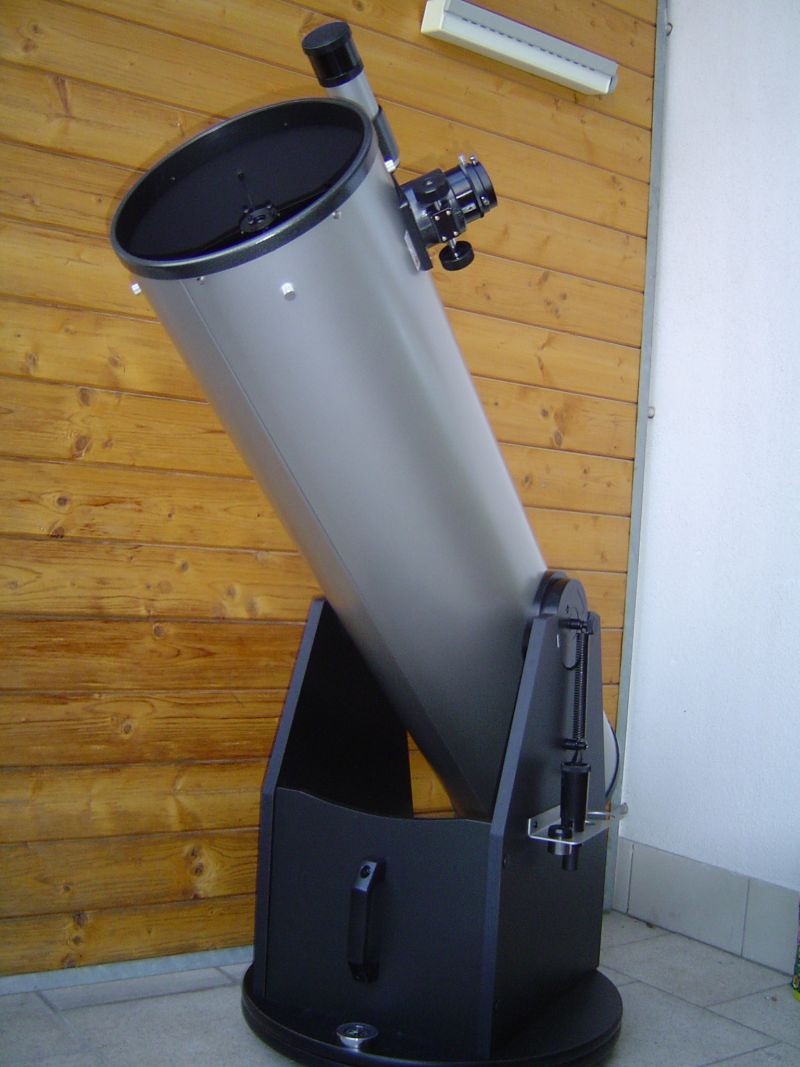
Credit: first uploaded on the English-speaking Wikipedia under the same filename
At its core, a Dobsonian consists of:
- Optical Tube Assembly (OTA) with a parabolic primary mirror and a small flat secondary mirror that redirects light into the focuser.
- Alt‑azimuth base (the “Dobsonian mount”), typically wood or engineered wood, that provides smooth vertical (altitude) and horizontal (azimuth) motion.
- Crayford or rack‑and‑pinion focuser, usually 2 inches with a 1.25‑inch adapter to accommodate a wide range of eyepieces.
This deceptively simple design yields major benefits:
- Large aperture at lower cost than most refractors or catadioptrics.
- Intuitive “push‑to” operation with smooth, balanced movements ideal for starhopping.
- Quick setup with minimal components; no complex tripod or counterweights are needed.
However, Dobsonians come with trade‑offs you should weigh carefully (explored in Dobsonian vs. Other Telescope Types):
- Manual tracking requires nudging the scope to follow targets as Earth rotates.
- Open‑tube Newtonians need collimation (mirror alignment) for best performance (see collimation steps).
- Large tubes and bases may present storage and transport considerations.
For many observers—especially those focused on visual astronomy—6–8 inch Dobsonians hit a special sweet spot: bright views, friendly ergonomics, manageable size, and strong performance on both the Moon/planets and deep‑sky objects.
Dobsonian vs. Other Telescope Types: Value, Portability, and Use Cases

Artist: OpenStax
Comparing a Dobsonian with refractors, Schmidt‑Cassegrains (SCTs), and equatorially mounted Newtonians helps clarify why 6–8 inch Dobsonians are so popular. Your observing goals, observing site, and tolerance for setup complexity should guide your choice.
Dobsonian vs. Refractor
- Value: Inch‑for‑inch, reflectors deliver far more aperture per dollar than refractors.
- Color and contrast: Quality refractors exhibit high contrast and may have less scatter, especially for planetary viewing. A well‑collimated Dobsonian with cooled optics, however, can deliver excellent lunar and planetary detail.
- Maintenance: Refractors usually need no collimation; Newtonians do. Dobsonian primary mirrors eventually need recoating (often after many years, depending on use and storage).
- Portability: Short‑tube refractors are compact; 8‑inch Dobsonians are bulkier but still car‑portable.
Dobsonian vs. SCT/Mak‑Cass
- Cost: Dobsonians often cost less for a similar aperture.
- Cooldown: Closed‑tube catadioptrics can take longer to reach thermal equilibrium; open Dobsonians cool faster, especially with a small fan on the primary mirror.
- Field of view (FOV): Dobsonians typically offer wider fields with 2‑inch eyepieces, great for large nebulae and star fields.
- Tracking: SCTs often come with motorized forks or can be placed on equatorial mounts for tracking. Dobsonians are mostly manual unless you opt for GoTo/tracking variants or an equatorial platform (see observing techniques).
Dobsonian vs. Equatorially Mounted Newtonian
- Setup and ergonomics: Dobsonians are simpler, lower to the ground, and quicker to deploy. EQ mounts require polar alignment and counterweights.
- Visual observing: Dobsonians excel at casual yet precise starhopping and low‑friction motions. With an EQ, the eyepiece can end up in awkward positions unless you rotate the tube.
- Astrophotography: EQs are superior for deep‑sky imaging. Dobsonians are optimized for visual use (see astrophotography FAQ).
For newcomers aiming at visual exploration, especially from suburban skies, a 6–8 inch Dobsonian is a balanced, cost‑effective entry into serious observing. If you prioritize electronically assisted astronomy (EAA) or traditional deep‑sky astrophotography, consider a tracking solution or a different platform.
Aperture, Focal Length, and f/Ratio in Dobsonian Reflectors

Artist: Fernly at English Wikibooks
Understanding a few optical fundamentals will help you choose eyepieces wisely and set realistic expectations for image brightness, contrast, and field of view.
Aperture and Resolution
- Aperture is the diameter of the primary mirror. It determines light‑gathering power and, all else equal, resolving power.
- Common Dobsonian sizes in this guide: 6 inches (150–152 mm) and 8 inches (200–203 mm).
- Approximate resolving power using the Dawes limit (arcseconds):
116 / D(mm).- 6 inch (152 mm): ~0.76″
- 8 inch (203 mm): ~0.57″
In practice, atmospheric seeing often limits resolution more than the optics. On an average night, you may be limited to 1–2 arcseconds or more, regardless of aperture.
Focal Length, f/Ratio, and Image Scale
- Focal length is the distance over which the mirror brings light to focus. Typical values:
- 6 inch Dobsonian: ~1200 mm (often f/8)
- 8 inch Dobsonian: ~1200 mm (f/6) to ~1250 mm
- f/Ratio = focal length / aperture. Typical values:
- 6 inch: f/8 (for example, 1200 mm / 150 mm)
- 8 inch: f/6 (for example, 1200 mm / 200 mm)
Lower f/ratios (“faster” optics) enable wider fields for a given eyepiece, but they also make collimation and eyepiece performance more demanding. At f/6–f/8, basic Plössls and many budget wide‑fields perform well; at f/5 and faster, edge aberrations can become more noticeable without better‑corrected eyepieces.
Exit Pupil, Brightness, and Magnification
Three simple relationships guide eyepiece choice:
Magnification (M) ≈ Focal length of telescope / Focal length of eyepiece
True Field of View (TFOV) ≈ Apparent FOV (AFOV) / Magnification
Exit Pupil (mm) ≈ Eyepiece focal length (mm) / f-ratio
- Exit pupil near 2–3 mm is often ideal for galaxies and nebulae.
- Exit pupil near 0.5–1 mm is common for high‑power planetary and lunar viewing.
- Maximum useful magnification is typically 30–40× per inch of aperture on most nights; up to ~50×/inch in excellent seeing. For 6 inches, that’s roughly 180–300×; for 8 inches, roughly 240–400×. Always let conditions and image quality guide your choice.
The “sweet spot” magnification for many deep‑sky objects in 6–8 inch Dobsonians often lies between 60× and 180×, depending on the target and sky brightness.
How to Choose a 6–8 Inch Dobsonian: Features, Options, and Budget
The 6–8 inch range balances capability and convenience. A 6‑inch is lighter, more compact, and particularly forgiving optically; an 8‑inch offers a noticeable step up in brightness and resolution while remaining portable for most observers. Here’s how to compare real‑world models and features.
Solid‑Tube vs. Truss or Collapsible Designs
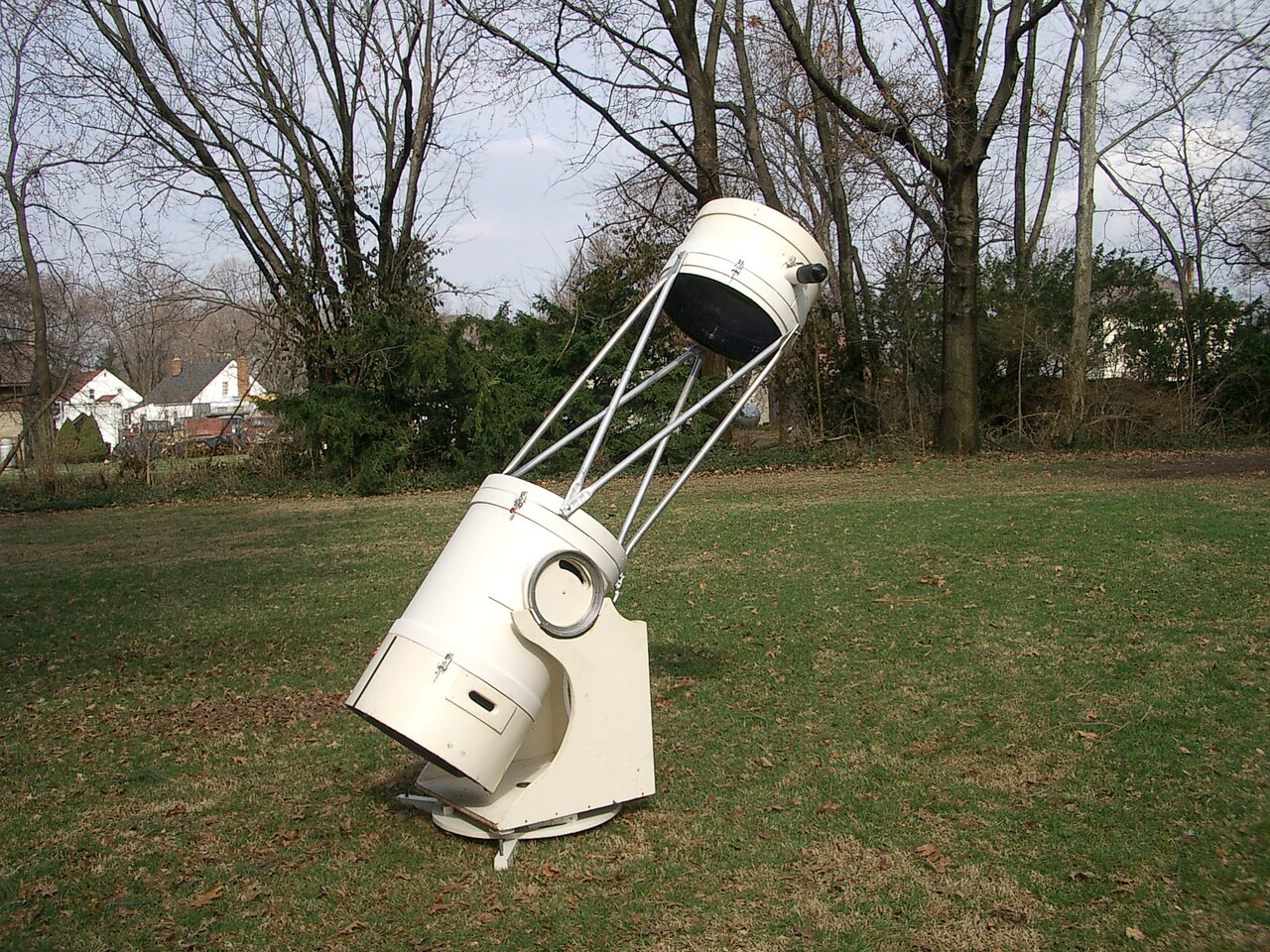
Artist: JamesStewart669
- Solid‑tube: Most common in 6–8 inches. Simple, keeps alignment stable, shields stray light. Tube lengths are manageable (~1200 mm). Great for quick setup and storage in a closet.
- Truss/collapsible: Typically found in larger apertures but available in some 8‑inch variants. More compact for transport but exposes the optical path, requiring a shroud and slightly more collimation attention.
Base Materials and Bearings
- Base: Usually particle board or plywood. Plywood resists moisture better and is sturdier for repeated transport.
- Azimuth bearing: Good Dobsonians have low‑stiction azimuth movement using laminate/Teflon or modern polymer pads. Smooth azimuth is crucial for high‑power tracking.
- Altitude bearings: Larger radius bearings or spring/tension systems help balance heavy eyepieces and maintain smooth motion at different elevations.
Primary Mirror and Cell
- Parabolic primary mirrors are standard in quality 6–8 inch Dobsonians. Avoid spherical mirrors in these apertures for general observing.
- Mirror cell: Should support the mirror evenly and allow good airflow. Many 6–8 inch cells include simple collimation bolts accessible from the back.
- Cooling fan: A small, quiet fan behind the primary helps reach thermal equilibrium faster (see cooldown tips).
Focuser Type and Size
- 2‑inch Crayford focusers (with 1.25‑inch adapter) are ideal for flexibility and wide‑field eyepieces.
- Dual‑speed (fine focus) is a bonus for high‑power planetary work and critical focusing.
- Well‑made rack‑and‑pinion units can also perform well; ensure they have minimal image shift and smooth motion.
Finder Options
- Red‑dot or reflex finder: Fast to aim at bright stars and alignment points.
- Optical finder (6×30, 8×50): Shows fainter stars for starhopping, aiding precise target acquisition.
- Many observers use both: reflex for coarse pointing, optical finder for fine‑grained hops.
Push‑To Encoders and GoTo
- Push‑to systems pair encoders with a handset or app to guide you to objects while you manually push the scope. They preserve Dobsonian simplicity but accelerate target acquisition—a great match for urban skies.
- GoTo Dobsonians include motors and tracking, which is convenient at high power and for outreach. They are heavier and cost more, and you’ll still want basic starhopping skills as a backup.
Budget Ranges and Value
- 6‑inch solid‑tube: Entry price often delivers strong value for beginners, including basics like an eyepiece or two and a finder.
- 8‑inch solid‑tube: Costs more but opens up dimmer galaxies and finer planetary detail. If budget allows and size isn’t a barrier, 8 inches is a compelling long‑term choice.
Regardless of the model, inspect build quality: stable base, smooth motions, firm but not sticky altitude tension, smooth focuser travel, and a well‑aligned optical train. If possible, test under the night sky or at least focus on a distant daytime target to verify motion and focus smoothness.
Essential Accessories: Eyepieces, Finders, Filters, and Tools
Accessories are where you tailor a Dobsonian to your observing style. Smart choices here can make a dramatic difference in performance and enjoyment.
Eyepiece Set Strategy
- Low power, wide field (2‑inch recommended): Framing large nebulae, star clouds, and open clusters. For an 8‑inch f/6, a 30–35 mm 2‑inch eyepiece can yield a generous true field; for a 6‑inch f/8, a 32–40 mm can work similarly. Beware of overly heavy eyepieces and edge performance in faster scopes.
- Medium power (~60–120×): The workhorse range for many galaxies and nebulae; a 15–20 mm eyepiece often shines here.
- High power (~150–300×, conditions permitting): Planetary, lunar, double stars, and small planetary nebulae. 5–10 mm focal lengths are typical, optionally with a quality Barlow.
Consider well‑corrected wide‑field designs for immersive views, especially in f/6 systems. Plössls remain excellent budget performers but have short eye relief at small focal lengths.
Finders and Alignment Aids
- Reflex finder + 50 mm RACI (right‑angle correct‑image) is a popular combo for painless neck ergonomics and accurate hopping.
- Digital setting circles (DSC) or push‑to encoders plus a planetarium app help under light pollution. You still learn the sky but spend less time searching.
Filters for Visual Observing
- UHC (ultra‑high contrast) filters: Enhance emission nebulae by passing OIII and H‑beta while attenuating broadband light pollution. Great in 6–8 inch scopes.
- OIII filters: Stronger line filter, excels on many planetary nebulae and supernova remnants (e.g., the Veil Nebula under dark skies). In 6 inches, an OIII can be transformative on the right targets.
- Neutral density or variable polarizer: For Moon brightness control and comfortable observation of lunar detail.
Collimation Tools
- Collimation cap: Simple, effective, often included.
- Cheshire/sight tube: Helps center and tilt the secondary and refine primary alignment.
- Laser collimator: Convenient, but ensure it’s itself collimated; barlowed laser methods can improve primary alignment accuracy (see collimation).
Dew and Thermal Management
- Dew shield or heater for the secondary in humid climates.
- Primary mirror fan to speed thermal equilibrium and stabilize images.
Comfort and Organization
- Adjustable observing chair boosts stability and acuity—far more than you might expect.
- Red flashlight, laminated star charts, or a dimmed planetarium app.
- Eyepiece case, lens brush/blower, and caps to keep dust at bay.
Setup, Cooldown, and Collimation: Step‑by‑Step Essentials
Getting your Dobsonian aligned and thermally settled is key to crisp, high‑contrast views. Fortunately, setup is fast and repeatable once you learn a simple routine.
Transport and Assembly
- Carry the base and tube separately if weight is a concern. Many 6–8 inch bases are easily lifted with attached handles.
- Place the base on a flat, firm surface. Grass is fine; pavement is better for stability. Avoid slopes for comfortable high‑power tracking.
- Seat the tube in the cradle or altitude bearings, attach any springs/tensioners, and check balance with your heaviest eyepiece installed. Add counterweights if needed to prevent drift.
Cooldown and Thermal Equilibrium
- Set the scope outside 30–60 minutes before high‑power observing. Use a quiet fan behind the primary to reduce tube currents and boundary layers.
- In rapidly cooling conditions, keep the fan running on low while observing to stabilize images.
- Avoid extending the tube into warm indoor air between looks; repeated heat plumes will soften detail.
Collimation: The Essential Steps
Newtonian collimation aligns mirrors so light cones converge cleanly at the focal plane. The process becomes second nature with practice.

Artist: M. Tewes
- Center the secondary under the focuser (mechanical alignment):
- With a sight tube (or collimation cap), ensure the edge of the secondary appears centered and circular in the focuser view. Adjust the secondary’s position along and across the focuser axis by loosening its central screw slightly, nudging, and retightening.
- This step is mainly geometric; you are not yet aiming reflections.
- Secondary tilt (aim the focuser axis at the center of the primary):
- Identify the primary center marker (a small ring or dot). Through a Cheshire or a properly aligned laser, adjust the secondary tilt screws to point the axis at that center marker.
- Primary tilt (aim the optical axis back to the focuser center):
- Using the Cheshire’s bright annulus or a barlowed laser, adjust the primary mirror’s collimation knobs so the reflected center marker aligns concentrically in the Cheshire or centers on the barlowed target.
When finished, defocus a bright star at moderate power. Concentric diffraction rings indicate good collimation. If the intra‑ and extra‑focal patterns differ significantly, revisit steps 2–3. For typical f/6–f/8 dobs, tolerances are forgiving; exacting alignment becomes more critical at faster f/ratios and high magnifications.
Safety and Handling Tips
- Do not touch mirror surfaces. If cleaning is required, follow conservative methods: bulb blower first, distilled water rinse with a drop of mild detergent if needed, and minimal gentle swabbing; allow to air dry. In most cases, dust does not affect views significantly.
- Check that all fasteners and the focuser are snug before rotating the tube or swapping heavy eyepieces.
- Secure caps on mirrors and eyepieces when not in use.
Observing Techniques: Starhopping, Magnification, and Light Management
A Dobsonian rewards skillful observing. A few learned habits improve your hit rate on faint targets and sharpen details on the Moon and planets.
Starhopping and Navigation
- Use a planisphere or app to identify seasonal constellations and bright “anchor” stars.
- With a reflex finder, place the anchor star at the reticle, then switch to your optical finder to hop along patterns of fainter stars mapped in your charts.
- Work at low power first to acquire the field, then increase magnification to isolate details.
- Under urban light pollution, consider a push‑to encoder system for fast acquisition (see push‑to).
Magnification and Exit Pupil Choice
Match magnification to target and conditions:
- Large nebulae and open clusters: Low power, 3–5 mm exit pupil; try a UHC for emission nebulae.
- Galaxies: Medium power, 2–3 mm exit pupil; dark skies matter more than filters for galaxies.
- Planetary nebulae: Start low to locate with a filter, then increase to 150–250× to reveal structure.
- Planets and Moon: High power limited by seeing. On steady nights, 200–300× reveals belts, festoons, craterlets, and rilles; on turbulent nights, back off.
Light Pollution and Filters
- UHC/OIII filters significantly improve contrast on emission nebulae under city skies, but they do not brighten galaxies.
- Keep surroundings dark; use a hood or shield to block stray light. Flock the tube opposite the focuser if needed (see flocking).
- Protect dark adaptation with a dim red light and avoid phone glare.
Tracking and Nudge Technique
- Practice smooth nudges in azimuth and altitude to keep targets centered at high power.
- Balance the tube for your heaviest eyepiece; use tension springs or counterweights to prevent altitude drift.
- Consider a GoTo Dobsonian or an equatorial platform if sustained high‑power tracking is a priority (comparison here).
Seeing, Transparency, and Timing
- Seeing (steadiness) matters most for planets and double stars; observe near the target’s meridian (highest point) when possible.
- Transparency (clarity) matters for faint deep‑sky; choose nights without haze or smoke for galaxy hunting.
- Let targets drift through the field and use averted vision to boost sensitivity to faint structure.
What You Can See with 6–8 Inch Dobsonians: Planets, Moon, and Deep‑Sky
Under suburban skies, a 6–8 inch Dobsonian will reveal a wealth of targets. Under dark skies, it becomes a galaxy and nebula machine. Here’s what to expect, target by target.
Moon
- At 100–250×, expect razor‑edged craters, terraced walls, central peaks, sinuous rilles, and delicate wrinkle ridges.
- Use a neutral density or variable polarizer to moderate brightness and increase comfort (see filters).
Planets
- Jupiter: Main belts, festoons, polar hoods, and the Great Red Spot when visible. In steady air, small ovals and barges appear. The Galilean moons show disks and frequent transits with inky black shadows.
- Saturn: Cassini Division, ring shadow on the globe, subtle banding, and several moons. On excellent nights, glimpses of the Encke Minima and finer ring structure may appear at the limits of seeing and aperture.
- Mars: During favorable oppositions, polar caps, Syrtis Major, Sinus Meridiani, and limb haze. Dust activity affects contrast; wait for steady conditions.
- Venus: Brilliant crescent phases; surface detail is not visible in the optical.
- Mercury: Phases visible in twilight; turbulence near the horizon often limits clarity.
Double Stars
- 6–8 inches resolve many challenging doubles in good seeing. Try Epsilon Lyrae (the Double Double), Albireo’s color contrast, and Rigel’s close companion.
Deep‑Sky Objects (DSO)
- Open clusters: Pleiades (M45), Double Cluster, M35, and many in Auriga and Cassiopeia burst with pinpoint stars. Wide fields shine here—use your 2‑inch eyepiece.
- Globular clusters: M13, M92, M3, and M5 resolve into glittering stars at 150–250×, especially in the 8‑inch. Try averted vision and steady focus.
- Planetary nebulae: M57 (Ring), M27 (Dumbbell), NGC 2392 (Eskimo), and NGC 3242 (Ghost of Jupiter) show shape and structure; OIII can help.
- Emission and reflection nebulae: Orion Nebula (M42/M43) shows delicate wings and dark lanes; the Lagoon (M8) and Swan (M17) respond well to UHC and OIII. Under very dark skies, the North America Nebula (NGC 7000) is within reach, especially with wide fields.
- Galaxies: M31’s core and dust lanes, M51’s spiral hints in good conditions, the Leo Triplet (M65/M66/NGC 3628), M81/M82 with structure, and many Messier/NGC galaxies under dark skies. For galaxies, sky quality and transparency dominate performance.
Seasonal Sampler
- Winter: Orion Nebula (M42), Running Man, Open clusters in Auriga (M36–M38), Castor double.
- Spring: Galaxy fields in Leo, Virgo Cluster (Markarian’s Chain), M3 globular.
- Summer: Sagittarius/Scutum star clouds, Lagoon (M8), Trifid (M20), Swan (M17), Wild Duck (M11), globular M13 near zenith.
- Autumn: Andromeda Galaxy (M31), Triangulum (M33 under dark skies), Double Cluster, NGC 891 edge‑on galaxy (challenging but rewarding).
Your mileage varies with seeing and transparency, but the 6–8 inch class has the reach to keep you busy for years, especially as your observing techniques improve.
Upgrades and Maintenance: Smooth Motions, Flocking, and Mirror Care
A Dobsonian’s simplicity makes it remarkably upgrade‑friendly. Small tweaks can noticeably enhance performance and ease of use.
Smoother Motions and Balance
- Azimuth bearings: If stock motion is sticky, replacing pads with suitable low‑friction materials or adding a better laminate can help. Be careful not to reduce friction so much that wind or slight imbalance causes drift.
- Altitude balance: Magnetic counterweights or sliding weights help balance heavy eyepieces and binoviewers. Some dobs include adjustable altitude tension knobs—use them to tune motion.
Light Control and Contrast
- Flocking (matte black material) opposite the focuser reduces internal reflections and improves contrast, especially under urban lights.
- Shrouds for collapsible/truss designs block stray light and dew.
- Inspect the focuser drawtube’s interior; blacken shiny edges if needed.
Optics Optimization
- Primary mirror fan: A quiet 12V fan helps regulate mirror temperature and speeds cooldown.
- Secondary heater: In dew‑prone regions, a small heater or shield mitigates dewing of the secondary mirror.
- Coma corrector: Usually unnecessary at f/6–f/8; more relevant for faster systems (f/5 and faster), particularly for wide‑field eyepieces. Visual observers can often do without in 6–8 inch f/6–f/8 scopes.
Care and Cleaning
- Keep dust caps on optics when not in use, and store the scope in a dry area.
- Clean mirrors sparingly. Most dust has minimal visual impact; over‑cleaning risks scratches.
- Check collimation before high‑power sessions; minor touch‑ups are normal after transport.
- Periodically check screws/bolts on the base and focuser for snugness.
Budgeting and the Used Market: How to Inspect and Save
Dobsonians hold value well because the design is robust and the optics, when cared for, last for many years. Buying used can be an excellent way to step up to an 8‑inch within a 6‑inch budget.
What to Inspect When Buying Used
- Mirror condition: Use a flashlight at an angle (not directly on the surface) to inspect for coating issues. Minor dust is fine; widespread coating failure (peeling, extensive pinholes) or scratches are a concern.
- Secondary mirror: Check edges for chips and the stalk/spider for bends or excessive flex.
- Focuser: Smooth travel with no binding or excessive play. Verify that heavy eyepieces don’t cause sag.
- Base integrity: Moisture can swell particle board; ensure panels are flat, hardware is tight, and bearing surfaces are in good shape.
- Accessories: Confirm the included finders, eyepieces, and collimation tools are functional and appropriate (accessory guide).
Test Under the Sky or Simulate
- If possible, perform a star test: Defocus a bright star inside and outside focus at moderate power to assess symmetry and smoothness of diffraction rings. Don’t expect perfection; you’re looking for gross asymmetries or astigmatism that rotates with the mirror (indicating optical rather than mechanical issues).
- In daylight, focus on a distant object to test smooth tracking and focuser performance. Check that the tube stays put at various elevations with your heaviest eyepiece.
Negotiation and Value
- Factor in the cost of missing accessories you’ll likely need: a decent 2‑inch eyepiece, a UHC filter, and a collimation tool can add up.
- Minor base wear is common and usually not critical. Cosmetic tube scuffs rarely affect performance.
Frequently Asked Questions
Is a 6‑inch or 8‑inch Dobsonian better for a first telescope?
Both are excellent. A 6‑inch is lighter, often less expensive, and very forgiving optically—great for small spaces and quick sessions. An 8‑inch has a clear performance edge, especially on globular clusters, galaxies, and resolving fine planetary detail, while remaining portable for many observers. If you can comfortably transport and store an 8‑inch, it’s an outstanding long‑term choice; if in doubt, a 6‑inch ensures you’ll use the telescope more often.
Can I do astrophotography with a Dobsonian?
Dobsonians are optimized for visual observing. That said, you can capture lunar and planetary images by recording short high‑frame‑rate videos and stacking the best frames. For traditional long‑exposure deep‑sky astrophotography, you typically need an equatorial mount with accurate tracking. Some Dobsonians with GoTo/tracking or on an equatorial platform support short exposures and electronically assisted astronomy (EAA), but they are not the standard path for deep‑sky imaging. If your primary goal is long‑exposure DSO imaging, consider an equatorial mount and a small, fast imaging scope.
Final Thoughts on Choosing the Right Dobsonian Telescope
A 6–8 inch Dobsonian remains one of the best all‑around choices for visual astronomy: generous aperture, intuitive alt‑az operation, and upgradeable simplicity. A carefully chosen eyepiece set, a UHC filter, and basic collimation skills will unlock crisp lunar/planetary views and a deep catalog of nebulae, clusters, and galaxies. As you refine techniques—starhopping, matching magnification and exit pupil to targets, and managing light and thermal conditions—you’ll see more than you thought possible from your backyard.
If you’re on the fence, start with the scope you’ll use most often. For many, that’s an 8‑inch; for others, the lighter, grab‑and‑go 6‑inch wins. Either way, a Dobsonian invites you to observe more, learn the sky deeply, and grow into the hobby without outgrowing your instrument too quickly. For more guides like this, tips on accessories, and seasonal observing lists, subscribe to our newsletter and explore related topics in our archive.

Artist: James Stewart 669