
Table of Contents
- What Is Betelgeuse? Location, Properties, and Why It Matters
- Inside the 2019–2020 “Great Dimming” of Betelgeuse
- The Red Supergiant Engine Room: Convection, Mass Loss, and Molecules
- Why Betelgeuse Varies: Pulsations, Hot Spots, and Light Curves
- Will Betelgeuse Go Supernova? Timeline, Safety, and What We’d See
- How to Observe Betelgeuse: Seasons, Star‑Hopping, and Citizen Science
- Betelgeuse in History, Myth, and Modern Culture
- What the Dimming Taught Us: Telescopes, Techniques, and Data
- Frequently Asked Questions
- Glossary and Key Numbers for Betelgeuse
- Final Thoughts on Observing and Understanding Betelgeuse
What Is Betelgeuse? Location, Properties, and Why It Matters
Betelgeuse (Alpha Orionis) is a luminous red supergiant star anchoring the shoulder of the constellation Orion. Visually striking with a warm orange hue, it is among the most studied stellar behemoths in the sky, and it is easily spotted even from urban areas on winter evenings in the Northern Hemisphere. The star’s physical scale, evolving variability, and proximity make it a prime laboratory for understanding how massive stars live and die.
Betelgeuse is a cool, evolved star of spectral type roughly M1–M2 Ia‑ab. It has exhausted hydrogen in its core and is now fusing heavier elements in shells, a stage that precedes an eventual core‑collapse supernova. Its basic parameters are large but somewhat uncertain because this star’s atmosphere is extended and turbulent:
- Distance: approximately several hundred light‑years, commonly cited around 600–700 light‑years. Extremely precise distance measurements are challenging because Betelgeuse’s bright, extended envelope complicates parallax measurements.
- Radius: hundreds of times the Sun’s radius; estimates have ranged broadly (roughly 700–900 times the Sun’s radius is a commonly reported range). If placed at the center of our Solar System, it would extend far beyond the orbit of Mars and possibly approach that of Jupiter depending on the estimate.
- Mass: on the order of ~10–20 times the mass of the Sun (M☉), consistent with evolved red supergiants.
- Effective temperature: around 3,500 K, which helps explain its orange‑red coloration.
- Luminosity: tens of thousands to over 100,000 times the Sun’s luminosity (L☉), varying with its semi-regular pulsations and convective activity.

Attribution: Daniel William “Danny” Wilson
From a scientific standpoint, Betelgeuse is compelling because it is close enough for interferometers and space telescopes to resolve its surface asymmetries and circumstellar material. That allows astronomers to watch, almost in real time, large‑scale convective cells, plumes, and dust formation. The 2019–2020 brightness drop, often called the Great Dimming, made headlines and sparked global interest in whether the star was about to explode—spoiler: it was not—but the event offered a rare chance to probe star‑envelope physics. We explain what happened in detail in Inside the 2019–2020 “Great Dimming” of Betelgeuse.
For skywatchers, Betelgeuse is a seasonal guidepost. In the Northern Hemisphere, it rises in late autumn, dominates the winter sky along with Rigel and the Orion Belt, and sets by late spring. Observers in the Southern Hemisphere see it during their summer months. If you are new to stargazing, jump to How to Observe Betelgeuse for star‑hopping tips and simple visual observing projects you can start tonight.
Inside the 2019–2020 “Great Dimming” of Betelgeuse
In late 2019, Betelgeuse’s brightness dropped to an unusually low level, declining by roughly a magnitude from its typical appearance. By early 2020, the star looked distinctly faint to the naked eye compared to its normal self. This “Great Dimming” became one of the most widely discussed astronomical events in recent memory, triggering an international observing campaign that spanned wavelengths, instruments, and observing techniques.

Attribution: ESO/M. Montargès et al.
The key question was whether the dimming signaled an imminent supernova. The broad scientific consensus that emerged is that the event resulted primarily from dust formation associated with a large surface mass ejection, likely triggered by convective activity. Here is the gist of the scenario supported by observations:
- Convective dynamics on a vast scale: Red supergiants harbor giant convective cells that can persist for months. These cells can concentrate cool material over large regions of the star’s photosphere, temporarily lowering local temperatures.
- Surface mass ejection: Observations, including space‑based ultraviolet spectra and high‑resolution imaging, indicated that Betelgeuse expelled a significant amount of material from its outer layers in 2019. Such ejections are not unheard of in evolved massive stars, but the scale here was noteworthy.
- Dust condensation: As the ejected gas expanded and cooled, dust grains formed. When that dust crossed our line of sight, it absorbed and scattered starlight, making the star appear dimmer in visible wavelengths.
- Asymmetry matters: Interferometric and direct imaging suggested that the dimming was not uniform across the stellar disk. One hemisphere or quadrant appeared more affected, consistent with a localized dust cloud.
While dust was the primary culprit, Betelgeuse is also a semi‑regular variable. Its intrinsic pulsations and photospheric temperature variations contribute to normal ups and downs in brightness. The Great Dimming likely coincided with a natural low in the star’s pulsation cycle, enhancing the effect. This blend of intrinsic variability and circumstellar dust is what made the episode so dramatic.
By spring 2020, Betelgeuse began recovering, reinforcing the interpretation that transient dust—rather than a permanent change in the star’s energy output—played a central role. For a deeper dive into the physics that create such behavior, see The Red Supergiant Engine Room and Why Betelgeuse Varies. If your main concern is whether this meant a supernova was imminent, head to Will Betelgeuse Go Supernova?
Takeaway: The Great Dimming was a teachable moment about mass loss and dust formation in red supergiants—not a prelude to an immediate explosion.
The Red Supergiant Engine Room: Convection, Mass Loss, and Molecules
Red supergiants like Betelgeuse are stellar giants near the end of their lifespans. Their cores have exhausted hydrogen and are fusing heavier elements in shells around an inert or evolving core (e.g., helium and later heavier elements). The outer layers are cool and puffed up, resulting in a colossal radius and low surface gravity. That combination encourages vigorous convection, complex winds, and molecule and dust formation close to the photosphere.
Convection on colossal scales
Unlike the Sun, whose surface is covered with millions of small granules, Betelgeuse’s convection cells can be comparable to a significant fraction of the star’s radius. These cells drive hot material upward and allow cooler material to sink, creating brightness and temperature variations across the surface. Because the star’s photosphere is so extended and the gravity so gentle, the tops of these convective plumes can loft gas into the circumstellar environment.
- Surface inhomogeneities: High‑resolution imaging has revealed spots and asymmetries across Betelgeuse’s disk. These are likely manifestations of large convective cells and cool patches.
- Temporal evolution: These features evolve over weeks to months, modulating observed brightness and spectral lines.

Attribution: ALMA (ESO/NAOJ/NRAO)/E. O’Gorman/P. Kervella
Mass loss and stellar winds
Betelgeuse continuously loses mass via a stellar wind, a slow outflow of gas and dust that enriches the interstellar medium with heavy elements. The mass‑loss rate of a red supergiant is substantial by stellar standards—enough to shape the star’s future evolution and ultimate supernova type. Episodic outbursts, like the one implicated in the Great Dimming, may contribute significant amounts of material in short bursts, layered on top of a steady wind.
- Drivers of the wind: Pulsation, shocks, radiation pressure on dust, and possibly magnetic fields play roles in lifting material from the photosphere to regions where dust can condense and be driven outward.
- Consequences: Over time, mass loss can peel away the star’s outer layers, affecting the final core mass and the supernova’s observable features.
Molecules, dust, and a warm extended atmosphere
Betelgeuse hosts a molecule‑rich extended atmosphere, with species like CO, H2O, and TiO contributing to spectral features. Close to the star, temperatures allow for the formation of dust grains—silicates and possibly alumina—especially when material cools during expansion after a surface ejection. Dust strongly influences the star’s spectral energy distribution (SED) and can modulate visual brightness when clumps cross our line of sight.
These processes are not merely academic. They inform stellar evolution models and explain how the galaxy becomes enriched with the elements necessary for planets and, ultimately, life. For observers, they offer visible manifestations like color changes and brightness variations that you can track with simple equipment—see How to Observe Betelgeuse.
Why Betelgeuse Varies: Pulsations, Hot Spots, and Light Curves
Betelgeuse is classified as an SRc (semiregular variable) star. That means its brightness changes are not strictly periodic, but they do show dominant timescales and patterns. Several mechanisms intertwine:
- Radial pulsations: The star expands and contracts in complex modes, leading to temperature and radius variations. Observers have reported characteristic timescales on the order of a few hundred days for some modes.
- Convective modulation: Giant convective cells create surface hot/cool spots, introducing irregular brightness changes as they evolve.
- Circumstellar dust changes: Newly formed dust can selectively dim the star, most strongly at shorter wavelengths, as during the Great Dimming.
For visual observers, Betelgeuse’s apparent visual magnitude typically ranges around the first magnitude but can wander noticeably. On some nights, it may rival Rigel (Beta Orionis) in brightness; on others it appears clearly fainter. Because the human eye is very good at comparing nearby stars, you can estimate its brightness by bracketing it with constellational neighbors of known magnitude—more on that in How to Observe Betelgeuse.
What a light curve reveals
A light curve is a plot of brightness versus time. For Betelgeuse, multi‑year light curves show overlapping cycles, beats, and irregularities. Photometry through different filters (e.g., V band, R band) can separate temperature changes from dust extinction, because dust affects blue/visual light more than red or infrared. During the Great Dimming, multi‑band observations showed a color change consistent with increased dust along our line of sight, not just a cooler photosphere.

Attribution: AAVSO
Practical tip: Keep an observation log
One of the simplest ways to contribute to science is to record visual magnitude estimates or camera‑based photometry at regular intervals. Even qualitative notes—color impressions, atmospheric conditions, and relative brightness compared to Rigel or Aldebaran—are useful if systematic. A simple log format might look like this:
Date (UTC), Location, Method, Betelgeuse Est. Mag, Comparison Stars, Sky Conditions, Notes
2025-01-15, 40.7N 74.0W, Naked eye, 0.8, Rigel(0.1), Aldebaran(0.9), SQM 18.5, Haze toward south
2025-02-01, 40.7N 74.0W, Binoculars 10x50, 1.0, Procyon(0.4), Bellatrix(1.6), Clear, Slightly more orange than Aldebaran
Consistency is key. Over months, your personal light curve will reveal the star’s character and connect your backyard observations with professional datasets.
Will Betelgeuse Go Supernova? Timeline, Safety, and What We’d See
Betelgeuse is destined to explode as a core‑collapse supernova. The open questions are “when?” and “what will it look like from Earth?”
Timescale: not tomorrow
Stellar evolution models indicate that a star like Betelgeuse remains in the red supergiant phase for a relatively short span of its life, on the order of a hundred thousand years or so. The precise clock depends on its mass, rotation, internal mixing, and mass‑loss history. Despite occasional headlines, there is no robust evidence that a supernova is imminent on human timescales. The 2019–2020 dimming episode was not a supernova precursor by itself; it was best explained by dust formation following a surface mass ejection, enhanced by normal variability, as described in Inside the 2019–2020 “Great Dimming”.
What kind of supernova?
When Betelgeuse’s core can no longer support itself, it will collapse and produce a powerful outburst—likely a Type II supernova, the variety associated with massive stars that retain hydrogen in their outer layers. The light curve could exhibit a plateau (Type II‑P) if sufficient hydrogen is present, though details depend on the mass and structure of the envelope at the time of explosion.
How bright would it be?
At a distance of several hundred light‑years, a Betelgeuse supernova would be spectacular but safe. Predictions vary, but it would likely outshine all other night‑sky objects except the Moon, and for a time could be visible even in daylight. The bright phase might last for weeks, followed by a gradual decline. This would be a once‑in‑many‑lifetimes event for humanity.
Safety considerations
Even though core‑collapse supernovae release gamma rays, cosmic rays, and neutrinos, Earth is far enough from Betelgeuse that dangerous levels are not expected to reach us. The first detectable signal on Earth would almost certainly be a burst of neutrinos—harmless particles that zip through us constantly—arriving hours before the optical light brightens. Neutrino detectors worldwide will provide early warnings. The optical and high‑energy emissions at this distance are not expected to threaten Earth’s biosphere.
If you’re curious about how astronomers would observe and model the event in detail, see What the Dimming Taught Us, which covers multi‑wavelength strategies—many of which would be mobilized for a nearby supernova, too.
How to Observe Betelgeuse: Seasons, Star‑Hopping, and Citizen Science
Betelgeuse is an ideal target for both beginners and seasoned observers. You can enjoy its color and brightness by eye, sketch its position among Orion’s stars with binoculars, and even perform scientifically useful photometry with modest equipment.
Finding Betelgeuse in the sky
- Season and timing: In the Northern Hemisphere, Betelgeuse is best viewed from late autumn through winter evenings. In the Southern Hemisphere, look for it in the summer months. It culminates (reaches highest point) around local midnight in mid‑winter, making it easy to spot.
- Asterism guide: Locate Orion’s three Belt stars (Alnitak, Alnilam, Mintaka) in a straight line. Betelgeuse glows orange above the Belt, forming Orion’s right shoulder. Rigel, the blue‑white star at Orion’s foot, provides a great color contrast.
- Urban viewing: Betelgeuse is bright enough for city observers. Its warm hue stands out even through light pollution.
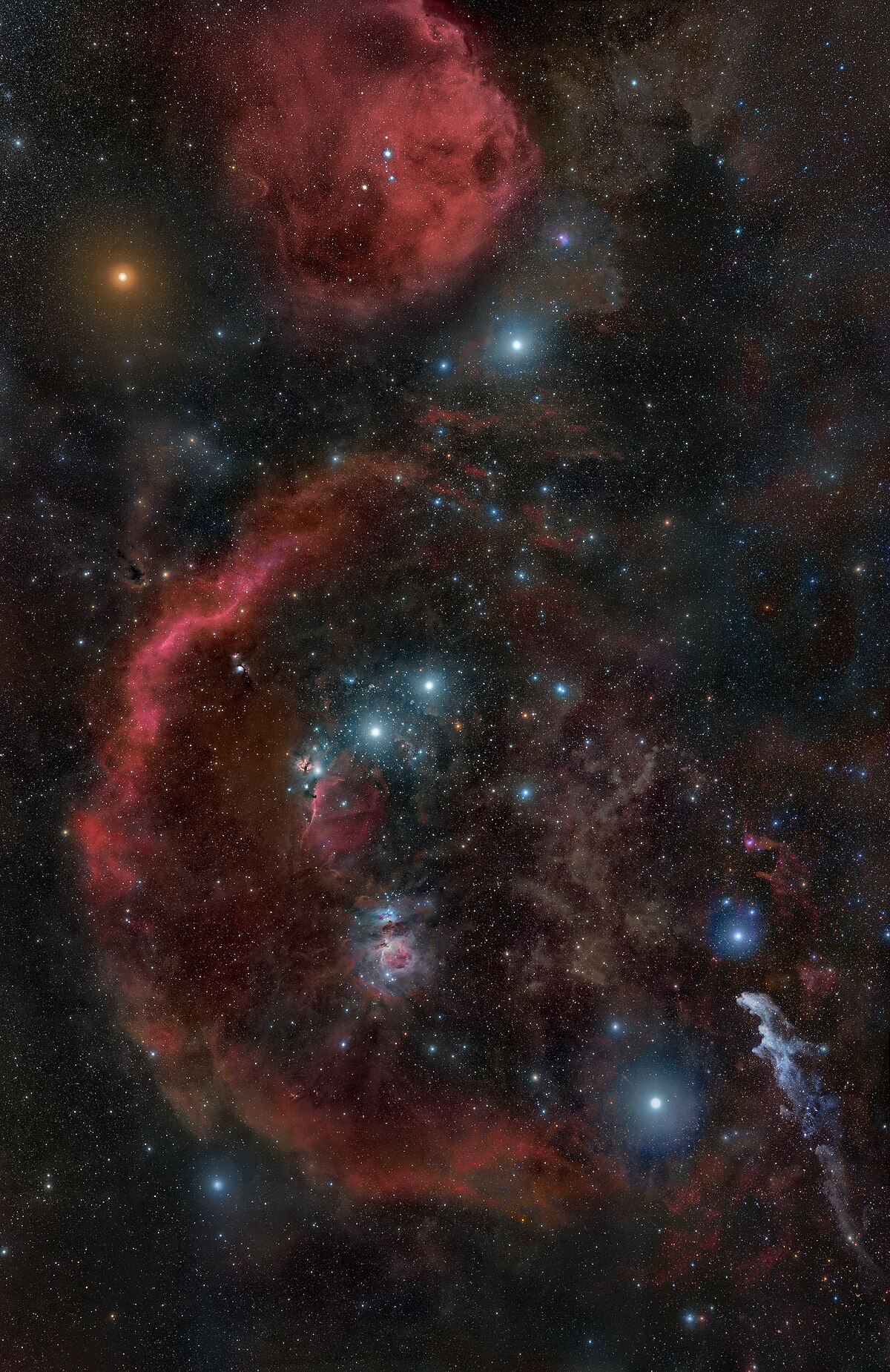
Attribution: Rogelio Bernal Andreo
Naked‑eye color and brightness estimates
Start by noting its distinct color. Compare it to the red giant Aldebaran and the cooler, orange giant Arcturus when they are visible. For brightness estimates, bracket Betelgeuse with nearby stars of known magnitude—Rigel (roughly magnitude 0) and Bellatrix (magnitude ~1.6) are handy references. This kind of relative estimation is the backbone of visual variable star observing.
Binoculars and small telescopes
- Binoculars (7×50, 10×50): These provide a bright, wide field framing all of Orion, perfect for color comparisons and for checking the star’s appearance over many nights.
- Small telescopes (60–150 mm): While Betelgeuse remains a point source in small apertures, the telescope can help you scrutinize subtle color changes and explore nearby deep‑sky objects like M42 (Orion Nebula) during the same session.
- Photometry with DSLR/CMOS: Short exposures with a fixed tripod can capture paired images of Betelgeuse and comparison stars. With careful calibration (dark frames, flat fields) and appropriate aperture photometry software, you can estimate magnitudes. See also Why Betelgeuse Varies for how to interpret your light curve.
Citizen science opportunities
Many organizations coordinate variable star observations. Search for programs that accept visual and instrumental estimates for bright variables. Regular contributions from multiple observers fill in gaps left by professional observatories and provide valuable long‑baseline data.
Observing checklist
- Confirm sky clarity and transparency; note any haze or high clouds.
- Use the same comparison stars each night for consistency.
- Record date/time (UTC), location, method, and estimated magnitude.
- If photographing, keep exposures short to avoid saturation; calibrate with darks and flats.
- Log color impressions—Betelgeuse’s hue can subtly shift with atmospheric conditions and intrinsic changes.
If you’re curious how your backyard efforts feed into professional understanding, check What the Dimming Taught Us to see how ground‑based and space‑based observations interlock.
Betelgeuse in History, Myth, and Modern Culture
Betelgeuse’s allure isn’t purely scientific. The star’s prominence in a striking constellation has captured human imagination for millennia. Positioned at Orion’s shoulder, it has been chronicled by cultures worldwide and features in calendars, navigation, and storytelling.
- Names and etymology: The common English name “Betelgeuse” likely derives from Arabic origins, historically miscopied and transformed over centuries. The name’s long evolution is a reminder of how star lore journeys across languages and time.
- Seasonal marker: In many traditions, the heliacal rising of bright stars like Betelgeuse served as seasonal indicators for agriculture and navigation.
- Color symbolism: Its orange‑red tint has been noted since antiquity, contrasting with Orion’s brilliant blue‑white Rigel—a pairing that often symbolizes youth and age, heat and coolness, or complementary forces in myth.
- Modern popular culture: In recent decades, the star’s fame spread further thanks to media references and its memorable name. The 2019–2020 dimming briefly turned it into a global headline, bringing a new generation to stargazing.
Appreciating the cultural side of Betelgeuse enriches the experience of observing. As you compare it to Rigel or sketch Orion, you are joining a human tradition that spans continents and centuries.
What the Dimming Taught Us: Telescopes, Techniques, and Data
The Great Dimming mobilized a kind of “all instruments on deck” moment. The combination of professional observatories and amateur contributions across wavelengths yielded a multi‑layered picture of a complex star in flux.
High‑resolution imaging and interferometry
Optical and near‑infrared interferometers, along with adaptive‑optics‑equipped large telescopes, resolved the stellar disk and nearby circumstellar environment. These observations revealed asymmetric features and provided compelling visual evidence that one region was dimmer—consistent with localized dust or a cool patch.
Space‑based spectroscopy and photometry
Ultraviolet and optical spectra from space telescopes captured signatures of mass ejection, heating, and cooling in Betelgeuse’s outer layers. Meanwhile, broad‑band photometric monitoring tracked how the star’s brightness and color changed over time, putting quantitative constraints on dust properties.
Infrared insights
In the infrared, dust emission becomes more prominent, giving a complementary perspective to optical dimming. IR data helped disentangle whether observed changes were due to cooler temperatures or to increased extinction from dust along the line of sight.

Attribution: Giuseppe Donatiello
Polarimetry and scattering
Polarimetric measurements probed the scattering geometry of the circumstellar material, contributing to the case for an asymmetric dust cloud. When combined with interferometry, these data sets map a three‑dimensional picture of outflowing material.
Citizen scientist light curves
Contributions from visual and small‑instrument observers, coordinated by variable star networks, provided dense time coverage. That coverage helped pin down the timing and depth of the brightness changes and offered a check on instrumental systematic errors. For how to contribute your own measurements, revisit How to Observe Betelgeuse.
In sum, the episode was a living demonstration of multi‑wavelength, multi‑scale astrophysics: a surface ejection (small scale) condensed into dust (microscopic physics) that altered the star’s macroscopic brightness (observable to the unaided eye). The lessons learned now feed back into models of mass loss, dust formation, and the late stages of massive star evolution—topics we introduced in The Red Supergiant Engine Room.
Frequently Asked Questions
Is Betelgeuse safe for Earth if it explodes?
Yes. At several hundred light‑years away, a Betelgeuse supernova would be a spectacular astronomical event but not a threat to life on Earth. The first sign would likely be a neutrino burst detected by specialized observatories, followed hours later by the optical brightening. High‑energy emissions attenuate with distance, and models do not predict hazardous levels at Earth’s location.
Did the Great Dimming mean a supernova was imminent?
No. The 2019–2020 Great Dimming is best explained by dust formed from material ejected from Betelgeuse’s outer layers, possibly triggered by convective upwelling, coinciding with the star’s normal pulsation cycle. The star subsequently brightened again. While Betelgeuse will eventually go supernova, there is no evidence that the dimming was a precursor in the near future. For the full story, see Inside the 2019–2020 “Great Dimming” and Why Betelgeuse Varies.
Glossary and Key Numbers for Betelgeuse
- Red supergiant: A massive, evolved star with a cool extended envelope, very large radius, and significant mass loss.
- SRc variable: A semiregular variable star with supergiant luminosity class; brightness changes are not strictly periodic but show dominant timescales.
- Mass loss: The process by which a star sheds material through winds and eruptions, important for late‑stage evolution.
- Dust condensation: Formation of solid particles (e.g., silicates) from cooling gas in the star’s outer layers or ejecta.
- Core‑collapse supernova: The explosive death of a massive star when its core collapses, producing a Type II supernova if hydrogen remains in the envelope.
- Interferometry: A technique that combines light from separate telescopes to resolve fine details, e.g., stellar surfaces and close‑in dust structures.
- Approximate distance: Commonly cited around 600–700 light‑years; precise values are challenging due to the star’s complex extended atmosphere.
- Approximate radius: Several hundred times the Sun’s radius (roughly 700–900 R☉ reported in the literature), varying by method and model.
- Approximate effective temperature: Around 3,500 K, giving its orange‑red color.
Keep in mind that large uncertainties for Betelgeuse are not bugs but features of measuring a boiling, extended, dust‑forming stellar envelope. As instruments and models improve, key numbers will sharpen. For discussion of methods, revisit What the Dimming Taught Us.
Final Thoughts on Observing and Understanding Betelgeuse
Betelgeuse is a front‑row seat to the late life of a massive star. Its accessible brightness invites casual stargazers, while its complex atmosphere and mass‑loss behavior demand the best tools in modern astrophysics. The 2019–2020 Great Dimming showed how rapidly our picture can evolve when nature surprises us—and how effective a global observing network can be when amateurs and professionals coordinate across wavelengths and techniques.
If you are new to watching the sky, make Betelgeuse your winter companion. Track its color and brightness, log a few measurements each week, and compare notes against public light curves. If you are already experienced, consider adding multi‑band photometry or contributing to coordinated campaigns. And if you are simply curious, follow the thread from visible changes to physical causes by moving between variability, stellar physics, and instrumentation sections above.
In the longer view, Betelgeuse connects science to culture and time. It teaches how elements are recycled into the cosmos and why dust—often seen as a nuisance—is a bridge between stars and planets. When it finally ends in a supernova, the event will be a global moment of shared wonder. Until then, there is much to learn from this restless star, one careful observation at a time.
If you enjoyed this deep dive, consider subscribing to our newsletter. You’ll get future articles on stellar evolution, observing guides, and timely coverage of night‑sky events delivered straight to your inbox.