
Table of Contents
- What Is Dark Matter in Astrophysics?
- Observational Evidence Across Scales: Rotation Curves to Lensing
- Why Not Modified Gravity Alone? Testing Alternatives
- Leading Dark Matter Candidates and Models
- How We Search: Direct, Indirect, and Collider Probes
- Mapping Dark Matter with Gravitational Lensing and Dynamics
- Simulations and the Structure Formation Story
- The Early Universe and Relic Abundance
- Frequently Asked Questions
- How to Interpret Null Results and Set Expectations
- Final Thoughts on Understanding and Searching for Dark Matter
What Is Dark Matter in Astrophysics?
Dark matter is the name astronomers and physicists give to a form of matter that does not emit, absorb, or reflect enough light to be seen directly, but reveals itself through gravity. It influences how stars orbit within galaxies, how galaxies cluster together, how light is bent by massive structures, and how the cosmic microwave background (CMB) encodes the contents of the early universe. Put simply: dark matter is the unseen mass that shapes the universe’s large-scale structure.

Artist: Daag
Decades of evidence—from the rotation curves of spiral galaxies to gravitational lensing of distant quasars—indicate that the visible, “baryonic” matter (stars, gas, dust) accounts for only a fraction of the total mass. In the standard cosmological model (Lambda Cold Dark Matter, or ΛCDM), dark matter constitutes most of the matter in the universe, while a smaller share is normal matter. Dark energy dominates the energy budget governing accelerated cosmic expansion.
Unlike ordinary matter, dark matter appears to interact very weakly with light and with itself. This makes it challenging to detect and characterize. To navigate this puzzle, researchers combine astrophysical observations, precision cosmology, particle-physics searches, and high-performance simulations. Each approach constrains the properties of dark matter and narrows the field of viable theories. In the sections below, we explore the evidence, competing ideas, experimental strategies, and implications for cosmic history. If you’re new to the topic, the observational highlights in Observational Evidence Across Scales provide the clearest entry point.
Observational Evidence Across Scales: Rotation Curves to Lensing
The case for dark matter rests on multiple, independent lines of evidence that consistently converge. This multi-pronged convergence is a hallmark of robust scientific inference. Here are the pillars—spanning galaxies, clusters, and the universe at large—that make the dark matter case compelling.
Galaxy Rotation Curves: Flat at Large Radii
In spiral galaxies, stars and gas orbit the galactic center. If most mass were concentrated in the luminous disk, orbital speeds would decline at large radii (like planets in the Solar System). Instead, observations show that orbital speeds tend to remain roughly constant far from the center—“flat rotation curves.” This implies the mass continues to rise linearly with radius beyond the visible extent of the galaxy, pointing to an extended, invisible halo of matter. Pioneering work on galaxy kinematics highlighted this discrepancy and motivated the dark matter halo concept, now standard in galactic dynamics.
Rotation curves are measured using Doppler shifts of spectral lines (e.g., the 21-cm line of neutral hydrogen for outer disks). Across a wide variety of galaxies—bright spirals, low surface brightness systems, and some dwarfs—flat or slowly declining curves persist, each suggesting mass beyond the luminous component. The mass-to-light ratios inferred from dynamics exceed what stellar populations and observed gas can provide, strengthening the need for a non-luminous mass component.
Galaxy Clusters: More Mass Than Meets the Eye
Galaxy clusters—the largest gravitationally bound structures—also imply missing mass. Three independent diagnostics line up:
- Galaxy velocities: Member galaxies orbit within the cluster potential. Their velocity dispersion indicates a gravitational mass exceeding the visible galaxies by a large factor.
- Hot intracluster gas (X-rays): Clusters contain hot gas emitting X-rays. Hydrostatic equilibrium models reveal a deep gravitational well requiring additional mass beyond baryons.
- Gravitational lensing: Clusters bend and distort light from background galaxies. Strong and weak lensing maps reveal mass distributions substantially larger than what the cluster’s starlight and hot gas account for.
A striking example is a colliding cluster system where the dominant mass (inferred from lensing) is spatially offset from the hot gas (seen in X-rays). In such mergers, the gas (which interacts electromagnetically) slows down and is displaced by ram pressure, while the bulk of the gravitational mass passes through more like a collisionless component. This behavior is naturally explained if most mass is in a weakly interacting, non-luminous form.
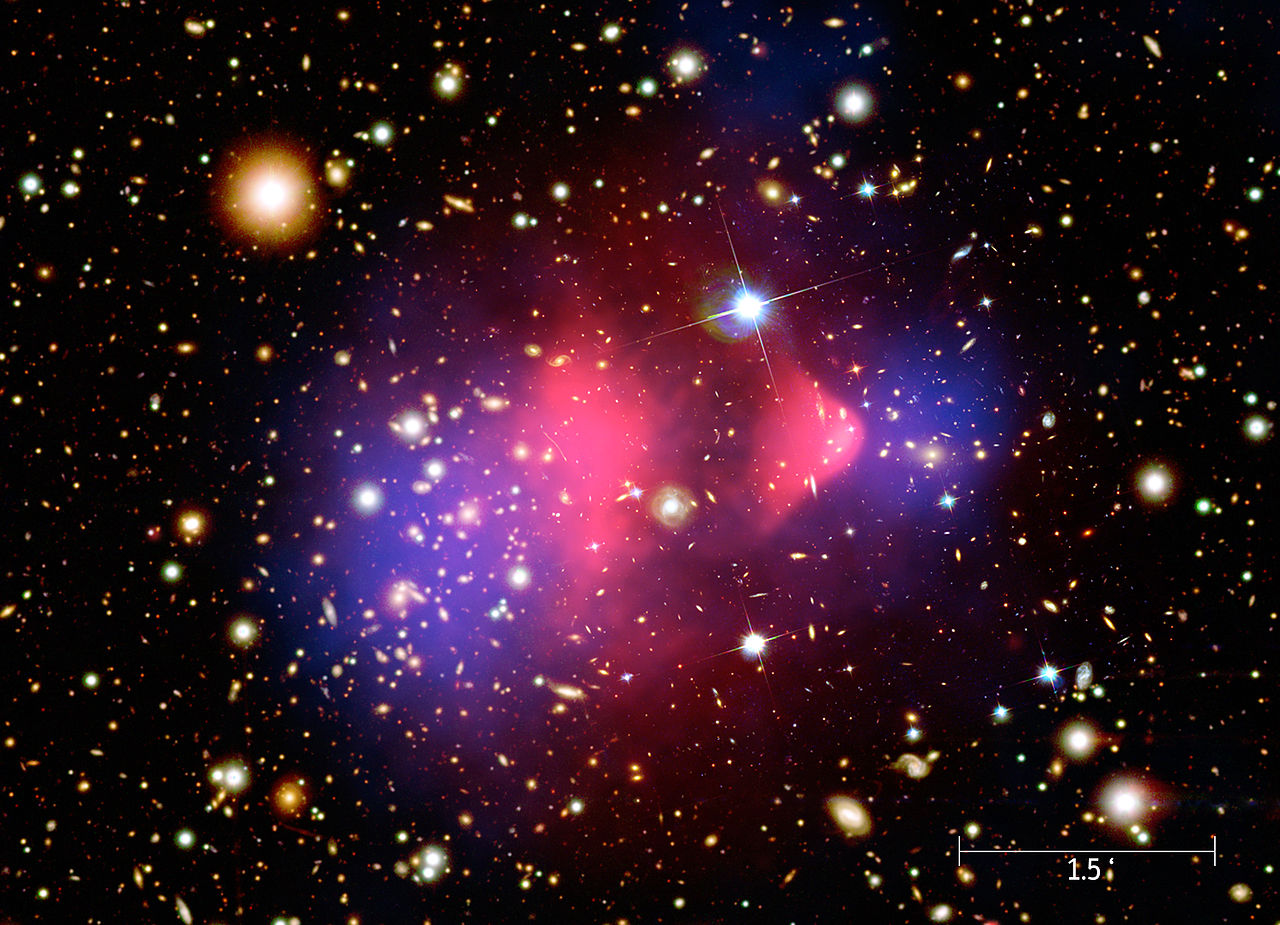
Artist: NASA/CXC/M. Weiss
Gravitational Lensing: Mass Maps Without Light
Gravitational lensing—the deflection of light by mass—offers a clean, physics-based method to map total mass, independent of its composition. Two regimes are especially informative:
- Strong lensing: Multiple images, arcs, and Einstein rings provide precise constraints on the mass of lenses (galaxies or clusters). The lensing mass often exceeds what visible matter can explain, implying dark halos.
- Weak lensing: Small, coherent distortions in the shapes of background galaxies (cosmic shear) trace large-scale mass distributions. Combining millions of galaxies, wide-field surveys statistically map the matter field, aligning with ΛCDM predictions on large scales.

Artist: ESA/Hubble & NASA; derivative work: Bulwersator
Lensing bypasses assumptions about the dynamical state of matter and is sensitive to everything that gravitates. Its agreement with rotation curves and cluster dynamics is powerful, as independent techniques converge on similar mass profiles. You can learn how lensing becomes a cosmological tool in Mapping Dark Matter with Gravitational Lensing and Dynamics.
Cosmic Microwave Background and Large-Scale Structure

Artist: ESA and the Planck Collaboration
The CMB’s subtle temperature and polarization anisotropies encode the universe’s composition ~380,000 years after the Big Bang. Acoustic peaks in the power spectrum are sensitive to matter density, baryon density, and radiation content. Analyses of the CMB, combined with other probes, indicate that most matter is non-baryonic and effectively cold (moving slowly in the early universe), matching the dark matter required by galaxy and cluster observations.
On later timescales, galaxy surveys and weak-lensing maps trace the growth of structure. The observed clustering of galaxies and matter agrees with the paradigm in which dark matter provides the gravitational scaffolding, drawing baryons into filaments, walls, and nodes of the cosmic web. Without dark matter, the growth from primordial fluctuations to present-day structure would be too slow to match observations.
Additional Evidence: Dwarf Galaxies and Satellites
Dwarf spheroidal galaxies orbiting the Milky Way show high mass-to-light ratios when analyzed via stellar velocities, indicating dominance by unseen mass. Their small sizes and low baryon content reduce the ambiguity from gas dynamics and make them clean laboratories for dark matter studies. The number and properties of these satellites also tie into predictions from cosmological simulations, a topic discussed further in Simulations and the Structure Formation Story.
Together, rotation curves, cluster mass estimates, lensing, and cosmological measurements weave a consistent narrative: most mass is dark. Different methods, different systems, shared conclusion.
Why Not Modified Gravity Alone? Testing Alternatives
Could the evidence be signaling a breakdown of gravity on galactic and larger scales rather than unseen mass? Modified Newtonian Dynamics (MOND) and related theories were proposed to explain galaxy rotation curves without invoking halos. Some frameworks, such as relativistic extensions (e.g., tensor–vector–scalar theories), attempt to fit lensing and cosmology too. These ideas have spurred fruitful debates and tests.
MOND and Galaxy Scaling Relations
MOND introduces a characteristic acceleration scale below which gravity deviates from Newton’s law. It can reproduce many galaxy rotation curves and naturally leads to empirical relations like the baryonic Tully–Fisher relation. The success at the level of individual galaxies is noteworthy and highlights regularities in galaxy dynamics that dark matter models must also explain.
Challenges on Cluster and Cosmological Scales
On galaxy cluster scales, MOND-like modifications often still require additional unseen mass to explain the total gravitational field inferred from lensing and X-rays. Cosmologically, fitting the CMB power spectrum and the growth of structure in detail has proven challenging for many modified-gravity models without introducing extra components that behave effectively like dark matter.
Collision Systems and Lensing Offsets
In merging clusters where the mass distribution (from lensing) is offset from the collisional gas, the interpretation is straightforward in a dark matter framework: baryons interact and slow down, while the dominant mass component does not. Modified gravity needs to accommodate these distinct spatial distributions, which has been difficult to reconcile without some additional matter component. The observational picture from such collisions complements galaxy and CMB evidence and can be explored alongside Observational Evidence Across Scales.

Artist: ScienceDawns
The upshot: modified gravity has had selective successes, especially at galactic scales, but a single, gravity-only explanation has not yet matched the breadth of observations that the dark matter hypothesis accounts for across galaxies, clusters, and cosmology. This does not end the conversation—indeed, constraints from lensing maps and the early universe continue to press on both dark matter and gravity theories—but it sets a high bar for alternatives.
Leading Dark Matter Candidates and Models
“Dark matter” is not a single theory—it is a family of possibilities constrained by what we know it does and does not do. Viable candidates must reproduce the evidence in Observational Evidence while respecting laboratory and astrophysical bounds.
Weakly Interacting Massive Particles (WIMPs)
WIMPs are hypothetical particles with masses roughly in the GeV–TeV range and interactions of weak-scale strength. A thermal relic WIMP naturally freezes out in the early universe with a relic abundance in the right ballpark for dark matter (the “WIMP miracle”). While elegant, the WIMP parameter space has been steadily constrained by direct-detection experiments, collider searches, and indirect-detection observations. Still, significant parameter space remains at low masses, low cross-sections, or models with non-standard interactions.
Axions and Axion-like Particles (ALPs)
Originally proposed to solve the strong CP problem of quantum chromodynamics (QCD), axions are very light bosons that can be produced non-thermally (e.g., via the misalignment mechanism) and behave as cold dark matter. Experimental efforts target the axion–photon coupling with resonant microwave cavities and other technologies. ALPs extend the idea with a broader mass–coupling landscape. Searches cover a wide swath of masses, with experiments sensitive to microelectronvolt-scale axions and beyond.
Sterile Neutrinos and Warm Dark Matter
Sterile neutrinos are hypothetical neutrinos that do not couple via the weak force. If they exist with keV-scale masses, they would be “warm,” suppressing structure on small scales compared to cold dark matter. Observations of the Lyman-α forest, dwarf galaxy counts, and other small-scale tracers set strong constraints on warm dark matter, narrowing the viable parameter space. Reports of an X-ray line around 3.5 keV in some data sets prompted sterile-neutrino discussions, but the interpretation remains debated with no consensus.
Ultralight (“Fuzzy”) Dark Matter
In ultralight scenarios (masses around 10^-22 eV), the de Broglie wavelength can be kiloparsec-scale, leading to wave-like behavior that suppresses structure below a certain scale and may produce cored density profiles in dwarf galaxies. Such models are actively constrained by Lyman-α forest data and galactic dynamics. They remain an intriguing alternative that modifies small-scale structure while maintaining ΛCDM’s large-scale success.
MACHOs and Primordial Black Holes (PBHs)
Massive astrophysical compact halo objects (MACHOs) such as faint stars or stellar remnants were early candidates. Microlensing surveys have largely ruled out MACHOs as the dominant halo component across a broad mass range. Primordial black holes—formed in the early universe—remain under investigation, but constraints from microlensing, gravitational waves, CMB distortions, and wide binary survival limit the mass ranges in which PBHs could comprise all dark matter. They might still contribute a fraction in certain mass windows.
Self-Interacting Dark Matter (SIDM)
SIDM assumes dark matter particles interact with each other with a cross-section large enough to affect halo structure, potentially alleviating small-scale tensions (e.g., cores in dwarf galaxies). Constraints from merging clusters and halo shapes limit the interaction strength, and velocity-dependent models are a lively research area. SIDM illustrates how astrophysical observations across multiple systems can probe microphysics without seeing the particle directly.
While no single candidate has been confirmed, the diversity of ideas increases our chances. Different search methods target different pieces of this landscape, which is why a portfolio approach, like that outlined in How We Search, is essential.
How We Search: Direct, Indirect, and Collider Probes
Because dark matter has not yet been detected in the laboratory, researchers use complementary strategies. Each probes a different type of interaction or mass range, and together they build a consistent set of constraints.
Direct Detection: Sensing Tiny Recoils
Direct-detection experiments are typically placed deep underground to shield from cosmic rays. They look for rare interactions between dark matter particles passing through Earth and nuclei (or electrons) within a detector. The signal would be a tiny recoil energy deposit.
- Noble-liquid detectors: Large liquid xenon or argon time projection chambers measure scintillation and ionization to distinguish signal-like nuclear recoils from backgrounds. Recent generations have set stringent limits on WIMP–nucleon scattering cross-sections, probing below roughly 10^-47–10^-48 cm^2 in favored mass ranges.
- Cryogenic detectors: Supercooled crystals measure phonons and ionization with exquisite sensitivity, pushing to lower mass ranges by detecting small energy deposits.
- Electron-recoil and light dark matter searches: Novel technologies aim to detect sub-GeV dark matter via electron scattering, superconducting sensors, or semiconductor targets, opening discovery space beyond classic WIMP regimes.
As sensitivity improves, background control and calibration become paramount. Neutrinos will eventually form an irreducible “floor” of background through coherent neutrino–nucleus scattering, motivating directional detectors and new techniques to lift this limitation. We discuss how to interpret tightening limits in How to Interpret Null Results.
Axion Searches: Listening for Whisper-Weak Signals
Axion detectors convert axions to photons in a resonant cavity under a strong magnetic field, with sensitivity dependent on noise temperature and quality factor. Frequency tuning scans across mass space. Other concepts include dielectric haloscopes, NMR-based experiments for ultralight axions, and broadband antennas. Together, these experiments probe different parts of the axion and ALP parameter space and continue to improve sensitivity into theoretically well-motivated regions.
Indirect Detection: Sky as a Calorimeter
If dark matter can annihilate or decay into Standard Model particles, the by-products could be detectable as excess gamma rays, cosmic rays, or neutrinos. Strategies include:
- Gamma rays: Observations of the Galactic Center, dwarf spheroidal galaxies, and galaxy clusters look for spectral features or spatially correlated excesses. Dwarfs are especially clean targets due to low astrophysical backgrounds.
- Cosmic-ray antimatter: Measurements of positrons, antiprotons, or anti-deuterons can reveal anomalies. However, astrophysical sources and propagation effects complicate interpretations.
- Neutrinos: Solar or terrestrial neutrino detectors can search for neutrinos from dark matter captured in massive bodies (like the Sun) and subsequently annihilating.
So far, no indirect signal has been unambiguously attributed to dark matter. Debates continue about hints in gamma-ray data toward the Galactic Center, with pulsars and other sources providing plausible astrophysical explanations. Ongoing and future observatories will sharpen these probes and test additional channels.
Collider Searches: Producing Dark Matter in the Lab
Particle colliders, such as the Large Hadron Collider (LHC), can produce dark matter candidates if they couple to Standard Model particles strongly enough. Since dark matter would escape the detectors unseen, searches look for “missing energy” recoiling against one or more visible particles (mono-jet, mono-photon, or mono-Z/W signatures). Limits from the LHC complement direct and indirect searches by constraining interaction strengths and mediators. No definitive dark-matter-like signal has been found to date, but the constraints significantly shape theoretical model building.
These detection avenues feed directly into our understanding of candidate models and back into early-universe production scenarios, forming a closed loop of hypothesis, test, and iteration.
Mapping Dark Matter with Gravitational Lensing and Dynamics
Even if we cannot detect dark matter particles directly, gravity lets us map where dark matter is and how it evolves. Modern surveys transform lensing measurements into 2D and 3D mass maps, which in turn constrain cosmology and dark matter physics.
Weak Lensing and Cosmic Shear
Weak-lensing surveys measure coherent shape distortions of millions to billions of galaxies. From these data, cosmologists compute shear correlation functions and reconstruct the matter power spectrum over time. Key results include:
- Mass maps of the cosmos: Projected mass distributions show filaments and clusters aligning with the cosmic web.
- Growth of structure: Tomographic lensing partitions sources by redshift to trace how fluctuations grow across cosmic time.
- Parameter constraints: Lensing tightly constrains combinations of matter density and clustering amplitude. Comparisons with CMB-derived parameters test the consistency of ΛCDM.
Some lensing surveys report slightly lower inferred clustering amplitude than CMB inferences, a topic of active study. Whether this reflects statistical variance, systematics, or new physics remains under examination. Regardless, the large-scale picture remains consistent with dark-matter-driven structure formation.
Strong Lensing and Time Delays
Strong lens systems (e.g., multiply imaged quasars) enable precise maps of the mass within lens galaxies and clusters. In time-delay cosmography, variability in lensed quasars allows inference of time delays between images; combined with lens models, these yield distance measures. While these primarily inform cosmology, the mass distributions inferred are consistent with massive dark halos surrounding galaxies, and the small-scale structure in lenses can even probe subhalos predicted by dark matter models.

Artist: ALMA (NRAO/ESO/NAOJ)/Y. Tamura (The University of Tokyo)/Mark Swinbank (Durham University)
Galactic Dynamics, Tidal Streams, and Stellar Motions
Within our own Milky Way, stellar streams—remnants of tidally disrupted satellites—act like test particles moving through the Galactic potential. Gaps and perturbations in these streams can reveal dark matter subhalos, even if they contain few stars. Combined with precise astrometry and spectroscopy, these dynamics help trace the Milky Way’s dark halo shape, mass, and the prevalence of substructure, cross-validating expectations from simulations.
Simulations and the Structure Formation Story
The ΛCDM model’s great success is its ability to explain the cosmic web’s emergence from tiny primordial fluctuations. Cosmological simulations start with an initial power spectrum (informed by the CMB) and evolve dark matter using N-body methods. Adding gas dynamics, star formation, and feedback processes yields virtual universes that can be compared with observations.
Cold Dark Matter on Large Scales
On scales above galaxies, simulations of cold dark matter reproduce the filamentary network of matter: clusters at the nodes, sheets and filaments connecting them, and vast cosmic voids. The halo mass function, correlation functions, and large-scale flows match observed galaxy statistics quite well. These successes underlie the current standard cosmology.
Small-Scale Puzzles and Baryonic Physics
At galactic and sub-galactic scales, some tensions emerge:
- Cusp–core problem: Pure dark matter simulations predict steep density cusps in halo centers, while some dwarf galaxies appear to have flatter (cored) profiles.
- Too-big-to-fail: Simulations predict subhalos that are too dense to host the relatively faint satellite galaxies we observe.
- Missing satellites: Early simulations predicted more subhalos than observed luminous satellites. Improved observations have found many fainter satellites, and feedback plus reionization can suppress star formation in small halos, easing the discrepancy.
Crucially, adding realistic baryonic physics—supernova feedback, stellar winds, black hole feedback, and gas dynamics—can transform inner halo profiles and satellite properties, addressing many tensions within the cold dark matter paradigm. Different dark matter microphysics (e.g., SIDM or ultralight models) can also change small-scale structure, providing an astrophysical test of particle properties.
Hydrodynamical Simulations
State-of-the-art hydrodynamical simulations incorporate dark matter and baryons self-consistently, modeling gas cooling, star formation, and feedback. While subgrid models remain a source of uncertainty, the best simulations reproduce galaxy scaling relations, morphology distributions, and halo–galaxy connections over cosmic time. These simulations are invaluable for interpreting observations and for predicting signatures that can distinguish between dark matter models, such as the internal kinematics of dwarfs and the abundance of substructure that perturbs stellar streams (see streams).
The Early Universe and Relic Abundance
Dark matter’s cosmic abundance today is a relic of its production in the early universe. Production mechanisms inform search strategies by linking a particle’s mass and interactions to its present-day density.
Thermal Freeze-Out: The WIMP Miracle
In the hot early universe, particles were in thermal equilibrium. As the universe expanded and cooled, interactions froze out when the interaction rate fell below the expansion rate. For WIMPs with weak-scale interactions, this process naturally leaves a relic abundance comparable to the observed dark matter density. This numerical coincidence inspired years of focused WIMP searches across direct, indirect, and collider fronts.
While the most straightforward WIMP scenarios are increasingly constrained, variants exist: co-annihilation with other particles, resonant annihilation, p-wave suppression, or non-standard cosmological histories that alter freeze-out.
Non-Thermal Production: Axions and Beyond
Axions can be produced via the misalignment mechanism, where the axion field starts displaced from its minimum and later oscillates, behaving like cold matter. The resulting density depends on the initial field value and the axion mass. Topological defects (strings, domain walls) can contribute as well. Other non-thermal candidates include particles produced from decay of heavier species or via freeze-in (extremely weak interactions where particles are slowly accumulated rather than annihilating away).
Cosmological Constraints
Cosmology places broad constraints on dark matter properties:
- Big Bang Nucleosynthesis (BBN): Abundances of light elements limit new energy injection or additional relativistic species during nucleosynthesis.
- CMB: Annihilation or decay of dark matter can deposit energy into the primordial plasma, affecting recombination history and anisotropies. Measurements then constrain such processes.
- Structure formation: The Lyman-α forest and small-scale galaxy observations restrict the free-streaming length, limiting warm or ultralight dark matter models.
Together, these constraints help carve out viable regions in parameter spaces discussed in Leading Dark Matter Candidates.
Frequently Asked Questions
Is dark matter just regular stuff we can’t see?
No. Ordinary (“baryonic”) matter that is dim—like cold gas, faint stars, or stellar remnants—contributes, but cannot account for the full gravitational effects seen in rotation curves, cluster dynamics, and lensing. Moreover, the CMB and nucleosynthesis tightly constrain the total baryon content, showing that most matter must be non-baryonic.
Could black holes make up all dark matter?
Not as far as current evidence shows. Stellar-mass black holes from normal stellar evolution cannot supply the needed abundance, and microlensing surveys rule out compact objects as the dominant component over broad mass ranges. Primordial black holes—formed in the early universe—are more exotic and remain a topic of active research, but constraints from lensing, gravitational-wave observations, accretion effects, and dynamical arguments limit the mass windows where they could be all of dark matter. They might account for a fraction in some ranges, but not the entirety given current constraints. For other candidates, see Leading Dark Matter Candidates and Models.
How to Interpret Null Results and Set Expectations
Year after year, experiments push sensitivity deeper with no confirmed detections. How should we interpret this?
Null Results Are Data
Every upper limit trims theory space. When a direct-detection experiment rules out a cross-section for a given mass, it constrains broad classes of models. When gamma-ray or neutrino searches find no excess, they bound annihilation or decay rates. Collider limits carve away mediator couplings and masses. Collectively, these non-detections shape a progressively sharper picture of what dark matter is not.
Systematics, Backgrounds, and Cross-Checks
Hints occasionally appear—small excesses or anomalous events. Scrutiny of detector backgrounds, calibration, and astrophysical foregrounds is critical. Independent confirmation using different techniques and targets is the gold standard. As instrumentation advances and collaborations share methods, robustness increases. A true discovery will withstand cross-examination across multiple search channels and align with astrophysical expectations from mass maps and structure formation.
The Landscape Beyond Classic WIMPs
For years, the canonical WIMP dominated expectations due to the freeze-out argument. While still viable in parts of parameter space, the attention of the field has diversified: ultralight bosons, sub-GeV dark matter, dark sectors with rich dynamics, axions/ALPs with varied couplings, and models that decouple from nucleons or annihilate invisibly. This diversity expands discovery opportunities, but also demands a wider array of techniques.
Expect Surprises, Prepare for Patience
The first detections of gravitational waves and the first image of a black hole’s shadow each took decades of conceptual work and technological progress. Dark matter searches follow a similar arc. Patience, creativity, and rigor—combined with the synergy of astronomy, cosmology, and particle physics—are key to eventual success.
Final Thoughts on Understanding and Searching for Dark Matter
Dark matter is one of the universe’s great organizing principles. It underpins galaxy rotation profiles, binds galaxy clusters, sculpts the cosmic web, and imprints the CMB’s acoustic peaks. Multiple, independent lines of evidence—from galactic dynamics and gravitational lensing to early-universe cosmology—consistently require a non-luminous, predominantly collisionless matter component.
On the particle side, the shortlist remains open: WIMPs, axions and ALPs, sterile neutrinos, ultralight bosons, self-interacting variants, or a mixture that still fits cosmological constraints. Searches are steadily advancing, refining what is possible and guiding theorists toward models that are viable, testable, and predictive. The path forward is not monolithic—it’s a coordinated suite of approaches: exquisitely sensitive direct detectors, precise sky surveys mapping the matter field, indirect observations across the electromagnetic spectrum and neutrino channels, and particle colliders probing new interactions.
Key takeaways:
- Evidence for dark matter is broad and mutually reinforcing across many scales.
- No single experiment can close the case; cross-confirmation is essential.
- Null results are progress: they prune theory space and motivate innovation.
- Small-scale structure offers a laboratory for dark matter microphysics, complementing cosmology.
- New technologies in sensing, computing, and surveys will open fresh discovery windows in the coming years.
If you enjoyed this deep dive, explore related topics in our archive on galaxy dynamics, gravitational lensing, and cosmology. For timely updates on discoveries and accessible explainers on cutting-edge research, subscribe to our newsletter and never miss the next article.
# Estimate circular velocity profile for a toy galaxy model
# v_c(r) = sqrt(G * M(r) / r) with M(r) from disk + halo
import numpy as np

G = 4.302e-6  # kpc (km/s)^2 / Msun

# Exponential disk mass profile (approximate cumulative)
# M_d(r) ~ M_d * (1 - exp(-r/R_d) * (1 + r/R_d))

def M_disk(r, M_d=6e10, R_d=3.0):
    x = r / R_d
    return M_d * (1 - np.exp(-x) * (1 + x))

# NFW-like halo cumulative mass (simplified; real halos need full expression)
# M_h(r) ~ M_200 * f(c*r/R_200) with f(...) an analytic function.
# Here we use a crude approximation: M_h(r) ~ M_200 * (r / (r + r_s))**2

def M_halo(r, M_200=1e12, r_s=20.0):
    return M_200 * (r / (r + r_s))**2

r = np.linspace(0.1, 50.0, 200)  # kpc
Mtot = M_disk(r) + M_halo(r)
v_c = np.sqrt(G * Mtot / r)

# The presence of the halo term keeps v_c relatively flat at large radii,
# mimicking observed rotation curves beyond the luminous disk.