
Table of Contents
- What Is the Summer Triangle Asterism?
- Origins and Cultural History of Vega, Deneb, and Altair
- Stellar Physics of Vega, Deneb, and Altair
- How to Find the Summer Triangle from Different Latitudes
- Deep-Sky Highlights Around the Summer Triangle
- Astrophotography Tips for the Summer Triangle Region
- Scientific Highlights and Why This Region Matters
- Seasonal Observing Planner: Month-by-Month Guide
- Frequently Asked Questions
- Final Thoughts on Exploring the Summer Triangle
What Is the Summer Triangle Asterism?
The Summer Triangle is one of the Northern Hemisphere’s most recognizable sky patterns: a large, isosceles triangle spanning the bright stars Vega (in Lyra), Deneb (in Cygnus), and Altair (in Aquila). It is not a constellation but an asterism—a popular pattern that spans multiple constellations and helps observers navigate the sky. For anyone learning stargazing, this triangle is a superb seasonal landmark that points the way to the Milky Way, multiple constellations, and a wealth of deep-sky objects.

Artist: Tomruen at en.wikipedia
In northern summer evenings, the Milky Way’s luminous band runs right through the Summer Triangle, particularly striking across Cygnus the Swan, where Deneb marks the swan’s tail and the large “Northern Cross” pattern. Vega anchors the western corner with the small harp-shaped constellation Lyra, while Altair to the south is flanked by two fainter stars (Tarazed and Alshain) that form a distinctive line through the eagle of Aquila.
Because the Summer Triangle’s stars are bright (magnitude ~0 to 1.3), the asterism is visible even from light-polluted suburbs. Under darker skies, the region transforms into a detailed tapestry of star clouds, dark dust lanes, glowing nebulae, and subtle clusters. Once you lock onto the triangle, you can use it as a reliable pointer to many classic targets described in Deep-Sky Highlights Around the Summer Triangle and techniques in Astrophotography Tips.
- Constellations involved: Lyra (Vega), Cygnus (Deneb), Aquila (Altair).
- Prime season (Northern Hemisphere): late spring through autumn evenings.
- Prime season (Southern Hemisphere): winter to early spring evenings, low in the north.
- Milky Way: passes prominently from Cygnus through Aquila.
Asterism vs. constellation: A constellation is an official sky region recognized by the International Astronomical Union (IAU). An asterism is an informal pattern that may include parts of one or more constellations. The Summer Triangle is a textbook asterism.
Origins and Cultural History of Vega, Deneb, and Altair
The three stars of the Summer Triangle hold a special place across cultures and time. Together they form a navigational key for modern observers, but individually they are woven into mythology and scientific history.
Vega: Zero-Point Icon and Future Pole Star
Vega (Alpha Lyrae) has long been used as a photometric standard. In traditional visible-light photometry, it helped define magnitude zero for certain bands, making it a cornerstone for stellar brightness calibration. Although modern systems, such as the AB magnitude system, use a spectrum-based standard, Vega remains a familiar benchmark in observational astronomy and is among the brightest stars in the night sky.
Thanks to the Earth’s axial precession—a roughly 26,000-year wobble in the orientation of the rotation axis—Vega has served, and will serve again, as a pole star. It was close to the north celestial pole many thousands of years ago and will be again in the distant future. Today, Polaris holds that role, but Vega’s precessional journey highlights long-term cycles used historically in archaeoastronomy.
Deneb: The Faraway Beacon of the Northern Cross
Deneb (Alpha Cygni) is the radiant tail of the Swan and the apex of the Northern Cross. In mythology, swans symbolize grace and transformation; in the sky, Cygnus sweeps down the Milky Way with Deneb at its far northern end. Deneb is a luminous, blue-white supergiant whose distance has historically been uncertain due to parallax challenges for bright, faraway stars. Even with modern space astrometry, estimates still come with uncertainties, but Deneb is widely recognized as a truly luminous star—likely tens to hundreds of thousands of times brighter than the Sun—sitting roughly on the order of a couple thousand light-years away.
Altair: The Eagle’s Heart and the Weaver’s Bridge
Altair (Alpha Aquilae) is the eye-catching heart of Aquila the Eagle. Altair is part of beloved East Asian sky lore: in Chinese tradition (Qixi) and Japanese Tanabata, Vega (Zhinu/Orihime) and Altair (Niulang/Hikoboshi) are lovers separated by the River of Heaven—the Milky Way—who are allowed to meet once a year when a bridge (often depicted as a flock of magpies) forms across the starry stream. These festivals take place in mid-summer, appropriately timed for the Summer Triangle’s evening prominence.
Across cultures and calendars, the Summer Triangle embodies both scientific utility and human storytelling—making it a uniquely engaging gateway into night-sky exploration. When you share the triangle with newcomers, you pass along a piece of this history while opening a door to the science described in Stellar Physics of Vega, Deneb, and Altair.
Stellar Physics of Vega, Deneb, and Altair
Although the three stars are similar in apparent brightness, they represent distinct stellar types and evolutionary stages. Understanding their physics adds depth to your observing and clarifies why they look the way they do in the sky.
Vega (Alpha Lyrae): Fast-Spinning A-Type Standard
Vega is an A-type main-sequence star located about 25 light-years away. It is bright and relatively nearby, making it a natural anchor for many photometric calibrations and a frequent target for interferometry. One of Vega’s most intriguing characteristics is its rapid rotation coupled with an orientation that is nearly pole-on as viewed from Earth. Fast rotation leads to a slightly oblate shape and a subtle phenomenon called gravity darkening, where the equatorial regions are cooler and dimmer than the poles. Because Vega’s pole is pointed toward us, it appears a tad hotter and brighter than if we were looking along its equator.
Vega also exhibits a prominent debris disk, inferred from an infrared excess first revealed by the IRAS mission in the 1980s. The disk likely contains dust from ongoing collisions among small bodies (analogous to asteroids and comets). Although there have been intriguing hints of planets in the system, no confirmed planets have been established around Vega to date. The debris disk itself is a laboratory for studying planetary-system evolution and dust dynamics.
Deneb (Alpha Cygni): Luminous Supergiant with Uncertain Distance
Deneb is a blue-white supergiant (spectral type commonly classified in the B range). It has a very high luminosity and a powerful stellar wind, characteristic of evolved massive stars. Deneb’s exact distance has long been a subject of study because precise parallax measurements for bright, distant stars are challenging. While modern astrometric missions have improved matters, the value still carries uncertainties. Broadly speaking, Deneb seems to be on the order of a couple thousand light-years away, making its radiant brightness all the more impressive—its intrinsic power output is vastly greater than the Sun’s. Deneb’s evolutionary track: it was born as a massive, hot star and is now in a short-lived, advanced stage. Such stars enrich the interstellar medium through mass loss, influencing subsequent generations of star and planet formation in regions like the Milky Way’s Cygnus arm.
Altair (Alpha Aquilae): Oblate, Rapidly Rotating A-Star
Altair is another nearby A-type star, about 17 light-years away, famous for its extreme rotation. It completes a spin in roughly 9 hours—a tiny fraction of the Sun’s ~25-day equatorial rotation. This spin makes Altair significantly oblate (flattened at the poles) and exhibits gravity darkening similar to Vega, a phenomenon confirmed with optical interferometry. Despite the star’s speed and oblateness, Altair has no confirmed planetary companions as of current knowledge. Its rapid rotation and proximity make it a valuable laboratory for understanding stellar structure and atmospheres.
Colors, Spectra, and Why They Look “Bluish-White”
All three stars are relatively hot compared to the Sun, so they emit a larger fraction of their light in the blue-white part of the spectrum. Human night vision and atmospheric effects can shift perceptions, but on a good night you may sense Vega and Altair as crisp white with a blue tinge, while Deneb appears blue-white. Spectroscopy reveals hydrogen Balmer lines prominently in A-type stars and distinct ionization signatures in hot B-type supergiants like Deneb. These spectral fingerprints underpin classifications and yield temperature, composition, and gravity information—one reason these bright stars feature prominently in stellar astrophysics courses.
How to Find the Summer Triangle from Different Latitudes
Finding the Summer Triangle is straightforward once you know a few seasonal cues and latitude-based tips. Because the triangle’s stars are bright, you can start from light-polluted areas and then refine your view under darker skies to spot the Milky Way’s rich structure.
At Mid-Northern Latitudes (e.g., 35–50° N)
- Timing: In May and June evenings, look toward the northeast for Vega, then scan eastward for Deneb and southward for Altair. By July and August, the triangle dominates the high eastern to overhead sky by nightfall.
- Altitude estimates at 40° N: Vega (~+38° declination) climbs to near-zenith (~88°). Deneb (~+45°) also nears the zenith (~85°). Altair (~+9°) culminates around ~59°—well up in the south.
- Milky Way cue: If you can see a hazy river of light arching overhead in summer, trace it across the Triangle, especially through Cygnus. The dense star clouds around Sadr (Gamma Cygni) are a reliable waypoint.
At Low Latitudes (e.g., Tropical Regions)
- Timing: The Summer Triangle is a near-zenith feature at many tropical latitudes during mid-to-late summer evenings. Begin with Vega after dusk; Deneb will be north of zenith, Altair to the south.
- Visibility window: Extended—good views from late spring into autumn, with the Milky Way band bright and well placed.
At Southern Mid-Latitudes (e.g., 25–40° S)
- Timing: Look north on winter and early spring evenings (June to September in the Southern Hemisphere). Altair rises high enough to be prominent; Vega and Deneb skim the northern sky.
- Altitude estimates at 35° S: Altair (~+9°) culminates at ~46° above the northern horizon; Vega (~+38°) reaches ~17°; Deneb (~+45°) sits very low at ~10°. Haze and extinction can reduce visibility for the northernmost stars, so choose nights with clear, dry air.
Star-Hopping Shortcuts
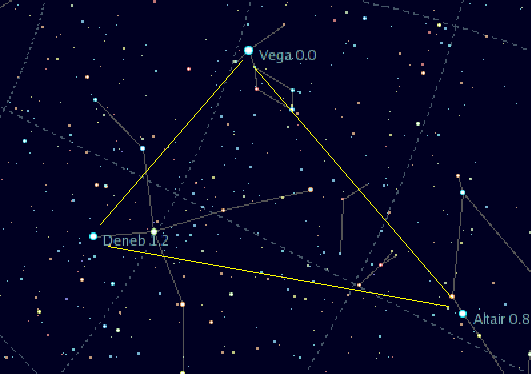
Artist: Jim Thomas
- Lyra to Vega to Epsilon Lyrae: Find Vega first; a short hop northeast reveals the distinctive small parallelogram of Lyra. Near Vega lies the famed “Double Double” (Epsilon Lyrae), an optical double that splits into two doubles in small telescopes under steady air. See Deep-Sky Highlights for details.
- Cygnus and the Northern Cross: Spot a cross-shaped pattern: Deneb at the top, Albireo at the base, and Sadr at the center. The Milky Way’s bright lane splits around dark rifts here.
- Altair’s wingmen: Altair forms a line with two fainter stars: Tarazed (brighter, slightly orange) and Alshain. This line helps confirm you’ve identified Altair correctly.
For deeper planning and equipment advice, jump to the Seasonal Observing Planner or Astrophotography Tips.
Deep-Sky Highlights Around the Summer Triangle
The Summer Triangle region is dense with rewarding binocular and telescope targets, many framed by the Milky Way’s star clouds. Here are reliable highlights for a range of skill levels and sky conditions.
Lyra: Home of the Ring Nebula and Tight Doubles
- M57 (Ring Nebula): Between Beta and Gamma Lyrae lies the celebrated planetary nebula. In small telescopes, M57 appears as a tiny smoke ring; with larger apertures and dark skies, the ring’s oval shape and central hole become obvious. Under moderate light pollution, it remains a viable, high-surface-brightness target. An OIII filter can improve contrast.

This new image shows the dramatic shape and colour of the Ring Nebula, otherwise known as Messier 57. From Earth’s perspective, the nebula looks like a simple elliptical shape with a shaggy boundary. However, new observations combining existing ground-based data with new NASA/ESA Hubble Space Telescope data show that the nebula is shaped like a distorted doughnut. This doughnut has a rugby-ball-shaped region of lower-density material slotted into in its central “gap”, stretching towards and away from us.
Artist: NASA, ESA, and C. Robert O’Dell (Vanderbilt University)
- Epsilon Lyrae (The Double Double): Close to Vega, Epsilon Lyrae appears as a neat double star in binoculars. With higher magnification and steady seeing, each component separates into two, forming a “double double.” This is a favorite test of optics and atmospheric steadiness.
- M56 (globular cluster): Between Lyra and Cygnus, M56 is a modest, somewhat compressed globular that benefits from medium apertures and dark skies. It is a good stepping stone when sweeping from M57 toward the Milky Way in Cygnus.
Cygnus: Nebulae, Clusters, and the Milky Way’s Dark Rifts
- NGC 7000 (North America Nebula) and IC 5070 (Pelican Nebula): Near Deneb lies a large, diffuse complex of emission nebulae. Visually, these are challenging under light pollution but pop with wide-field imaging or with a narrowband filter from dark sites. The shape of NGC 7000 resembles the North American continent with a prominent “Gulf of Mexico.”
- The Veil Nebula (Cygnus Loop): A supernova remnant spanning several degrees, with famous components like NGC 6960 (the Western Veil, overlapping bright star 52 Cygni) and NGC 6992/6995 (the Eastern Veil). An OIII filter is transformative; from dark sites the delicate filaments are unforgettable.

This Picture of the Week revisits the Veil Nebula, a popular subject for Hubble images! This object was featured in a previous Hubble photo release, but now new processing techniques have been applied, bringing out fine details of the nebula’s delicate threads and filaments of ionised gas. To create this colourful image, observations taken by Hubble’s Wide Field Camera 3 instrument through 5 different filters were used. The new post-processing methods have further enhanced details of emissions from doubly ionised oxygen (seen here in blues), ionised hydrogen and ionised nitrogen (seen here in reds). The Veil Nebula lies around 2100 light-years from Earth in the constellation of Cygnus (The Swan), making it a relatively close neighbour in astronomical terms. Only a small portion of the nebula was captured in this image. The Veil Nebula is the visible portion of the nearby Cygnus Loop, a supernova remnant formed roughly 10 000 years ago by the death of a massive star. The Veil Nebula’s progenitor star — which was 20 times the mass of the Sun — lived fast and died young, ending its life in a cataclysmic release of energy. Despite this stellar violence, the shockwaves and debris from the supernova sculpted the Veil Nebula’s delicate tracery of ionised gas — creating a scene of surprising astronomical beauty.
Artist: ESA/Hubble & NASA, Z. Levay
- Sadr Region (Gamma Cygni): The field around Sadr is packed with emission nebulae and star clouds. Open clusters and dark lanes create striking contrast in wide binocular views and ultra-wide telescope fields.
- Albireo (Beta Cygni): A celebrated double star with contrasting colors (golden and bluish). Modern studies indicate the brighter and fainter components are likely not a gravitationally bound pair but rather an optical double, yet the color contrast remains a visual delight.
Aquila and Vulpecula: Planetary Showpieces and Asterisms
- M27 (Dumbbell Nebula) in Vulpecula: Among the brightest planetary nebulae for small scopes, M27 shows a rectangular or apple-core shape in modest apertures. An OIII filter enhances the outer shell in dark conditions. It’s an excellent first planetary nebula for beginners.
- Brocchi’s Cluster (The Coathanger, Cr 399): In Vulpecula, this popular asterism really shines in binoculars and small refractors with a wide field. It looks like a coat hanger of stars hanging in space.
- Open Clusters in Aquila: Aquila hosts several modest open clusters and wide fields of stars. While not as iconic as Lyra or Cygnus, sweeping here with binoculars is rewarding, especially near the Milky Way band.
If you’re just getting started with a new telescope, begin with the high-contrast planetary nebulae (M57 and M27) and the Double Double. Once comfortable with magnification and star-hopping, attempt the Veil Nebula with a narrowband filter from a dark site. Return to How to Find the Summer Triangle if you need help confirming your starting stars.
Astrophotography Tips for the Summer Triangle Region
The Summer Triangle is a natural canvas for astrophotography at every level—from static wide-angle Milky Way shots to tracked mosaics and narrowband deep-sky images. Below are pragmatic, field-tested tips consistent with common equipment and techniques.
Wide-Angle Milky Way Landscapes
- Lens choice: 14–35 mm on full-frame (10–24 mm APS-C) to frame the entire Triangle and Milky Way band. A fast prime (f/1.4–f/2.8) helps capture faint nebulosity while keeping ISO modest.
- Exposure: Untracked, try 10–20 s at f/2–f/2.8, ISO 1600–3200 as a starting point; refine by histogram and star trailing. On a tracker, 1–3 minutes at ISO 800–1600 often works at f/2.8–f/4.
- Composition: Place the Milky Way swath through Cygnus rising from a landscape element (trees, ridge lines, water). Use the bright anchors Vega and Altair to orient your frame; Deneb sits in the densest Milky Way region of the three.
- Sky quality: Transparency is crucial. Even thin haze mutes faint nebulosity and dims the Milky Way’s contrast. Check humidity and aerosol forecasts.
Tracked Wide-Field Nebulae and Star Clouds
- Targets: NGC 7000/IC 5070, the Sadr region, and the Veil. Use 50–135 mm lenses on a star tracker for sweeping fields that still capture structure.

NGC 6960 or the Veil Nebula is a cloud of heated and ionized gas and dust in the constellation Cygnus. The analysis of the emissions from the nebula indicate the presence of oxygen, sulfur, and hydrogen. This is also one of the largest, brightest features in the x-ray sky. It is the Western Veil of the nebula (also known as Caldwell 34), consisting of NGC 6960 (the \”Witch’s Broom\”, \”Finger of God\”, or \”Filamentary Nebula\”) near the foreground star 52 Cygni. The image details of NGC6960 is a three frame mosaic taken with 5 different filters, standard Red – Green – Blue with details enhanced with narrowband data of Hydrogen (Ha) and Oxygen (OIII). The Ha was color mapped to Red and the OIII to teal. So it is a representative color image consisting of over 39 hours of exposure time.
Artist: Ken Crawford
- Filters: For color cameras in light pollution, dual-band (Hα + OIII) filters can preserve nebular signal while suppressing city glow. For broadband dark-sky work, shoot unfiltered for star color fidelity.
- Calibration: Take flats, darks, and bias frames. Flats are vital to correct vignetting common with fast lenses.
- Focusing: Use live view on Vega or Deneb, magnify 10×, and fine-tune with a Bahtinov mask if possible. Recheck focus as temperatures change.
Telescopic Imaging of Planetary Nebulae
- M57 and M27: These high surface brightness targets are friendly to short exposures. Try 30–120 s subframes at moderate gain/ISO. Narrowband filters (especially OIII) accentuate shell detail; LRGB captures star color.
- Sampling: Aim for pixel scale appropriate to seeing (e.g., 1–2 arcsec/pixel). Oversampling wastes signal; undersampling softens details.
- Guiding: For long sub-exposures, autoguiding enhances star roundness. Dither between frames to improve noise reduction during stacking.
Processing and Color Balance
- Stacking: Integrate many subs (1–4+ hours total integration) to reduce noise and reveal faint structures like the Veil’s wisps or the North America Nebula’s coastal contours.
- Color: Preserve the natural blue-white hues of Vega, Deneb, and Altair while managing nebula colors. For dual-band data, map Hα to red and OIII to green/blue; balance to avoid over-saturated teals.
- Star control: Star reduction can help emphasize nebulae; apply gently to avoid unnatural halos. Consider starless techniques sparingly and always compare to a more natural baseline.
Logbook: A Practical Capture Recipe
Untracked (full-frame, 24 mm, f/2.0):
  ISO 3200
  Exposure 12–15 s
  White balance ~3800–4200 K
  60–120 subs + darks/flats/bias

Tracked (full-frame, 50 mm, f/2.8):
  ISO 1600
  Exposure 60–120 s
  90–180 subs + darks/flats/bias
  Dual-band filter if needed
More on planning your targets by date appears in the Seasonal Observing Planner. If you’re choosing between targets, the guide in Deep-Sky Highlights can help you prioritize.
Scientific Highlights and Why This Region Matters
Beyond its beauty, the Summer Triangle sits atop scientifically rich sections of the Milky Way. From star-forming complexes to stellar evolution laboratories, this patch of sky reveals key astrophysical processes.
Star Formation in Cygnus
The North America and Pelican nebulae near Deneb, along with broader emission complexes around Sadr, trace regions of active or recent star formation. Emission nebulae glow as energetic photons from hot young stars ionize surrounding hydrogen, which then recombines and emits characteristic Hα light. Dust lanes sculpt the nebulosity into recognizable shapes. Observations across wavelengths—from radio to infrared to X-ray—help astronomers map the interplay between gas, dust, and newly formed stars.
Supernova Remnants and the Cycle of Matter
The Veil Nebula is a stellar corpse: the remains of a massive star that exploded thousands of years ago. Its shock waves ripple through the interstellar medium, compressing gas and dust, enriching it with heavier elements forged in stellar cores. Such remnants are critical to the cosmic recycling process; they seed the galaxy with the raw materials for future generations of stars and planets. The Veil’s filamentary structure showcases instabilities and magnetic interactions, making it a target for both professional and advanced amateur studies.
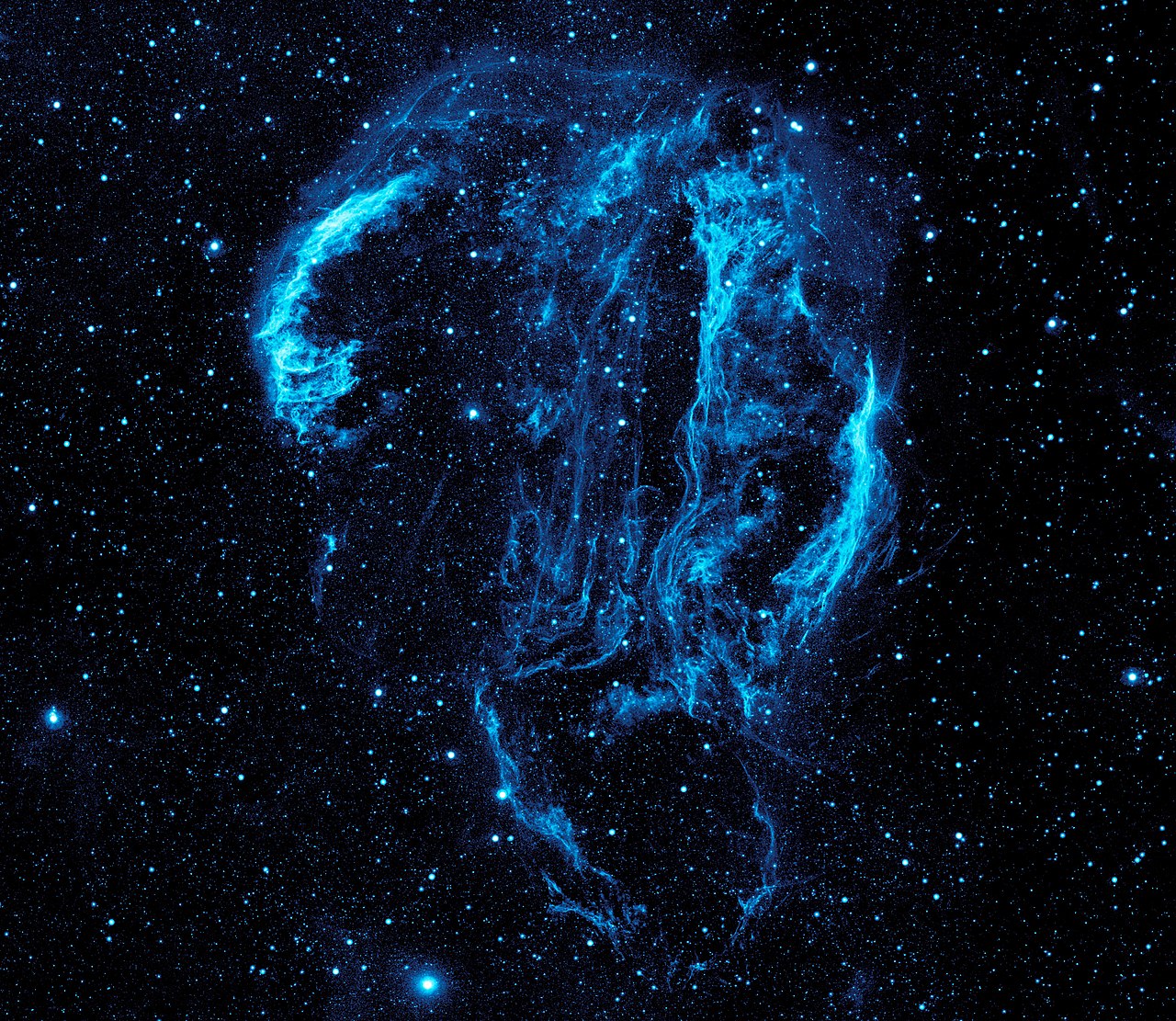
Artist: NASA/JPL-Caltech
Photometric Standards and Interferometric Milestones
Vega’s role as a photometric cornerstone underpins countless measurements of stellar brightness and color. Meanwhile, optical interferometry has resolved the shapes of fast rotators like Altair, confirming oblateness and gravity darkening predictions. These observations validate and refine stellar models—bridging textbook physics and real stars you can find by eye.
Exoplanets and Debris Disks: What We Know
While no confirmed exoplanets orbit Vega, its infrared excess and debris disk spurred a revolution in our understanding of planetary system evolution. Dusty belts can indicate ongoing collisional cascades among planetesimals, and structures in disks can hint at gravitational sculpting by planets. Altair similarly lacks confirmed planets as of current knowledge. The Summer Triangle region also borders fields observed by planet-hunting missions; for instance, the Kepler mission stared toward Cygnus and Lyra (slightly north-west of the Triangle’s central swath), where it discovered thousands of planetary candidates. This proximity reminds us that seemingly serene starfields can hide dynamic planetary systems.
Precession and Celestial Navigation
Historically, bright stars like Vega have served navigators and calendar makers. The slow drift of the pole due to precession means that over millennia, different stars take turns as pole stars. While Polaris is the current northern pole star, Vega’s past and future proximity to the pole anchors discussions of long-term celestial mechanics. Amateur observers can use the Summer Triangle as a beacon to align a sense of the sky’s seasonal clock: each year, it climbs earlier in the evening from spring to summer, then migrates westward by autumn.
Seasonal Observing Planner: Month-by-Month Guide
Use this month-by-month overview as a practical roadmap. Your exact timings will vary with latitude and longitude, but the sequence holds across regions.
Late Spring (May–June, Northern Hemisphere)
- May: Vega rises in the northeast shortly after dusk. Deneb and Altair follow through late evening. The Milky Way begins to show in darker locations after midnight.
- June: The Triangle is complete by mid-evening. Start with easy binocular sweeps through Cygnus; on moonless nights, try spotting the dark rifts slicing the Milky Way near Sadr. Consider a first attempt at M57 in small scopes.
Mid-Summer Peak (July–August)
- July: The Summer Triangle crowns the sky by late evening. Planetary nebulae M57 and M27 are well placed. The Veil Nebula becomes a prime target after astronomical twilight ends. Use an OIII filter for best results.
- August: The Perseid meteor shower peaks typically around mid-August, and although the radiant is in Perseus, the Summer Triangle often sits impressively overhead as a backdrop. Nebulae around Deneb and Sadr are excellent for tracked wide-field imaging.
Early Autumn (September–October)
- September: Cooler, steadier air can enhance double-star splits (Epsilon Lyrae) and finer details in M57. The Triangle moves westward but remains well placed during prime evening hours.
- October: M27 and the Veil remain within reach in early evening. As nights lengthen and transparency improves, take advantage of longer integrations for astrophotography projects.
Late Autumn to Early Winter (November–December)
- November: The Summer Triangle descends toward the western sky after dusk. It’s your last call for casual evening sessions targeting the Veil and North America Nebula.
- December: The Triangle becomes an early-evening farewell in the northwest. Shift focus to winter constellations, but keep this guide handy for planning the next season.
Southern Hemisphere Notes
- June–September: Look north in the evening. Altair reaches a comfortable height; Vega and Deneb remain low. Wide-field Milky Way shots can still capture Cygnus’ nebulosity from favorable latitudes with clear northern horizons.
- Transparency matters: At low altitudes, even slight haze can wash out faint targets like the Veil. Prioritize nights with exceptional clarity for northern-horizon objects.
Not sure which targets suit your equipment? Review Deep-Sky Highlights and match target size to your field of view. For imaging settings, consult Astrophotography Tips.
Frequently Asked Questions
Is the Summer Triangle a constellation or an asterism?
The Summer Triangle is an asterism, not a constellation. It is a recognizable pattern connecting stars from three different constellations (Lyra, Cygnus, Aquila). The IAU defines 88 official constellations as formal sky regions; asterisms are informal but commonly used guides for navigation and education.
Why does Vega look bluish-white to the eye?
Vega is a relatively hot A-type star that emits more strongly at shorter (bluer) wavelengths than cooler stars like the Sun. Human color perception at night is limited, but under good conditions you may detect Vega as bluish-white. Air transparency, light pollution, and individual color sensitivity all influence how its color appears to you in practice.
Final Thoughts on Exploring the Summer Triangle
The Summer Triangle is more than an easy sky pattern—it is a gateway to understanding stellar physics, star formation, and the structure of the Milky Way. Its three brilliant vertices—Vega, Deneb, and Altair—embody different stellar stories: a nearby fast rotator and photometric touchstone; a distant, luminous supergiant shaping its surroundings; and a rapidly spinning, oblate star that helps test models of stellar atmospheres. Between them lie planetary nebulae, supernova remnants, and sprawling emission regions, accessible to binoculars, backyard telescopes, and DSLR cameras.
If you’re new to stargazing, start by locating the triangle from your latitude with the cues in How to Find the Summer Triangle. Then, step through the curated list in Deep-Sky Highlights. If imaging calls to you, the guidance in Astrophotography Tips will help you plan efficient, high-impact sessions. Season by season, you’ll notice how the Triangle tracks the sky’s rhythm—arriving earlier as summer unfolds and gliding west as autumn deepens.
Key takeaways:
- The Summer Triangle is a reliable seasonal signpost and a practical bridge to advanced topics.
- Vega, Deneb, and Altair showcase different stellar types and evolutionary stages.
- Classic objects like M57, M27, the Veil, and NGC 7000 offer variety for observers and imagers.
- Filters and careful planning can overcome light pollution for many targets.
For more observing guides and science explainers, explore our related articles and consider subscribing to our newsletter. You’ll receive monthly sky highlights, equipment tips, and deep dives into the physics behind the night sky’s most captivating sights.