Table of Contents
- What Do Numerical Aperture and Resolution Mean in Microscopy?
- Magnification vs. Resolution: Avoiding Empty Magnification
- Diffraction, Abbe, and Rayleigh Criteria for Lateral Resolution
- Illumination, Condenser NA, and Image Contrast
- Objective Design, Immersion Media, and Refractive Index Mismatch
- Depth of Field, Depth of Focus, and Working Distance
- Digital Sampling, Pixel Size, and the Nyquist Criterion
- Wavelength Choice, Color Channels, and Contrast Mechanisms
- Common Misconceptions About NA, Resolution, and Magnification
- A Practical Checklist for Matching Objectives, Illumination, and Cameras
- Frequently Asked Questions
- Final Thoughts on Balancing NA, Resolution, and Magnification
What Do Numerical Aperture and Resolution Mean in Microscopy?
When people talk about how “good” a microscope is, they often focus on magnification. But in optical microscopy, resolution—the ability to distinguish two closely spaced points as separate—is the central performance metric. Resolution is fundamentally tied to numerical aperture (NA) and the wavelength of light. Magnification matters too, but only insofar as it allows you to see the resolved detail your optics can actually deliver. Understanding how NA, wavelength, and magnification work together is the key to meaningful, high-quality imaging.
Numerical aperture quantifies how much light an optical system can gather and how finely it can capture angular details from the specimen. It is defined as NA = n × sin(θ), where n is the refractive index of the imaging medium (air, water, oil, etc.), and θ is the half-angle of the largest cone of light that can enter or exit the lens. Higher NA has two immediate consequences:

Artist: PaulT (Gunther Tschuch)
- Improved resolution: Higher NA captures higher spatial frequencies from the specimen, enabling finer detail to be resolved (see Diffraction, Abbe, and Rayleigh).
- Brighter images at a given illumination: More light is collected from the specimen due to the larger acceptance cone.
Resolution in the lateral (x-y) plane is diffraction-limited and scales with λ/NA, where λ is the wavelength of light. Shorter wavelengths and higher NA yield smaller, sharper point spread functions (PSFs) and thus higher resolving power. Axial (z) resolution in widefield imaging depends even more strongly on NA, scaling approximately with λ / NA2 under common approximations. While we will avoid overspecifying coefficients here, the essential point is that axial sectioning improves rapidly with higher NA.
Crucially, magnification does not increase resolving power once the optical resolution limit is reached. Beyond the threshold where detail is fully sampled, greater magnification simply spreads the same information over more display space—this is known as empty magnification, a point we explore in detail in Magnification vs. Resolution.
Before diving into equations, it helps to hold onto three working rules:
- NA sets the detail you can theoretically resolve. It is the most important single number on an objective lens.
- Wavelength matters: shorter wavelengths improve resolution, all else equal.
- Magnification is meaningful only if it matches the delivered resolution and your detector’s sampling. See Digital Sampling for how camera pixels and magnification interact.
Taken together, these principles explain why a well-chosen, high-NA objective paired with appropriate illumination and properly sampled detection can produce sharper, more informative images than a “higher magnification” objective with lower NA.
Magnification vs. Resolution: Avoiding Empty Magnification
Magnification enlarges the specimen’s image but does not create new detail. Once the finest resolvable features are set by the optics and wavelength, additional magnification can only make the same information appear larger. If magnification is too low, you may undersample detail; if it is too high relative to your detector and optical resolution, you are just spreading the same data across more pixels or a larger field of view without gaining information.
Two practical ideas help keep magnification in perspective:
- Resolve, then display: The optical system’s NA and wavelength determine resolution first. Magnification should then be chosen to render those details clearly on the sensor or display (see Nyquist sampling).
- Avoid empty magnification: When the projected pixel size becomes much finer than the optical resolution, you are not adding information—just enlarging blur.
For visual observation through eyepieces, a useful qualitative check is whether increasing magnification makes new features discernible. If not, you’re likely in the regime of empty magnification. For cameras, an objective-and-tube-lens combination that produces an object-space pixel size near half of your optical resolution limit usually provides efficient sampling. We unpack this relationship quantitatively in Digital Sampling, Pixel Size, and the Nyquist Criterion.
Key takeaway: Magnification is the messenger, not the message. NA and wavelength define the message (resolvable detail); magnification only scales how you see or record it.
Diffraction, Abbe, and Rayleigh Criteria for Lateral Resolution
Light behaves as a wave, and when it passes through a finite aperture (like an objective pupil), it diffracts and spreads. Even if the specimen had infinitely fine details, the image would be blurred by the system’s point spread function (PSF). The blur size sets a fundamental limit on how close two points can be while still appearing distinct. This is known as the diffraction limit.
Two commonly referenced criteria characterize this limit in the lateral plane:
- Abbe criterion for resolving periodic structures suggests a lateral resolution approximately
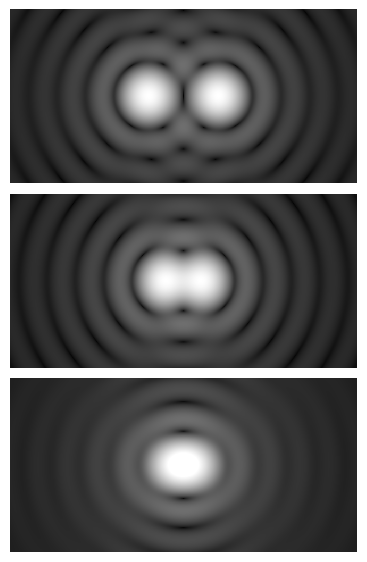
d ≈ λ / (2 · NA). This expression relates the smallest resolvable feature spacing to wavelength and NA. - Rayleigh criterion for two point sources gives an estimate
d ≈ 0.61 · λ / NA. It uses the first minimum of one Airy pattern falling at the central maximum of the other as the threshold for “just resolved.”
Artist: Spencer Bliven
Though the numerical constants differ, both criteria emphasize the same dependencies: resolution improves with higher NA and shorter wavelengths. For practical microscopy, either expression is used as a scale for “order-of-magnitude” expectations of resolvable detail, with context guiding which is more appropriate.
It is also essential to remember that real systems are never perfectly diffraction-limited. Aberrations (e.g., spherical aberration from refractive index mismatch), misalignment, coverglass thickness errors, or dust on optics can broaden the PSF and reduce contrast. Excellent optics can approach the diffraction limit, but sound technique and proper matching of components (see Objective Design, Immersion Media, and Refractive Index Mismatch) are vital to realize that potential.
Finally, lateral resolution is only one dimension of image quality. The axial resolution (sectioning along the z-axis) improves strongly with increasing NA and decreasing wavelength, which is why high-NA immersion objectives are preferred for fine optical sectioning even in widefield imaging. The exact coefficients depend on imaging modality and assumptions, but the proportionality to λ / NA² is a robust intuition for how axial blur scales.
Illumination, Condenser NA, and Image Contrast

Artist: ZEISS Microscopy from Germany
Objective NA is only part of the resolution story. In transmitted-light brightfield microscopy, the condenser shapes the illumination at the specimen and therefore influences resolution and contrast. A key quantity here is condenser NA, which ideally should be comparable to the objective’s NA for optimum resolution in brightfield. When the condenser NA is too low relative to the objective NA, high spatial frequencies are not efficiently illuminated, and fine detail may be lost or have poor contrast.
Illumination also has a coherence dimension. With spatially incoherent (or partially coherent) Köhler-type illumination, information transfer behaves differently than with coherent illumination. Broadly speaking, decreasing coherence can enhance contrast for certain spatial frequencies in brightfield imaging. The exact behavior is governed by the system’s optical transfer function (OTF) and its modulation transfer function (MTF), which quantify how well different spatial frequencies are passed from object to image.
Practical considerations for illumination and condenser NA include:
- Match NA for resolution: For brightfield, set the condenser aperture such that the illumination NA is close to the objective’s NA to support high-frequency detail. If you stop the condenser down too far, you increase contrast for low frequencies but often at the expense of resolving the finest detail.
- Control glare and depth cues: Partially closing the condenser aperture can boost contrast and depth cues in thick specimens but limits ultimate resolution for fine features.
- Contrast methods: Phase contrast and DIC use specialized illumination optics to convert phase gradients into intensity differences. These techniques change the effective contrast transfer without violating diffraction limits (see Wavelength Choice, Color Channels, and Contrast Mechanisms).
In fluorescence microscopy, the “condenser” role is typically replaced by epi-illumination through the objective. There, the objective NA influences both excitation and emission collection. High NA improves photon collection efficiency and spatial resolution simultaneously.
Tip: If your images look surprisingly soft despite a high-NA objective, check whether illumination conditions are limiting contrast transfer. The balance between condenser NA and objective NA is a frequent culprit in transmitted-light imaging.
Objective Design, Immersion Media, and Refractive Index Mismatch
Objectives are labeled not only by magnification and NA, but also by the intended immersion medium (air, water, glycerol, oil) and often by the coverglass thickness for which they are corrected. These annotations are not cosmetic: they reflect the design conditions under which aberrations are minimized and resolution is maximized.
Consider these factors:
- Immersion medium and NA: Since
NA = n · sin(θ), increasing the refractive index n enables higher NA for a given cone angle. Oil-immersion objectives (with immersion oils near the refractive index of glass) can achieve very high NA values compared to air objectives. Water-immersion lenses trade slightly lower maximum NA than oil for improved index matching with aqueous samples and reduced spherical aberration when imaging into water-based media. - Refractive index mismatch: When light passes through layers with different refractive indices (e.g., immersion oil, coverglass, mounting medium, specimen), spherical aberration can arise, broadening the PSF and reducing resolution and contrast. Imaging deep into a medium markedly different from the objective’s design medium usually degrades axial and lateral resolution.
- Coverglass thickness: Many high-NA objectives are corrected for a standard coverglass thickness close to 0.17 mm (often marked “0.17”). Deviations can introduce spherical aberration. Objectives specified for “no coverglass” are designed for uncovered specimens and will underperform with a coverglass added, and vice versa.
- Working distance vs. NA: Raising NA often reduces working distance because achieving a large cone angle requires the lens to be close to the specimen. Long-working-distance designs exist, but extreme working distances are typically not compatible with the highest NAs.

Artist: Thebiologyprimer
An especially important practical point is that spherical aberration increases with the degree of index mismatch and with imaging depth into mismatched media. Water-immersion objectives help mitigate this in live-cell imaging where the sample environment is aqueous. Oil-immersion objectives usually offer the highest NA at the coverglass plane and are excellent for thin specimens mounted to match conditions. Glycerol-immersion objectives (with an index between water and oil) can reduce aberrations for specimens mounted in media near that index.
Objective correction types (achromat, fluorite/semi-apochromat, apochromat) address chromatic and spherical aberrations over different wavelength ranges and fields of view. While these corrections don’t change the nominal NA, better correction can improve contrast and off-axis sharpness so that the lens more closely approaches its diffraction-limited performance. If you find that off-axis details are soft or colors do not focus together, an objective with higher correction may help without changing magnification or NA.
It bears repeating that NA sets the physical ceiling for resolution under given illumination conditions, but realizing that resolution requires the specimen, immersion medium, coverglass, and objective to be in harmony. For further implications on axial sectioning and image crispness, see Depth of Field, Depth of Focus, and Working Distance.
Depth of Field, Depth of Focus, and Working Distance
Two related but distinct ideas govern how sharply features appear along the optical axis:
- Depth of field (DOF): The axial range in the specimen over which features appear acceptably sharp in the image.
- Depth of focus: The tolerance in the image plane (camera or eye) within which the sensor can move while the image remains acceptably sharp.
As NA increases, depth of field decreases. This is because the axial PSF narrows with higher NA (a positive for sectioning), and the tolerance for defocus also shrinks. At the same time, depth of focus on the sensor side also becomes smaller at higher NA, which is one reason high-NA imaging can be more sensitive to focus errors and mechanical vibrations.
While exact expressions for DOF and depth of focus include both diffraction and geometric terms, one robust qualitative trend is:
- DOF scales inversely with NA squared for the diffraction-limited contribution, and increases with wavelength. Longer wavelengths have larger DOF; higher NA has smaller DOF.
High NA is therefore a double-edged sword: you gain lateral and axial resolution but have less axial tolerance. This motivates careful focusing and stable support when working at high NA, and it also explains why partially closing the condenser aperture (reducing illumination NA) can sometimes increase perceived DOF and contrast in thick specimens at the expense of ultimate high-frequency resolution (revisit Illumination, Condenser NA, and Image Contrast).
Working distance (WD)—the free space between the objective front lens and the specimen—typically decreases with higher NA and higher magnification within a given design family. Long-working-distance objectives are engineered to provide more clearance, but they usually sacrifice some NA compared to short-WD, high-NA objectives. When imaging thick or uneven samples, or when using accessories between the objective and specimen, WD becomes a practical constraint that must be balanced against the desire for high NA.
Rule of thumb: If you need maximum sectioning and finest detail, choose the highest-NA objective appropriate for your specimen and medium. If you need tolerance to thickness or sample unevenness, moderate NA can offer more DOF and WD.
Digital Sampling, Pixel Size, and the Nyquist Criterion
High optical resolution is only useful if your detector samples the image finely enough to capture it. This is where Nyquist sampling comes in. In essence, to record a spatial frequency without aliasing, you need at least two samples per period. Translating this to microscopy, your object-space pixel size should be small enough to sample the finest details the optics can resolve.
Let’s define key quantities:
- Camera pixel size (sensor-side), p: The physical size of a pixel on the camera sensor (e.g., micrometers).
- Total optical magnification, M: The product of objective magnification and any intermediate magnification (e.g., tube lens factors).
- Object-space pixel size, s: The effective pixel size at the specimen plane given by
s = p / M.
Nyquist sampling suggests that s should be no larger than about d/2, where d is your system’s diffraction-limited lateral resolution (e.g., use either Abbe λ/(2·NA) or Rayleigh 0.61λ/NA as a reference scale). In other words:
p / M ≤ d / 2.
This inequality can be rearranged to estimate the minimum useful magnification given a camera pixel size and an optical resolution scale d. If your magnification is lower than that, you under-sample; higher than needed simply over-samples, which may waste field of view and signal-to-noise ratio (SNR) without adding information, similar to empty magnification in visual viewing.
Important caveats and practical notes:
- SNR matters: Smaller object-space pixels capture fewer photons per pixel for a given exposure, which can reduce SNR. Oversampling beyond Nyquist reduces per-pixel SNR; undersampling risks aliasing and loss of detail.
- Wavelength and channel choice: Because
ddepends on wavelength, the optimal sampling for a blue channel can differ from a red channel. If multi-color imaging is critical, base sampling on the shortest wavelength you will use to avoid undersampling in that channel (see Wavelength Choice, Color Channels, and Contrast Mechanisms). - Display sampling: After capture, display resolution also affects perceived detail. A well-sampled image can still look soft on a low-resolution monitor or with excessive downscaling; conversely, a poorly sampled image cannot be rescued by display magnification.
- MTF perspective: Nyquist is a minimum. Practical image quality benefits from having some headroom because transfer near the cutoff frequency is low-contrast. Sampling so that the usable frequencies are adequately sampled often means targeting object-space pixel sizes around one-third to one-half of
d, depending on your goals and SNR.
In summary: Align your magnification with your camera pixel size such that s = p/M is at or below d/2. Doing so ensures that the detector can faithfully record the optical detail provided by your NA and wavelength choices.
Wavelength Choice, Color Channels, and Contrast Mechanisms
Resolution and contrast both depend on wavelength, but in different ways. As discussed in Diffraction, Abbe, and Rayleigh, shorter wavelengths improve resolution. However, sample contrast, absorption, scattering, and autofluorescence all vary with wavelength, and so do the spectral transmissions of filters and optics in fluorescence systems. Selecting illumination and detection wavelengths involves trade-offs among resolution, brightness, photobleaching (in fluorescence), and contrast.

Artist: SiriusB
Some guiding considerations:
- Lateral resolution scales with λ: Blue or near-UV excitation offers finer theoretical resolution than red light, with the caveat that shorter wavelengths may scatter more and can be more phototoxic in live samples.
- Chromatic aberration corrections differ by objective: Apochromatic objectives aim to bring multiple wavelengths to common focus and magnification, improving multi-color image registration and sharpness. Achromats are corrected over a narrower spectral range.
- Contrast techniques change transfer:
- Brightfield: Contrast arises from absorption, scattering, and refractive index differences modulating amplitude and phase. Matching condenser NA to objective NA helps pass high spatial frequencies.
- Phase contrast: Transforms phase gradients into intensity differences by interfering background and diffracted light; excellent for transparent specimens.
- DIC (Differential Interference Contrast): Converts optical path length gradients into intensity contrast using sheared beams and polarizing optics; emphasizes edges and fine relief.
- Fluorescence (widefield): Excitation and emission wavelengths are separated by filters. Resolution is governed primarily by emission wavelength and objective NA; collection efficiency increases with NA.
While these methods do not bypass diffraction limits, they can make fine structures more visible by enhancing contrast where it matters. For instance, in DIC the gradient contrast can reveal sub-resolution edges more clearly, and in phase contrast, transparent structures that were nearly invisible in brightfield become obvious.
In multi-color fluorescence imaging, minor differences in effective resolution across channels occur because d scales with λ. If channel-to-channel resolution matching is important (for co-localization, for example), it may be sensible to choose sampling based on the shortest emission wavelength you will image and apply appropriate deconvolution or processing judiciously.
Common Misconceptions About NA, Resolution, and Magnification
Because these topics are intertwined, several myths persist. Clearing them up helps you choose and use equipment wisely.

Artist: QuodScripsiScripsi
- “Higher magnification always means better detail.” False. Magnification without sufficient NA yields larger, blurrier images. See Magnification vs. Resolution for why NA and wavelength set fundamental detail.
- “Two objectives with the same NA resolve identically.” Not necessarily. While NA sets the physical limit, real-world performance depends on aberration correction, manufacturing quality, and match to the intended coverglass and medium (see Objective Design).
- “Closing the condenser aperture always improves images.” It can increase contrast for low spatial frequencies, but it reduces the illumination NA and thus attenuates high-frequency information. Balance is key (see Illumination and Condenser NA).
- “Camera pixel size alone determines resolution.” The detector cannot create detail the optics didn’t deliver. Pixel size must be matched to the optical resolution (see Nyquist sampling), but finer pixels do not help if NA and wavelength limit detail.
- “Oil immersion is always best.” Oil enables very high NA at the coverglass, but if you image into aqueous samples or away from the coverglass, refractive index mismatch can introduce spherical aberration. Water- or glycerol-immersion objectives may be better for certain specimens (see Immersion Media).
- “Resolution and contrast are the same.” They are related but distinct. You can have high resolution but low contrast (fine details exist but are faint), or strong contrast at low resolution (edges are bold but blurred). Techniques in Wavelength and Contrast Mechanisms affect contrast transfer without changing the diffraction limit.
A Practical Checklist for Matching Objectives, Illumination, and Cameras
Putting principles into practice doesn’t require guesswork. Use this concise checklist to align the key variables that drive image quality. It is not a lab protocol but rather a framework for making technically sound choices.
1) Define your resolution goal
- Estimate the smallest feature you want to resolve. Use a lateral scale
dfrom Abbe or Rayleigh with a representative wavelength for your modality. - If your features are anisotropic (e.g., fine lines), consider whether you need equal resolution in x and y or if orientation matters.
2) Choose an objective with suitable NA and compatible design
- Select the highest NA consistent with your sample thickness, working distance, and immersion constraints.
- Match immersion medium to your specimen environment to minimize index mismatch and spherical aberration (see Objective Design, Immersion Media).
- Verify coverglass compatibility (e.g., objectives corrected near 0.17 mm coverglass when using one).
3) Align illumination NA and contrast method to your needs
- In transmitted brightfield, choose a condenser aperture that yields an illumination NA near the objective NA to support high-frequency detail (see Illumination).
- For transparent specimens, consider phase contrast or DIC to convert phase gradients into intensity contrast.
- In fluorescence, recognize that objective NA affects both excitation focusing and emission collection efficiency.
4) Match magnification to your camera sampling
- Compute object-space pixel size
s = p / Mand compare to your targetd/2from Nyquist (see Digital Sampling). - Avoid severe undersampling (aliasing) and excessive oversampling (SNR loss without added detail).
5) Balance wavelength choices with contrast and SNR
- Shorter wavelengths boost resolution; longer wavelengths may offer better penetration or reduced phototoxicity in live imaging.
- If using multiple emission colors, ensure your sampling supports the most demanding (shortest-wavelength) channel (see Wavelength Choice).
6) Consider depth, DOF, and stability
- Higher NA tightens depth of field and depth of focus. Stable focusing and mechanical rigidity help preserve sharpness (see Depth of Field).
- Thick specimens benefit from strategies that manage contrast and sectioning; in widefield, high NA still helps by narrowing the axial PSF.
By iterating through this list, you connect the design parameters (NA, immersion, magnification) with practical outcomes (resolution, contrast, SNR) in a way that is grounded in optical theory rather than intuition alone.
Frequently Asked Questions
How does numerical aperture affect brightness in addition to resolution?
Numerical aperture influences the collection efficiency of the objective. A higher NA captures light over a larger solid angle, which increases the detected signal from the specimen for a given illumination intensity. This improves the image brightness and can enhance signal-to-noise ratio, especially important in low-light applications such as fluorescence. However, higher NA also narrows depth of field and can increase sensitivity to aberrations if the immersion and coverglass conditions are not well matched. In transmitted brightfield, illumination NA (set by the condenser aperture) should be considered alongside objective NA to ensure that fine details are actually illuminated and transferred (see Illumination, Condenser NA, and Image Contrast).
Is there a simple way to tell if I am oversampling or undersampling with my camera?
A practical first check is to compute the object-space pixel size s = p / M and compare it with half your expected lateral resolution d/2 (using Abbe or Rayleigh as a scale with a representative wavelength). If s is much larger than d/2, you are likely undersampling; if it is much smaller, you may be oversampling without gaining usable detail. You can also inspect a high-contrast resolution target: if fine line pairs near your optical cutoff appear to “beat” or show aliasing patterns, that suggests undersampling. If they appear smooth but low-contrast, you may be adequately sampled but limited by the optics’ transfer near cutoff. Adjust magnification or pixel binning accordingly (see Digital Sampling, Pixel Size, and the Nyquist Criterion).
Final Thoughts on Balancing NA, Resolution, and Magnification
In optical microscopy, numerical aperture is the master key: it governs the finest resolvable detail and, together with wavelength, defines the diffraction-limited performance of the system. Magnification is a supporting actor, valuable only to the extent that it presents the resolved information at the right scale for your eyes or detector. Illumination and the condenser determine which spatial frequencies are excited and how strongly they are transferred, while immersion media and coverglass conditions decide whether the theoretical limits are approached or compromised by aberrations. Finally, your camera sampling must keep pace with the optical detail to avoid either aliasing or wasted SNR.
If you remember nothing else, let it be this triad: maximize NA within your specimen and medium constraints, choose wavelengths and contrast mechanisms suitable for your sample and goals, and match magnification to your detector so that object-space pixel size is near half of the optical resolution limit. This coherent approach will yield images that are not only sharper but also more informative and reproducible.
For more educational deep-dives like this one, including focused explainers on contrast techniques, objective corrections, and detector optimization, explore our related topics and consider subscribing to our newsletter so you never miss a new article.