
Table of Contents
- What Is the Orion Constellation in the Night Sky?
- How to Find Orion: Seasons, Latitudes, and Timing
- Major Stars of Orion: Betelgeuse, Rigel, and the Belt
- Orion’s Nebulae and Deep-Sky Objects: M42, Horsehead, and More
- Inside the Orion Molecular Cloud: Star Formation and Feedback
- Backyard Observing Tips: Binoculars, Telescopes, and Filters
- Astrophotography Planning for Orion: Lenses, Filters, and Workflows
- Cultural History and Mythology of Orion Across the World
- The Orionid Meteor Shower: When and How to Watch
- Frequently Asked Questions
- Final Thoughts on Exploring the Orion Constellation
What Is the Orion Constellation in the Night Sky?
Orion is one of the most recognizable constellations in the night sky, visible from both hemispheres and rich with bright stars, glowing nebulae, and active star-forming regions. Straddling the celestial equator, Orion is accessible to observers from almost every inhabited latitude. Its standout feature is a striking asterism known as the Belt of Orion: three bright stars aligned in a near-straight line. Beneath the Belt hangs the “Sword,” a vertical chain of stars and faint nebulosity that includes the famous Orion Nebula (Messier 42), a stellar nursery where new stars are being born.

Located within the Local Orion Arm (also called the Orion–Cygnus Spur) of our Milky Way, Orion’s stars are not physically clustered at a single distance; rather, they lie along our line of sight at different depths. Some are relatively nearby supergiants that formed tens of millions of years ago, while others are embedded in the more distant Orion Molecular Cloud complex where star formation is ongoing. Because Orion spans such diverse environments—from evolved red supergiants to protostars cocooned in dust—it provides a living laboratory for studying how stars are born, evolve, and eventually end their lives.
For practical observers, Orion is an ideal seasonal target. In the Northern Hemisphere it dominates the winter evening sky; in the Southern Hemisphere it shines during the summer months. Newcomers quickly learn to use Orion as a celestial signpost: by extending a line through the Belt to the southeast you find Sirius, the brightest star in the sky; extend the Belt to the northwest and you reach Aldebaran and the V-shaped Hyades cluster in Taurus. These simple star-hops transform Orion into a map for locating other prominent winter constellations and deep-sky objects.
If you are reading this to plan your first observation, consider starting with naked-eye recognition and then move on to binoculars. Scan the Belt and Sword with 7×50 or 10×50 binoculars under dark skies—you’ll likely spot a vaguely luminous patch in the Sword. That soft glow is M42, the Orion Nebula. From there, a small telescope will reveal the Trapezium star cluster within the nebula, and larger apertures will gradually unveil the deeper structures described in Orion’s Nebulae and Deep-Sky Objects.
How to Find Orion: Seasons, Latitudes, and Timing
Finding Orion is easy once you know when and where to look. Because the constellation straddles the celestial equator, it is visible from virtually all inhabited latitudes, from about +85° to −85°. Orion reaches prime evening visibility during the months when your local weather often provides the clearest skies: roughly November through February for northern observers and May through August for southern observers. The precise best month depends on your longitude and daylight saving changes, but a simple rule of thumb is that Orion culminates—reaches its highest point on the meridian—around local midnight in late December to early January, and earlier in the evening as the season progresses.
Practical timing tips:
- Late autumn to winter (Northern Hemisphere): Spot Orion rising in the east in the early evening by November; by January it is high in the south around mid-evening.
- Late spring to winter (Southern Hemisphere): Look for Orion in the eastern sky by October–November evenings; by December–January it is high overhead or to the north at mid-evening.
- Before dawn (transitional seasons): In late summer or early autumn (north) or late winter/early spring (south), Orion rises before dawn, offering pre-sunrise views.
Identifying the pattern is straightforward. First, find the Belt: three bright stars in a line with roughly equal spacing. Below the Belt (toward the celestial south) lies the Sword, where you’ll notice a hazy patch to the naked eye under dark conditions. Above the Belt (toward the celestial north) are two prominent stars that serve as Orion’s “shoulders,” one of which is the red supergiant Betelgeuse. Diagonally opposite are the “knees,” marked by the brilliant blue-white supergiant Rigel and the luminous Saiph.
If you’re navigating with a star chart app, you’ll see that Orion’s right ascension is centered around 5 hours, with declinations roughly between +20° and −20°. For manual star-hopping, use nearby bright waypoints: draw a line along the Belt to the left (northeastward if you’re facing south in the Northern Hemisphere), and you’ll run into Aldebaran and the V-shape of the Hyades in Taurus. To the right (southwestward), the Belt points down toward Sirius in Canis Major, the sky’s brightest star. These relationships are helpful for locating objects covered in Major Stars of Orion and Orion’s Nebulae and Deep-Sky Objects.
Light pollution can affect visibility, especially of the nebulosity in the Sword. If your site is urban or suburban (Bortle 6–8), you’ll still see the Belt, Betelgeuse, and Rigel easily, but the Orion Nebula will appear faint or washed out. Try to observe when Orion is as high above the horizon as possible to reduce atmospheric extinction and skyglow. A simple trick is to plan a session when the Moon is below the horizon or near its new phase—nebulous detail in M42 and neighboring objects stands out best under moonless, transparent skies.
Major Stars of Orion: Betelgeuse, Rigel, and the Belt
Orion’s fame owes much to its spectacular roster of bright, contrasting stars. The constellation features red and blue supergiants, hot multiple systems, and a variety of interesting variables. Here are the not-to-miss highlights:
Betelgeuse (Alpha Orionis)
Betelgeuse marks Orion’s right shoulder (on the sky’s left side when facing south) and is among the most observed red supergiants in the heavens. Its orange-red hue is obvious to the naked eye. Betelgeuse is a semiregular variable, meaning its brightness changes over time due to pulsations in its extended atmosphere and other processes. In late 2019 and early 2020, Betelgeuse underwent an unusually deep dimming event, which analysis indicates was largely caused by a surface mass ejection that formed dust and temporarily obscured the star, not an imminent supernova. As for its distance, measurements remain somewhat uncertain owing to the star’s complex atmosphere and brightness, but estimates commonly place it in the range of roughly 500–700 light-years. Betelgeuse is expected to end its life in a core-collapse supernova someday, but the timeframe could be tens of thousands to perhaps a hundred thousand years or more—astronomically soon, but not a near-term event.
Rigel (Beta Orionis)
Rigel, a blue-white supergiant of spectral type roughly B8 Ia, anchors Orion’s left knee (on the sky’s right side when facing south). It is among the sky’s brightest stars and an important reference in astrophysics. Rigel is much more luminous than the Sun—tens of thousands of times more—and lies at a greater distance, often quoted around 800–900 light-years. Small telescopes can reveal Rigel as a beautiful double star: its faint companion is visible at moderate magnification under steady seeing, though high contrast between the primary and secondary can make the split challenging.
Bellatrix (Gamma Orionis) and Saiph (Kappa Orionis)
Bellatrix forms Orion’s left shoulder (right of Betelgeuse as you face south). It is a bright B-type giant located roughly a few hundred light-years away; a useful anchor for star-hopping to the northern part of the constellation. Saiph, marking Orion’s right knee, is a luminous blue supergiant comparable in temperature to Rigel, though somewhat less bright to the eye. These two stars complete the rectangle of Orion with Betelgeuse and Rigel.
The Belt of Orion: Alnitak, Alnilam, and Mintaka
The Belt is a remarkable row of three bright stars nearly evenly spaced. From left to right (east to west as you face south), they are:
- Alnitak (Zeta Orionis): A hot, massive multiple system including a luminous O-type supergiant. The surrounding region hosts the Flame Nebula and the famous Horsehead silhouette (see Orion’s Nebulae and Deep-Sky Objects).
- Alnilam (Epsilon Orionis): The central and often brightest Belt star to unaided eyes. A distant B-type supergiant, Alnilam contributes significantly to illuminating nearby dust and gas.
- Mintaka (Delta Orionis): A multiple system as well, with a primary hot giant. It lies closer to the celestial equator than the others, making it a useful positional reference.
The Belt stars lie far beyond the Orion Nebula, at distances on the order of a thousand to a couple thousand light-years. Their intense radiation sculpts nearby gas and dust, creating the dramatic emission and reflection nebulae that astrophotographers favor. The row-like alignment of the Belt is a matter of line-of-sight perspective rather than physical closeness in three-dimensional space, though the Belt region is embedded within broader star-forming complexes in Orion.
Other noteworthy stars
- Meissa (Lambda Orionis): At the head of Orion, Meissa is part of a ring-like structure of gas and young stars, signposting past episodes of stellar feedback.
- Sigma Orionis: Near Alnitak and the Horsehead, this multiple star system illuminates a small reflection nebula and sits within a young cluster—a rewarding target for small telescopes.
- Iota Orionis: A bright star in the Sword, near M42, often used as a navigation point within the nebular complex and part of the dynamic history of the region’s stellar motions.
Learning to identify these stars is more than an exercise in celestial map reading—it prepares you to navigate to the deep-sky gems covered in Orion’s Nebulae and informs the physical story of the Orion Molecular Cloud.
Orion’s Nebulae and Deep-Sky Objects: M42, Horsehead, and More
Orion is the northern winter showcase for nebulae—glowing clouds of gas and dust that are either emitting their own light through ionization or reflecting the light of nearby stars. The crown jewel is the Orion Nebula (Messier 42), but the region is rich with additional targets including the Running Man Nebula, De Mairan’s Nebula (M43), the Flame Nebula (NGC 2024), the iconic Horsehead Nebula (Barnard 33), and the soft glow of M78. Observers at dark sites may also seek the broad sweep of Barnard’s Loop, a vast arc of hydrogen emission that frames the constellation.
Messier 42 (The Orion Nebula) and the Trapezium
M42 is a bright, extensive emission nebula visible to the naked eye under dark conditions as a luminous patch in Orion’s Sword. Through binoculars it appears as a diffuse glow around a central core; telescopes from 80 mm to large apertures reveal a complex structure of bright wings, dark lanes, and subtle texture. At its heart lies the Trapezium Cluster, a tight grouping of hot, young stars (designated A, B, C, and D for the four brightest) that floods the surrounding gas with ultraviolet radiation, causing it to fluoresce. The Orion Nebula is approximately 1,300–1,400 light-years away, making it one of the nearest massive star-forming regions. Long-exposure images reveal shocks, protoplanetary disks (proplyds), and pillars where new stars are forming—evidence that M42 is a stellar nursery in action.

M43 (De Mairan’s Nebula) and NGC 1977 (The Running Man)
Just north of the bright core of M42 is M43, a separate but adjacent emission nebula divided by a dark dust lane. It surrounds the hot star NU Orionis and is easy to find at low magnification. Farther north, the Running Man Nebula (NGC 1977/1975/1973 complex) is a combination reflection and emission nebula complex that forms a trio of glowing patches. In images and under excellent conditions, dark lanes silhouette a pattern that some describe as a “running man.” This region is a rewarding field for wide-field imaging and for visual observers using medium-power eyepieces and narrowband filters.
Flame Nebula (NGC 2024) and the Horsehead Nebula (Barnard 33)
Near the easternmost Belt star, Alnitak, lies a bright knot of emission known as the Flame Nebula. It features striking dark lanes set against a glowing hydrogen background, illuminated in part by nearby hot stars. Just to the south of Alnitak is the famous Horsehead Nebula—actually a dark nebula (Barnard 33) silhouetted against the bright emission background of IC 434. The Horsehead is a challenging visual target even in larger amateur telescopes; a narrowband H-beta filter and very dark, transparent skies are often essential. Astrophotography, especially with hydrogen-alpha filters, readily reveals the Horsehead’s distinctive equine profile.
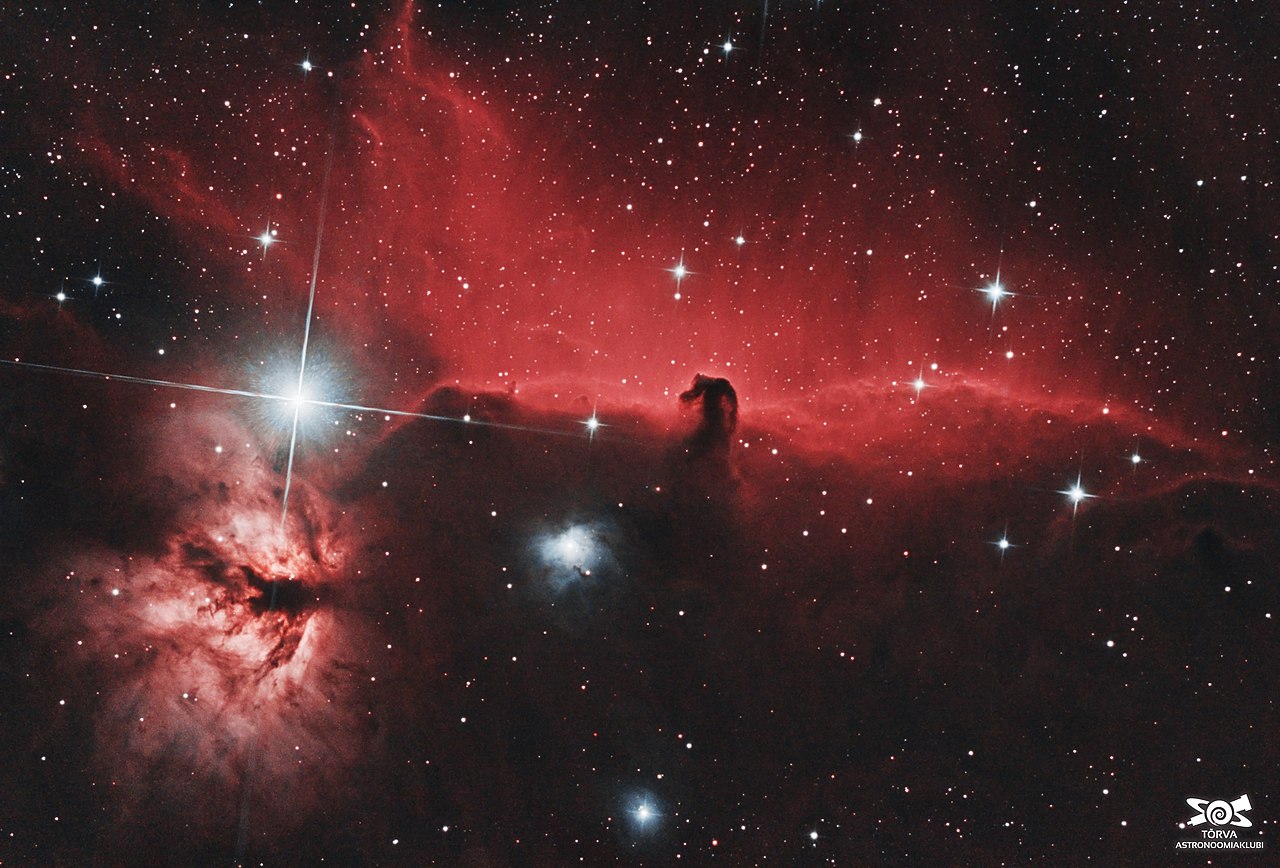
M78 and reflection nebulae
M78 is a bright reflection nebula northeast of Orion’s Belt, illuminated by embedded B-type stars. In small telescopes it appears as a hazy patch with a stellar core; longer exposures show swirls and lanes of dust. The broader Orion region is rich with reflection nebulae where interstellar dust scatters the light of nearby stars, creating blue-tinged patches in images. These subtle glows are excellent targets for wide-field imaging sessions described in Astrophotography Planning for Orion.
Together, these objects highlight Orion’s dual identity as both an observational showpiece and a scientific frontier. The Orion Nebula and its surroundings are a cornerstone of our understanding of star formation, informing the physical picture detailed in Inside the Orion Molecular Cloud.
Inside the Orion Molecular Cloud: Star Formation and Feedback
The Orion Molecular Cloud (OMC) is one of the Milky Way’s nearest and most intensively studied star-forming complexes. It spans hundreds of light-years and is divided into several major components, often labeled Orion A and Orion B. Orion A includes the famous Orion Nebula (M42) and the L1641 region to the south, while Orion B encompasses areas around the Belt stars, including dense clouds near NGC 2024 (the Flame Nebula) and the Horsehead region. These giant molecular clouds are composed primarily of cold molecular hydrogen (H2) mixed with dust, traced observationally by emissions from molecules like carbon monoxide (CO) and by dust continuum at infrared to submillimeter wavelengths.

Star formation in the OMC proceeds in clusters and filaments. Gravitational instabilities cause parts of the cloud to collapse, forming dense cores that give birth to protostars. Young stellar objects evolve through stages—Class 0 to Class III—marked by different spectral energy distributions as they accrete material, launch jets and outflows, and eventually shed their envelopes. The Trapezium Cluster in M42 is a prime example of a young, massive cluster whose radiation and stellar winds sculpt the surrounding gas, creating ionization fronts, pillars, and photoevaporative flows. Observations across the spectrum—from radio maps of molecular lines to infrared surveys by space telescopes—have revealed hundreds to thousands of these young objects embedded across Orion’s filaments.
Feedback from massive stars plays a central role. Intense ultraviolet radiation ionizes hydrogen, producing H II regions (glowing emission nebulae) and driving photoevaporation of surrounding gas. Stellar winds and supernovae from previous generations of massive stars compress nearby clouds, possibly triggering sequential star formation. Large-scale structures like Barnard’s Loop and the Orion–Eridanus superbubble highlight how multiple episodes of feedback carve cavities in the interstellar medium. The superbubble extends well beyond the constellation’s visible stars and contains hot, diffuse gas traced by X-ray and radio observations.

Why does this matter for observers? Understanding the physics in Orion explains the variety you see through the eyepiece and in images: bright emission arcs near the Trapezium, dark globules silhouetted against glowing gas, and reflection nebulae illuminated by nearby blue stars. When you point a telescope at M42, you’re not just seeing “a cloud”; you’re witnessing a dynamic environment in which gravity, radiation, magnetic fields, and turbulence shape the birth of stars and planetary systems. This scientific context enriches practical observing covered in Backyard Observing Tips and imaging approaches in Astrophotography Planning for Orion.
Backyard Observing Tips: Binoculars, Telescopes, and Filters
Orion offers something compelling at every scale of equipment and experience. Whether you’re stepping outside for a five-minute sky tour or planning an all-night session, these practical tips can elevate your viewing:
With the naked eye
- Identify the Belt, then locate Betelgeuse and Rigel to appreciate the color contrast. Slightly defocus your eyes to enhance color perception.
- Under dark skies, look for the faint glow in the Sword—that’s M42. If you can see it with the naked eye, conditions are promising for deeper views with optics.
- Use Orion as a signpost: extend the Belt to find Sirius and Aldebaran for an impromptu sky tour.
Binoculars (7×50, 10×50, or 15×70)
- Scan the Sword at low power to pick out the Trapezium’s glow within M42 and the smaller M43 to the north.
- Try M78 as a soft patch northeast of the Belt, and sweep around Sigma Orionis near Alnitak for scattered clusters and nebulosity.
- From very dark sites, attempt the large arc of Barnard’s Loop as an extremely faint, diffuse glow with wide-field binoculars; this is challenging and often more a photographic target.
Small to medium telescopes (80–200 mm aperture)
- M42 rewards low to medium magnifications. Start around 30–60× to frame the wings, then increase to 100–150× to inspect the Trapezium. With steady air, try to split the fainter E and F components of the Trapezium with apertures of 100–150 mm or larger.
- Rigel is a beautiful double—use 100–150× to tease out the companion, and wait for moments of steady seeing.
- Near Alnitak, look for the Flame Nebula (NGC 2024) as a bright patch with dark lanes at low power, and note the bright star’s glare—it can reduce contrast.
Large telescopes (200 mm+)
- Horsehead Nebula (B33): Use a H-beta filter under dark, transparent skies. Low to moderate power provides the best contrast. This is primarily a challenge object—patience and averted vision are your allies.
- Explore faint reflection nebulae around M78 and complex filaments near NGC 2024 and the Running Man. Narrowband filters can help, though reflection nebulae often benefit most from dark skies rather than filters.
Filters and techniques
- UHC or O III filters boost emission nebula contrast in M42 and M43, enhancing the bright arcs and suppressing skyglow.
- H-beta filters can be decisive for the Horsehead and help with very faint hydrogen emission structures.
- Preserve night vision by avoiding bright phone screens; use a red-light mode if available.
- Allow dark adaptation for at least 20–30 minutes for faint nebulae, and use averted vision to detect subtle details.
If you’re planning a multi-object tour, consider structuring your route: start with bright showcase items (M42/M43), then move to intermediate challenges (M78, Running Man), and finish with the extreme objects (Horsehead, Barnard’s Loop) once your eyes are fully dark-adapted. Cross-reference with How to Find Orion to align your timing with Orion’s altitude for best results.
Astrophotography Planning for Orion: Lenses, Filters, and Workflows
Orion is a dream target for astrophotographers, from beginners shooting fixed-tripod wide fields to advanced imagers capturing narrowband mosaics. With careful planning, you can produce striking results even from suburban skies. Here’s how to approach Orion imaging across skill levels:
Wide-field and fixed-tripod imaging
- Targets: The Belt and Sword, Orion Nebula (M42), Running Man, Flame, and portions of Barnard’s Loop with longer integrations.
- Lenses: 24–85 mm on full-frame (or 16–50 mm APS-C) capture the constellation context. For tighter fields around the Belt and Sword, 85–135 mm works well.
- Settings: Use the NPF rule or a 500-based rule-of-thumb to limit star trailing on a fixed tripod. For example: 24 mm at f/2–f/2.8, ISO 1600–3200, 8–15 seconds per sub, stacked in post.
- Processing: Stack many short exposures to improve signal-to-noise. Apply gradient reduction for light pollution, gentle color calibration, and star reduction to emphasize nebulosity.
Tracked wide-field and telephoto
- Mount: A star tracker allows longer exposures and lower ISO, bringing out faint structures like IC 434 and Barnard’s Loop.
- Lenses/Telescopes: 135–300 mm primes are popular. Small refractors (e.g., 60–80 mm f/5–f/7) give a sharp, rich field around M42 and the Belt region.
- Filters: From light-polluted sites, consider dual- or tri-band narrowband filters tailored for emission lines (H-alpha, O III) to isolate nebulae while keeping stars manageable.
- Targets: Belt region framing Flame and Horsehead; Sword region featuring M42/M43 and Running Man in a single field.
Deep-sky telescopic imaging
- Optics: Short focal ratio refractors excel for wide nebula fields. Larger reflectors let you resolve fine structure in M42 but demand excellent tracking and seeing.
- Acquisition: Calibrated datasets with bias, dark, and flat frames are essential. Dither between sub-exposures to reduce pattern noise, and monitor guiding carefully.
- Narrowband: Ha/OIII/SII imaging separates emission components. A bi-color (Ha/OIII) approach can produce striking contrast, while a tri-band SHO palette maps ionization zones.
- Dynamic range: The Trapezium core in M42 saturates quickly. Use high dynamic range strategies—short exposures for the core blended with long exposures for faint wings.
Composition and planning
- Framing: Align the Belt diagonally for dynamic composition; include Rigel and the Witch Head Nebula region in very wide fields (the Witch Head lies outside Orion but makes for a compelling Orion-adjacent composition from dark sites).
- Moon phase: Emission nebulae tolerate some moonlight with narrowband filters, but broadband reflection dust suffers—plan around new Moon for best results.
- Transparency and seeing: Orion’s nebulae are high-contrast structures; prioritize transparent nights for wide-field and good seeing for high-resolution core details.
As you iterate on processing, compare results across filters and color maps to emphasize different physical components (ionized hydrogen vs. doubly ionized oxygen). For specific framing, revisit Orion’s Nebulae and Deep-Sky Objects and plan mosaics to cover multiple targets in a cohesive field.
Cultural History and Mythology of Orion Across the World
Orion’s distinctive pattern has inspired stories across cultures for millennia. In Greco-Roman tradition, Orion is a mighty hunter, often depicted pursuing the Pleiades (in Taurus) or battling the bull. The constellation’s bright stars made it a seasonal marker for navigation and agriculture, with heliacal risings and settings signaling changes in weather cycles for ancient observers.
A sampling of global perspectives:
- Greek and Roman: Orion the hunter, accompanied by Canis Major (with Sirius) and Canis Minor, framed by Taurus and Gemini along the ecliptic vicinity.
- Egyptian: Ancient associations linked Orion with Osiris in some texts and iconography, reflecting themes of death and rebirth. Orion’s seasonal appearances had ritual and calendrical significance.
- Arabic: The stars of the Belt were known by names like Alnitak and Mintaka, echoing their current common usage; traditional star lore integrated Orion into broader sky navigation systems.
- Maori (Aotearoa New Zealand): The Belt is called Tautoru, a prominent seasonal signpost in the southern skies.
- Norse: Some northern European traditions refer to the Belt as “Frigg’s Distaff” or “Freya’s staff,” weaving Orion into mythic and domestic symbolism.
- Latin American and Iberian traditions: The Belt is sometimes called the “Three Marys” or “Three Kings,” reflecting Christian-era cultural overlays on older constellations.
These varied interpretations underscore how Orion’s obvious geometry transcends language and geography. For modern skywatchers, engaging with this cross-cultural heritage can deepen appreciation during a night out under the stars. Consider coupling cultural stories with a practical tour from How to Find Orion and a deep dive into Major Stars of Orion for a well-rounded experience that blends myth and science.
The Orionid Meteor Shower: When and How to Watch
The Orionid meteor shower is an annual event that peaks around late October, typically between the 20th and 22nd, with activity spanning much of October into early November. The Orionids originate from debris left by Comet 1P/Halley. As Earth passes through the stream of meteoroids, fragments burn up in the upper atmosphere, producing swift meteors that often leave persistent trains.
Practical considerations for observing the Orionids:
- Radiant location: Near Orion, roughly north of Betelgeuse. You don’t need to stare at the radiant; watch a wide region of sky 40–60° away for longer meteor trails.
- Peak rates: The Zenithal Hourly Rate (ZHR) often hovers around 20 meteors per hour under dark skies, though actual rates vary with observing conditions and radiant altitude.
- Timing: Best after midnight to pre-dawn when the radiant is higher. Give your eyes 20–30 minutes to dark-adapt.
- Setup: Lie back in a reclining chair with a wide view. Avoid bright screens; log counts if you’re contributing to citizen science projects.
Because Orion is prominent during the Orionid season, a combined outing—meteor watching and a binocular tour of M42—can make for a gratifying autumn session. Check the Moon phase; a gibbous or full Moon will substantially reduce meteor counts and wash out faint deep-sky detail.
Frequently Asked Questions
Is Betelgeuse about to explode as a supernova?
Betelgeuse is a red supergiant nearing the end of its life, and it will eventually undergo a core-collapse supernova. However, “eventually” in stellar terms can mean tens of thousands to more than a hundred thousand years. The unusual dimming of 2019–2020 was investigated extensively and appears to have been caused largely by dust formed from a surface mass ejection, combined with changes in the star’s extended atmosphere, rather than an immediate precursor to explosion. In short, it is an exciting object to monitor, but there’s no evidence that a supernova is imminent.
Can I see the Horsehead Nebula with a small telescope?
The Horsehead Nebula (Barnard 33) is a challenging visual target, even for experienced observers. It is a dark nebula silhouetted against the emission background of IC 434, so you’re looking for a subtle notch of darkness rather than a luminous cloud. Conditions must be excellent: very dark skies, steady transparency, and a telescope typically 200 mm (8 inches) or larger. A narrowband H-beta filter can make a decisive difference by enhancing the contrast of the background emission. In contrast, the Horsehead is much easier to capture in astrophotographs, particularly using hydrogen-alpha filters and long exposures.
Final Thoughts on Exploring the Orion Constellation
Orion is the consummate all-level constellation: it offers easy recognition for beginners, bright showpieces like M42 for casual observers, and a lifetime of detail for dedicated amateurs and imagers. The juxtaposition of evolved giants like Betelgeuse and Rigel with the youthful glow of the Orion Nebula makes it both visually dramatic and scientifically profound. Add in the photogenic structures near Alnitak—the Flame and Horsehead—and the reflection patches around M78, and you have a seasonal sky-tour that never grows old.

As you plan your sessions, revisit How to Find Orion for timing and altitude, use Backyard Observing Tips to match targets to your equipment, and consult Astrophotography Planning for Orion if you’re capturing images. On moonless, transparent nights, sweep the Sword slowly and let averted vision pull out delicate arcs and lanes in M42; on bright nights, focus on stellar color contrasts and double-star splits. If you observe over multiple months, note how Orion shifts earlier each evening, and—if you’re a variable-star enthusiast—track Betelgeuse’s subtle changes.
For more deep-sky guides and seasonal planning tools, explore related constellation articles and subscribe to our newsletter. We publish practical observing tips, science explainers, and equipment walkthroughs timed to the night sky, so your next clear night can be your best one yet.