Table of Contents
- What Is Numerical Aperture in Microscopy?
- How Numerical Aperture Controls Resolution and Contrast
- Diffraction, Abbe Limit, and Rayleigh Criterion Explained
- Depth of Field vs. Depth of Focus: How NA Shapes 3D Clarity
- Illumination, Condenser NA, and Matching for Brightfield and Darkfield
- Immersion Media, Refractive Index, and Working Distance Trade-offs
- Digital Sampling, Pixel Size, and Nyquist in Microscopy
- Selecting Objectives by NA for Different Specimens and Techniques
- Common Misconceptions About Magnification, NA, and Resolution
- Practical Calculations and Back-of-the-Envelope Estimates
- Diagnosing Resolution Limits: NA, Aberrations, and Alignment
- Frequently Asked Questions
- Final Thoughts on Choosing the Right Numerical Aperture for Your Microscopy
What Is Numerical Aperture in Microscopy?
Numerical aperture (NA) is one of the most important specifications on any microscope objective and condenser. It quantifies the range of angles over which the lens can accept or emit light and, as a result, governs the system’s resolving power, brightness, contrast, and tolerance to focus errors. The NA of an objective is printed on the barrel (for example, 10×/0.25, 40×/0.65, 60×/1.4 oil), but what it means is often misunderstood.

In its simplest form, numerical aperture is defined by:
NA = n · sin(θ)
where n is the refractive index of the medium between the coverslip and the objective front lens (air ≈ 1.0, water ≈ 1.33, standard immersion oil ≈ 1.515), and θ is the half-angle of the maximum cone of light accepted by the objective.
Key takeaways that guide the rest of this article:
- Higher NA increases resolving power and Light collection (brightness scales roughly with the square of NA under matched illumination).
- Higher NA reduces depth of field, producing a shallower in-focus region in the specimen.
- NA depends on refractive index: changing from air to water or oil can increase NA substantially—provided the lens is designed for that medium.
- Condenser NA matters too. In transmitted-light modalities like brightfield or darkfield, the illumination cone set by the condenser directly influences resolution and contrast.
Understanding NA turns a label on a lens into a powerful predictor of how the microscope will perform, especially when paired with correct illumination and camera sampling. In the following sections, we connect NA to resolution, contrast, depth of field, and practical choices you make at the bench or in the classroom.
How Numerical Aperture Controls Resolution and Contrast
Resolution describes the minimum distance at which two points can be distinguished as separate. In optical microscopy, resolution is constrained by diffraction. Numerical aperture is the lever that lets us squeeze more spatial detail through this diffraction limit.
A commonly used estimate for lateral (xy) resolution in widefield microscopy is the Rayleigh criterion:
d_xy ≈ 0.61 · λ / NA

where λ is the wavelength of light in the specimen medium (often taken as the vacuum wavelength for practical approximations), and NA is the objective’s numerical aperture. This simple relation captures two practical truths:
- Shorter wavelengths resolve finer details (blue/green light resolves better than red).
- Higher-NA objectives resolve finer details than low-NA objectives at the same wavelength.
Contrast—the visibility of features against their background—also depends on how many and which spatial frequencies of the specimen are transmitted by the optical system. Higher NA transmits higher spatial frequencies (finer details) with stronger modulation. In other words, as NA increases, the modulation transfer function (MTF) extends to higher frequencies, improving both resolution and the contrast of small features. Stopping down the system’s aperture (by closing the condenser iris or using a lower-NA objective) reduces the bandwidth of spatial frequencies that pass and can suppress fine detail even if the image looks crisper at low magnification.
Because illumination and condenser NA play a role in what spatial frequencies are available to form the image, resolution in transmitted-light modalities benefits when the condenser NA is matched to the objective NA. This ensures that high-angle illumination can excite high-frequency detail in the specimen that the objective is capable of capturing.
Diffraction, Abbe Limit, and Rayleigh Criterion Explained
Two classical formulations describe resolution in optical systems:
- Abbe limit: for periodic structures in incoherent or partially coherent illumination, the minimum resolvable feature size is often approximated as
d ≈ λ / (2 · NA). This is a heuristic that emphasizes the inverse proportionality to NA. - Rayleigh criterion: for two point sources, the lateral separation at which the principal maximum of one diffraction pattern coincides with the first minimum of the other gives
d ≈ 0.61 · λ / NA.
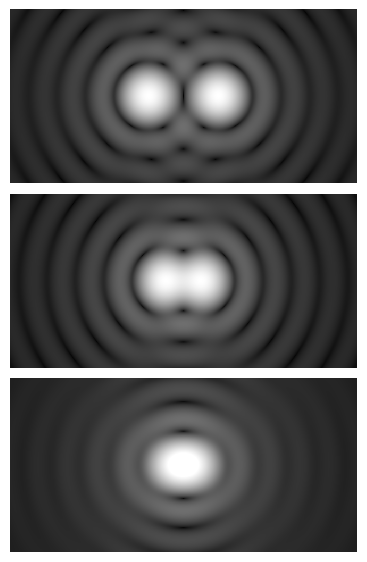
Both capture the essential scaling of resolution with λ/NA, differing mainly by a constant factor due to the chosen criterion and model (points versus periodic gratings). In microscope practice:
- Lateral resolution (xy) is often estimated by
d_xy ≈ 0.61 · λ / NA. - Axial resolution (z), relevant to focus discrimination, scales as
d_z ∝ λ · n / NA²in widefield imaging, highlighting that axial resolution improves strongly (quadratically) with increasing NA.
It is useful to treat these as order-of-magnitude guides. Real-world performance additionally depends on aberrations, sample scattering, alignment, and the optical transfer characteristics of the modality (e.g., phase contrast, DIC, fluorescence). Even so, whenever you ask “Will I see more detail with this lens?” the answer often reduces to “What does the NA allow?”
Rule of thumb: doubling NA (if possible) cuts the lateral diffraction-limited feature size by about half and the axial extent by roughly a factor of four, assuming the same wavelength and good correction.
We return to these scalings when we relate NA to depth of field and to digital sampling.
Depth of Field vs. Depth of Focus: How NA Shapes 3D Clarity
Depth of field (DOF) is the thickness of the specimen region that appears acceptably sharp in the image. It is an object-space measure. Depth of focus, by contrast, is the range in image space (near the camera sensor or eyepiece focal plane) over which the image remains sharp for a fixed object position. Both depend on NA, but in different ways.
For widefield imaging with incoherent illumination, a simple approximation for depth of field combines a diffraction term with a detector-limited term governed by the acceptable blur (circle of least confusion). One commonly used form is:
DOF ≈ (n · λ) / NA² + (n · e) / (M · NA)
where n is the refractive index in object space, λ is wavelength, e is the acceptable blur diameter in the image (camera pixel size can be a practical surrogate), M is the objective magnification, and NA is the objective’s numerical aperture. The first term captures diffraction-limited defocus, and the second captures detection-limited sharpness.
Several clear consequences follow:
- DOF shrinks as NA increases (the
1/NA²dependence in the diffraction term dominates at high NA). - Shorter wavelengths reduce DOF, mirroring the improvement in lateral resolution.
- Higher magnification reduces the detector-limited component by projecting a larger image onto the sensor, tightening sharpness criteria per pixel.
Depth of focus in image space scales differently but also tightens with higher NA. Practically, this means that high-NA objectives are more sensitive to tiny focus errors and mechanical drift. Achieving and maintaining sharp focus, especially in high-NA fluorescence or DIC, often requires stable mechanics and, where available, focus-lock aids. This is not a procedural recommendation; rather, it highlights the sensitivity that NA imposes on the imaging task.
Before changing objectives to “get more resolution,” consider whether you can live with a much thinner DOF. For thick or uneven specimens, the shallow DOF of high-NA optics can make it harder to interpret structures unless you employ techniques that optically or computationally section the sample.
Illumination, Condenser NA, and Matching for Brightfield and Darkfield
The objective is only half of the story. In transmitted-light microscopy, the condenser focuses illumination into the specimen, setting the cone of incident angles. Its NA, adjustable via the condenser iris, determines which spatial frequencies in the specimen can be excited and subsequently relayed by the objective.
Core principles that help you get the most from your lenses:
- Match the condenser NA to the objective NA for brightfield when the goal is maximum resolution and even illumination. As a heuristic, set the condenser iris so the effective condenser NA is close to (or modestly below) the objective NA. This supplies the high-angle illumination needed to generate fine detail in the specimen that the objective can collect.
- Stop down the condenser iris to boost contrast on low-contrast, thick, or scattering specimens. Stopping down reduces the range of illumination angles, suppresses glare and stray high-frequency detail, and increases depth cues. The cost is a loss in fine resolution and brightness.
- Darkfield in transmitted light requires that direct illumination not enter the objective. A central stop or dedicated darkfield condenser delivers a hollow cone of light at angles such that unscattered rays bypass the objective aperture while scattered light is captured. In practice, this means the effective condenser NA exceeds the objective NA, ensuring only scattered light contributes to the image.
These relations make more sense in the context of diffraction. If your condenser NA is much smaller than your objective’s NA in brightfield, top-end spatial frequencies that the objective could, in principle, pass are simply never excited in the specimen and so cannot appear in the image.
Illumination uniformity also depends on proper conjugation of field and aperture planes (often referred to as Köhler illumination). While setup specifics vary by microscope, the important idea is that even, angle-controlled illumination supports the objective in reaching its designed performance. If images appear uneven or lack crispness at high NA, one check is whether the condenser iris is appropriately set for the objective and whether the light is evenly distributed across the field.

In reflected-light (epi) modalities, the objective acts as both condenser and imaging lens. There, the effective illumination NA is set by the objective’s own aperture and internal beam-splitting optics, and similar NA-based trade-offs with resolution and DOF apply.
Immersion Media, Refractive Index, and Working Distance Trade-offs
Because NA = n · sin(θ), boosting NA beyond about 0.95 requires using a medium with a refractive index higher than air. Common immersion types are:
- Air: n ≈ 1.0. Practical maximum NA for dry objectives is typically below 1.0 (often up to about 0.95) because
sin(θ)cannot exceed 1, and lens designs must also control aberrations. - Water: n ≈ 1.33. Water-immersion objectives can reach NA around 1.0–1.2. They help mitigate spherical aberration when imaging into aqueous samples, because the immersion medium’s index is closer to that of the specimen and mounting medium.
- Oil: standard immersion oils are formulated near n ≈ 1.515 at visible wavelengths. Oil-immersion objectives commonly achieve NA around 1.3–1.4, offering the highest lateral resolution in conventional widefield imaging.

Working distance—the space between the objective front element and the specimen—typically decreases as NA increases for a given magnification. High-NA oil objectives often have very short working distances and require a coverslip of a specified thickness (often around 0.17 mm, sometimes labeled as “No. 1.5”).
Key trade-offs you should anticipate when selecting immersion type and NA:
- Spherical aberration and refractive-index mismatch: If the immersion medium and the specimen environment differ in refractive index, imaging deeper into the specimen can introduce spherical aberration, broadening the point-spread function (PSF) and reducing contrast. Water immersion can reduce this problem for aqueous samples compared to oil, especially when focusing tens of micrometers into the medium.
- Coverslip thickness sensitivity: Many high-NA objectives are designed for a specific coverslip thickness. Deviations can introduce aberrations. Objectives with a correction collar allow tuning for different coverslip thicknesses and are preferable when thickness varies. See the FAQ for how coverslips interact with NA and resolution.
- Mechanical tolerance: Short working distances make focus more sensitive and increase the risk of contacting the coverslip. This is a practical concern when exploring rough or uneven specimens.
- Specimen compatibility: Some samples or mounting media are not compatible with particular immersion oils. Water immersion offers a gentler interface with watery environments, at the cost of some maximum NA compared to oil.
Ultimately, immersion choice tunes NA and aberration performance simultaneously. When deciding between oil and water immersion for a fine-detail task near the coverslip, oil’s higher NA may win. For imaging deeper into aqueous material, water immersion often yields a more compact PSF and better contrast even if its nominal NA is lower, because reduced spherical aberration preserves the effective resolution.
Digital Sampling, Pixel Size, and Nyquist in Microscopy
A modern microscope’s resolving power is only fully realized if the image is sampled finely enough by the camera. The relevant guideline is the Nyquist sampling criterion: the camera’s effective pixel size in the specimen plane should be small enough to represent the finest resolvable details.
If the camera pixel pitch is p (in micrometers), and the objective’s magnification is M, then the specimen-plane pixel pitch is:
s = p / M
Let d_xy be the diffraction-limited lateral resolution (for example, d_xy ≈ 0.61 · λ / NA). Nyquist sampling calls for at least two samples across the smallest resolvable feature, so a practical rule is:
s ≤ d_xy / 2
Combining these gives the minimum magnification required to meet Nyquist for a given pixel size, wavelength, and NA:
M ≥ p / (d_xy / 2) = (2p) / d_xy = (2p · NA) / (0.61 · λ)
Example for visible light imaging:
- Camera pixel size: p = 6.5 µm
- Objective NA: 1.40 (oil)
- Wavelength: λ = 550 nm = 0.55 µm
Then:
M ≥ (2 · 6.5 · 1.40) / (0.61 · 0.55) ≈ 18.2 / 0.3355 ≈ 54.3×
So a 60×/1.4 oil objective will typically satisfy Nyquist sampling with a 6.5 µm pixel camera under these conditions. If you choose a 40× objective with the same camera, the image may be slightly undersampled for the finest resolvable details at this NA and wavelength.
Important implications:
- Undersampling (too large a specimen-plane pixel pitch) causes aliasing and loss of high-frequency detail. The lens could resolve more than the pixels can represent.
- Oversampling (very small specimen-plane pixel pitch) is acceptable but yields diminishing returns and larger data files, with no gain beyond what the optics can resolve.
- Changing NA changes sampling requirements. Higher NA reduces
d_xyand pushes the required magnification (or smaller pixels) upward to meet Nyquist.
For fluorescence imaging, use the emission wavelength for λ in the calculation, since that light forms the image. For broadband white-light imaging, a representative green value (around 550 nm) is often chosen as a practical middle ground when estimating sampling needs.
If this section seems abstract, cross-check the numbers in the Practical Calculations section, or revisit how NA drives the base resolution in How Numerical Aperture Controls Resolution and Contrast.
Selecting Objectives by NA for Different Specimens and Techniques
Choosing an objective is not just choosing a magnification; it is choosing a numerical aperture and all the optical consequences that come with it. Below are common use contexts and the NA-guided considerations that help you make an informed selection.
Low-NA objectives (e.g., 0.10–0.25, 4×–10×)
- Best for: large-scale overviews, surveying slides, navigating to regions of interest, thick or rough specimens where a larger depth of field is beneficial.
- Advantages: generous depth of field, long working distance, tolerant of minor alignment issues.
- Limitations: restricted lateral resolution. Fine cellular details remain unresolved.
Moderate-NA objectives (e.g., 0.40–0.70, 20×–40× dry)
- Best for: general transmitted-light imaging, many educational and routine applications, moderate-detail features.
- Advantages: balance of resolution, brightness, and working distance; compatible with air (dry) imaging.
- Limitations: limited ability to push toward the diffraction limit; DOF begins to shrink noticeably at the higher end of this range.
High-NA objectives (e.g., 0.80–1.40, 60×–100× water or oil)

- Best for: resolving submicrometer features, high-contrast differential interference contrast (DIC), and high-NA fluorescence imaging near the coverslip.
- Advantages: finest lateral resolution, highest light collection (critical for low-signal imaging).
- Limitations: shallow depth of field, very short working distance, sensitivity to coverslip thickness and refractive-index mismatch. Requires careful attention to condenser matching in transmitted light.
Water vs. oil immersion choice
- Near the coverslip: oil immersion usually provides higher NA and thus finer lateral resolution.
- Deeper into aqueous samples: water immersion often yields better effective resolution because it reduces spherical aberration. Nominal NA is not the only determinant of image sharpness; aberration control matters.
Specialty modalities
- Phase contrast: generally pairs with objectives designed for phase rings. NA still governs resolution, but contrast of transparent, low-absorption specimens is greatly improved without staining.
- DIC (Differential Interference Contrast): benefits from higher NA for enhanced gradient contrast and fine detail. Alignment and matched prisms/condensers are critical for optimal performance.
- Polarized light: NA considerations are similar to brightfield, while the optical elements are specialized for birefringent specimens.
When in doubt, ask: “Which NA gives me the resolution and depth of field I need, with compatible working distance and immersion?” Then confirm that your camera sampling and illumination support that choice.
Common Misconceptions About Magnification, NA, and Resolution
Misconceptions about NA are common. Clearing them helps you predict actual performance rather than relying on magnification numbers alone.
- “More magnification always means more detail.” False. Magnification without sufficient NA is empty magnification—the image looks bigger but contains no additional resolved information. Always anchor expectations to NA, not just magnification.
- “Closing the condenser iris always improves image quality.” Not in general. Stopping down increases contrast and apparent sharpness for low-contrast scenes but reduces the system’s effective NA, limiting fine detail. For highest resolution in brightfield, match the condenser NA to the objective NA as discussed in Illumination and Condenser NA.
- “Oil immersion is always better than water immersion.” Not necessarily. Although oil offers higher nominal NA near the coverslip, water immersion can yield better effective resolution when imaging into aqueous specimens due to reduced spherical aberration. See Immersion Media and Trade-offs.
- “Resolution depends on magnification in the eyepiece or camera adapter.” The optical resolution is set by NA and wavelength. Additional magnification in the tube or adapter does not add optical information; it only changes sampling and display scale.
- “All high-NA lenses perform the same way.” Lens design, coatings, and aberration corrections matter. Two objectives of the same NA and magnification can differ in contrast and field flatness, but their diffraction-limited lateral resolution ceiling is governed by NA and wavelength.
Practical Calculations and Back-of-the-Envelope Estimates
NA turns conceptual when you plug in numbers. The following quick calculations can guide expectations and decisions for typical visible-light scenarios.
Estimating lateral resolution
Using d_xy ≈ 0.61 · λ / NA with λ = 0.55 µm (green light):
- NA = 0.25:
d_xy ≈ 0.61 · 0.55 / 0.25 ≈ 1.34 µm - NA = 0.65:
d_xy ≈ 0.61 · 0.55 / 0.65 ≈ 0.52 µm - NA = 1.00:
d_xy ≈ 0.61 · 0.55 / 1.00 ≈ 0.34 µm - NA = 1.40:
d_xy ≈ 0.61 · 0.55 / 1.40 ≈ 0.24 µm
These values show why a jump from a 40×/0.65 dry objective to a 60×/1.4 oil objective can substantially improve the visible detail—when the sample and imaging chain support it.
Brightness gain with NA
Under matched illumination and collection, image irradiance at the detector scales approximately with the square of NA (other things being equal). As a rough guide:
- Going from NA 0.70 to NA 1.40 increases the theoretical light collection by roughly a factor of
(1.40/0.70)² = 4. - Going from NA 0.40 to NA 0.80 increases collection by a factor of
(0.80/0.40)² = 4.
Real gains depend on transmission, detector quantum efficiency, and illumination coupling, but the NA² scaling explains why high-NA lenses are valuable in low-light conditions.
Axial resolution and DOF
A simple widefield approximation for axial resolution and the diffraction term of DOF is:
d_z (or DOF_diffraction) ∝ (n · λ) / NA²
Thus, increasing NA from 1.0 to 1.4 improves axial discrimination by a factor of about (1.4/1.0)² ≈ 2, not counting other factors. The precise coefficients depend on the chosen definition and imaging modality, but the 1/NA² dependence is a robust trend to keep in mind.
Nyquist sampling example
Using the formula from Digital Sampling with a 4.8 µm pixel camera at 525 nm and NA 1.20:
M ≥ (2 · 4.8 · 1.20) / (0.61 · 0.525) ≈ 11.52 / 0.320 ≈ 36×
A 40× water-immersion lens would therefore be a sensible pairing for critical sampling in this case.
Diagnosing Resolution Limits: NA, Aberrations, and Alignment
When images fail to meet expectations, it is tempting to blame the camera or software. Often, the bottleneck sits earlier in the optical chain. A systematic, NA-centered view can help diagnose issues without resorting to trial-and-error.
Start with the physics budget
- Check the NA on the objective: Does it support the spatial detail you expect at the wavelength you are using? Refer back to Practical Calculations to estimate the lateral resolution.
- Confirm condenser settings (for transmitted light): Is the condenser iris adjusted to provide an effective NA near the objective’s NA for high-resolution brightfield? If resolution looks suppressed, a too-small condenser aperture is a common culprit. See Illumination and Condenser NA.
- Consider immersion and index matching: Are you using the correct immersion medium for the objective? If imaging into aqueous samples with an oil lens, spherical aberration may be broadening the PSF, particularly away from the coverslip. See Immersion Media.
Assess aberrations and alignment
- Coverslip thickness: For high-NA lenses, deviations from the specified coverslip thickness can introduce spherical aberration that degrades resolution and contrast. Objectives with correction collars are designed to compensate over a small range of thicknesses.
- Field uniformity: Uneven illumination or vignetting can mask high-NA performance near the field edges. Verify uniformity and center alignment of the illumination field.
- Contamination and damage: Dust, oil residues, or minor scratches on the front element have outsized effects on high-NA objectives due to steep ray angles. Cleanliness and careful handling preserve performance.
Camera and sampling
- Nyquist mismatch: If the camera undersamples, the lens may resolve details that the sensor cannot capture faithfully. Check the sampling calculation in Digital Sampling.
- Contrast transfer: Even when sampled correctly, low contrast near the resolution limit can make details difficult to see without proper exposure and noise control. Higher NA helps by transferring higher spatial frequencies with stronger modulation.
This diagnostic mindset prioritizes NA and its corollaries (illumination, aberrations, sampling) before more complex explanations.
Frequently Asked Questions
Does a higher NA always mean better images?
Higher NA increases potential resolution and light collection, both of which are desirable. But whether the image looks better depends on context:
- Depth of field shrinks as NA rises, which may hinder interpretation in thick or uneven specimens.
- Aberration sensitivity increases, especially regarding coverslip thickness and refractive-index mismatch. Misalignment or mismatched immersion can negate NA gains.
- Sampling must keep up. If your camera undersamples, you may not benefit from the extra optical resolution. See Digital Sampling.
In short, higher NA expands the optical performance ceiling, but the rest of the system—specimen, illumination, and detection—must be aligned to realize the benefit.
How does cover glass thickness affect NA and resolution?
Many high-NA objectives are corrected for a specific coverslip thickness (commonly around 0.17 mm). If the actual thickness deviates significantly, spherical aberration can arise, broadening the PSF and reducing contrast and resolution. This does not change the nominal NA printed on the objective, but it reduces the effective resolution you can achieve in practice.
Objectives with a correction collar allow you to compensate for modest deviations in coverslip thickness and, in some cases, refractive-index differences between mounting media and immersion media. For the best performance at high NA, use coverslips within the specified thickness class and, where applicable, tune the collar while observing a fine-structure specimen or focus metric.
Final Thoughts on Choosing the Right Numerical Aperture for Your Microscopy
Numerical aperture is the central specification that translates microscope optics into practical imaging performance. It sets the diffraction-limited resolution, governs how much light your system can collect, and determines how shallow the in-focus region will be. It also shapes illumination strategy and drives the camera sampling required to capture what the optics can deliver. Across this article, we have connected NA to core outcomes:
- Resolution: increases as
1/NAfor lateral detail (e.g.,d_xy ≈ 0.61 · λ / NA) and as1/NA²for axial discrimination. - Brightness and contrast: higher NA collects more light and extends the MTF to finer spatial frequencies; matched condenser NA in brightfield is important.
- Depth of field: shrinks rapidly with NA; plan for shallow DOF at high NA.
- Sampling: to meet Nyquist, ensure the specimen-plane pixel size is ≤ half the optical resolution. Adjust magnification or choose a camera accordingly.
- Immersion and aberrations: choose oil vs. water immersion based on specimen environment and imaging depth; respect coverslip thickness specifications and use correction collars where available.
When selecting objectives, resist the temptation to think in magnification alone. Instead, decide the NA you need for the smallest features of interest, ensure your illumination supports it, and verify that your camera samples it. This NA-centric approach leads to consistent, physically grounded choices for both educational and advanced imaging tasks.
If you found this deep dive useful, explore related fundamentals such as illumination strategies and sampling theory, and consider subscribing to our newsletter for future articles that build on these optical principles.