
Table of Contents
- What Is the Orion Constellation and Why It Matters to Stargazers
- How to Find Orion in the Night Sky from Any Latitude
- Key Stars of Orion: Betelgeuse, Rigel, Bellatrix, and Saiph
- Deep-Sky Treasures in Orion: M42, the Running Man, and Barnard’s Loop
- Stellar Physics in Orion: Red Supergiants, Blue Supergiants, and Star Formation
- Myths, Etymology, and Cultural Astronomy of Orion
- An Observing Guide: Star-Hopping, Binocular Targets, and Seasonal Visibility
- Betelgeuse’s Brightness Variations and the 2019–2020 Dimming
- Astrophotography Tips for Capturing Orion’s Nebulae and Asterisms
- Frequently Asked Questions
- Final Thoughts on Exploring the Orion Constellation
What Is the Orion Constellation and Why It Matters to Stargazers
The Orion constellation is among the most recognizable patterns in the night sky. Dominated by a striking hourglass figure and a distinctive three-star Belt, Orion sits astride the celestial equator, making it visible from nearly every inhabited part of Earth. This broad visibility, coupled with its bright supergiant stars and rich star-forming regions, makes Orion a gateway constellation for new observers and a continuing source of scientific insight for astronomers.
Beyond its visual appeal, Orion hosts an entire ecosystem of stellar evolution in action. Within its boundaries lie newborn stars cocooned in nebulae, massive blue-white supergiants nearing the ends of their lives, and a vast complex of molecular clouds fueling the next generation of suns and planets. The Orion Molecular Cloud Complex is one of the nearest massive star-forming regions to Earth, and it underpins much of what we know about how stars and planetary systems come to be. If your interest lies in stellar physics and star formation, Orion is a natural laboratory. If you want to learn to star-hop and plan observations, Orion’s bright landmarks are perfect guides. And if you’re eager to photograph your first nebula, the Orion Nebula (M42) is an ideal starting point for astrophotography.
Artist: Rochus Hess
Because Orion straddles the celestial equator, it acts like a seasonal signpost: in the Northern Hemisphere, it heralds winter evenings; in the Southern Hemisphere, it crowns late-spring and early-summer skies. Many cultures have woven rich stories around it, which you can explore in Myths, Etymology, and Cultural Astronomy of Orion. Whether you’re a casual skywatcher or building a deeper observing practice, Orion gives you both a spectacular view and a roadmap to the sky.
How to Find Orion in the Night Sky from Any Latitude
Orion’s fame comes in part from how easy it is to locate, even under suburban skies. The key is to start with Orion’s Belt: three nearly straight-line stars of similar brightness that cut across the constellation’s center. From there, the rest of the figure falls into place as an elongated hourglass shape with bright stars on its corners.
Seasonal timing and visibility
- Northern Hemisphere: Best seen on evenings from late fall through winter (roughly November to February), highest around midnight in December and January.
- Southern Hemisphere: Prominent in late spring to summer evenings (approximately December to March), with Orion standing high in the north.
- Equatorial regions: Orion passes nearly overhead; the Belt often runs nearly east-west.

Artist: Rogelio Bernal Andreo
Because it lies along the celestial equator, Orion rises due east and sets due west. If you’re observing in mid-evening in December from the Northern Hemisphere, look toward the southeast and scan for the Orion Belt. From southern latitudes, look to the northeast.
Using the Belt as a celestial signpost
- Follow the Belt downward (southeastward in the Northern Hemisphere) to find the spectacular Orion Nebula (M42) hanging as a misty patch in Orion’s Sword. Learn more in Deep-Sky Treasures in Orion.
- Trace a line from the Belt upward and left (northeast) to reach the bright red supergiant Betelgeuse and downward and right (southwest) to find the brilliant blue-white Rigel. We detail these stars in Key Stars of Orion.
- Extend the Belt’s line northwest to find the V-shaped Hyades and bright Aldebaran in Taurus, and further to the Pleiades (M45). These are beyond Orion but helpful for broader sky navigation.
Orientation cues
The orientation of Orion flips depending on your hemisphere and time of night. In the early evening in the Northern Hemisphere, Orion often appears leaning to the southeast; by midnight, it stands upright. In the Southern Hemisphere, Orion may appear inverted, with the Belt tilted differently. Over a single night, the constellation’s tilt changes as the Earth rotates, but the Belt remains your easiest anchor to re-orient yourself.
Tip: If you can’t immediately pick out the Belt, look for a small group of three close-together stars set against a relatively sparse region of sky. Even in modest light pollution, those three points stand out. Once you find them, jump down to the Sword and you’ll see a faint, foggy patch—your first look at M42.
Key Stars of Orion: Betelgeuse, Rigel, Bellatrix, and Saiph
Orion’s outline is anchored by four bright stars forming a skewed rectangle: Betelgeuse (Alpha Orionis) and Bellatrix mark the shoulders, while Saiph and Rigel mark the knees. Across the middle runs the three-star Belt: Alnitak, Alnilam, and Mintaka. Each star offers a window into a distinct stage of stellar evolution and composition.
Betelgeuse (Alpha Orionis)
- Type: Red supergiant, spectral type roughly M1–M2
- Distance: Approximately on the order of 500–700 light-years (modern measurements continue to refine this value; many analyses place it around ~550 light-years, with uncertainties)
- Brightness: Typically among the top ten brightest stars; its brightness varies naturally over time
Betelgeuse is in a late stage of stellar evolution, having expanded enormously after exhausting core hydrogen. Its photosphere is dynamic, with large convective cells, surface activity, and mass ejections that contribute to circumstellar dust. For a detailed look at its brightness changes, see Betelgeuse’s Brightness Variations.
Rigel (Beta Orionis)
- Type: Blue-white supergiant, spectral type around B8 Ia
- Distance: Roughly 800–900 light-years
- Notable: Slightly variable; part of a multiple star system with a faint companion detectable in larger amateur telescopes
Rigel is a massive, hot star shining tens of thousands of times brighter than the Sun in visible light. It is a young, short-lived object compared to sunlike stars, and its powerful radiation and stellar winds influence the gas and dust in its vicinity.
Bellatrix (Gamma Orionis)
- Type: Blue giant, roughly B2 III
- Distance: On the order of a couple hundred light-years (commonly cited around ~240–250 light-years)
- Role: Marks Orion’s left shoulder (for a viewer in the Northern Hemisphere)
Bellatrix’s name means “female warrior” in Latin, a modern reinterpretation of Arabic star names. Its blue color reveals a surface much hotter than the Sun’s. Though less massive than Rigel, it is still a luminous, evolved star compared to the Sun.
Saiph (Kappa Orionis)
- Type: Blue supergiant, often classified around B0.5 Ia
- Distance: Several hundred to on the order of ~700 light-years
- Role: Marks Orion’s right knee
Saiph is frequently overlooked because Rigel steals attention in that corner of the constellation, but Saiph’s own luminosity and temperature are considerable. Its name derives from an Arabic term that can relate to a sword or brightness.
The Belt: Alnitak, Alnilam, Mintaka
- Alnitak (Zeta Orionis): A multiple star system including a hot O-type primary; associated with the Flame Nebula and the Horsehead Nebula region.
- Alnilam (Epsilon Orionis): The center and typically the brightest of the Belt stars; one of the more distant naked-eye stars in Orion.
- Mintaka (Delta Orionis): A multiple system; its orientation makes it a handy reference—near the celestial equator—with components resolvable in larger amateur scopes.
The Belt stars are all very luminous and relatively distant compared to many other bright stars. Modern parallax measurements (including data from the Gaia mission) continue to refine their distances, which range roughly from hundreds to a couple thousand light-years. If you’re planning a binocular tour, note that the area around Alnitak is especially rich with emission and dark nebulae; you can jump directly there from An Observing Guide.
Other notable stars and groupings
- Meissa (Lambda Orionis): Marks Orion’s “head” and is part of the Lambda Orionis ring of gas and dust.
- Sigma Orionis: A multiple star system near the Horsehead Nebula; interesting for small telescopes and an anchor for star-forming studies.
- The Trapezium (Theta1 Orionis): A tight group of young, hot stars at the heart of the Orion Nebula; central to understanding early stellar evolution.
Deep-Sky Treasures in Orion: M42, the Running Man, and Barnard’s Loop
Orion’s deep-sky objects, centered around the Orion Molecular Cloud Complex, are among the most studied and photographed in the sky. They span emission, reflection, and dark nebulae, as well as embedded clusters where star birth is ongoing.
The Orion Nebula (M42) and the Trapezium
- Type: Emission nebula and H II region
- Distance: Roughly 1,300–1,400 light-years
- Coordinates (approx.): RA 05h 35m, Dec −05° 23′
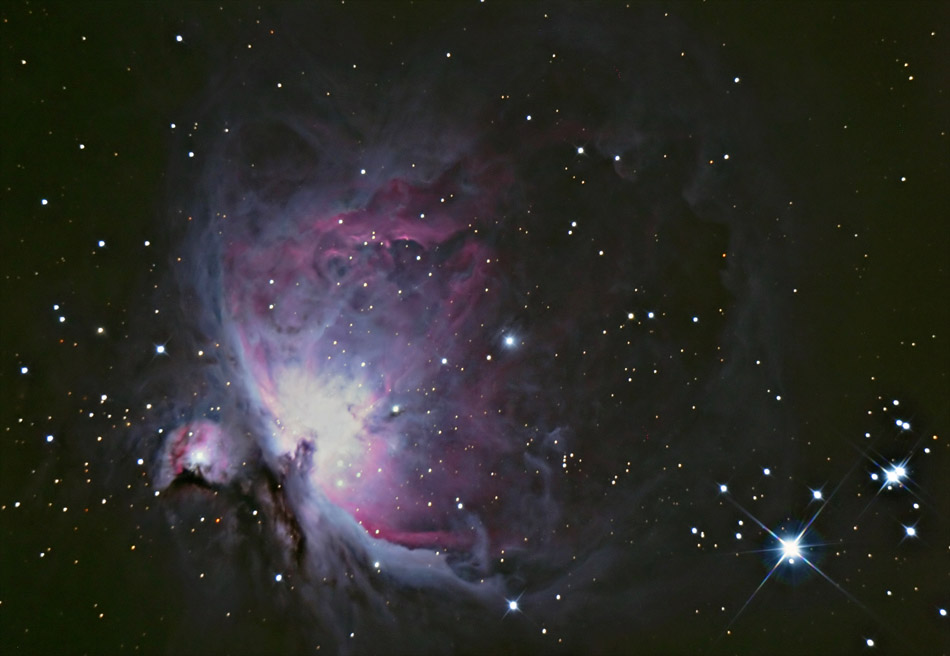
M42 is visible to the unaided eye as a diffuse patch; binoculars reveal a winged shape of nebulosity, and small telescopes show complexity increasing with magnification and steady seeing. At its core, the Trapezium Cluster illuminates the nebula and sculpts its cavities with intense radiation and stellar winds. The Orion Nebula is a cornerstone for studies of star formation, including protoplanetary disks (proplyds), jets, and Herbig–Haro objects. If you’re new to deep-sky observing, M42 is an ideal first target for learning the interplay of aperture, magnification, and surface brightness. For imaging considerations, see Astrophotography Tips.

Artist: NASA, ESA, M. Robberto (Space Telescope Science Institute/ESA) and the Hubble Space Telescope Orion Treasury Project Team
NGC 1977: The Running Man Nebula
Just north of M42 lies NGC 1977, a reflection nebula that appears as a softer, bluish glow around young stars. In photographs, dust lanes and bright regions give the impression of a running human figure—hence the nickname. The Running Man is often captured in wide-field shots together with M42 and M43.
Horsehead Nebula (Barnard 33) and the Flame Nebula (NGC 2024)
East of the Belt star Alnitak, the bright emission nebula IC 434 forms a glowing backdrop; silhouetted against it is the famous Horsehead Nebula, a dark nebula cataloged as Barnard 33. Nearby, the Flame Nebula (NGC 2024) is a striking region with dark rifts; it is also ionized in part by nearby hot stars. While the Horsehead is notoriously difficult visually under most urban skies, it is a rewarding challenge from dark sites with large apertures and appropriate narrowband filters.

The image is a frame mosaic taken with 5 different filters, standard Red – Green – Blue with details enhanced with narrowband data of Hydrogen-alpha (Hα) and O III. The Hα was color-mapped to red and the O III to teal. So it is a representative color image consisting of over 900 minutes of exposure time.
Artist: Ken Crawford
Barnard’s Loop and the Orion-Eridanus Superbubble
Barnard’s Loop is a vast, faint arc of hydrogen emission encircling much of Orion. It is believed to be part of a larger superbubble structure (sometimes referred to as the Orion–Eridanus superbubble) carved by stellar winds and supernova activity over millions of years. The Loop is rarely visible visually without specialized equipment, but it shows up in wide-field, long-exposure images, often framing Orion’s entire figure with a subtle red arc.

The field of view is 50° × 39°. Equatorial center coordinates are RA=4h36m and DEC=3°. North is up.
Artist: SimgDe
The Orion Molecular Cloud Complex
Spanning hundreds of light-years, the Orion Molecular Cloud Complex contains multiple star-forming subregions, including the Orion A and B molecular clouds. The Orion Nebula region (part of Orion A) is an active nursery for low- and high-mass stars, while areas around the Belt (notably near Alnitak and Alnilam) provide laboratories for understanding how massive stars interact with their environment. The complex hosts embedded clusters, protostellar objects, and bright-rimmed clouds shaped by ultraviolet radiation from massive stars in the OB associations. Explore how these structures tie into stellar lifecycles in Stellar Physics in Orion.
Stellar Physics in Orion: Red Supergiants, Blue Supergiants, and Star Formation
Orion is an astronomical classroom where different stages of the stellar life cycle are on display at a single glance. Its bright corners and misty sword reveal massive-star evolution and the complex interplay between radiation, winds, and interstellar clouds.
Massive stars and short lifespans
Stars like Rigel and the Belt stars are massive compared to the Sun. High mass means higher core pressures and temperatures, which dramatically accelerate nuclear fusion. As a result, these stars live fast and die young—on timescales of millions (not billions) of years. They rapidly evolve into luminous supergiants and end their lives in core-collapse supernovae, seeding the interstellar medium with heavy elements.
Red supergiants and variability
Betelgeuse exemplifies the red supergiant phase. After exhausting core hydrogen, such stars burn heavier elements in shells, expand to enormous radii, and cool at their surfaces, giving them a red hue. Their outer layers are unstable, with large convective cells and pulsations that cause brightness variations. Mass loss enriches surrounding space with dust and molecules, which can later assemble into new stars and planets. We discuss Betelgeuse’s notable 2019–2020 dimming in Betelgeuse’s Brightness Variations.
H II regions and photodissociation
The Orion Nebula (M42) is a classic H II region, where ultraviolet radiation from hot, young stars ionizes hydrogen, causing it to glow in characteristic emission lines (notably H-alpha). Surrounding M42, you’ll also find photodissociation regions (PDRs), where far-ultraviolet light influences chemistry, breaking molecular bonds and driving complex reactions in gas and dust. Observations across the spectrum—radio, infrared, optical, ultraviolet—reveal different facets of this environment. Recent infrared observations, including those from advanced space telescopes, have offered detailed looks at the Orion Bar (a bright PDR), mapping molecules and dust properties that help test models of interstellar chemistry.
OB associations and triggered star formation
Massive stars often form in associations—loose groupings of hot O and B stars. In Orion, the Orion OB1 association comprises several subgroups of different ages, spread across the constellation. Their winds and radiation sculpt cavities and compress nearby clouds, potentially triggering new rounds of star formation. Over millions of years, the combined feedback can generate superbubbles like the Orion–Eridanus structure, which in turn shapes the larger interstellar neighborhood.
Protostars, protoplanetary disks, and jets
Embedded within Orion’s clouds are nascent stars and their protoplanetary disks—flattened, rotating structures of gas and dust where planets may form. Observations reveal compact jets and outflows (seen as Herbig–Haro objects) that emerge from accreting protostars, interacting with surrounding gas. In the Orion Nebula, externally photoevaporated disks (often called proplyds) are directly observed, offering key insights into how strong stellar radiation from massive neighbors can erode disks and influence planet formation outcomes.
The role of multiwavelength astronomy
To decode Orion’s astrophysics, astronomers combine data from radio telescopes (tracing cold molecular gas), infrared observatories (probing dust and embedded stars), optical telescopes (revealing ionized gas and young stellar clusters), and X-ray observatories (sensitive to energetic processes). This multiwavelength approach produces a layered understanding of how stars form, evolve, and shape their environments. For practical observing guidance at the eyepiece, see An Observing Guide; for imaging strategies that exploit narrowband filters sensitive to ionized gas, see Astrophotography Tips.
Myths, Etymology, and Cultural Astronomy of Orion
Orion’s prominence has inspired rich mythologies across cultures and epochs. While detailed stories vary, the constellation’s distinct shape and bright stars commonly evoke a figure—often a hunter or warrior.
Classical and Near Eastern traditions
- In Greco-Roman lore, Orion is a mighty hunter. Variations of the myth involve his extraordinary size and strength, encounters with Artemis, and ultimately his placement in the sky.
- Some traditions link Orion with rising or setting times that heralded seasonal changes, such as the onset of winter weather or times favorable for navigation or agriculture.
Arabic star names and medieval astronomy
Many of Orion’s bright stars carry Arabic-derived names—Betelgeuse, Rigel, Mintaka, Alnilam, Alnitak, and Bellatrix (though the latter’s Latin meaning is commonly cited). These names reflect a deep heritage of observational astronomy and translation through medieval scholarship, where Greek, Arabic, and later Latin texts blended to transmit stellar knowledge.
Global cultural perspectives
- In some Indigenous Australian traditions, parts of Orion and its neighboring constellations figure in stories of hunting and seasonal cycles.
- In Mesoamerican and Andean traditions, asterisms in and around Orion can mark agricultural calendars or mythic narratives.
While details differ, a common thread is practical skywatching: Orion’s seasonal visibility and movement across the sky made it a natural clock and compass for pre-telescope cultures. For practical navigation tips using Orion’s Belt (and beyond), jump to How to Find Orion and An Observing Guide.
An Observing Guide: Star-Hopping, Binocular Targets, and Seasonal Visibility
Whether you’re observing with the naked eye, binoculars, or a small telescope, Orion is rich with targets and teaching moments. The steps below offer actionable star-hops and strategies for a productive night out.
Star-hopping pathways
   Betelgeuse (red)           Meissa
         *                      *
          \
           \\             Orion's Belt
            \\           *   *   *  (Mintaka - Alnilam - Alnitak)
             \\            \
              \\            \\  Orion's Sword
               \\            *   (M42 region)
                \\          *
                 \\        *
                  \\    Rigel (blue-white)
- Belt to Sword: Center the Belt in binoculars. Drift gently south (toward Rigel) to a small, linearly arranged cluster—the Sword. The brightest patch is M42. From urban skies, look for a soft glow rather than vivid detail.
- Alnitak to Horsehead region: Place Alnitak at the edge of your field. Slide eastward to see the Flame Nebula as a bright, mottled area. The Horsehead itself is a subtle notch against IC 434; it generally requires dark skies and a hydrogen-beta filter in visual observing.
- Rigel’s companion: With moderate aperture and steady seeing, you can try splitting Rigel. Its close, faint companion can be a satisfying challenge.
- Sigma Orionis cluster: Near the eastern side of the Belt, this multiple-star system and surrounding young cluster region displays different magnitudes and colors in small telescopes.
What to expect with different equipment
- Naked eye: Identify the hourglass, Belt, Sword, and the reddish tint of Betelgeuse compared to the bluish-white of Rigel. From truly dark sites, the Orion Nebula is a subtle fuzzy patch.
- Binoculars (7×50 to 10×50): M42’s core brightens; the Running Man appears as a faint glow north of M42. Wide-field views can hint at the Flame Nebula. Star colors and the density gradient near the Belt become apparent.
- Small telescopes (80–150 mm): The Trapezium resolves into four main components, sometimes more in steady air. Nebular structure in M42 becomes filamentary. With filters, the Flame shows richer contrast; the Horsehead remains a challenge but not impossible from dark sites with larger apertures.
Seasonal altitude and planning
At mid-northern latitudes, Orion culminates (reaches its highest point) around local midnight in early January, making that month ideal for deep-sky detail when Orion is highest and atmospheric distortion is minimized. At mid-southern latitudes, Orion rides high to the north during local summer months. If you’re observing from high latitudes, Orion’s altitude drops but remains visible. Consult a planetarium app to time your session so that M42 is well above 30 degrees altitude for best clarity. For imaging considerations and recommended exposure strategies, see Astrophotography Tips.
Filters and contrast
- UHC/OIII filters: Enhance nebular emission in M42 and the Flame; can also subtly help on faint background H II emission near the Belt.
- H-beta filters: Particularly useful for the Horsehead (B33) against IC 434 in very dark skies.
- Light pollution filters: May help with broadband glow but are less effective than simply seeking darker skies.
Pro tip: Give your eyes time. A 20–30 minute dark adaptation period can transform what you see in M42 from a pale smear to striated wings of nebulosity. Use a dim red light for charts to preserve night vision.
Betelgeuse’s Brightness Variations and the 2019–2020 Dimming
Betelgeuse is a semiregular variable star, meaning its brightness changes over time due to processes in its extended atmosphere and interior. Ordinarily, these variations unfold on timescales of months to years and by modest amounts. However, in late 2019 and early 2020, observers worldwide noted an unprecedented dimming event, with Betelgeuse fading significantly beyond its usual range. This “Great Dimming” sparked intense interest and observations across multiple wavelengths.
What likely happened
Multiple studies suggest that a combination of factors contributed to the event: a sizable surface disturbance and cooling paired with the formation of new dust along our line of sight. Observations captured signatures consistent with mass ejection and subsequent dust condensation that temporarily obscured part of the star. The dimming resolved over months as conditions changed and the dust effect diminished.
What it tells us
- Dynamic envelopes: Betelgeuse’s outer layers are active, with convective motions and episodic mass loss that can produce observational surprises.
- Dust formation: Red supergiants can create dust that affects their apparent brightness and color; this process contributes to the dust budget of the interstellar medium.
- Community science: The event showcased coordinated professional and amateur monitoring, demonstrating the value of long-term, multiwavelength, and multi-epoch datasets.
Despite its advanced evolutionary state, there is no evidence that Betelgeuse is about to go supernova imminently on human timescales. The dimming episode provided a rare real-time look at red supergiant behavior rather than a herald of an immediate explosive end. For a practical take on how to watch Betelgeuse throughout the season, revisit An Observing Guide.
Astrophotography Tips for Capturing Orion’s Nebulae and Asterisms
Few regions reward astrophotographers as richly as Orion. From the expansive glow of Barnard’s Loop to the electric detail of M42’s core, there’s something for every focal length and experience level. The suggestions below are practical starting points; refine them to suit your specific gear and skies.
Choose your framing
- Ultra-wide (14–24 mm full-frame): Capture the entire constellation, potentially including Barnard’s Loop, the Belt, and the Sword. Longer total integration and an H-alpha-sensitive setup help reveal the Loop.
- Wide field (50–135 mm): Frame the Belt and Sword together, highlighting the complex around Alnitak (Flame, Horsehead) and M42/NGC 1977.
- Medium telephoto (200–400 mm): Focus on M42 and the Running Man as a dramatic duo; or isolate the Horsehead/Flame region.
- Long focal length (500–1000+ mm): Resolve Trapezium detail and intricate shock fronts in M42; tease out the dusty structure in the Flame.
Exposure and dynamic range
M42 has extreme dynamic range—its bright core easily saturates while faint outer wings need deep exposure. A common solution is to blend multiple exposure lengths:
- Short subexposures (e.g., 5–30 seconds) to preserve the bright trapezium core.
- Medium subexposures (e.g., 60–180 seconds) for the mid-brightness nebula.
- Long subexposures (e.g., 180–600 seconds, guided) for faint outer arcs and dust.

Artist: Astrofalls
Stack and combine these using high dynamic range (HDR) techniques or masked stretches in your processing workflow. For the Horsehead region, narrowband filters (especially H-alpha and sulfur/oxygen bands for monochrome cameras) can help punch through light pollution and enhance contrast.
Filters and color balance
- Dual- or tri-band filters are helpful with one-shot color (OSC) cameras under urban skies.
- Full narrowband (Hα, O III, S II) enables detailed structure mapping and flexible color palettes with monochrome sensors.
- Infrared-leak control and accurate white balance (or synthetic luminance from narrowband) help manage the intense blue from bright stars like Alnitak and Rigel.
Calibrations and gradients
Because Orion rides through a broad dust complex, gradients are common in wide-field frames. Build solid calibration libraries (darks, flats, bias/flat-darks) and consider background extraction or gradient reduction tools during processing. Star color preservation matters in this region—manage star sizes with deconvolution or morphological transforms, but avoid over-reduction that yields unnatural halos.
Planning tools and timing
- Use a planetarium app to track meridian transit for Orion; shoot when your target is highest.
- Consult clear-sky charts for clouds, seeing, and transparency.
- Mind the Moon phase; narrowband can mitigate lunar glow, but broadband targets like Barnard’s Loop are best on dark, moonless nights.
For visual observers ready to transition to imaging, begin with wide fields and short subs. As your tracking and guiding improve, push focal length and exposure. For a complementary visual plan, circle back to An Observing Guide.
Frequently Asked Questions
Is Betelgeuse about to explode as a supernova?
Betelgeuse is in a late stage of evolution and will eventually end as a core-collapse supernova, but there is no evidence it is imminent on human timescales. The 2019–2020 dimming likely resulted from a combination of surface changes and newly formed dust obscuring our line of sight. While astronomers monitor Betelgeuse carefully, a supernova could still be thousands to hundreds of thousands of years away.
When is the best time to see the Orion Nebula?
The Orion Nebula is best observed on moonless nights when Orion is high in the sky. In the Northern Hemisphere, this typically means late fall through winter evenings, with January offering prime altitude around midnight. In the Southern Hemisphere, look during late spring to summer. For the sharpest view, observe when M42 is above 30 degrees elevation to reduce atmospheric distortion. See How to Find Orion and An Observing Guide for planning details.
Final Thoughts on Exploring the Orion Constellation
Orion is that rare constellation that satisfies at every level. Beginners can learn to navigate by its Belt and Sword, intermediate observers can study double stars and young clusters, and advanced amateurs can chase subtle nebulae and dynamic phenomena like the variability of Betelgeuse. Scientifically, it remains a flagship region for understanding how stars are born, how they live fast and bright when massive, and how their radiation and winds sculpt the cosmos. From the photogenic Orion Nebula to the ephemeral arcs of Barnard’s Loop, Orion rewards patience, planning, and curiosity.
If you’ve enjoyed this deep dive, consider keeping an observing log this season and revisiting Orion under different conditions—moonless and moonlit, binoculars and telescope, low and high magnification. You’ll notice new details each time. And if you’d like more articles like this—covering night-sky highlights, astrophysics explained clearly, and practical gear guides—subscribe to our newsletter. We’ll help you explore the sky, one constellation at a time.