Table of Contents
- What Is Numerical Aperture in Microscopy?
- How Resolution Works: Abbe, Rayleigh, and the PSF
- Magnification, Resolution, and Digital Sampling
- Objective Lenses and Immersion Media: NA Limits and Trade-offs
- Condenser NA, Illumination, and Contrast Control
- Depth of Field, Working Distance, and Field of View
- Cover Glass, Refractive Index, and Spherical Aberration
- Practical Scenarios: Choosing the Right NA
- Cameras and Nyquist: Matching Pixels to Optics
- Frequently Asked Questions
- Final Thoughts on Choosing the Right Numerical Aperture
What Is Numerical Aperture in Microscopy?
Numerical aperture (NA) is the most important single number attached to a microscope objective because it dictates how much detail the lens can resolve and how much light it can gather. When students ask why two objectives with the same magnification produce images of very different clarity, the answer almost always comes back to NA.
Artist: Ice Boy Tell
Formally, numerical aperture is defined as NA = n × sin(θ), where n is the refractive index of the medium directly in front of the objective (air, water, oil) and θ is the half-angle of the widest cone of light that the objective can accept from the specimen. This single equation encapsulates three essential ideas:
- Collection angle: A larger acceptance cone (bigger θ) means the lens captures higher-angle diffracted rays that carry fine spatial detail.
- Refractive index: Imaging through a higher-index medium (water or oil rather than air) increases the effective aperture because rays can bend more strongly without leaving the medium, allowing larger &theta for the same geometry.
- Throughput: NA is also proportional to light-gathering capability; higher NA increases image brightness given the same illumination conditions.
From a practical point of view, NA ties the optics to the specimen: it determines the smallest distance between features that can be separated in the image. We explore this resolution link in detail in How Resolution Works, and show how NA interacts with magnification and pixels in Magnification, Resolution, and Digital Sampling.
Because NA multiplies the refractive index, there is a hard limit for “dry” objectives in air: since n ≈ 1 and sin(θ) cannot exceed 1, practical dry NA values peak below 1. In contrast, water (n ≈ 1.33) and oil (n ≈ 1.51 at visible wavelengths) raise the ceiling for NA, enabling substantially finer resolution when used appropriately. We unpack those trade-offs in Objective Lenses and Immersion Media.
How Resolution Works: Abbe, Rayleigh, and the PSF
Optical resolution is not determined by magnification alone. Instead, the wave nature of light imposes a limit: even a perfect lens blurs a point of light into a characteristic point spread function (PSF). Understanding the PSF and classical resolution criteria provides a rigorous lens for interpreting what “detail” means in a microscope image.
The Abbe and Rayleigh criteria
Two closely related criteria are commonly cited for the smallest lateral separation, d, that can be distinguished between two point-like features under incoherent illumination (typical of brightfield and fluorescence):
- Abbe limit:
d ≈ λ / (2 × NA) - Rayleigh criterion:
d ≈ 0.61 × λ / NA
Artist: Spencer Bliven
Here, λ is the imaging wavelength in the specimen medium. The two expressions are numerically similar and both scale inversely with NA and directly with wavelength. The take-home message is simple: for better resolution, use higher NA and, when appropriate for the specimen and contrast method, shorter wavelengths.
Lateral resolution describes the smallest distance you can resolve in the specimen plane, i.e., across the field of view. There is also axial resolution (along the optical axis), which is more demanding. In widefield microscopy, a commonly used approximate expression for axial resolution is:
Axial (z) resolution (widefield, approximate):
Δz ≈ 2 × n × λ / NA^2
Note how axial resolution depends more steeply on NA: doubling NA improves axial resolution by a factor of four in this approximation. This is one reason high-NA objectives are favored for three-dimensional imaging, while acknowledging that specimen properties and aberrations complicate real-world performance. We discuss the impact of refractive index matching on axial fidelity in Cover Glass, Refractive Index, and Spherical Aberration.
The point spread function: your microscope’s fingerprint
The PSF is the impulse response of the imaging system: the image of an ideal point source. For a circular aperture, it appears as a bright central lobe (“Airy disk”) surrounded by rings. The diameter of the central lobe relates directly to Rayleigh’s criterion, and its exact shape depends on NA, wavelength, and aberrations.
- No free lunch: Narrowing the PSF laterally (higher NA, shorter wavelength) increases resolution but generally decreases depth of field and working distance, as discussed in Depth of Field, Working Distance, and Field of View.
- Aberrations spread the PSF: Imperfect index matching, cover glass errors, or decentering broaden the PSF and reduce contrast. See Cover Glass, Refractive Index, and Spherical Aberration for mitigation strategies.
- Illumination coherence matters: Coherence affects contrast and the effective transfer of spatial frequencies, especially in phase-sensitive modalities. We revisit this in Condenser NA, Illumination, and Contrast Control.
Resolution versus detectability
Resolution formulas quantify the physical limit for separating features, but detectability also depends on signal-to-noise ratio (SNR) and contrast. Two features near the limit may be theoretically resolvable but difficult to discern if noise is high or contrast is low. This is why good illumination practice and careful matching of condenser NA to objective NA are so important: they optimize the optical transfer of both high and low spatial frequencies, enhancing usable detail without altering the fundamental limit.
Magnification, Resolution, and Digital Sampling
Artist: ZEISS Microscopy
Magnification is the most visible microscope specification, yet it is the least predictive of image detail. It simply enlarges the intermediate image projected by the objective (and tube/relay optics) to the detector or eyepiece. Without sufficient NA, magnification only produces bigger blur—so-called empty magnification.
Why magnification alone misleads
Two objectives labeled 40× can produce dramatically different images if one has NA 0.65 and the other NA 0.85. The higher-NA lens resolves smaller features and collects more light, yielding greater contrast at fine spatial frequencies. As a rule of thumb, the useful magnification range is linked to NA. A common heuristic for visual observation is to aim for a total magnification roughly between 500× and 1000× the objective NA, ensuring that the eye can see the resolved detail without needless enlargement. This is not a hard limit but a reminder that magnification should serve resolution, not replace it.
Digital sampling and the Nyquist criterion
When using a camera, pixels must sample the image finely enough to represent the optical detail captured by the lens. The Nyquist–Shannon sampling theorem states that to represent a feature of spatial period P, you need at least two samples per period. Translating this to microscopy, the pixel size at the specimen plane should be at most about half of the optical resolution limit.
Rule of thumb (widefield): choose a specimen-plane pixel size ≤ 0.5 ×
d(the lateral resolution), for example ≤0.5 × 0.61 × λ / NAunder the Rayleigh criterion.
The specimen-plane pixel size is the camera pixel size divided by the total magnification from specimen to sensor. This relationship motivates carefully matching objective magnification and camera pixel size so that you neither undersample (lose detail and produce aliasing) nor dramatically oversample (waste light and field of view without gaining resolution). For deeper guidance on pixels and optics, see Cameras and Nyquist.
Aliasing and contrast transfer
Undersampling does more than reduce apparent sharpness—it can misrepresent structure by folding high spatial frequencies into lower ones (aliasing). In periodic samples (e.g., gratings or fibers), this can produce moiré patterns not present in the specimen. Ensuring adequate sampling preserves the modulation transfer function (MTF) of the optics in the digitized image. Because MTF declines at higher spatial frequencies even below the resolution limit, practical sampling often targets slightly finer than the strict Nyquist boundary to faithfully render contrast gradients and edges.
Importantly, oversampling does not improve resolution beyond the optical limit set by NA and wavelength. It can, however, support image processing tasks such as deconvolution that benefit from finer sampling of the PSF, provided exposure and SNR are sufficient.
Objective Lenses and Immersion Media: NA Limits and Trade-offs

Artist: Kiran Foster
Objective design and immersion medium determine the practical ceiling for NA and thus define the resolution and brightness you can achieve. Choosing among air, water, and oil immersion has consequences for image quality, specimen compatibility, and ease of use.
Air (dry) objectives
In air, n ≈ 1.0, so NA is limited to sin(θ). In practice, dry objectives top out below NA ≈ 1. High-NA dry lenses exist and are convenient because they require no medium and avoid mess. They are suitable for many routine applications, particularly at moderate magnifications. However, because air’s refractive index differs substantially from water and glass, dry objectives can suffer increased spherical aberration when imaging through thick cover glasses or deeper into aqueous specimens. We address index mismatch effects in Cover Glass, Refractive Index, and Spherical Aberration.
Water-immersion objectives
Water-immersion lenses use a droplet of water between the front lens and the cover glass or specimen. With n ≈ 1.33, these objectives can reach NA values notably higher than dry lenses. Their biggest advantage is refractive index compatibility with live cells and tissues embedded in aqueous environments. That match reduces spherical aberration and improves axial resolution and brightness when focusing into the sample. Water immersion is a common choice for live-cell imaging and thicker specimens where oil introduces severe index mismatch away from the cover glass.
Oil-immersion objectives
Oil immersion provides the highest NA values used in standard light microscopy. Dedicated immersion oils have refractive indices close to that of cover glass (approximately 1.51 at visible wavelengths), enabling numerical apertures around 1.3–1.4 in practice. At equal wavelength, oil-immersion objectives deliver the finest lateral resolution and increased light collection efficiency compared with dry or water lenses.
However, achieving the theoretical performance of high-NA oil lenses requires careful control of cover glass thickness and refractive index, and is optimized at or near the cover glass interface. Imaging substantially deeper into aqueous specimens with oil can degrade resolution due to index mismatch. For three-dimensional imaging through thick, watery samples, high-NA water or specialized correction designs may outperform oil despite the lower maximum NA.
Working distance and mechanical constraints
Higher NA typically entails a larger front lens element and shorter working distance (the free space between the front lens and the specimen at focus). This matters when imaging uneven or thick samples, or when adding accessories like immersion chambers. Some high-NA objectives are engineered as “long working distance” designs that trade a bit of NA for practical clearance. Always balance NA with the physical realities of your specimen and stage configuration, as we discuss further in Depth of Field, Working Distance, and Field of View.
Correction collars and specialized designs
Some objectives include a correction collar to compensate for small departures from the nominal cover glass thickness. Adjusting the collar minimizes spherical aberration by fine-tuning the lens group spacing. Specialized objective families (plan apochromats, glycerol immersion, silicone immersion, and multi-immersion designs) extend performance for particular refractive index environments or spectral ranges. The key principle remains: match the optical design and immersion medium to your specimen and imaging depth to preserve the NA performance the label promises.
Condenser NA, Illumination, and Contrast Control
The condenser is the often-overlooked partner to the objective. It shapes the illumination cone that interacts with your specimen and, together with the objective, determines the system’s effective aperture for brightfield and related contrast techniques. If the condenser’s NA is too low relative to the objective, the resolution potential of a high-NA objective is underused.
Matching condenser NA to objective NA
For brightfield imaging, resolution in transmitted light depends on the sum of illuminating and collecting apertures. In practice, using a condenser with NA comparable to the objective’s NA allows the objective to receive the high-angle diffracted rays needed for fine detail. If you regularly use objectives of varying NA, choose a condenser that can reach the highest NA you plan to use, while remaining adjustable to reduce aperture for lower-NA lenses when increased contrast or depth of field is desired.
The condenser aperture diaphragm controls the illumination cone. Opening it increases resolution and brightness but reduces contrast, while closing it does the opposite. A common approach is to set the condenser aperture to a fraction of the objective’s NA to balance resolution against contrast and glare. The exact setting depends on the specimen and imaging goals. The principle is the same one that governs diffraction-limited resolution—aperture controls which spatial frequencies are transmitted.
Illumination uniformity and Koehler

Artist: ZEISS Microscopy from Germany
Uniform, well-aligned illumination is essential to make good use of high NA. The widely used Koehler illumination method images the field diaphragm onto the specimen plane for even lighting and sets the condenser diaphragm near a conjugate plane of the objective pupil. This configuration helps minimize stray light and supports optimal contrast transfer. While alignment steps vary by microscope, the guiding idea is to control where images of the lamp filament, diaphragms, and pupils fall in the optical path to avoid structure in the illumination that would masquerade as specimen detail.
Contrast methods and the condenser
Phase contrast and differential interference contrast (DIC) alter the illumination and detection pathways to convert phase variations into intensity differences. These methods typically use specialized condenser components (annuli for phase contrast; prisms/polarizers for DIC) and expect specific objective types. Matching these components maintains the intended optical transfer function and avoids contrast artifacts. For detailed discussions of phase and DIC modalities, see resources dedicated to contrast mechanisms; in this article we focus on how they interact with NA: both benefit from well-matched condenser and objective apertures because phase information resides in diffracted high-angle rays.
Depth of Field, Working Distance, and Field of View
Three practical quantities shape how an image looks and how easy it is to acquire: depth of field (DOF), working distance, and field of view (FOV). Each is influenced by NA and magnification, and together they define the trade space for selecting objectives and camera optics.
Depth of field and NA
Depth of field is the range along z over which the specimen appears acceptably sharp. As a qualitative rule, DOF decreases as NA increases and as wavelength decreases. High-NA objectives have very shallow DOF, making fine focusing more exacting and three-dimensional structures appear blurred away from the focal plane. This is not a flaw—it’s an unavoidable consequence of using a narrower PSF to achieve higher resolution. For flat, thin specimens, shallow DOF is usually desirable. For thick specimens, you will often stack z-planes or choose lower NA to include more structure in a single view.
Working distance
Working distance is the free space between the objective’s front lens and the specimen when in focus. High-NA lenses, especially at high magnification, frequently have shorter working distances due to the need for a large front element close to the sample. Long-working-distance objectives trade some NA to preserve clearance for micro-manipulation, thicker slides, or protective covers. When planning to use immersion media, consider access for adding and removing the medium without disturbing the sample.
Field of view and field number
Field of view describes how much of the specimen you see or capture in a single image. In visual microscopy, the eyepiece’s field number (FN), measured in millimeters, sets the diameter of the intermediate image that is visible. The specimen-plane FOV diameter is approximately FOV ≈ FN / M, where M is the objective magnification. For camera-based imaging, the sensor size and any relay optics determine FOV. A larger FOV enables faster surveying and quantitative imaging over bigger areas, but remember that resolution does not change with field size; it is set by NA and wavelength.
Maximizing FOV while maintaining resolution often involves pairing a camera with pixels small enough to satisfy Nyquist sampling and a sensor diagonal that matches the microscope’s image circle to avoid vignetting. Practical systems balance FOV against data rates and storage requirements, since higher-resolution sensors generate larger files.
Cover Glass, Refractive Index, and Spherical Aberration
The optical performance promised by high NA assumes that the specimen–cover glass–immersion medium stack matches the objective’s design conditions. Departures from those conditions introduce aberrations, particularly spherical aberration, that broaden the PSF and reduce contrast—especially along z.
Cover glass thickness and flatness
Many objectives are specified for a particular cover glass thickness, commonly around 0.17 mm (often labeled as #1.5). If the actual cover is thicker or thinner, rays traversing the glass experience excess or insufficient refraction, shifting focus differently for axial and marginal rays. The result is spherical aberration: the image of a point smears axially and laterally, reducing resolution and brightness. Objectives with correction collars allow small adjustments to compensate for realistic variation in coverslips or to account for mounting media.
Refractive index mismatch
When light travels through layers of different refractive index (e.g., glass to water to cytoplasm), the wavefront distorts, especially for high-NA rays that traverse the interfaces obliquely. As you focus deeper into a specimen with mismatched indices, spherical aberration accumulates and the apparent focal position shifts. For thin specimens at or near the cover glass, this effect may be small. For thicker, aqueous specimens, water-immersion or specially designed objectives can significantly improve axial fidelity and brightness by better matching the average refractive index seen by the light cone. This is a key reason to align immersion choice with specimen environment, as emphasized in Objective Lenses and Immersion Media.
Wavelength dependence
Refractive indices vary with wavelength (dispersion), and objectives are corrected across a band of wavelengths. High-quality apochromatic objectives minimize chromatic aberration by bringing multiple wavelengths to a common focus, which is especially valuable in multi-color fluorescence imaging. Even so, resolution limits, sampling needs, and SNR vary with wavelength; it is often practical to optimize focus and exposure independently for each spectral channel when performing quantitative imaging.
Practical Scenarios: Choosing the Right NA
How should you select NA for a given specimen and imaging goal? There is no universal recipe, but here are representative scenarios that highlight the trade-offs described in Resolution Theory, Immersion Media, and Condenser Control. The emphasis is educational: match principles to tasks.
Scenario 1: Surveying large specimens
When the goal is to scan a large area to locate regions of interest—think whole mounts or broad overviews—a moderate magnification with modest NA is efficient. Lower NA increases depth of field and relaxes alignment sensitivity, while the larger field of view speeds the search. After locating features, you can switch to a higher-NA lens for detailed inspection. This two-step approach avoids oversampling unneeded areas while preserving access to high-resolution information.
Scenario 2: Fine structural detail near the cover glass
For thin histological sections or monolayer cultures that sit flush against the cover glass, high-NA oil-immersion objectives excel. Their high light collection efficiency and fine lateral resolution reveal submicron features with high contrast. Ensure the cover glass specification matches the objective’s design and that condenser NA is sufficiently high to support the objective’s resolving power in transmitted light.
Scenario 3: Live specimens in aqueous media
For live-cell imaging in buffered solutions or tissues in aqueous mounting, water-immersion objectives generally maintain better axial sharpness with depth, as outlined in Refractive Index Mismatch. High-NA water lenses provide a strong compromise between resolution and reduced spherical aberration when focusing tens of micrometers into the sample. They also simplify handling compared to oils in dynamic live imaging setups.
Scenario 4: Thick or uneven specimens
Imaging thick or irregular samples—e.g., small organisms or engineered materials with relief—often benefits from objectives with a bit more working distance and a slightly lower NA than the maximum available. The extra clearance helps avoid collisions, and the increased depth of field can render more of the surface in apparent focus per frame. If you need high resolution in selected regions, stacking z-planes remains an option; just remember that higher NA creates shallower slices per step.
Scenario 5: Quantitative image analysis
When measurements depend on resolving and accurately sampling fine features (edges, line widths, feature sizes), align three choices: objective NA, illumination stability, and camera sampling. Ensure your specimen-plane pixel size meets or surpasses Nyquist for the optical resolution you target, and keep illumination uniform to avoid shading artifacts that complicate thresholding and segmentation. In transmitted light, maintain a well-matched condenser aperture for faithful contrast transfer across spatial frequencies of interest.
Scenario 6: Low-light fluorescence
Fluorescence microscopy is often photon-limited. Higher NA directly improves signal collection (solid angle) and resolution at the emission wavelength, which can make the difference between detectable and indistinct signals. At the same time, ensure exposure and sampling are adapted to maintain SNR without saturating the camera. While this article focuses on widefield optics, the same NA–wavelength–sampling relationships guide choices in fluorescence as they do in transmitted light.
Cameras and Nyquist: Matching Pixels to Optics
Digital sensors bridge optics and computation. To capitalize on the resolution allowed by your objective’s NA, pixel size and magnification must be chosen coherently. This section unpacks the key relationships without tying them to any particular brand or sensor model.
Specimen-plane pixel size
The effective pixel size at the specimen is the camera pixel size divided by the total magnification from the specimen to the sensor. For microscopes with infinity-corrected objectives, the objective forms a parallel beam that is focused by a tube lens; camera ports often include a relay that sets additional magnification (or demagnification) between the intermediate image and the sensor.
Once you know the effective specimen-plane pixel size, compare it to the lateral resolution limit. A conservative target is to sample at least two pixels across the smallest resolvable distance; many practitioners aim for 2–3 pixels to better capture edge transitions, which aids deconvolution and precise localization.
Aliasing symptoms and remedies
Undersampled images may appear surprisingly sharp but contain spurious patterns or incorrect spacing in periodic structures. Edges can show stair-stepping, and fine textures may flicker or shift with small focus changes. Remedy options include increasing total magnification (e.g., inserting a higher magnification relay), choosing a camera with smaller pixels, or selecting a higher-NA objective to reduce the optical resolution limit so that existing pixels satisfy Nyquist. Each option has trade-offs in field of view and light budget.
Dynamic range and SNR
Sampling is necessary but not sufficient. Detectors vary in quantum efficiency, read noise, and full-well capacity. Achieving strong SNR helps you approach the theoretical resolution by making weak high-frequency information detectable. For quantitative imaging, strive for consistent illumination and exposure so that contrast differences reflect specimen structure rather than acquisition variability. These exposure considerations complement, but do not replace, the optical constraints from objective NA and condenser settings.
Frequently Asked Questions
Is a 100× objective always better than a 60× objective?
Not necessarily. What matters most for detail is numerical aperture, not magnification alone. A 60× objective with high NA can resolve finer features than a 100× objective with lower NA. Additionally, higher magnification narrows the field of view and often reduces working distance. Choose based on the NA your specimen and imaging depth can support, and ensure your camera sampling meets Nyquist criteria.
How do wavelength and color filters affect resolution?
Resolution improves at shorter wavelengths. For example, imaging in the blue-green part of the spectrum yields a smaller diffraction-limited spot than imaging in red. However, shorter wavelengths may also increase specimen absorption or photodamage in fluorescence applications and may not be optimal for certain contrast mechanisms. The right choice balances resolution, specimen compatibility, and detector sensitivity. In all cases, the dependence is governed by the formulas in How Resolution Works, where resolution scales with λ and NA.
Final Thoughts on Choosing the Right Numerical Aperture
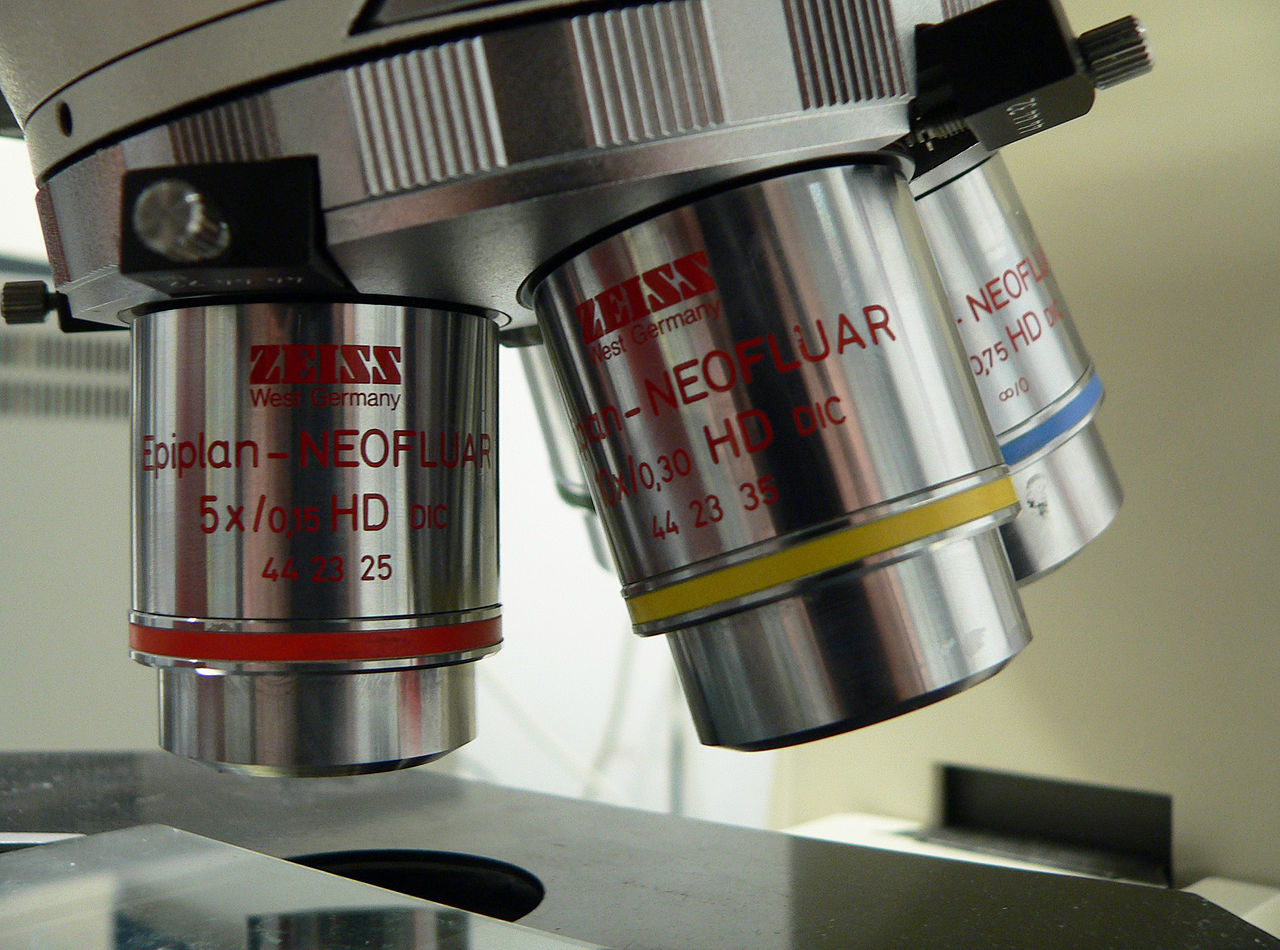
Artist: Rama
Numerical aperture is the central lever that controls what a light microscope can reveal. Increasing NA improves lateral and axial resolution, collects more light, and enhances contrast transfer at fine spatial frequencies. But NA does not act in isolation. Real-world imaging also depends on the condenser’s aperture and illumination quality, specimen preparation and refractive index environment, cover glass consistency, working distance needs, and how you match magnification to camera pixels. Throughout this article, those interdependencies recur:
- Resolution obeys wave optics: smaller
λand higher NA reduce the diffraction limit (Abbe/Rayleigh). - Immersion choice sets the NA ceiling and affects aberrations with depth (Objectives and Immersion and Index Matching).
- Condenser NA must support the objective for transmitted-light resolution (Condenser Control).
- Sampling should satisfy Nyquist to capture, not invent, detail (Magnification and Sampling and Cameras and Nyquist).
If you remember one principle, let it be this: magnification should serve resolution, and resolution is set by NA and wavelength in the context of proper illumination and minimal aberrations. Start your system design or objective choice with the NA required for your smallest features of interest, then select immersion, condenser settings, and camera sampling to support that optical goal.
For more foundational microscopy topics and practical deep dives into optics, subscribe to our newsletter so you don’t miss the next article in this fundamentals series. Explore related pieces on illumination, contrast mechanisms, and sampling strategies to build a coherent understanding that elevates every image you capture.