Table of Contents
- What Is Numerical Aperture (NA) in Microscopy?
- How NA, Wavelength, and Diffraction Set Resolution
- Depth of Field, Depth of Focus, and Working Distance
- Contrast Mechanisms and Illumination Aperture Matching
- Magnification vs Resolution: Pixels, Sampling, and Nyquist
- Refractive Index and Immersion Media: Air, Water, Glycerol, Oil
- Aperture Diaphragm, Field Diaphragm, and Köhler Principles
- Common Misconceptions About NA, Zoom, and Image Quality
- Frequently Asked Questions
- Final Thoughts on Choosing the Right NA, Illumination, and Sampling
What Is Numerical Aperture (NA) in Microscopy?
Numerical aperture (NA) is the optical parameter that most directly governs a microscope’s ability to resolve fine detail. It links the light-gathering power and angular acceptance of an optical system to the medium in which the imaging takes place. For an objective lens, NA is defined as:
NA = n · sin(θ)
where n is the refractive index of the imaging medium between the specimen and the objective’s front lens (for example, air, water, glycerol, or immersion oil), and θ is the half-angle of the maximum cone of light that can enter the objective. A larger NA means the objective accepts a wider cone of diffracted light and therefore can transfer higher spatial frequencies from the specimen to the image.

Artist: QuodScripsiScripsi
Three immediate implications follow from this definition:
- Medium matters: Increasing the refractive index of the immersion medium (e.g., using oil instead of air) can increase NA and boost resolution because n multiplies
sin(θ). - Geometry matters: Increasing the acceptance angle θ (through appropriate lens design) raises NA. Objectives that achieve large angles typically have shorter working distances and more complex optics.
- Resolution and brightness: Higher NA generally improves resolution and image brightness. In brightfield, image intensity (for a given illumination) tends to scale with the square of NA because a wider cone collects more light. This also increases sensitivity for weak signals in many modalities.
NA appears on objective barrels as a dimensionless number (e.g., 0.10, 0.40, 0.75, 1.30). It is not the same as magnification. While magnification tells you how large the image appears, NA tells you how much fine detail can be transferred and with what contrast. In practical microscopy, NA is the key design parameter for detail and contrast transfer, whereas magnification must be chosen to complement NA and the camera or eyepiece.
To understand why NA governs detail, we need to consider diffraction and how a lens forms images. That leads us to the core relationships covered in How NA, Wavelength, and Diffraction Set Resolution.
How NA, Wavelength, and Diffraction Set Resolution
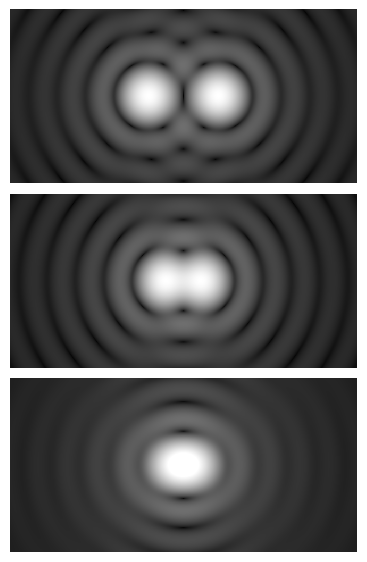
All optical imaging is subject to diffraction: even a perfect lens blurs a point of light into a finite-sized intensity pattern (the Airy pattern). The size of that blur controls the smallest separations you can distinguish. Two common, closely related criteria describe this “diffraction limit” in lateral (x–y) resolution for widefield imaging:
- Abbe limit (periodic structures):
d ≈ λ / (2 · NA) - Rayleigh criterion (point-like features):
d ≈ 0.61 · λ / NA
Artist: Spencer Bliven
Here, d is the smallest resolvable distance, and λ is the wavelength of light used for imaging (in the specimen medium). Shorter wavelengths and higher NA both reduce d, enabling finer detail to be resolved.
These simple expressions are widely used approximations. A few important nuances help apply them correctly:
- Wavelength dependency: Using blue light (shorter wavelength) rather than red light (longer wavelength) improves resolution at the cost of potentially lower specimen transmission, increased photodamage risk in sensitive samples, or lower detector sensitivity depending on the camera. For reflective or fluorescence modes, effective emission wavelengths may differ from excitation wavelengths, and the emission spectrum matters for resolution.
- Illumination coherence: For incoherent imaging of isolated features, the objective NA largely sets lateral resolution. For periodic structures under coherent or partially coherent illumination, the condenser NA also enters Abbe’s limit through the sum
NA_obj + NA_cond. In practice, ensuring the condenser NA is well matched to the objective NA typically optimizes contrast transfer and perceived resolution in transmitted-light brightfield. See Contrast Mechanisms and Illumination Aperture Matching for details. - Axial (z) resolution: Along the optical axis, the best focus region has a characteristic thickness that scales approximately as
~ (λ · n) / NA²in widefield imaging. Different definitions (e.g., full width at half maximum vs. Rayleigh-like criteria) yield different constants, but the trend is consistent: higher NA and shorter wavelengths improve both lateral and axial resolution, with axial improving roughly with the square of NA.
Key takeaway: Lateral diffraction-limited resolution scales as
~ λ / NA, while axial resolution scales more steeply as~ λ · n / NA². Increasing NA reduces both blur size and the thickness of the in-focus region.
Resolution is not the only consideration. High-NA imaging collects more out-of-focus light in thick specimens unless the modality rejects it (as in confocal or structured illumination). That interplay between NA and optical sectioning leads many users to balance NA with sample thickness, stain contrast, and illumination strategy.
Depth of Field, Depth of Focus, and Working Distance
Depth of field (DOF) and depth of focus describe how tolerant an image is to axial displacements, but from opposite sides of the lens:
- Depth of field (object space): The axial range in the specimen over which features remain acceptably sharp. In microscopy, DOF decreases rapidly as NA increases and increases with longer wavelengths. Approximate scaling follows
DOF ∝ λ / NA²(with constants depending on definition and imaging modality). Closing the illumination aperture (reducing effective NA) increases DOF but degrades resolution. - Depth of focus (image space): The tolerance at the image plane over which the image remains acceptably sharp. It grows with magnification and also scales approximately with
λ / NA²(times factors related to magnification and image-side refractive index).
Many users conflate DOF with axial resolution. They are related but not identical. Axial resolution describes how close two planes can be and still be distinguished as separate; DOF describes the continuous zone of acceptable sharpness around best focus for a given contrast criterion and aperture setting. In practice:
- High-NA objectives offer superb lateral resolution but a shallow DOF. This is ideal for thin specimens or for optical sectioning methods that suppress out-of-focus light.
- Low-NA objectives offer large DOF, which can be useful for surveying thick or uneven samples, at the cost of fine detail transfer.
Working distance is the physical space between the front of the objective and the specimen at focus. As a general trend, working distance shrinks as NA and magnification increase. Long-working-distance objectives exist, but they balance NA, field flatness, and aberration correction to achieve space for tools or thick samples. When choosing objectives, consider whether your specimen geometry (e.g., slide, dish, microdevice) and any coverings leave enough clearance for focusing without risking contact.
Because DOF and working distance both tighten with higher NA, mechanical stability and precise focusing become more important. Even small vibrations or thermal drifts can shift the specimen out of the narrow in-focus zone. If your application relies on sustained high-NA imaging, plan for stable mounting and small, controlled focus steps.
Contrast Mechanisms and Illumination Aperture Matching
Resolution presumes that fine details produce enough contrast to be detectable. Many biological and materials samples are weakly absorbing in brightfield, so contrast comes from phase or refractive index variations, scattering, or selective labeling. How we illuminate a specimen strongly affects which spatial frequencies (detail levels) and contrast mechanisms are transferred to the image.
Two key components in transmitted-light microscopes shape this outcome:
- Condenser and its numerical aperture (NA_cond): The condenser focuses illumination onto the specimen. A higher condenser NA supports higher-angle illumination, enabling the microscope to capture more diffracted orders from fine specimen structures.
- Aperture diaphragm (in or near the condenser): This iris sets the effective illumination cone angle. Opening it increases effective condenser NA (boosting resolution potential but reducing phase contrast and increasing glare). Closing it reduces condenser NA (increasing DOF and edge contrast but limiting high-frequency detail transfer).
For brightfield imaging with extended, periodic structures, Abbe’s theory shows that the highest captured spatial frequency depends on NA_obj + NA_cond. Practically, matching the condenser NA to the objective NA helps transfer the broadest range of spatial frequencies with balanced contrast. If the condenser NA is much lower than the objective NA, the optics cannot deliver the angular spectrum required to support fine-detail contrast, even if the objective itself is capable of high NA.
Different contrast methods manipulate illumination in structured ways:
- Oblique or partially closed aperture brightfield: Increases edge contrast and DOF but at the expense of ultimate resolution. Good for quick surveys.
- Darkfield (transmitted): Blocks the central beam and uses only scattered light entering the objective at high angles. Very sensitive to tiny refractive index fluctuations or small particles, but alignment and cleanliness are critical.
- Phase contrast: Converts phase shifts into intensity differences using condenser annuli and objective phase plates. Effective for unstained transparent specimens, at modest NA costs and specific optical alignment requirements.
- Differential interference contrast (DIC): Highlights gradients in optical path length, producing pseudo-relief images with high lateral resolution and excellent contrast for thin specimens.
While this article focuses on fundamentals, the principle is consistent across modalities: contrast arises when the imaging system transforms specimen variations into detectable intensity differences. Illumination geometry and aperture settings determine which variations are emphasized. For an application that values edge enhancement and depth, a slightly reduced NA_cond may help. For maximum fine detail, especially in thin, high-contrast samples, keep NA_cond well matched to NA_obj.
Because NA, resolution, and contrast are interconnected, changes to the aperture diaphragm will influence sampling requirements and perceived detail, as discussed in Magnification vs Resolution: Pixels, Sampling, and Nyquist.
Magnification vs Resolution: Pixels, Sampling, and Nyquist

Artist: Anaqreon
It is natural to reach for higher magnification to see more detail. But magnification does not create information—the optical system’s NA and wavelength determine how much detail exists in the image. If you magnify beyond what the optics and detector can support, you get empty magnification: a larger picture with no new resolved structure.
In the digital era, the detector’s pixel size and the optical magnification together determine sampling at the specimen plane. Key concepts include:
- Effective pixel size at the specimen:
p_spec = p_cam / M_total, where p_cam is the camera pixel pitch and M_total is the total magnification from specimen to sensor (objective × tube lens factors, etc.). - Optical cutoff frequency (incoherent imaging): For intensity imaging with an incoherent source, the optical transfer function (OTF) has a lateral cutoff spatial frequency approximately
f_c ≈ 2 · NA / λ(cycles per unit length). Spatial frequencies beyond f_c are not transferred by the optics. - Nyquist sampling: To represent a maximum spatial frequency f_c without aliasing, the sampling frequency must be at least
2 · f_c. In spatial terms, the sampling interval must satisfyp_spec ≤ 1 / (2 · f_c) ≈ λ / (4 · NA).
These relations provide practical guardrails for pairing objectives and cameras:
- If
p_specis much larger thanλ / (4 · NA), you are undersampling and may lose fine detail or introduce aliasing artifacts. - If
p_specis much smaller thanλ / (4 · NA), you are oversampling. This preserves detail but spreads photons over more pixels, potentially lowering the signal-to-noise ratio per pixel for a given exposure. Oversampling also increases data size without necessarily increasing resolvable information.
A simple way to check your pairing is to compute p_spec and compare it to a target like λ / (4 · NA) for your wavelength of interest. Many practitioners choose slightly finer sampling (e.g., 2.3–3 pixels across the smallest optical feature) to avoid contrast loss at the cutoff. The exact choice depends on noise tolerance, dynamic range, and downstream processing.
The classical rule-of-thumb for visual observation speaks to the same trade-off. The useful total magnification range for the human eye is often quoted as approximately 500× to 1000× the NA of the objective. Below this range, you may not be enlarging the diffraction-limited detail enough to reach the eye’s angular resolution; above it, you are likely in empty magnification. For digital imaging, substitute the camera’s sampling criterion in place of eye acuity to determine how much magnification is genuinely useful.
Because NA and illumination aperture govern the highest spatial frequencies transferred, any change to condenser settings or objective choice should prompt a quick sampling check. This is especially important when switching between objectives or altering illumination wavelength. For worked values, see the simple pseudocode below that estimates a sampling target for incoherent imaging:
# Given: wavelength lambda (in micrometers), objective NA, camera pixel p_cam (um)
# Choose a target sampling factor S (e.g., 2.5) pixels across the smallest feature
# Smallest optical feature size ~ 0.61*lambda/NA (Rayleigh). Target pixel size at specimen:
# p_spec_target = (0.61 * lambda / NA) / S
# Required total magnification:
# M_required = p_cam / p_spec_target

lambda = 0.55  # um, green light example
NA = 0.75
p_cam = 3.45   # um
S = 2.5
p_spec_target = (0.61 * lambda / NA) / S
M_required = p_cam / p_spec_target
print(M_required)
This approach uses the Rayleigh feature size as a reference. You could equivalently target p_spec ≤ λ / (4 · NA) based on the OTF cutoff and choose a safety factor. The goal is the same: ensure your magnification and pixels record the optical information your objective’s NA can deliver.
Refractive Index and Immersion Media: Air, Water, Glycerol, Oil
Because NA = n · sin(θ), the immersion medium’s refractive index directly influences the attainable NA and the level of aberration at the specimen interface. Common media and approximate refractive indices at visible wavelengths include:
- Air: n ≈ 1.00
- Water: n ≈ 1.33
- Glycerol: n ≈ 1.47
- Immersion oil: n ≈ 1.515 (formulated to match standard cover glass glass)

Artist: Thebiologyprimer
Choosing the right immersion medium involves more than maximizing NA. Consider the specimen environment, coverslip properties, and imaging depth:
- Air objectives: Convenient and versatile, with moderate NA and typically longer working distances. Best for dry specimens or quick surveys. Resolution is limited compared with immersion objectives due to lower n.
- Water immersion: Useful when imaging aqueous specimens (e.g., live cells in buffer) because the refractive index more closely matches the medium, reducing spherical aberration at the interface and within shallow depths. Higher NA than air is possible, with less index mismatch at the sample surface.
- Glycerol immersion: Intermediate refractive index that can reduce aberration when imaging into media whose index is near that of glycerol. Sometimes used for thicker specimens or cleared tissues matched to similar indices.
- Oil immersion: Supports very high NA because the front lens, immersion oil, and standard cover glass can be closely index-matched. Particularly effective for thin specimens mounted under standard coverslips with the specified thickness.
Index mismatch is a common source of degraded image quality. Two aspects are frequently encountered:
- Coverslip thickness and rating: Many high-NA objectives specify a standard coverslip thickness (commonly around 0.17 mm, often indicated as #1.5). Departures from this thickness or from the index the objective was corrected for introduce spherical aberration, broadening the point spread function and reducing resolution and contrast. Some objectives include correction collars to compensate for moderate variations in cover glass thickness.
- Imaging depth into mismatched media: Even with the correct coverslip, focusing deeper into a specimen whose refractive index differs from the immersion medium can introduce spherical aberration that worsens with depth. The effect is more pronounced for higher NA. Choosing an immersion medium closer to the sample’s index can mitigate this, particularly for shallow depths.
Matching the immersion medium to the specimen environment and the objective’s design target helps preserve the high-frequency information that NA enables. If you change immersion media or coverslip types, expect shifts in apparent focus, field curvature, and contrast. Re-optimizing illumination aperture and refocusing can recover performance, but large mismatches cannot be fully corrected by focus alone.
Because immersion choice and condenser settings are intertwined, revisit Contrast Mechanisms and Illumination Aperture Matching after changing media. A higher NA objective justified by oil immersion, for instance, benefits only if the illumination and sampling also support the additional spatial frequencies it can capture.
Aperture Diaphragm, Field Diaphragm, and Köhler Principles

Images donated as part of a GLAM collaboration with Carl Zeiss Microscopy – please contact Andy Mabbett for details.
Artist: ZEISS Microscopy
Köhler illumination is the standard framework for shaping illumination so that it evenly and efficiently fills the objective’s entrance pupil while allowing control over contrast and glare. Without prescribing procedural steps, we can outline the functional roles of the two key diaphragms and why their placement matters:
- Field diaphragm: Imaged at the specimen plane. Adjusting it controls the illuminated field size, reducing stray light and improving contrast by limiting illumination to the region of interest. Properly set, its edges lie just outside the field of view to avoid vignetting.
- Aperture diaphragm: Conjugate to the objective’s back focal plane. Adjusting it controls the angular distribution of illumination (the effective condenser NA). Opening it increases resolution potential and brightness; closing it increases DOF and edge contrast while reducing the transfer of high spatial frequencies.
Why the conjugate planes matter: In Köhler illumination, the light source (e.g., the lamp filament or LED emitter) is focused not at the specimen, but at the condenser aperture plane (conjugate to the objective pupil). This decouples the illumination uniformity from source structure. The field diaphragm is instead imaged in the specimen plane, letting you control the illuminated area independently of the angular cone that sets resolution and contrast. As a result, two independent knobs—field size and aperture—govern stray light and contrast, respectively.
When you adjust the aperture diaphragm, you are effectively altering the condenser NA. To make the most of a high-NA objective, the aperture diaphragm should be opened sufficiently so that the angular spectrum reaching the specimen can excite and collect the diffracted orders that define fine detail, as described in How NA, Wavelength, and Diffraction Set Resolution. Conversely, for low-contrast specimens where edge definition is more important than ultimate resolution, partially closing the aperture diaphragm can yield crisper edges by suppressing low-angle glare and boosting phase gradient visibility.
Many specialized contrast techniques (phase contrast, DIC, darkfield) place additional masks or prisms at these conjugate planes. While each method has unique components and alignments, the underlying logic remains the same: control the angular and spatial extent of illumination in planes conjugate to the objective pupil and specimen, respectively, to sculpt contrast.
Common Misconceptions About NA, Zoom, and Image Quality
Even experienced users can fall into habits that limit performance. Here are frequent misconceptions and clarifications to help avoid common pitfalls:
- “Higher magnification means higher resolution.” Not necessarily. Resolution is set by NA and wavelength, not by magnification. Excess magnification beyond sampling and optical limits simply makes blur circles and noise larger. For cameras, verify that
p_specmeets the Nyquist criterion for your optics; for visual observation, keep to the useful magnification range relative to NA. - “Brightness equals resolution.” A bright image can still be low in detail if the illumination aperture is too small or the objective NA is modest. Conversely, high-NA imaging can look dim if the source intensity or exposure is insufficient. Adjust illumination and exposure to match NA, but do not conflate brightness with resolvable detail.
- “Closing the aperture always improves image quality.” It may increase DOF and suppress glare, but it also suppresses high spatial frequencies. For maximum resolution, keep the condenser NA well matched to the objective NA. For survey or edge-enhanced views, a smaller aperture is a deliberate trade-off.
- “Oil immersion is always best.” Oil can enable very high NA and superb lateral resolution for thin, coverslipped specimens. But if you image into an aqueous sample or through mismatched media, oil may worsen spherical aberration with depth. Water or glycerol immersion may deliver better overall performance for certain specimen geometries.

Leica microscope objective PL FLUOTAR 100x, oil immersion, aperture 1,30, cover glass 0,17 mm, PH3; DIC prism D
Artist: PaulT (Gunther Tschuch) - “All coverslips are equivalent.” High-NA objectives are corrected for specific coverslip thicknesses and refractive indices. Deviations broaden the point spread function and reduce contrast. Use coverslips that meet the objective’s specification or adjust correction collars if available.
- “Any camera works if magnification is high enough.” Camera pixel size and quantum efficiency matter. If pixels are too large relative to magnification, you undersample fine detail. If pixels are very small, you may oversample and disperse photons, affecting signal-to-noise. Check sampling rather than relying on nominal magnification.
Most of these pitfalls stem from separating magnification from NA, or contrast from illumination geometry. Keeping these pairs linked—NA with resolution, and aperture with contrast—avoids confusion and leads to efficient optimization.
Frequently Asked Questions
Does condenser NA affect resolution in brightfield, or only contrast?
In transmitted-light brightfield, the condenser NA affects both contrast and the range of spatial frequencies that reach the objective. For incoherent imaging of isolated features, the objective NA largely determines the diffraction-limited resolution. For periodic or extended structures and partially coherent illumination, Abbe’s analysis shows a dependence on NA_obj + NA_cond. Practically, matching the condenser NA to the objective NA helps ensure that the fine diffracted orders needed for detail are present and efficiently transferred, thereby influencing both resolution potential and contrast.
How do I balance NA, DOF, and sampling for thick specimens?
For thick or uneven specimens, a moderate NA often provides a useful compromise: enough resolution to see meaningful features while preserving a larger depth of field. Reducing the illumination aperture increases DOF and edge contrast but lowers the transfer of high spatial frequencies. For digital imaging, verify that your magnification and camera pixel size satisfy Nyquist for the effective NA you are using (which decreases when you close the aperture diaphragm). If you need thin optical sections, consider contrast techniques that reject out-of-focus light paired with high NA, or acquire focus stacks for computational combination if appropriate for your application and sample.
Final Thoughts on Choosing the Right NA, Illumination, and Sampling
Optimizing a microscope for informative, high-fidelity images is ultimately an exercise in matching three pillars:
- Optics (NA and wavelength): Choose an objective whose numerical aperture and immersion medium suit your specimen’s geometry and refractive index environment. Remember that lateral resolution scales as
~ λ / NAand axial resolution as~ λ · n / NA². Higher NA shortens both the diffraction blur and the in-focus thickness, trading depth tolerance for detail. - Illumination (aperture and geometry): Use the condenser and aperture diaphragm to shape the angular spectrum that reaches the specimen. Match condenser NA to objective NA for maximum detail transfer; close the aperture judiciously to boost edge contrast and DOF when needed.
- Detection (magnification and sampling): Pair your objective with camera pixels so that effective sampling at the specimen approximates or exceeds the Nyquist target for the optical cutoff. Avoid both undersampling (aliasing, lost detail) and severe oversampling (photon starvation per pixel, unnecessary data bloat).
These elements are interdependent. Changing any one of them—switching objectives, altering immersion media, choosing a different wavelength, or adjusting the aperture diaphragm—shifts the optimal settings for the others. A smooth workflow emerges when you adopt a short checklist for each new imaging condition:
- Confirm the immersion medium and coverslip standard match the objective’s specification, or use correction collars if provided.
- Ensure the field diaphragm limits illumination to the region of interest without vignetting.
- Set the aperture diaphragm in accordance with your goals: maximum detail (open to match NA), edge enhancement or DOF (partially closed).
- Verify that your magnification and camera pixels sample the optical information adequately at the chosen wavelength.
Mastering these fundamentals pays dividends across all microscope types and applications. Whether you are surveying mineral thin sections, examining botanical structures, or exploring microfabricated devices, the same relationships govern clarity and contrast. By grounding your choices in NA, wavelength, illumination aperture, and sampling, you avoid empty magnification and unlock the full potential of your optics.
If you found this guide useful, explore related topics on illumination strategies, contrast methods, and sampling theory. For regular deep dives into microscopy principles tailored to students, educators, and hobbyists, subscribe to our newsletter and never miss a new article.