
Table of Contents
- Introduction
- What Are Eclipses and Occultations?
- Geometry and Mechanics
- Types of Events
- Why These Events Matter Scientifically
- Planning and Prediction Tools
- Observing Techniques and Safety
- Recording, Timing, and Reporting Your Data
- Case Studies and Milestone Results
- Common Mistakes and Troubleshooting
- Beginner FAQs
- Advanced FAQs
- Resources and Tools
- Conclusion
Introduction
Eclipses and occultations turn the clockwork of the sky into living, measurable phenomena. A total solar eclipse reveals the Sun’s delicate corona. A lunar eclipse paints Earth’s shadow across the Moon. A split-second asteroid occultation can tell us a minor planet’s size, shape, and even hint at rings or satellites. Although the word “eclipse” typically conjures spectacular visuals, both eclipses and occultations are also precision experiments in celestial mechanics, offering insights into orbits, atmospheres, and the physical properties of distant worlds.

Image by Brucewaters
This guide explains the geometry behind these events, how to predict them, how to observe them safely and effectively, and what science they unlock. It also includes practical planning advice and answers to common questions. If you want to get up to speed quickly, skim the Planning and Prediction Tools section; if you’re ready to head outside, jump to Observing Techniques and Safety. To understand how your data contribute to research, read Recording, Timing, and Reporting Your Data and Why These Events Matter Scientifically.
What Are Eclipses and Occultations?
In astronomy, an eclipse occurs when one body enters the shadow of another. A familiar example is a lunar eclipse, when Earth’s shadow falls on the Moon, or a solar eclipse, when the Moon’s shadow touches Earth. An occultation occurs when a closer object passes in front of a more distant one, hiding it from view. The Moon occulting a star (or a planet) is common; rarer are asteroid occultations of stars, which last fractions of a second to tens of seconds.
Eclipse: blocking of light via shadows. Occultation: blocking by alignment along the line of sight, regardless of shadow geometry.
Closely related are transits, in which a small body crosses a larger one’s face without fully covering it, such as Mercury transiting the Sun. In the outer solar system, transits, occultations, and mutual events among moons offer powerful probes of orbits and atmospheres. For observers, the techniques for prediction and observation of transits overlap strongly with occultations; you can navigate to the Types of Events section for specifics.
Geometry and Mechanics
Eclipses and occultations arise from precise alignments along the observer’s line of sight. The key geometric elements are:
- Shadow cones: For eclipses, the umbra (full shadow), penumbra (partial shadow), and in the case of annular solar eclipses, the antumbra (where the Moon appears smaller than the Sun).
- Angular sizes and distances: Whether one body can completely cover another depends on their apparent sizes. The Moon’s and Sun’s apparent diameters are similar from Earth because the Sun is about 400 times farther and 400 times larger than the Moon.
- Orbital nodes: Eclipses occur near points where the Moon’s orbit crosses the ecliptic, the ascending and descending nodes.
- Inclinations and precession: The Moon’s 5° inclination relative to the ecliptic prevents eclipses every month. The node line precesses over an ~18.6-year cycle, influencing eclipse seasons.
- Relative velocities: The speed of the occulting body across the sky determines event duration. Asteroid occultations can be milliseconds to seconds; the Moon taking a star is typically seconds to a minute; solar eclipse totality is up to several minutes.
The recurring patterns of solar and lunar eclipses are often summarized by the Saros cycle (~18 years 11 days 8 hours), which groups similar eclipses. While Saros families are helpful for historical context and broad planning, precise local circumstances require detailed predictions using Besselian elements (for solar eclipses) or exact ephemerides and star positions (for occultations). You can explore practical forecasting in Planning and Prediction Tools.
For occultations by minor planets, modern predictions rely strongly on Gaia DR2/DR3 star positions, which dramatically improved path accuracy. For larger bodies (like the Moon), high-resolution topographic models, e.g., from the Lunar Reconnaissance Orbiter (LRO/LOLA), refine grazing occultation predictions and contact timings.
Types of Events
There is a surprisingly rich taxonomy of eclipses and occultations. Understanding the varieties helps you choose targets, techniques, and equipment.
Solar Eclipses: Total, Annular, Hybrid, and Partial
A solar eclipse happens when the Moon passes between Earth and the Sun. The details depend on the Moon’s distance and the geometry:
- Total solar eclipse: The Moon’s umbra reaches Earth, producing a path of totality where the solar photosphere is fully covered and the corona becomes visible. Outside the path, observers see partial phases.
- Annular eclipse: The Moon is near apogee and appears smaller than the Sun; it cannot cover the solar disk completely, leaving a bright ring (the annulus). Safety filters are required during all phases.
- Hybrid eclipse: Rare cases where the eclipse is annular along part of the path and total along another, due to Earth’s curvature and the Moon’s varying distance.
- Partial eclipse: The Moon’s penumbra brushes the observer’s location; only part of the Sun is covered.
Key terms include the contact times (C1 through C4) marking stages: first contact (start of partial), second (start of totality or annularity), third (end of totality/annularity), fourth (end of partial). Experienced observers plan observations around these, for example timing the appearance of Baily’s beads near C2 and C3 produced by sunlight streaming through lunar valleys.

Image by Brian W. Schaller
Lunar Eclipses: Penumbral, Partial, and Total
A lunar eclipse occurs when the Moon passes into Earth’s shadow. Because the entire Moon is visible from night-side Earth, lunar eclipses are widely observable and safe to view without special solar filters. Types:
- Penumbral: The Moon enters Earth’s penumbral shadow. The dimming can be subtle; careful observers often compare the limb brightness to detect it.
- Partial: Part of the Moon enters the umbra, producing a dark bite with a color gradient along the umbral boundary.
- Total: The Moon fully enters the umbra, often glowing reddish due to sunlight refracted through Earth’s atmosphere. The Danjon scale (L=0 to 4) characterizes the eclipse’s brightness and color.

Image by Robert Jay GaBany
Lunar eclipse color and brightness vary with Earth’s atmospheric conditions, especially aerosols and volcanic dust. Systematic visual rankings and calibrated photometry can contribute to long-term records; see Recording, Timing, and Reporting Your Data.
Occultations by the Moon: Stars and Planets
The Moon frequently occults bright stars and occasionally planets. Lunar occultations are excellent training grounds for timing techniques because they are predictable, often visible from large geographic areas, and the on/off events are sharp at the dark limb. Grazing occultations along the lunar limb are especially valuable: small shifts in observer position determine whether a star disappears behind crater rims or skims along mountaintops, enabling detailed studies of the lunar limb profile. For planning a graze, the refined limb profiles from LRO/LOLA improve predictions of where and when successive reappearances and disappearances occur; practical methods appear in Planning and Prediction Tools and Observing Techniques and Safety.
Asteroid and TNO Occultations of Stars
When a minor planet or trans-Neptunian object (TNO) passes in front of a star, the star’s light can wink out for a fraction of a second to tens of seconds. Observers along the path record chords—durations that map to lines across the object’s silhouette. Multiple chords from different sites reconstruct the object’s size and shape. High-profile examples include the discovery of rings around the Centaur Chariklo in 2013 and around the dwarf planet candidate Haumea in 2017—both revealed via unusual multiple dips during stellar occultations.
Thanks to the Gaia mission’s high-precision star positions and improved minor-planet orbits, asteroid occultation predictions today are far more accurate than a decade ago. Networks of amateurs and professionals coordinate via tools like Occult Watcher Cloud to position observers across the predicted path, including miss locations that still constrain size and shape. For practical timing setups, jump to Observing Techniques and Safety and for data submission, see Recording, Timing, and Reporting Your Data.
Planetary Occultations and Transits
Planets can occult stars, and very occasionally one another, though planetary mutual occultations are exceptionally rare. Historically, transits of Venus across the Sun were used to estimate the astronomical unit. Today, transits of Mercury are occasional visual highlights (with proper solar filters). In the outer solar system, stellar occultations by planets—like those of Pluto—are key for monitoring tenuous atmospheres, as the starlight brightens and dims according to refractive effects. These events require careful predictions and modest telescopes with sensitive cameras; see Planning and Prediction Tools.
Mutual Events among Moons
Mutual eclipses and occultations among the Galilean moons of Jupiter occur in seasons when the system’s geometry aligns edge-on to Earth. Photometry during these events constrains satellite orbits and can even test shape models. For smaller telescopes, they are an accessible introduction to time-series measurements and the fundamentals of differential photometry.
Why These Events Matter Scientifically
Eclipses and occultations are more than visual spectacles. They are controlled experiments that isolate geometry and timing to reveal physical properties.
- Atmospheres via stellar occultations: As a star sets behind a planetary atmosphere (e.g., Pluto), refractive bending and extinction imprint a characteristic light curve. Fitting this signal yields temperature and pressure profiles. Multi-wavelength data can probe haze and aerosol content.
- Rings and satellites detection: Narrow rings and small moons can be invisible in direct imaging but betray themselves through brief secondary dips before and after the main occultation, as shown by the 2013 Chariklo event and later ring detections. These discoveries led to new questions about ring formation and stability around small bodies.

Using occultation data, the team assessed that this satellite is roughly 3 miles (5 km) in diameter, orbiting Polymele, which is itself around 17 miles (27 km) along its widest axis. Image by NASA’s Goddard Space Flight Center
- Sizes, shapes, and densities: Chords from asteroid occultations provide sizes with kilometer or sub-kilometer precision. When combined with mass estimates (from spacecraft flybys or mutual interactions), densities and internal structures can be inferred.
- Lunar limb profiles: Grazing occultations refine the lunar limb shape and validate digital elevation models. Historically, this helped calibrate contact timings for solar eclipse predictions; today, it validates datasets like LRO/LOLA.
- Solar science during totality: Total solar eclipses remain invaluable for imaging the corona’s faint extended structures and dynamics, complementing space-based coronagraphs that block the inner corona. Polarization studies and high-resolution imaging during totality continue to test models of coronal heating and solar wind acceleration.
- Earth’s atmosphere via lunar eclipses: The color and brightness of a total lunar eclipse respond to global atmospheric conditions. Long-term records track variability tied to volcanic aerosols and seasonal changes.
Crucially, contributions from skilled amateurs—especially in asteroid occultations and lunar/planetary events—are regularly incorporated into professional analyses. Coordinated campaigns amplify the value of each observer’s data. For how to prepare your station and submit results, see Recording, Timing, and Reporting Your Data.
Planning and Prediction Tools
Accurate planning is the difference between a clean dataset and a miss. The following approaches and tools are widely used by observers worldwide.
Forecasting Solar and Lunar Eclipses
- NASA Eclipse Webpages: Detailed global maps, local circumstances, and Besselian elements for solar eclipses, plus lunar eclipse geometry and timelines. Besselian elements enable precise calculation of contact times for any location—essential for automated planning and for observers organizing expeditions.
- Timeanddate.com: User-friendly maps and visualizations for both solar and lunar eclipses, including local visibility, magnitude, and time progressions.
- Planetarium software: Tools like Stellarium or SkySafari simulate eclipses for your location and help you rehearse the sequence and camera timings. For more on rehearsal strategies, see Observing Techniques and Safety.
Lunar Occultations of Stars and Planets
- Prediction portals: Observing organizations and national astronomical societies publish monthly lists of lunar occultations with circumstances for major cities, including disappearance (D) and reappearance (R) at the dark/bright limb. Sorting by magnitude helps you choose targets suited to your telescope.
- Grazing occultations: Maps show narrow “graze lines” where a star skims the limb. Advanced predictions leverage LRO/LOLA limb profiles; small position errors can shift whether you see multiple bead-like reappearances versus a clean on/off, so accurate GPS location and scouting are crucial.
Asteroid and TNO Occultations
- Occult Watcher Cloud (OWC): A central coordination hub for upcoming asteroid occultations, with star magnitudes, path maps, and station planning. Users can declare intended observing sites, helping create a lattice of chords across the predicted shadow path. For a step-by-step checklist, see Observing Techniques and Safety.
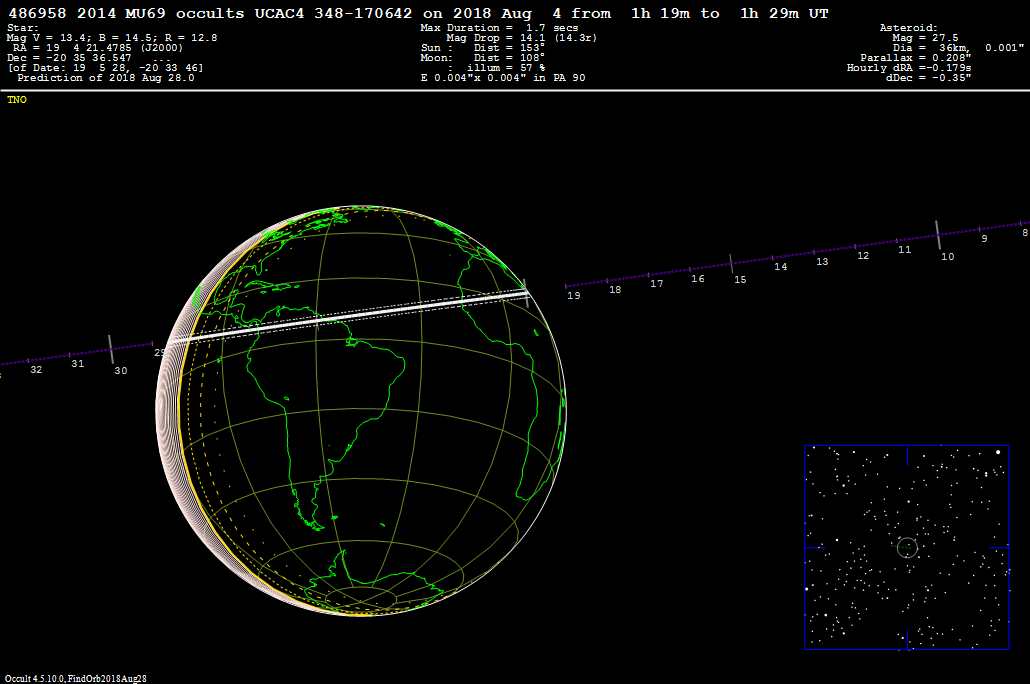
Path of the August 4, 2018 occultation. Attempts were made to observe this event from locations in Senegal and Colombia. Image by Renerpho
- International Occultation Timing Association (IOTA): Event lists, prediction updates, and reporting guidelines. Regional IOTA chapters often maintain dedicated mailing lists for late-breaking updates.
- Ephemerides and star catalogs: JPL Horizons and the Minor Planet Center provide precise positions. Predictions now routinely exploit Gaia DR3, which yields milliarcsecond star positions, significantly improving path accuracy compared to pre-Gaia predictions.
Planetary Occultations and Mutual Events
- Professional alerts: When a planet like Pluto or Neptune is predicted to occult a bright enough star, coordinated campaigns announce opportunities for both large and modest telescopes. Good sky transparency and stable tracking are key.
- Jovian moons mutual events: Periodic seasons produce overlapping shadows and occultations. Planetarium tools and dedicated almanacs provide local times. Photometric techniques discussed in Observing Techniques and Safety transfer well to these targets.
Observing Techniques and Safety
Successful observations blend logistics, optics, and timing. The right approach depends on the event type, your equipment, and your goals (visual enjoyment, imaging, or scientific timing).
Solar Eclipse Safety
Never look at the Sun without proper filtration except during the brief moments of totality when the photosphere is completely covered. Follow these guidelines:
- Filters: Use eclipse glasses or handheld viewers that comply with ISO 12312-2. Inspect for scratches or damage prior to use. For telescopes and binoculars, use full-aperture solar filters designed for visual use; do not use improvised materials.
- During totality: It is safe to remove filters only when the Sun is fully covered. Replace filters before the diamond ring returns at third contact to avoid eye damage.
- Photography: Cameras and smartphones also require appropriate solar filters during partial phases to prevent sensor damage. Test your setup days in advance.
For planning camera sequences and rehearsing contact timings, see Planning and Prediction Tools. For data recording beyond images—like timing Baily’s beads—jump to Recording, Timing, and Reporting Your Data.
Lunar Eclipse Observation
- Naked-eye and binoculars: Track color changes and brightness gradients. Compare the appearance near the umbral edge to the center. Assign a Danjon scale value during totality.
- Telescope: Low power frames the entire Moon. To measure color, use a DSLR or mirrorless camera with a fixed white balance and record RAW images for post-analysis.
- Photometry: For quantitative work, take calibrated images using consistent exposure sequences; reference the brightness to nearby standard stars or use the limb as a relative indicator.
Lunar Occultations: Visual and Video Timing
The simplest approach is visual timing of a bright star’s disappearance or reappearance at the lunar limb. However, video improves precision and objectivity.
- Visual timing: Observe the dark limb to catch the sudden drop. Use a short, spoken countdown synchronized to a time source and call the event. Accuracy is limited by human reaction time (~0.2–0.3 s).
- Video with time insertion: A sensitive camera (analog or digital) feeding a GPS time inserter provides timestamps on each frame. This method achieves sub-0.1 s, sometimes ~0.01 s timing precision.
- Exposure and gain: Keep star images small and well above the noise floor. Avoid overexposure near the bright limb.
- Grazes: At a graze, expect multiple on/off events. Record continuously and ensure your mount tracks well along the limb.
Asteroid Occultations: Field Setup and Timing
An effective asteroid occultation station balances sensitivity, field of view, and precise timing.
- Site selection: Use path maps (e.g., via Occult Watcher Cloud) and choose a station that fills a gap between other observers. Report your intended location to improve the campaign’s chord coverage.
- Optics and camera: A small to medium telescope with a low-noise video or CMOS camera can capture stars down to ~mag 12–14 or fainter under dark skies. Frame rates of 25–60 fps are typical; shorter exposures improve timing precision but reduce sensitivity.
- Timing accuracy: GPS time inserters provide per-frame timestamps. If using computer-controlled cameras, consider hardware timing solutions or validated NTP setups; test against a reference clock.
- Focus and stability: Achieve critical focus on a bright nearby star. Recheck frequently to avoid slow drift.
- Prepointing: Many targets are faint and near the camera’s sensitivity limits. Slew to the target field early, confirm star field patterns, and lock in framing well before the event.
- Acquisition window: Start recording several minutes before and after the predicted time to capture timing uncertainties. Note any clouds or interruptions in a voice log.
After recording, you’ll analyze the light curve to extract drop and reappearance times. See Recording, Timing, and Reporting Your Data for analysis and submission steps.
Planetary Occultations and Mutual Events
- Tracking and guiding: Planets drift slowly; ensure accurate tracking. For faint stars behind a planet, select red-sensitive cameras if the event benefits from longer wavelengths, which can reduce atmospheric scattering.
- Filters: For bright planets, narrowband filters can reduce glare and enhance contrast with the background star, but ensure the star remains detectable.
- Photometric sequences: Use consistent exposure times and avoid saturation. Records must be stable to detect subtle refraction signatures when atmospheres are involved.
General Logistics and Checklists
- Timing reference: Carry redundant time sources. Cross-check GPS-based devices with an independent reference; verify NTP drift if using a laptop clock.
- Power and backups: Bring extra batteries and power distribution. Test cables and connectors in daylight.
- Field notes: Keep a paper or digital log noting start/end times, equipment settings, sky conditions, and any anomalies.
- Safety and comfort: Dress for conditions, especially for long waits at night. Use dim red lights to preserve night vision.
Recording, Timing, and Reporting Your Data
High-quality data begin with careful acquisition and end with clear reporting. The goal is to produce time-stamped, reproducible measurements that others can analyze.
Data Acquisition
- Video timing: Prefer cameras with known frame rates and minimal dropped frames. GPS time inserters overlay UTC on each frame; annotate the scene with a voice track if possible.
- Image sequences: For eclipses and slower events, bracket exposures but keep metadata consistent. Save RAW files to preserve calibration flexibility.
- Calibration frames: For photometry (e.g., lunar eclipses, mutual events), capture dark frames and flats when practical to improve signal-to-noise and remove fixed-pattern noise.
Analysis
- Light-curve extraction: Software tailored for occultation analysis can measure ingress/egress times and uncertainties. For lunar grazes, mark each disappearance/reappearance carefully; for asteroid events, identify the sharp flux drop and return.
- Uncertainty estimates: Report timing uncertainties based on frame rate, signal-to-noise, and detection method. For visual timings, include an estimate of reaction-time uncertainty.
- Position accuracy: Provide coordinates for your observing site. A handheld GPS or smartphone can be adequate; for professional-grade work, differential GPS is used, but consumer devices are acceptable when their precision is documented.
Reporting
- Standard forms: Organizations such as the International Occultation Timing Association (IOTA) provide templates for reporting times, locations, equipment, and method.
- Occult Watcher Cloud submissions: After an asteroid event, report positive or miss results. Misses constrain the object’s size and path just as positives do.
- Collaborative projects: For major campaigns (e.g., Pluto or TNO atmospheres), follow the specific format requested by organizers to ensure your data fit the combined analysis.
Thoughtful reporting elevates your data from a personal record to a scientific measurement. For examples of the impact, see Case Studies and Milestone Results.
Case Studies and Milestone Results
These landmark events illustrate what eclipses and occultations can reveal.
A Total Solar Eclipse: Coordinated Corona Science

Image by Luc Viatour
During a total solar eclipse, the inner corona becomes visible to ground-based observers. This region is challenging for space coronagraphs, which must block the bright solar disk and often obscure inner structures. High-resolution eclipse imaging has documented coronal streamers, plumes, and magnetic structures, and when repeated over multiple eclipses, these data test models of coronal heating and solar wind acceleration. Teams often coordinate along the path of totality to extend coverage and study temporal evolution. For those planning observations of future eclipses, the preparation workflow in Planning and Prediction Tools and the safety guidance in Observing Techniques and Safety are directly applicable.
Chariklo’s Rings (2013)
In 2013, observers monitoring a stellar occultation by the Centaur (10199) Chariklo recorded brief, symmetric secondary dips bracketing the main occultation. Modeling revealed narrow rings encircling Chariklo—the first ring system discovered around a small body. Multiple stations were essential: chords at different distances from the object’s center constrained ring radii and widths. The discovery showed that ring systems can exist around minor bodies under the right conditions and highlighted the power of well-coordinated occultation networks.
Haumea’s Ring (2017)
Occultation observations in 2017 of the distant object (136108) Haumea yielded its elongated shape and revealed a ring, again identified via characteristic brightness dips beyond the main body’s occultation. Combining chords with rotational light curves refined Haumea’s dimensions and spin properties, demonstrating how occultations complement other techniques to build coherent physical models of distant worlds.
Pluto’s Atmosphere via Stellar Occultations
Long before spacecraft flybys, stellar occultations established that Pluto has a tenuous atmosphere. As the star’s light is refracted and attenuated while passing through the atmosphere, the light curve encodes pressure and temperature structure. Continued monitoring through multiple occultations tracks seasonal and possibly secular changes as Pluto moves along its eccentric orbit. The method remains sensitive to subtle variations that would be hard to detect otherwise.
Jupiter’s Galilean Moons: Mutual Events
When the orbital plane of the Galilean moons tilts edge-on to Earth, mutual eclipses and occultations occur. Timing and photometry of these interactions refine orbital parameters and can test dynamical models, illustrating how even small telescopes can contribute to solar system dynamics when observers are organized and persistent.
Common Mistakes and Troubleshooting
Many pitfalls are avoidable with rehearsal and checklists. Here are frequent issues and how to fix them.
- Missing the field: Failing to identify the correct star is common, especially for faint targets. Solution: build annotated finder charts with A–B–C star patterns and rehearse in advance at the same hour angle.
- Clock drift: Computer clocks can drift by seconds. Solution: rely on GPS time insertion where possible; if using NTP, verify offset and stability before and after the session and note it in your report.
- Dropped frames: Overburdened laptops may drop frames, corrupting timing. Solution: close background processes, record to fast media, and validate frame integrity with test runs.
- Focus creep: Temperature changes can shift focus, softening stars and reducing signal-to-noise. Solution: refocus periodically; use a Bahtinov mask or autofocus routine where available.
- Underestimating seeing/transparency: Poor conditions can mask faint events. Solution: have a backup brighter target and consider a larger aperture or more sensitive camera for marginal predictions.
- Safety lapses during solar work: Accidental unfiltered viewing can cause eye damage. Solution: establish a “filters-on unless totality” protocol and assign a safety officer in group settings.
Beginner FAQs
Is it safe to look at a solar eclipse with eclipse glasses?
Yes—provided the glasses meet the ISO 12312-2 safety standard and are in good condition. Use them during all partial phases and during annular eclipses. Remove them only during totality when the Sun’s photosphere is fully covered, and replace them before the diamond ring returns.
Do I need a telescope to see a lunar eclipse?
No. Lunar eclipses are beautifully visible to the unaided eye and through binoculars. A telescope adds detail but isn’t required. If you plan to measure color or brightness, a camera with a stable exposure sequence is more important than aperture.
How can I find out if the Moon will occult a bright star where I live?
Check monthly lunar occultation lists from reputable observing organizations or use planetarium software. Enter your exact location to get disappearance and reappearance times. For grazes, maps will show narrow corridors where the event skims the limb; you may need to drive to the line.
What’s the easiest occultation for a beginner to time?
A bright-star lunar occultation at the dark limb is ideal. The step is abrupt, and you can use a simple video setup or even visual timing synchronized to a time source as an introduction before moving on to asteroid events.
Are asteroid occultations worth trying with small equipment?
Yes. Many successful observations use modest telescopes and sensitive cameras. The key is careful planning and timing. Even a miss result is scientifically useful when reported properly.
Advanced FAQs
How precise does timing need to be for asteroid occultations?
Sub-0.1 s precision is desirable for most events, with ~0.01 s achievable using GPS time insertion and high frame rates. Visual timings are less precise but can still contribute, especially for bright events. Always report your method and estimated uncertainty.
What are Besselian elements and why do they matter?
Besselian elements describe a solar eclipse’s geometry in a coordinate system that allows precise computation of contact circumstances at any location. They enable dynamic calculations of local contact times, path limits, and obscuration, forming the foundation of serious eclipse planning and modeling.
How do Gaia star catalogs improve occultation predictions?
Gaia DR2/DR3 provide milliarcsecond-level positions and proper motions for stars. Combining these with improved minor-planet orbits significantly reduces path uncertainty, enabling better station placement and higher success rates. The improvement is especially dramatic for faint-star occultations where pre-Gaia catalogs had larger systematic errors.
What analysis software is used for occultation light curves?
Specialized tools can extract ingress and egress times, fit step functions, and estimate uncertainties while accounting for frame rates and scintillation noise. Video analysis utilities also check for dropped frames and timestamp integrity. Choose software that supports your file format and provides clear uncertainty propagation, and document your workflow in your report.
How are grazing lunar occultations used scientifically today?
Modern high-resolution lunar topography from missions like LRO has reduced the need for limb-profile discovery, but graze observations still serve as field tests of limb models and can refine predictions for delicate phenomena like Baily’s beads in solar eclipses. They also remain excellent training for precise timing under challenging geometry.
Resources and Tools
These references and tools support prediction, simulation, observation, and reporting. Always consult official sources for the latest updates.
- NASA Eclipse Resources: Global maps, local circumstances, and Besselian elements for solar and lunar eclipses.
- Timeanddate.com: Accessible maps and visibility tools for public planning.
- International Occultation Timing Association (IOTA): Event lists, techniques, and reporting guidelines; regional chapters for local coordination.
- Occult Watcher Cloud: Coordination platform for asteroid occultations, with station planning and reporting of positive/miss results.
- JPL Horizons: High-precision ephemerides for solar system bodies; useful for custom predictions and verification.
- Minor Planet Center (MPC): Orbital data and updates for minor planets and comets.
- Lunar Reconnaissance Orbiter (LRO/LOLA): High-resolution lunar topography, informing graze and limb-profile studies.
- Planetarium software: Stellarium, SkySafari, and similar tools for rehearsal and field charts.
For more on observation logistics, revisit Observing Techniques and Safety. For how to turn your observations into useful science, see Recording, Timing, and Reporting Your Data.
Conclusion
Eclipses and occultations unite beauty and measurement. With informed planning, safe practices, and careful timing, you can witness subtle celestial alignments while collecting data that sharpen orbits, reveal atmospheres, and even expose rings around distant bodies. Begin with a simple lunar occultation, build up to coordinating an asteroid event with other observers, and keep an eye on solar and lunar eclipse forecasts to plan your next expedition.
If this guide helped you, consider exploring more of our observing articles, subscribing for upcoming event previews, and sharing your results with local astronomy groups. The sky’s rare alignments reward preparation—start planning your next opportunity today.