
Pleiades (M45): Science, Myths, and How to See It
The Pleiades, also known as Messier 45 (M45) or the “Seven Sisters,” is one of the most beloved sights in the night sky. This article serves as a deep guide for understanding the cluster’s science, learning how to observe it under different conditions, and appreciating its place in human culture—and in modern astrophysics.
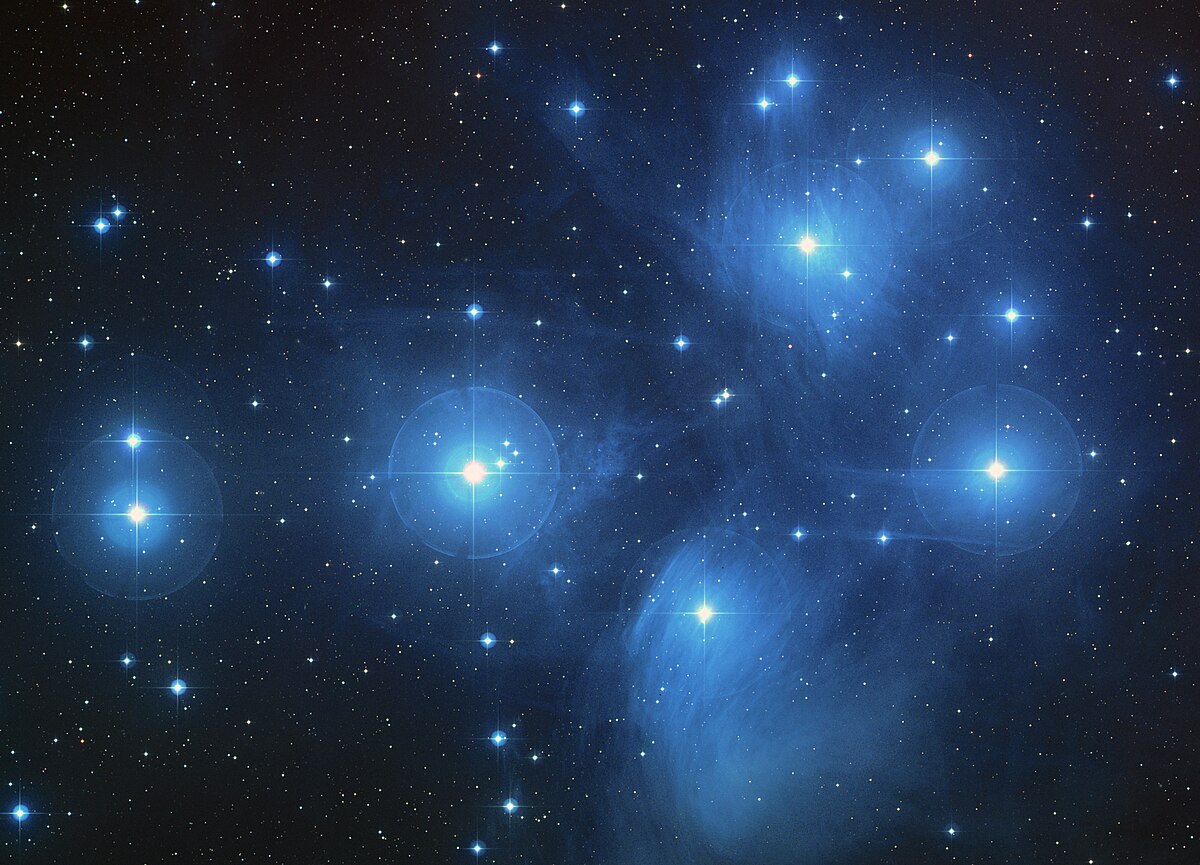
Attribution: NASA, ESA, AURA/Caltech, Palomar Observatory — The science team consists of: D. Soderblom and E. Nelan (STScI), F. Benedict and B. Arthur (U. Texas), and B. Jones (Lick Obs.)
Table of Contents
- What Is the Pleiades (M45) Open Star Cluster?
- How to Find and Observe the Pleiades from Any Sky
- Stellar Physics of the Pleiades: Age, Distance, and Motion
- Blue Reflection Nebulae: Dust, Scattering, and Spectra
- Stars, Brown Dwarfs, and Exoplanet Searches in M45
- Cultural History: The Seven Sisters Across Civilizations
- Using the Pleiades to Learn Naked-Eye Astronomy
- Research Frontiers: What the Pleiades Still Teach Us
- Frequently Asked Questions
- Final Thoughts on Exploring the Pleiades Star Cluster
What Is the Pleiades (M45) Open Star Cluster?
The Pleiades is a young, nearby open star cluster located in the constellation Taurus. To the unaided eye, it appears as a compact, glittering spray of blue-white stars that resembles a tiny dipper. Astronomically, the cluster is a laboratory for studying stellar evolution, rotation, magnetic activity, and the dynamics of star clusters in the Milky Way’s disk.
You can think of the Pleiades as a family of stars born from the same molecular cloud at roughly the same time. While the brightest members are hot B-type stars, the cluster includes hundreds of lower-mass, solar-type, and red-dwarf stars, plus a population of brown dwarfs. Taken together, these members move through space with a common velocity and share similar ages and compositions.
In most observing conditions, six of the cluster’s brightest stars stand out. Under dark skies and with good night vision, many observers can see more than six; with binoculars or a small telescope, dozens come into view against a background haze. That glow is enhanced by blue reflection nebulosity, sunlight scattered by nearby interstellar dust.
Names and designations
- Common names: Pleiades, Seven Sisters, Subaru (Japan)
- Catalogs: Messier 45, M45, Melotte 22, HIP/HD entries for individual stars
- Constellation: Taurus
- Approximate central coordinates (J2000):
RA 03h 47m,Dec +24°
While modern telescopes and surveys have cataloged over a thousand confirmed and candidate members, the Pleiades remains first and foremost a naked-eye showcase for all skywatchers. If you’re brand new to astronomy, jump to how to find and observe the Pleiades. If you’re a physics-minded reader, you may prefer to start with the cluster’s measured age and distance.
How to Find and Observe the Pleiades from Any Sky
Because M45 is bright, compact, and visible for months each year, it’s an ideal target for beginners and seasoned observers alike. You can spot it from the suburbs and enjoy it fully from dark rural skies.
Seasonal visibility and best times
- Northern Hemisphere: Best from late autumn to early spring. The cluster culminates (reaches its highest altitude) around local midnight in November–December, making late fall an excellent time for viewing.
- Southern Hemisphere: Visible during your spring and summer months; it still rises high enough to be a rewarding sight from mid-southern latitudes.
- Any latitude roughly between 66°N and 66°S can see the Pleiades well at some point during the year, given clear skies and a reasonably unobstructed view.
Star-hopping directions
- Find Orion: locate the three Belt stars in a short, straight line.
- Draw a mental line from Orion’s Belt upward and right (westward) toward the bright orange star Aldebaran in Taurus.
- Continue the same direction another ~15° to reach a compact little cluster that looks like a miniature dipper—the Pleiades.
On very clear nights, you may notice a subtle bluish haze around the brightest stars. This is not your imagination; it’s the cluster’s reflection nebula.
What to use: eyes, binoculars, or telescopes?
- Naked eye: Offers the pure aesthetic of a “tiny dipper” and is perfect for learning the sky.
- Binoculars (7×50, 8×42, 10×50): Arguably the best view. Binoculars frame the entire cluster and its outliers, revealing dozens of stars with a jeweled sparkle.
- Small telescopes: Use low power (20–60×) and a wide field of view. Higher magnifications can split close pairs but will crop the cluster’s overall shape. Consider sweeping across M45 at low power; wide-field eyepieces shine here.
Observing tips for different skies
- Suburban skies: M45 remains prominent. If the nebulosity is invisible, don’t worry; it’s subtle even in dark skies. Concentrate on star colors and the arrangement of the brightest members.
- Dark-sky sites: The cluster blooms. Scan with averted vision to pick up fainter members and the faint smoky sheen of dust, discussed in Blue Reflection Nebulae.
- Moonlight: Pleiades still shines, but fine details fade. Observe when the Moon is below the horizon for the best results.
Field guide: notable stars and asterisms
- Alcyone (Eta Tauri): Brightest member; easy to spot.
- Atlas and Pleione: A close pair east of Alcyone; look for Pleione tucked near Atlas. In steady air and with good optics, it’s a beautiful split.
- Maia, Merope, Electra, Taygeta, Celaeno: Other familiar Pleiads that form the classic dipper-like pattern.
- Merope Nebula: The brightest patch of reflection nebula near Merope; it is faint visually—binoculars under dark skies may hint at it.

Attribution: Juan Lacruz
If you like to record observations, try the log template in Using the Pleiades to Learn Naked-Eye Astronomy. For advanced background on what you’re seeing, visit Stellar Physics of the Pleiades.
Stellar Physics of the Pleiades: Age, Distance, and Motion
Beyond their beauty, the Pleiades are scientifically valuable because their stars share a common origin. That lets astronomers calibrate models of stellar evolution and compare stars of different masses at a known age and distance.
Distance and the Hipparcos–Gaia story
The Pleiades have long been a testbed for distance measurements. Early parallax estimates placed them roughly 400+ light-years away. A widely discussed controversy arose when the Hipparcos satellite (1990s) gave a shorter distance than expected. The discrepancy was resolved with subsequent measurements, including very long baseline interferometry and, crucially, data from the Gaia mission. Gaia’s high-precision parallaxes consistently support a distance of roughly 440–450 light-years (about 135–138 parsecs), aligning well with stellar models and other independent methods.

Attribution: ESO
This resolution was important for astrophysics: it validated main-sequence fitting techniques and reinforced confidence in using open clusters as benchmarks for distance scaling across the Galaxy.
Age and evolutionary state
The cluster is young by stellar standards—about 115–125 million years old. That age comes from multiple techniques, including fitting isochrones (theoretical curves of stellar brightness and color at a given age) to the color–magnitude diagram, as well as the lithium depletion boundary method, which observes when low-mass stars have depleted lithium in their cores. For the Pleiades, the lithium depletion boundary age and isochrone ages are in broad agreement, supporting the cluster’s youth.
In a color–magnitude diagram, Pleiades stars are still relatively close to the zero-age main sequence. The most massive members have evolved slightly, but none has yet exploded as a supernova. The cluster’s young age also explains why many stars exhibit rapid rotation and strong magnetic activity, emitting in ultraviolet and X-ray wavelengths more intensely than older, solar-age stars.
Proper motion, space motion, and tidal tails
Cluster members share a common motion through the Milky Way’s disk. Thanks to Gaia, astronomers can map this motion with exquisite precision, identify new candidate members, and trace the cluster’s extended structure. Evidence of long, faint “tidal tails” — streams of stars being stripped from the cluster by the Galaxy’s gravitational field — has emerged for several open clusters. Similar analyses for the Pleiades indicate extended structures around the cluster, offering insights into how open clusters gradually disperse over hundreds of millions of years.
These kinematic results matter beyond the Pleiades. They help researchers understand the survival timescales of open clusters, the role of Galactic tides, and how field stars (including the Sun) may once have belonged to now-dissolved clusters.
Composition and reddening
The Pleiades’ overall chemical composition is approximately solar, with small variations consistent with near-solar metallicity. A modest amount of interstellar dust toward the cluster produces slight reddening, which astronomers correct for when building precise color–magnitude diagrams. In practice, this reddening is small enough that casual observers won’t notice, but it matters for accurate astrophysical measurements and models.
For a direct connection to what you see in the eyepiece, explore the dust-scattering physics in Blue Reflection Nebulae, and then apply that insight during your next observing session as described in How to Find and Observe.
Blue Reflection Nebulae: Dust, Scattering, and Spectra
The delicate blue haze that photographs and deep visual observing sometimes reveal near M45 is a classic reflection nebula. It is not glowing gas (like an emission nebula) but starlight scattered by fine dust grains in the interstellar medium.
Why blue?
Small dust grains scatter shorter wavelengths more efficiently than longer ones—a process analogous to Rayleigh scattering in Earth’s sky. As a result, the reflected light from the Pleiades’ hot, blue-white stars is preferentially scattered in the blue part of the spectrum, giving the nebulosity its characteristic tint.
Illumination and geometry
A key point: the dust is likely unrelated to the original birth cloud of the Pleiades. Instead, the cluster appears to be passing through a patch of interstellar dust. The brightness and texture of the reflection nebula depend on the geometry—how dust sheets and filaments lie relative to the line of sight and the illuminating stars.
- The nebulosity is brightest around Merope (the Merope Nebula), where fine structures and jets of dust are revealed in long-exposure images.
- Other subtle patches surround Alcyone, Maia, and Electra, but these are challenging targets visually, even from pristine sites.

Attribution: Ngc1535
Spectra and polarization
Reflection nebulae show a continuum spectrum resembling that of the illuminating stars, modulated by dust scattering and absorption features. Observations also reveal polarization—light waves aligned in preferred directions due to scattering—which provides clues about dust grain size, composition, and alignment with magnetic fields.
Visual expectations
Even though the nebulosity is famous in images, it is subtle visually. Under dark, transparent skies with excellent seeing, keen observers using low-power, wide-field optics can sometimes detect a faint haze near Merope. Binoculars help by framing the nebulosity and boosting contrast. Don’t be disappointed if it eludes you; focus on the star colors and structure of the cluster, then revisit on exceptionally clear nights.
For a practical strategy to boost your chances of seeing the haze, revisit the tips in How to Find and Observe. Understanding the physics here can heighten your appreciation while observing.
Stars, Brown Dwarfs, and Exoplanet Searches in M45
Because all Pleiades members are nearly the same age and composition, the cluster is a favorite venue for testing stellar models across a broad range of masses, from hot B-type stars to cool M dwarfs and substellar brown dwarfs.
Bright B-type stars and lower-mass members
The cluster’s iconic stars—Alcyone, Atlas, Electra, Maia, Merope, Taygeta, and Celaeno—are hot, massive B-type stars that dominate the naked-eye view. But most cluster members are less massive, fainter stars that fill out the main sequence. Surveys using proper motion, color, and parallax identify these members with increasing precision, producing well-populated color–magnitude diagrams essential for testing stellar evolution theory.
Brown dwarfs in the Pleiades
The Pleiades played a historic role in the discovery of brown dwarfs—objects too low in mass to sustain hydrogen fusion in their cores. A landmark example is Teide 1, identified in the 1990s as a Pleiades brown dwarf. Since then, multiple brown dwarf candidates and confirmed members have been cataloged in the cluster. Because the Pleiades are young, their brown dwarfs are still relatively warm and luminous compared with older brown dwarfs, making them more detectable in deep surveys, especially in the infrared.
Rotation, magnetism, and activity
Young stars spin rapidly. In the Pleiades, periodic brightness variations caused by starspots reveal rotation periods that help calibrate models of angular momentum loss—a cornerstone of gyrochronology, which relates a star’s age to its rotation rate. These stars also exhibit strong magnetic activity, flares, and coronal emission detectable in ultraviolet and X-ray bands. Such activity wanes as stars age and spin down, so the Pleiades serve as a benchmark for youthful stellar behavior.
Disks, debris, and planet formation
At about 100+ million years old, most Pleiades stars have likely shed their primordial protoplanetary disks. However, some retain debris disks—belts of planetesimals and dust generated by collisions—that glow in the infrared. Debris disks are indirect signposts of ongoing planetesimal evolution rather than active planet formation.

Attribution: John Stauffer (Spitzer Science Center, Caltech); Credit: NASA/JPL-Caltech/J. Stauffer (SSC/Caltech)
What about exoplanets? Despite searches, there are no widely accepted, confirmed transiting exoplanets around Pleiades members comparable to the rich haul found in older or nearer clusters. The cluster’s youth creates challenges: rapid rotation and elevated stellar activity complicate radial velocity and transit measurements. Nonetheless, the Pleiades remain valuable for testing detection methods on young, active stars and for studying how debris evolves in planetary systems after the protoplanetary phase.
If you’re curious how these physical processes manifest in your eyepiece, combine this section with the observing guidance in How to Find and Observe and the dust physics in Blue Reflection Nebulae.
Cultural History: The Seven Sisters Across Civilizations
The Pleiades stir the human imagination. They appear in myth, navigation, agriculture, and calendars across the world—testimony to their brightness and prominence in the sky.
Greek myth and the name “Pleiades”
In Greek tradition, the Pleiades are the seven daughters of Atlas and Pleione: Alcyone, Merope, Electra, Maia, Taygeta, Celaeno, and Sterope (or Asterope). The cluster’s brightest stars bear these names. One recurrent motif is the “lost Pleiad,” explaining why most people easily see six stars and not seven—an observation echoed in many cultures.
Subaru and Japanese culture
In Japan, the cluster is called Subaru, meaning “to unite” or “to gather together.” The Subaru automobile logo features six stars as a stylized nod to the cluster. The Pleiades also appear in traditional Japanese star lore and seasonal references.
Pacific traditions: Matariki and Makali‘i
- New Zealand Māori: Matariki marks the start of the Māori New Year, associated with remembrance and renewal.
- Hawai‘i: Known as Makali‘i, the cluster plays roles in navigation, seasons, and planting cycles.
South Asian and East Asian calendars
- India: The Pleiades are Kṛttikā, one of the Nakshatras (lunar mansions) in traditional Indian astronomy.
- China: The cluster is the asterism Mǎo (昴), part of the traditional Chinese celestial mansions. It has been used in calendrical and astrological contexts for centuries.
Indigenous North American traditions
Stories about the Pleiades are widespread among Indigenous peoples of the Americas. A well-known example is the Kiowa legend of children placed into the sky to form the cluster. Similar motifs of transformation, protection, and seasonal cycles appear across cultures, underscoring how conspicuous the cluster is to observers worldwide.
In literature and scripture
The cluster appears in classical and modern literature, and in biblical texts (for example, the Book of Job references the Pleiades: “Can you bind the chains of the Pleiades?”). Such references often highlight the cluster’s compactness and the sense of cohesion among its stars—which resonates with its physical reality as a bound star cluster.
These cross-cultural threads make the Pleiades a powerful gateway to public engagement with astronomy. While observing, consider sharing the stories of the Seven Sisters alongside the science from Stellar Physics.
Using the Pleiades to Learn Naked-Eye Astronomy
The Pleiades are a versatile toolkit for improving your observing skills, whether you’re developing star-hopping techniques or testing your sky conditions. Here are practical ways to use M45 as a learning anchor.
Estimate your limiting magnitude
A classic approach is to count the number of Pleiads you can see unaided. While subjective and affected by experience, this gives a rough sense of your sky’s darkness and your night vision:
- 4–6 stars: Urban/suburban conditions or bright Moon.
- 7–9 stars: Good suburban skies and decent transparency.
- 10+ stars: Dark-sky site with good transparency and full dark adaptation.
Try the same on multiple nights and record your counts. Compare results against Moon phase, humidity, and transparency to learn how conditions change what you can perceive.
Practice averted vision and patience
Spend a few minutes simply gazing near the cluster rather than directly at it. Averted vision leverages the sensitivity of rods in your peripheral retina. The technique helps reveal faint outliers and any hint of nebulosity discussed in Blue Reflection Nebulae.
Binocular sweep and framing
With 7×50 or 10×50 binoculars, slowly sweep across the cluster. Note how the bright core transitions to sparser outskirts. Experiment with different magnifications and fields of view to learn which optics frame the cluster best—knowledge you can apply to other wide-field treasures like the Hyades, the Beehive Cluster (M44), or the Double Cluster.
Quick-start observing log template
Target: Pleiades (M45)
Date/Time (local):
Location (lat/long):
Sky Conditions: (Transparency/Seeing/Moon phase/Clouds)
Optics: (Unaided / Binoculars / Telescope + eyepiece)
Notable stars spotted: (Alcyone, Atlas, Pleione, Maia, Merope, etc.)
Number of stars visible naked-eye:
Notes on nebulosity (if any):
Sketch/Field map:
Revisit this log across the season to track how the cluster’s altitude, sky darkness, and your improved technique affect what you see. For reference values to compare your impressions with the science, see Age, Distance, and Motion.
Public outreach and education
M45 is ideal for introducing newcomers to the sky. Its brightness means it withstands city light, and its backstory bridges science and culture. When hosting a public night, you can move seamlessly from the cluster’s astrophysics to cross-cultural stories, then guide participants in a binocular sweep as described in How to Find and Observe.
Research Frontiers: What the Pleiades Still Teach Us
Even after centuries of observation, the Pleiades remain scientifically active terrain. Advances in precise astrometry, spectroscopy, and time-domain surveys keep turning this familiar cluster into a calibration tool and a test case.
Gaia-era membership and dynamics
Gaia’s precise parallaxes and proper motions refine cluster membership lists and identify extended structures. With these data, astronomers can:
- Map the cluster’s three-dimensional shape.
- Derive accurate velocity dispersions and assess dynamical states.
- Search for tidal tails and substructure that hint at the cluster’s past interactions with the Galactic environment.
Such analyses inform models of open cluster lifetimes and how stars drift into the Galactic field—a process relevant to the Sun’s own origins.
Rotation sequences and gyrochronology
The Pleiades are central to calibrating the relation between stellar age and rotation rate. Photometric surveys monitor thousands of stars for subtle, periodic variations caused by starspots. The resulting distribution of rotation periods across stellar masses constrains how magnetized stellar winds remove angular momentum over time.
Comparisons with slightly older or younger clusters test how fast stars spin down and when they converge onto well-defined rotation–age sequences. The Pleiades thus serve as a bridge between very young clusters with disks and older clusters like the Hyades and Praesepe.
Lithium depletion boundary and low-mass physics
By charting which low-mass stars have depleted lithium in their cores, astronomers obtain an age measurement relatively independent of some of the uncertainties in stellar models. The Pleiades’ lithium depletion boundary age offers a strong cross-check on isochrone fitting, improving confidence in the cluster’s overall age and informing our understanding of low-mass stellar interiors.
High-energy emission and activity cycles
Ultraviolet and X-ray observations reveal vigorous magnetic activity in Pleiades stars, tied to rapid rotation and deep convective zones in lower-mass members. Studying activity levels and cycles in a coeval population helps untangle how stellar magnetism evolves and affects planetary environments during the critical early epochs after planet formation.
Brown dwarf atmospheres and evolution
Brown dwarfs in the Pleiades, with a known age, enable tests of atmospheric and evolutionary models. Their emergent spectra carry signatures of clouds, molecules, and dust in cool atmospheres. Observations across infrared bands test predictions about cooling rates, surface gravities, and cloud properties in objects on the boundary between stars and planets.
Cross-reference these frontiers with the overview in Stars, Brown Dwarfs, and Exoplanet Searches and the foundational context in Stellar Physics.
Frequently Asked Questions
Why do most people see six stars in the Pleiades instead of seven?
Visibility depends on sky darkness, transparency, and individual eyesight. Under city or suburban skies, six bright stars stand out. The “Seven Sisters” name reflects cultural stories and brighter members in the cluster, not a guarantee that everyone can see seven unaided at all times. Under dark skies with full dark adaptation, many observers can spot more than seven. Binoculars quickly reveal several dozen.
Is the blue nebulosity leftover from the Pleiades’ formation?
The prevailing view is no. The dusty reflection nebula is likely an unrelated interstellar cloud through which the cluster is currently passing. The Pleiades are young, but the timescales and geometry suggest a chance encounter with ambient dust, not the original birth cloud. For the physics of why it looks blue, see Blue Reflection Nebulae.
Final Thoughts on Exploring the Pleiades Star Cluster
The Pleiades are a rare gift: a celestial object that thrills the eye, anchors myth and culture, and advances modern astrophysics. Through binoculars, they’re an elegant splash of starlight; through spectrographs and space telescopes, they’re a benchmark for age dating, stellar rotation, and dust physics. And thanks to the Gaia mission, the cluster’s distance and membership are known with greater precision than ever, strengthening its role as a cornerstone in stellar astronomy.

Attribution: Nico Carver
On your next clear night, step outside, find Orion, slide past Aldebaran, and let the tiny dipper of M45 draw you in. Use the guidance in How to Find and Observe, keep an eye out for the faint blue haze, and consider how the same cluster has guided calendars, navigation, and stories for millennia (Cultural History). Then, if curiosity sparks, dive deeper into the Stellar Physics and Research Frontiers sections to see how this familiar jewel continues to shape our understanding of stars.
If you enjoyed this guide, explore more of our weekly deep dives into the night sky, and subscribe to our newsletter so you never miss new observing tips, science explainers, and sky highlights.