
Table of Contents
- What Is the Pleiades (M45) Star Cluster?
- Where and When to Find the Pleiades in the Sky
- Science of the Seven Sisters: Distance, Age, and Stellar Evolution
- Blue Reflection Nebula: Why the Pleiades Shine in Dust
- Observing the Pleiades: Naked Eye, Binoculars, and Telescopes
- Pleiades for Astrophotographers: Planning, Capture, and Processing
- Cultural Astronomy and Etymology: Global Stories of M45
- Pleiades in the Gaia Era: Membership, Tidal Tails, and Rotation
- Frequently Asked Questions
- Final Thoughts on Exploring the Pleiades Star Cluster
What Is the Pleiades (M45) Star Cluster?
The Pleiades, also known as Messier 45 or M45, is one of the most recognizable open star clusters in the night sky. Often called the “Seven Sisters,” it forms a compact, glittering group of hot blue stars embedded in faint, ghostly nebulosity. Located in the constellation Taurus, the Pleiades have captivated skywatchers for millennia—serving as a seasonal marker for agriculture, a navigational aid, and a gateway target for new observers learning the sky.
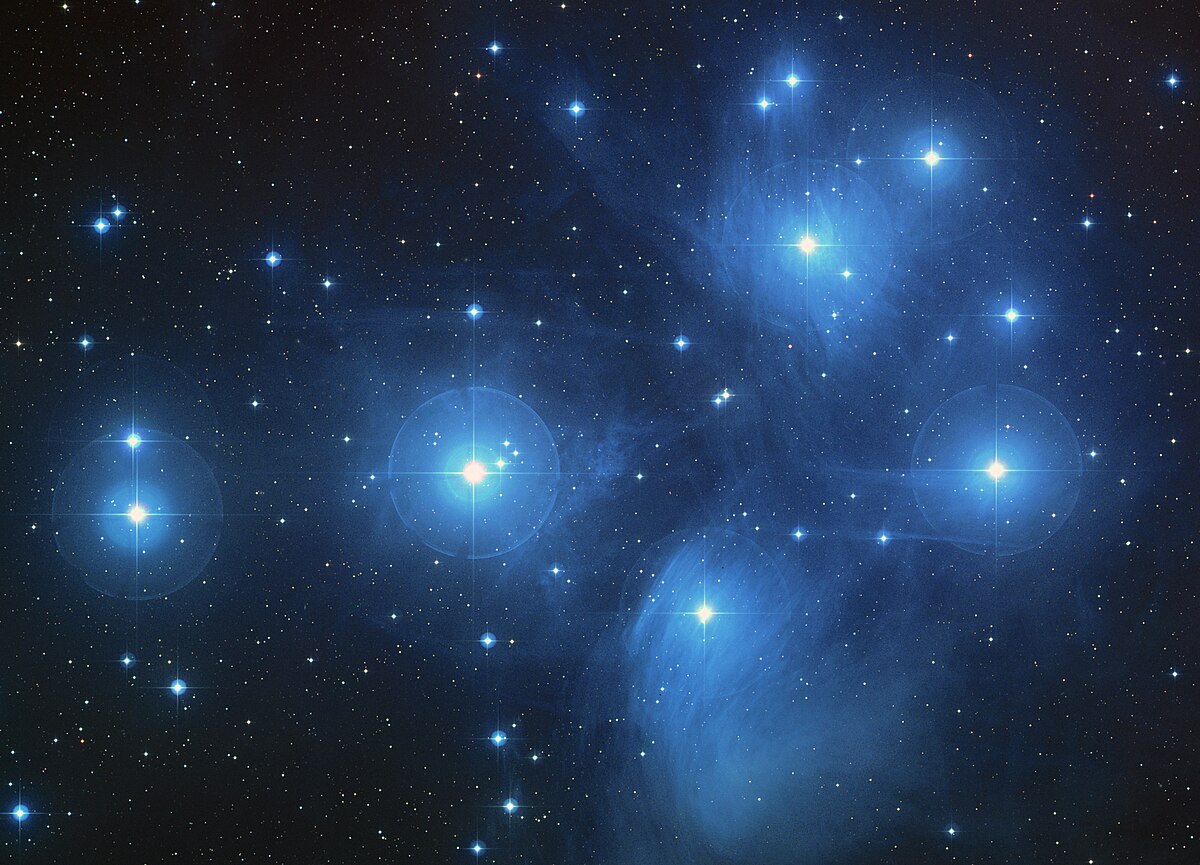
From a scientific perspective, the Pleiades provide a textbook example of an intermediate-age open cluster: young enough that many of its stars are still hot and rapidly spinning, yet old enough to exhibit a well-defined main sequence and a notable population of lower-mass stars and brown dwarfs. The cluster is close by on a galactic scale, so astronomers use it to calibrate distance measurements and test models of stellar evolution. The Gaia mission in particular has sharpened our understanding of its distance, membership, and internal dynamics.
To set the stage for everything that follows—whether your interest is scientific or observational—this article covers where to find the Pleiades, what physical processes shape their appearance, and practical guidance for observing or imaging them from a range of skies. If your priority is hands-on viewing advice, feel free to jump directly to Observing the Pleiades: Naked Eye, Binoculars, and Telescopes or to Pleiades for Astrophotographers for capture strategies. For deeper science, see Science of the Seven Sisters and Pleiades in the Gaia Era.
Where and When to Find the Pleiades in the Sky
Most observers can locate M45 without optical aid. Look for a tight, distinct knot of stars resembling a tiny dipper west of the orange star Aldebaran and the V-shaped Hyades cluster in Taurus. In the Northern Hemisphere, the Pleiades ride high on autumn and winter nights, roughly from October through April, and are beautifully placed during late evening hours in November through January. In the Southern Hemisphere, they are a prominent feature of the summer sky.
Some practical orientation tips:
- Star-hopping from Orion: Draw a line from Orion’s Belt through the bright star Aldebaran, then continue ~14 degrees to reach M45. As the Belt rises in the east during northern autumn evenings, the Pleiades rise ahead of it.
- Relation to the ecliptic: The Pleiades lie close to the ecliptic, so the Moon and planets occasionally pass near the cluster. Lunar close approaches or occultations can create dramatic naked-eye scenes, although bright moonlight will wash out the nebulosity and fainter cluster members.
- Altitude and visibility: At mid-northern latitudes, the Pleiades reach high altitudes and are easy to see; at tropical latitudes they pass nearly overhead; at far southern latitudes they are still well placed in the warm season.
Right Ascension and Declination are useful if you have a star charting app, an equatorial mount, or a go-to telescope:
RA (J2000): 03h 47m

Dec (J2000): +24° 07′

Angular size: ~100 arcminutes (bright core ~60′)

Integrated magnitude: ~1.6
# Observing Log — Pleiades (M45)

Date/Time (UTC):

Location/Lat-Long:

Seeing/Transparency:

Instrument/Eyepiece or Camera/Lens:

Sky Brightness (Bortle/SQM):

Notes: (visible stars, nebulosity hints, framing, color, etc.)
For the best visual experience, plan to observe when the Moon is below the horizon and avoid high haze or thin clouds. If you intend to photograph the Pleiades, check for the darkest nights near new Moon and see Pleiades for Astrophotographers for planning details and exposure recommendations.
Science of the Seven Sisters: Distance, Age, and Stellar Evolution
Open clusters like the Pleiades form when a giant molecular cloud collapses, spawning hundreds to thousands of stars in a relatively compact volume. Over time, gravitational interactions and the Galactic tidal field disperse many clusters; those that survive offer laboratories for testing how stars evolve when they share nearly the same age and initial chemical makeup.
The distance to the Pleiades was debated for years. Earlier space-based parallax measurements suggested a closer distance than traditional methods implied. The high-precision astrometry of the Gaia mission resolved this discrepancy, situating the Pleiades at roughly 136 parsecs—about 444 light-years. This distance is now widely adopted in the literature and has helped refine the upper main sequence fits and the calibration of stellar models.
Age estimates have converged using multiple techniques, including main-sequence turnoff analysis and the lithium-depletion boundary method. The consensus places the Pleiades at roughly 100–125 million years old, often cited around 112 million years. That makes the cluster old enough that the most massive O-type stars have already evolved off the main sequence (or would have exploded as supernovae long ago), but young enough that many B-type and A-type stars still dominate the light.
The brightest members include Alcyone (η Tauri), Atlas, Electra, Maia, Merope, Taygeta, Celaeno, Sterope (sometimes listed as Asterope), and Pleione. Several of these are blue-white B-type stars with temperatures tens of thousands of degrees Kelvin. A field of fainter, lower-mass stars fills the cluster, and surveys have identified a significant population of K- and M-type dwarfs along with brown dwarfs with masses below the hydrogen-burning threshold. These low-mass members are important for tracing the cluster’s mass function and dynamical evolution.
Rotation and magnetic activity are especially interesting in the Pleiades because of the cluster’s youth. Many of its stars spin quickly and show strong chromospheric activity. As stars age, they generally lose angular momentum through magnetized winds and spin down; the Pleiades provide a key benchmark for rotation-age relations (“gyrochronology”). Likewise, lithium is depleted in stellar envelopes over time, and the so-called lithium-depletion boundary within the faint, low-mass members offers an independent clock for the cluster’s age.
Mass segregation—where the more massive stars are concentrated more tightly toward the cluster’s center—appears in the Pleiades as it does in many open clusters. This can occur dynamically as encounters exchange energy, nudging massive stars inward while lower-mass members drift outward or are preferentially stripped by the Milky Way’s tidal field. As discussed in Pleiades in the Gaia Era, wide-field proper motion studies reveal extended structures beyond the cluster’s bright core, highlighting that the Pleiades are not confined to the compact knot you see with the naked eye.
Finally, the Pleiades are often invoked in discussions of dust and circumstellar material. Several bright stars exhibit infrared excesses indicative of debris disks—relics of planetesimal populations that grind down over time. The environment is rich for studying the interplay between cluster stars, interstellar dust, and evolving planetary systems.

Blue Reflection Nebula: Why the Pleiades Shine in Dust
One of the most striking features of M45 in photographs is the blue reflection nebula that seems to wrap around and stream away from its brightest stars, particularly Merope and Maia. Unlike emission nebulae, which glow red due to hydrogen recombination, reflection nebulae do not emit their own light. Instead, they scatter and reflect starlight off microscopic dust grains—preferentially scattering blue wavelengths in a manner loosely analogous to why Earth’s sky looks blue.

In the Pleiades, the dust is thought to be interstellar material that the cluster is currently passing through, rather than gas and dust left over from the cluster’s own formation. This interpretation explains the mismatch between the cluster’s inferred age and the short timescales over which the luminous blue nebula would dissipate if it were a residual formation cloud. The dust geometry is complex: in many astrophotos, you can see filamentary structures, rifts, and gradients in brightness that reveal an intricate three-dimensional interplay between stars and dust lanes.
The color is a diagnostic clue. Reflection nebulae appear bluish because small dust grains scatter shorter wavelengths more efficiently than longer ones; red light tends to pass through or be scattered less, so the scattered light that reaches us is enriched in blue. Spectroscopy of the Pleiades nebula confirms the continuum-dominated, starlight-reflection spectrum without strong emission lines that would indicate ionized gas at high temperatures. This is a key reason why filters designed for emission nebulae (such as H-alpha or OIII narrowband filters) are not helpful for imaging the Pleiades; the nebula is broadband reflected light, not line emission. If you plan on imaging, see the capture details in Pleiades for Astrophotographers.
Visual observers sometimes report a faint, milky glow around the brightest stars from exceptionally dark locations with pristine transparency. However, the surface brightness of the reflection nebula is low, and most viewers will not see extensive nebulosity visually. Long exposures and image stacking are far more revealing, which is why the Pleiades are a favorite subject for astrophotographers working at focal lengths from 50 mm to 400 mm.
Observing the Pleiades: Naked Eye, Binoculars, and Telescopes
The Pleiades reward every level of observer. They are a classic benchmark to assess sky quality, a delightful binocular object under almost any conditions, and a subtle, low-power telescope target.
Naked-eye views and star counts
From a dark rural site, most people can see six or seven stars without optical aid. Some can count nine or more, depending on visual acuity, experience, and the darkness of the sky. The naked-eye brightness and compact arrangement make M45 a useful natural indicator of light pollution: if you struggle to see more than four or five stars in the cluster, your sky is likely significantly affected by urban glow or haze.
Try averted vision—looking slightly away from the cluster while keeping it in your peripheral view—to detect fainter members. This technique can enhance sensitivity to dim stars because the human eye’s rod cells are more responsive away from the central fovea.
Binoculars: the best way to experience M45
Binoculars in the 7×35 to 10×50 range are often the ideal instrument for the Pleiades. The cluster spans about two degrees of sky—four times the diameter of the full Moon—so a wide field of view frames it beautifully. With 7×50 or 10×50 binoculars under decent skies, dozens of stars pop into view, and the triangular core anchored by Alcyone becomes obvious. Scan around the edges: you’ll notice streamers of fainter stars and possibly the close pair of Atlas and Pleione near Alcyone.
For steadier views, mount your binoculars on a tripod or use a reclining chair. If you wear glasses for astigmatism, keep them on to maintain sharp star images; otherwise, try without glasses and adjust the diopters for each eye.
Telescopes: low power and wide fields
Because of its size, the Pleiades are best seen through a telescope at low magnification with a wide-field eyepiece. Refractors with short focal lengths (e.g., 80–120 mm apertures) and Dobsonian reflectors equipped with 2-inch, wide-angle eyepieces excel at framing the entire cluster. If you zoom in too much, you’ll lose the context—and the aesthetic richness—of the star patterns.
Filters are usually unhelpful. Nebula filters are intended for emission lines and do not enhance broadband reflection nebulae. A mild broadband light pollution filter can sometimes improve contrast around bright stars, but the effect is subtle. For visual hints of nebulosity, prioritize dark, transparent nights over hardware solutions.
Targets within the cluster
- Alcyone (η Tauri): The brightest member, a blue-white B-type star. Examine the star field nearby to notice fine chains of fainter cluster stars.
- Atlas and Pleione: A close pair near the edge of the bright core. At low magnification they appear as a lovely double; higher power may split them further under steady seeing.
- Merope’s region: The Merope Nebula (NGC 1435) is a classic photographic subject. Visually, only a very faint haze may be suspected under exceptional skies.

Tip: If you only have a small telescope and a narrow eyepiece, sweep around the cluster rather than trying to keep the core centered. The sense of “cluster embedded in starfields” is part of the allure.
Urban and suburban observers can still enjoy the Pleiades. Even under light pollution, binoculars will show the main asterism, though the fainter stars and any hint of nebulosity will be suppressed. If you have access to a darker site, revisit the cluster there—you’ll be amazed at how much more populous and three-dimensional it seems. If imaging is your goal, jump to Pleiades for Astrophotographers for guidance tailored to bright-but-broadband reflection nebulae.
Pleiades for Astrophotographers: Planning, Capture, and Processing
The Pleiades are a prime target for astrophotographers at nearly every experience level. Their brightness and compact size make them accessible to short focal lengths, while the low surface brightness of the reflection nebulosity rewards long integration times and careful processing.

Framing and focal length choices
- 50–85 mm lenses: Great for wide-field compositions that show Pleiades in context with Taurus, the Hyades, and Aldebaran. You will capture the cluster as a compact jewel and begin to hint at the surrounding dust if your integration is long enough from dark skies.
- 100–200 mm lenses: Ideal for filling the frame with the cluster and its primary reflection nebulosity. This is a sweet spot for many DSLR or mirrorless shooters on a star tracker.
- 300–400 mm refractors: Reveals more intricate dust structures and the full extent of the bluish reflection. Requires accurate tracking and guiding for long subexposures.
Exposure strategy and sky conditions
The Pleiades are a broadband target. Since the nebula is reflection-dominated, narrowband filters (Hα, OIII) do not help. Light pollution filters designed for emission lines will also be of limited use. The best “filter” is a dark sky, good transparency, and sufficient total exposure time.
- Subexposure length: Choose based on sky brightness and tracking accuracy. Typical subexposures range from 30–180 seconds for DSLR/mirrorless on a tracker at 100–200 mm; 120–300 seconds for guided refractors under dark skies. Keep the bright stars below saturation to preserve color and structure.
- Total integration: Aim for 2–6 hours for clear nebulosity at moderate focal lengths; more time always helps, especially under suburban skies.
- ISO/gain: For DSLRs, mid-range ISO (e.g., 400–1600) balances read noise and dynamic range. For modern astro cameras, set gain according to unity or your camera’s sweet spot.
- Dithering and calibration: Dither between subs to combat fixed pattern noise. Calibrate with bias (or dark flats), darks, and flats to tame gradients and vignetting.
Color and star management
Processing the Pleiades is often a lesson in restraint. The blue reflection nebula can be brought out with careful background extraction and gentle stretches. Watch for halos and over-enhancement; the dust should have texture and subtle gradients, not uniform, over-saturated patches.
- Background modeling: Use gradient removal tools to correct light pollution and lens vignetting, but protect faint dust. Overaggressive gradient removal can erase real signal.
- Star color: The cluster’s stars are intrinsically blue-white. If your processing renders them stark white, reduce saturation selectively and adjust white balance. Star color calibration using reference catalogs or photometric tools can help.
- Star reduction: Mild star reduction can emphasize dust structures, but avoid harsh shrinking that produces unnatural halos or doughnut shapes around bright stars.
Common pitfalls
- Over-saturation of blues: The Pleiades are blue, but the end result should still show nuanced shading and transitions, not a uniform electric-blue wash.
- Ignoring dynamic range: Bright stars easily clip. Use HDR techniques or shorter subs mixed with longer ones to preserve stellar cores.
- Narrowband-only attempts: Reflection nebulae are broadband. Narrowband filters won’t capture their true character.
Finally, plan around Moon phase. Even a half Moon will raise the sky background enough to mute the nebula. If you can’t avoid moonlight entirely, consider shorter focal lengths and emphasize the asterism; then return under a new Moon to pursue the dust in depth.
Cultural Astronomy and Etymology: Global Stories of M45
The Pleiades are deeply embedded in cultural astronomy across the globe. Their prominence and seasonal rising and setting patterns made them natural markers of time and change for agricultural and navigational societies.
- Greek tradition: The name “Pleiades” is commonly linked to the myth of the seven daughters of Atlas and Pleione transformed into stars. Several star names in the cluster—Alcyone, Electra, Maia, Merope, Taygeta, Celaeno, and Sterope—reflect this tradition.
- Japanese name: In Japan, the Pleiades are called “Subaru,” meaning “to unite” or “to gather together.” The Subaru car company’s logo of six stars is inspired by the cluster (one of the seven sisters is traditionally fainter to the naked eye).
- Polynesian navigation: Across Polynesia, the cluster served as an important seasonal indicator and appears in navigation lore, with names and interpretations varying across island cultures.
- Indigenous traditions: Many Indigenous peoples worldwide incorporate the Pleiades into seasonal cycles and storytelling. The details differ by culture, but the shared emphasis on the cluster’s first dawn appearance (heliacal rising) as a time marker is common.
These cultural threads underscore the Pleiades’ role as a universal sky landmark. While interpretations vary, the astronomical reality—an open cluster of young stars—ties the global stories to a single physical object. If cultural context inspires you to observe, you’ll find practical guidance in Observing the Pleiades.
Pleiades in the Gaia Era: Membership, Tidal Tails, and Rotation
The European Space Agency’s Gaia mission provides astrometry—precise positions, parallaxes (distances), and proper motions—for over a billion stars. For nearby clusters like the Pleiades, Gaia has been transformative, enabling clean membership catalogs and revealing extended structures beyond the bright core.

Key insights in the Gaia era include:
- Refined distance and membership: Consistent parallax measurements place the Pleiades at roughly 136 pc. Proper motion clustering allows astronomers to separate genuine members from background field stars and to identify more distant, lower-luminosity members that extend the mass function toward brown dwarfs.
- Extended halos and tidal tails: Analyses of Gaia data have found that the Pleiades are embedded within a larger complex of co-moving stars and extended tidal tails. These structures can span tens of degrees on the sky, reflecting stars that have been gently stripped by Galactic tides yet retain coherent motion with the cluster. This demonstrates that open clusters are not sharp-edged islands; they are more like evolving streams shedding stars into the Galactic disk.
- Internal kinematics: With precise motions, researchers can probe the cluster’s internal velocity dispersion and search for evidence of mass segregation and dynamical heating. The Pleiades’ kinematic profile helps test models of open cluster lifetimes and dissolution processes.
- Rotation and activity: Photometric time series from wide-field surveys measure rotation periods for large samples of Pleiades stars. Rotation distributions at the cluster’s age reveal the bimodal spin populations and shed light on how stellar winds and magnetic coupling slow stars over time. These data underpin gyrochronology relations that, when calibrated with clusters like the Pleiades, help estimate ages of field stars.
This modern picture elevates the Pleiades from a pretty sky bauble to a dynamic, evolving collection of stars embedded in a web of Galactic forces. For observers, that dynamism is invisible to the eye—but for astrophysicists, it is a trove of precise measurements enriching our understanding of how stars form, evolve, and disperse.
Frequently Asked Questions
Are the Pleiades part of the Taurus star-forming region?
Although the Pleiades lie in the direction of the Taurus constellation, the cluster is not embedded in the Taurus star-forming clouds. The Pleiades are older—around 100–125 million years—and located at their own distance. The blue nebulosity is commonly interpreted as interstellar dust the cluster is currently passing through, not leftover star-forming material. In contrast, the Taurus Molecular Cloud is the site of ongoing, very young star formation.
How many stars are in the Pleiades, and why do I only see a few?
The Pleiades contain more than a thousand stars when accounting for low-mass members and brown dwarfs, depending on how membership is defined. Our eyes, however, see only the brightest handful under typical conditions—often six or seven from suburban skies, more from dark sites. The rest require binoculars or a telescope to bring into view. Wide-field photographs reveal even richer star counts and the surrounding reflection nebula.
Final Thoughts on Exploring the Pleiades Star Cluster
The Pleiades (M45) succeed on multiple levels: they are a naked-eye showpiece, a binocular favorite, a rewarding low-power telescope target, and a scientifically rich laboratory for modern astrophysics. With Gaia refining distance, membership, and dynamics, and with long-exposure imaging unveiling the delicate reflection dust, M45 remains both familiar and ever-new.
If you are observing, prioritize dark, moonless nights and low magnification to take in the cluster’s full breadth. If you are imaging, aim for long total integration under transparent skies, balancing star color and dust contrast with gentle processing. And if you are learning the science, use the Pleiades as a stepping stone to topics like open cluster evolution, gyrochronology, and interstellar dust scattering. For more practical tips, revisit Observing the Pleiades and Pleiades for Astrophotographers, and for context, explore Pleiades in the Gaia Era.
Clear skies, and if you enjoyed this deep dive, consider subscribing to our newsletter to receive upcoming guides on nearby clusters, seasonal targets, and the latest insights from sky surveys and space missions.