Table of Contents
- What Is Numerical Aperture in Microscopy?
- How Resolution, Numerical Aperture, and Magnification Interrelate
- Diffraction Limits: Abbe’s Theory and the Rayleigh Criterion
- Wavelength, Refractive Index, and Immersion Media
- Condenser NA, Illumination, and Coherence in Brightfield
- Contrast Transfer, MTF/OTF, and Practical Visibility
- Useful Magnification vs Empty Magnification
- Digital Imaging, Sampling, and Nyquist Criteria
- Common Misconceptions to Avoid
- Practical Ways to Optimize Resolution Responsibly
- Frequently Asked Questions
- Final Thoughts on Choosing the Right NA and Magnification Strategy
What Is Numerical Aperture in Microscopy?
Numerical aperture (NA) is a fundamental quantity that determines how much detail a microscope objective can collect from a specimen. In simple terms, NA sets the stage for the resolving power of your imaging system by quantifying the objective’s ability to gather light over a range of angles. Formally, it is defined as:
NA = n · sin(θ)
Here, n is the refractive index of the medium between the specimen and the objective’s front lens (for example, approximately 1.0 for air, ~1.33 for water, and typically ~1.515 for immersion oil used with standard cover glasses), and θ is half the angular aperture of the light cone that the objective can accept. This definition directly encodes two physical realities:
- Using a medium with higher n allows the objective to accept steeper rays (larger θ) without total internal reflection, so NA increases.
- Larger acceptance angle θ means the lens captures more high-angle diffracted light from fine features in the specimen, improving resolution.
NA values are engraved on objective barrels because they are core performance specifications. While magnification (e.g., 10×, 40×, 100×) describes image size, it does not set resolving power. Two objectives with the same magnification but different NAs will deliver different resolutions and contrast.

Artist: QuodScripsiScripsi
From an educational perspective, understanding NA clarifies why simply “turning up magnification” does not reveal new detail after a point. If you want to resolve finer structure, you typically need to increase NA or use a shorter wavelength, not just increase magnification. We will return to this central relationship in How Resolution, Numerical Aperture, and Magnification Interrelate.
How Resolution, Numerical Aperture, and Magnification Interrelate
Resolution is the smallest separation at which two features can be distinguished as separate. In optical microscopy, the fundamental limit arises from diffraction and is governed by NA and wavelength. Two standard, closely related expressions are widely cited:
- Rayleigh criterion (point objects):
d ≈ 0.61 · λ / NA - Abbe limit (periodic structures):
d ≈ λ / (2 · NA)
Both formulas show that resolution improves (smaller d) for higher NA and shorter wavelength λ. In practice, these two criteria yield very similar predictions for lateral resolution, and both are used in microscopy education. We will discuss their contexts in more detail in Diffraction Limits: Abbe’s Theory and the Rayleigh Criterion.
Magnification, by contrast, makes details larger but does not create new information. Once your image is sampled adequately (by the eye or a camera), extra magnification yields little benefit. This is known as empty magnification and is addressed in Useful Magnification vs Empty Magnification.
To visualize the interplay:
- NA sets the information content you can capture from the specimen (together with wavelength).
- Magnification scales that information up for comfortable viewing and sampling.
- Contrast transfer (how well different spatial frequencies are transmitted) ultimately determines whether you can see that information; see Contrast Transfer, MTF/OTF, and Practical Visibility.
These three—NA, resolution, and magnification—form a coherent triangle. To truly improve the meaningful detail in your images, focus first on NA and wavelength, ensure appropriate illumination and condenser settings, and then apply enough magnification to make those details visible and properly sampled.
Diffraction Limits: Abbe’s Theory and the Rayleigh Criterion
Light behaves as a wave, and when it passes through small features (such as apertures or fine specimen details), it diffracts. This diffraction causes point-like objects to blur into a characteristic intensity distribution called the Airy pattern, whose central bright region is the Airy disk. The size of this disk and the ability of the optical system to distinguish two overlapping disks underlie standard resolution criteria.

Artist: Anaqreon (talk) (Uploads)
Abbe’s formulation
Ernst Abbe described how periodic specimen structures (like gratings) produce diffracted orders. To form a resolvable image of a periodic pattern, the objective must collect at least the zeroth and first diffracted orders. This requirement leads to a lateral resolution limit of approximately:
d_Abbe ≈ λ / (2 · NA)
Abbe’s derivation emphasizes that the microscope acts as a spatial frequency filter. The objective NA sets the highest spatial frequencies (finest details) that reach the image plane. A larger NA means a broader passband.
Rayleigh’s criterion
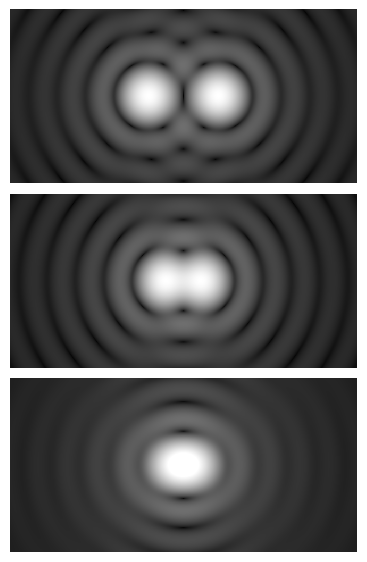
Lord Rayleigh described a criterion for two identical point sources: they are considered just resolvable when the principal maximum of one Airy pattern coincides with the first minimum of the other. This yields the familiar expression:
d_Rayleigh ≈ 0.61 · λ / NA
Artist: Spencer Bliven
While Abbe’s and Rayleigh’s limits are derived differently and apply to different object models (periodic structures vs. point sources), they produce comparable scales for lateral resolution. Both teach the same lesson: increasing NA or using a shorter wavelength improves resolution.
Axial (depth) resolution
In widefield microscopy, axial resolution (along the optical axis) is coarser than lateral resolution. A commonly used approximation for axial resolution is:
Δz (widefield) ≈ 2 · n · λ / NA²
This expression captures two important trends:
- Axial resolution improves quickly as NA increases (because of the
NA²dependence). - Higher refractive index n in the immersion medium improves axial resolution.
Because axial resolution worsens more severely at lower NA, three-dimensional detail benefits strongly from high-NA objectives and appropriate immersion media, as explored in Wavelength, Refractive Index, and Immersion Media.
Wavelength, Refractive Index, and Immersion Media
Both the Abbe and Rayleigh criteria scale with wavelength. Shorter wavelengths yield finer resolution. This is why blue light (shorter wavelength) resolves slightly better than red light (longer wavelength) under otherwise identical conditions. Yet the refractive index of the medium directly enters the NA via NA = n · sin(θ), so immersion media matter too.
Why immersion objectives achieve higher NA
Air objectives are limited because the highest acceptance angle still propagating in air limits the NA to values near 1.0. By filling the space between the cover glass and the objective front lens with a medium of higher refractive index, such as immersion oil (typically around 1.515 under standard conditions), objectives can accept steeper rays without total internal reflection. This enables NA values greater than 1.0, typically up to around 1.4 for standard oil immersion objectives, thereby improving resolution and light-gathering efficiency.

Artist: Thebiologyprimer
Water immersion objectives (with n ~ 1.33) offer advantages in certain contexts, particularly when imaging aqueous specimens where index matching reduces spherical aberrations induced by refractive index mismatch. Although water immersion NAs are generally lower than top-tier oil immersion NAs, the reduced aberrations in some specimens can produce sharper, more accurate images.
Wavelength selection and chromatic considerations
Because resolution scales inversely with wavelength, choosing shorter wavelengths improves the theoretical limit. However, practical imaging requires considering chromatic aberration correction in objectives and the spectral transmission of the optical path and detectors. Modern objectives are corrected for specific spectral ranges; pushing far into the ultraviolet or infrared without appropriate optics can degrade image quality despite theoretical resolution predictions. Balancing wavelength choice with objective correction is essential for obtaining the true benefit predicted by diffraction theory.
Balancing NA, wavelength, and specimen needs
Higher NA and shorter wavelengths are attractive for resolution, but they come with trade-offs, such as:
- Reduced depth of field with increasing NA.
- Potential increases in scattering or absorption at specific wavelengths within the specimen.
- Greater sensitivity to index mismatch and alignment as NA increases.
In practice, choose NA and wavelength in concert with your specimen’s optical properties and the imaging goals (e.g., resolving fine lateral detail vs. maintaining adequate depth of field). We revisit practical balancing strategies in Practical Ways to Optimize Resolution Responsibly.
Condenser NA, Illumination, and Coherence in Brightfield
Under transmitted brightfield with Köhler illumination, the objective is often treated as the primary determinant of resolution. However, the illumination system, especially the condenser NA and the degree of spatial coherence, significantly influences contrast and the effective transfer of high spatial frequencies.
Condenser NA and its role
The condenser forms an illumination cone at the specimen. To realize the full resolution that an objective can, in principle, achieve under incoherent illumination, the condenser NA should be similar to the objective’s NA. When the condenser NA is much lower than the objective NA, high-angle diffracted light from fine specimen details may be poorly illuminated, reducing contrast for high spatial frequencies and potentially limiting practical resolution.

Images donated as part of a GLAM collaboration with Carl Zeiss Microscopy – please contact Andy Mabbett for details.
Artist: ZEISS Microscopy from Germany
Conversely, setting the condenser aperture too large relative to the objective can reduce image contrast by flooding the system with high-angle illumination that suppresses visibility of some features. The art is in balancing illumination NA for the specimen and imaging task. This balance is closely related to contrast transfer and the OTF.
Spatial coherence considerations
Illumination coherence affects how spatial frequencies are transmitted. In standard brightfield with proper Köhler illumination, the illumination is largely spatially incoherent, and the system’s optical transfer properties produce a passband that extends to approximately 2 · NA / λ in spatial frequency. With coherent illumination (e.g., a narrow laser beam in some configurations), the transfer changes, and the effective resolution behavior differs.
For typical educational and hobby microscopes operating in brightfield, aiming for well-adjusted Köhler illumination provides a good balance of brightness, contrast, and effective resolution, allowing your objective’s NA to perform near its design intent.
Contrast Transfer, MTF/OTF, and Practical Visibility
Resolution formulas such as d ≈ 0.61 · λ / NA refer to the ultimate limit at which two features can theoretically be separated. Whether you can see them depends on contrast at the corresponding spatial frequency. This is quantified by the optical transfer function (OTF), whose magnitude is the modulation transfer function (MTF). The MTF describes how contrast at different spatial frequencies is transmitted from object to image.
Key takeaways about contrast transfer:
- Even below the diffraction limit, contrast often declines with increasing spatial frequency. Fine details may be technically resolvable but with low contrast.
- Illumination conditions (e.g., condenser aperture) impact the OTF and thus visibility, as noted in Condenser NA, Illumination, and Coherence.
- Aberrations, contamination on optical surfaces, coverslip mismatch, and specimen-induced scattering reduce contrast and can obscure details that are otherwise within the theoretical passband.
In practice, when observers say an objective is “sharper,” they often mean it maintains higher contrast up to its cutoff spatial frequency, or that its aberration control and coating quality preserve contrast in challenging conditions. Thus, the theoretical limit is a baseline; your experience depends on how effectively the system maintains contrast near that limit.
Useful Magnification vs Empty Magnification
Once an imaging system captures the available detail (as set by NA and wavelength), additional magnification simply spreads that information over a larger area, without revealing new structure. This regime is called empty magnification. Using excessive magnification can even make the image look worse: lower brightness per unit area, amplified noise or camera sampling artifacts, and a general sense that the image is “soft.”
A classic rule-of-thumb for useful magnification is to aim for a total magnification approximately on the order of 500× to 1000× the objective’s NA. This guideline is intended to ensure that the eye (or camera) samples the finest detail supported by the optics without going so far that the same information is over-enlarged. For visual observation, this aligns the optical resolution limit with the angular resolving capacity of the human eye at comfortable viewing distances.
Important context for this guideline:
- It is not a strict physical law. It encapsulates practical experience about visibility and sampling.
- For digital imaging, the sensor’s pixel size and effective sampling rate (see Digital Imaging, Sampling, and Nyquist) provide a more precise criterion than a single magnification number.
- The right magnification also depends on display size and viewing distance. If the final image will be viewed on a large display from closer distances, somewhat higher magnification may still be considered “useful” in the context of the display pipeline.
In short, choose magnification to match the information content that NA and wavelength make available, and to match the sampling needs of your eye or sensor. Avoid the temptation to equate “more magnification” with “more detail.”
Digital Imaging, Sampling, and Nyquist Criteria
Digital cameras discretize the image with a pixel grid. To faithfully capture the finest details your optics can resolve, the camera must sample the image at a sufficient rate. The Nyquist sampling theorem states that to represent a spatial frequency without aliasing, you must sample at least twice as fast as that frequency. Applied to microscopy, this translates to a maximum allowable pixel size at the specimen plane.
Relating pixel size to specimen-plane sampling
The pixel size on the sensor (e.g., 3.45 μm) translates to an effective pixel size in the specimen plane by dividing by the total optical magnification onto the sensor. If the optical path provides a total magnification M to the sensor, then:
p_specimen = p_sensor / M
To satisfy Nyquist for the optical resolution limit, a common practical guideline is:
p_specimen ≤ 0.5 · d
where d is the lateral resolution predicted by a standard criterion (e.g., Rayleigh: d ≈ 0.61 · λ / NA). Many microscopists adopt a slightly more conservative sampling interval (e.g., one-third of d) to preserve contrast near the cutoff. Whether you choose 0.5× or ~0.33× depends on your application and tolerance for attenuation near the highest spatial frequencies.
Example calculation
Suppose you are imaging with green light at λ = 550 nm and an objective with NA = 0.95. The Rayleigh limit is:
d ≈ 0.61 × 550 nm / 0.95 ≈ 353 nmTo satisfy Nyquist at 0.5× d sampling, you would target:
p_specimen ≤ ~176 nmIf your camera has p_sensor = 3.45 μm pixels, the magnification onto the sensor should be at least:
M ≥ p_sensor / p_specimen = 3.45 μm / 0.176 μm ≈ 19.6×Thus, a 20× optical magnification onto the sensor would sample near Nyquist for that objective and wavelength. If you used less magnification, the camera would undersample the available detail; if you used significantly more magnification, you might enter the realm of empty camera magnification unless the display pipeline or processing benefits from oversampling.
Aliasing and practical checks
Undersampling can produce aliasing, where high-frequency details masquerade as lower-frequency patterns. In microscopy, this may appear as false structures or moiré artifacts. Aligning your optical magnification and camera pixel size to achieve near-Nyquist sampling helps avoid these issues and preserves the detail your NA makes available. For more about visual detail and contrast transfer near the cutoff, revisit Contrast Transfer, MTF/OTF, and Practical Visibility.
Common Misconceptions to Avoid
Understanding NA, resolution, and magnification helps dispel widespread myths that can lead to disappointment and confusion. Below are frequent misconceptions and corrective insights, with inline pointers to relevant sections for deeper reading.
- Myth: Higher magnification always reveals more detail.
Reality: After your system’s resolution limit (set by NA and wavelength), extra magnification enlarges the same information. See Useful Magnification vs Empty Magnification. - Myth: All 40× objectives resolve the same detail.
Reality: NA matters more than nominal magnification. Two 40× objectives with different NAs will have different resolving powers. Review What Is Numerical Aperture? and Diffraction Limits. - Myth: The condenser is just for brightness control.
Reality: Condenser NA and diaphragm setting strongly affect resolution, contrast, and the transfer of high spatial frequencies. See Condenser NA, Illumination, and Coherence. - Myth: Resolution is the same in all directions.
Reality: Lateral and axial resolution differ. Axial resolution is typically worse in widefield and scales roughly as~ 2 n λ / NA². See Axial Resolution. - Myth: Wavelength choice doesn’t matter if NA is high.
Reality: Resolution scales with wavelength. Shorter wavelengths improve the limit, but must be balanced with optical correction and specimen considerations. See Wavelength, Refractive Index, and Immersion Media. - Myth: Camera resolution is only about megapixels.
Reality: Pixel size at the specimen plane must satisfy Nyquist for the optical resolution limit. See Digital Imaging and Nyquist. - Myth: If I can barely see two features as separate, the image is “resolved” with high quality.
Reality: Visibility depends on contrast transfer, not just theoretical separation. See Contrast Transfer and MTF/OTF.
Practical Ways to Optimize Resolution Responsibly
While resolution is fundamentally limited by diffraction, several practical, non-procedural considerations help you realize the best performance your optics can offer. The goal is not to prescribe step-by-step lab procedures, but to highlight principles that support optimal imaging.
Match objective NA, condenser NA, and illumination
- Use a condenser with sufficient NA for your objective and adjust the illumination cone to balance high-frequency transfer and contrast. As discussed in Condenser NA, Illumination, and Coherence, too little condenser NA can suppress fine detail; too much can reduce contrast.
- Aim for conditions similar to well-adjusted Köhler illumination for even field brightness and appropriate spatial coherence.
Choose the right immersion medium for your objective and specimen
- When objectives are designed for oil immersion, using the specified immersion medium supports high NA and reduces refractive index mismatch at the coverslip interface.
- For aqueous specimens with substantial index mismatch, water immersion objectives can mitigate spherical aberration relative to oil immersion in some scenarios, even if the nominal NA is lower.
Balance wavelength with optical correction
- Shorter wavelengths provide finer theoretical resolution, but ensure your optics are corrected and optimized in the spectral range you use. Otherwise, chromatic and spherical aberrations can diminish real-world performance.
- Consider detector sensitivity and specimen transmission at your chosen wavelengths to maintain adequate signal and contrast.
Plan magnification and sampling together
- For visual use, select total magnification in the realm of useful magnification (on the order of 500×–1000× the objective NA) to avoid empty magnification. See Useful Magnification vs Empty Magnification.
- For digital imaging, choose optical magnification to project an effective pixel size at the specimen plane that satisfies Nyquist for your optics. See Digital Imaging, Sampling, and Nyquist.
Mind aberrations and cleanliness
- Optical aberrations reduce contrast, especially near the resolution limit. Ensure that the optical surfaces are free of contamination, and that cover glass thickness and immersion conditions match objective design where relevant.
- Mechanical and thermal stability preserve fine detail. Vibrations or drifting focus degrade effective resolution regardless of nominal NA.
These considerations, combined with a clear understanding of how NA, wavelength, contrast, and sampling interplay, help realize the real-world performance implied by the resolution formulas in Diffraction Limits.
Frequently Asked Questions
Does doubling magnification double resolution?
No. Doubling magnification enlarges the image but does not change the fundamental resolution limit, which depends primarily on NA and wavelength (e.g., d ≈ 0.61 · λ / NA). If your system is already resolving the finest details it can, increasing magnification simply makes those details larger without revealing finer structure. See How Resolution and Magnification Interrelate and Useful Magnification vs Empty Magnification.
Is the condenser NA always equal to the objective NA?
Not always. Matching them is a useful guideline for fully illuminating the objective’s pupil and supporting high-frequency transfer under incoherent illumination. However, specific specimens and contrast needs may justify a slightly smaller or larger condenser aperture to balance visibility and contrast. The optimum setting depends on the imaging modality and specimen. See Condenser NA, Illumination, and Coherence and Contrast Transfer.
Final Thoughts on Choosing the Right NA and Magnification Strategy
In optical microscopy, numerical aperture is the true engine of resolving power. The key equations—d ≈ 0.61 · λ / NA for Rayleigh’s criterion and d ≈ λ / (2 · NA) for Abbe’s limit—cement the central role of NA and wavelength in setting how fine a structure you can discern. Magnification then scales that information for your eyes and sensors. Elevating image quality is less about pushing magnification and more about aligning the entire imaging chain: objective and condenser NA, wavelength choice, optical correction, contrast transfer, and digital sampling.

Artist: Ernst Leitz (Firm)
When planning your next observation or imaging session, start with the specimen’s needs and the details you aim to resolve. Choose an objective with appropriate NA, ensure illumination supports it, and match your magnification and camera sampling to the optical resolution. This holistic approach will consistently produce images that are crisp, information-rich, and faithful to the specimen.
If you found this deep dive helpful, consider subscribing to our newsletter for future articles on microscope fundamentals, imaging theory, and practical tips. Explore related topics in our archive to build a robust understanding of optics that will pay off every time you sit down at the microscope.