
Table of Contents
- What Makes a Good First Telescope for Beginners?
- Aperture, Focal Length, and f/Ratio Explained
- Refractor vs Reflector vs Maksutov: Pros and Cons
- Alt-Azimuth vs Equatorial Mounts: Stability and Tracking
- Eyepieces, Barlows, and Filters: Essential Accessories
- Light Pollution, Seeing, and Transparency: What You’ll Really See
- Setup, Collimation, and Care: Keep Your Telescope Performing
- Budget Tiers and Example Setups for Beginners
- Best First Targets by Season and Sky Location
- Common Beginner Mistakes and How to Avoid Them
- Star-Hopping, Finder Alignment, and Basic Sky Skills
- Frequently Asked Questions
- Final Thoughts on Choosing the Right Beginner Telescope
What Makes a Good First Telescope for Beginners?
Choosing your first telescope is as much about how you’ll use it as it is about optical specifications. The best beginner telescope is one you’ll set up often, align without frustration, and carry comfortably to a spot with dark skies. Whether you’re curious about the Moon’s sharp craters, Jupiter’s bands, Saturn’s rings, or bright nebulae like Orion (M42), the key is balancing aperture, portability, mount stability, and budget.
For many newcomers, a simple, stable, and low-maintenance instrument beats a complex, feature-packed one. That’s why compact refractors and Dobsonian reflectors are so popular: they prioritize ease of use and light-gathering power, respectively. Before diving into models, start by clarifying your observing goals and constraints:
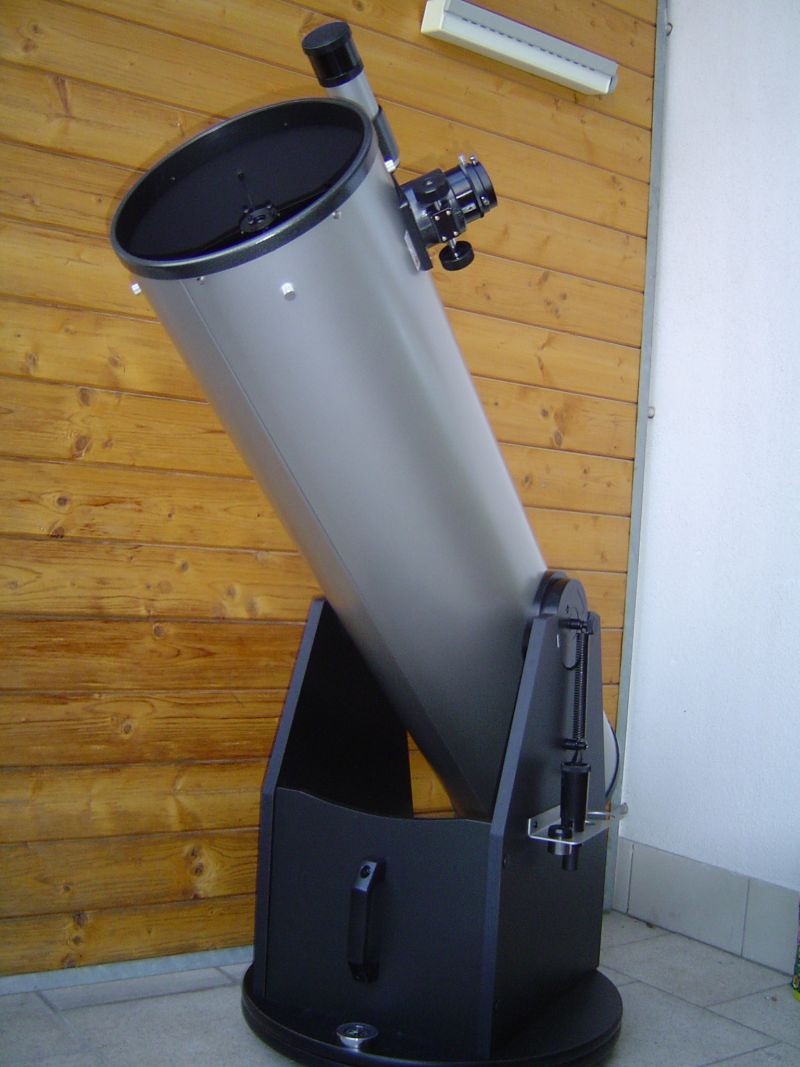
Credit: first uploaded on the English-speaking Wikipedia under the same filename
- Targets: Planets and the Moon, deep-sky objects (DSOs) like galaxies and nebulae, double stars, or a mix?
- Portability: Will you carry it up stairs, in a car, to a darker site? How much bulk is acceptable?
- Setup time: Do you prefer quick, grab-and-go sessions or longer, planned nights with more gear?
- Maintenance: Are you comfortable with occasional alignment (collimation) or do you want a nearly maintenance-free experience?
- Budget: Beyond the telescope, reserve funds for a stable mount, a couple of eyepieces, and a planisphere or astronomy app.
Realistic expectations are crucial. Telescopes don’t show Hubble-like images; galaxies are subtle smudges under light pollution. Planets can be small but detailed in steady air. Star clusters often sparkle like diamonds. Under dark skies, even modest apertures reveal dramatic views. Knowing what to expect—and what matters most in the gear—helps you choose wisely. In the sections below, we unpack the fundamentals, focusing on actionable advice you can trust.
Aperture, Focal Length, and f/Ratio Explained
Three numbers come up constantly when comparing telescopes: aperture, focal length, and focal ratio (f/ratio). Understanding how they shape what you see—and how easy the scope is to use—will clarify your decision.
Aperture: The Light-Gathering Engine
Aperture is the diameter of the main lens or mirror, usually in millimeters (mm). More aperture gathers more light and resolves finer detail. All else equal, a larger aperture reveals fainter objects and crisper planetary features. Common beginner apertures include:
- 70–90 mm refractors: sharp, low-maintenance, ideal for the Moon, planets, and brighter DSOs.
- 114–130 mm reflectors: versatile, good value, more light for galaxies and nebulae.
- 150–200 mm (6–8 inch) Dobsonian reflectors: excellent light gathering for deep-sky, still beginner-friendly.
Resolution scales roughly with aperture, often quoted via the Dawes limit:
Dawes limit (arcseconds) ≈ 116 / Aperture(mm)
In practice, atmospheric seeing usually caps usable resolution, especially for planets. Even a small scope can deliver pleasing views in steady air.
Focal Length and Image Scale
Focal length (FL) affects magnification and field of view. A longer focal length gives higher magnification with the same eyepiece; a shorter focal length gives wider views. The magnification formula is simple:
Magnification = Telescope focal length / Eyepiece focal length
For example, a 900 mm telescope with a 25 mm eyepiece gives 36×. High magnifications are tempting, but they rely on steady air and good optics. Much of the joy in visual astronomy comes at low to medium power, where views are bright, wide, and sharp.
Focal Ratio (f/ratio) and Brightness
The focal ratio (f/number) is focal length divided by aperture (e.g., 600 mm focal length / 100 mm aperture = f/6). For visual observing:
- Lower f/ratios (f/4–f/6) yield wider fields—great for star clusters and nebulae—but are typically more sensitive to eyepiece quality and collimation.
- Moderate f/ratios (f/7–f/9) balance wide fields with optical friendliness—common in 80–100 mm refractors.
- Higher f/ratios (f/10–f/15) favor planetary contrast and are more forgiving of eyepiece edges, typical of some Maksutov–Cassegrains and long refractors.
Note that for visual use, a lower f/ratio does not make the image intrinsically brighter at equal magnification; brightness at the eye depends on exit pupil:
Exit pupil (mm) = Aperture(mm) / Magnification
Brightest views are typically at 2–5 mm exit pupil; planetary detail often improves around 1–2 mm exit pupil; very high magnification below 1 mm exit pupil dims the image and shows the limits of seeing.
True Field of View and Eyepiece Choice
Field width depends on both telescope and eyepiece. A quick estimate for the true field of view (TFOV):
TFOV (degrees) ≈ ApparentFOV(eyepiece) / Magnification
For instance, a 25 mm eyepiece with a 52° apparent field at 36× yields roughly 1.4°. Pair this with a low-power eyepiece for sweeping the Milky Way, and a mid/high-power eyepiece to study lunar and planetary detail. We’ll explore eyepiece planning in Eyepieces, Barlows, and Filters.
Refractor vs Reflector vs Maksutov: Pros and Cons
Most beginner-friendly telescopes fall into three optical families: refractors (lenses), reflectors (mirrors), and catadioptrics (mirror–lens combos like Maksutov–Cassegrains). Each has strengths and trade-offs.

Artist: OpenStax
Refractors
Refractors use lenses at the front of the tube; you look through a diagonal at the back. They are prized for their crisp, high-contrast views and low maintenance—no collimation most of the time.
- Pros: Quick setup, stable alignment, great on the Moon, planets, and double stars; compact 70–100 mm models are very portable.
- Cons: Cost rises quickly with aperture; simpler “achromatic” refractors can show chromatic aberration (color fringing) on bright objects; larger refractors are long and heavy.
- Best for: Beginners who want grab-and-go convenience, sharp views, and minimal maintenance.
Reflectors (Newtonian and Dobsonian)
Reflectors use mirrors and offer the most aperture per dollar. A Newtonian on a boxy, ground-mounted base is called a Dobsonian, known for simplicity and stability.
- Pros: Excellent value in 130–200 mm sizes; very capable for DSOs; Dobsonian mounts are intuitive to push around the sky.
- Cons: Requires occasional collimation; open tube can need more cooldown time; lower f/ratio Newtonians may show edge-of-field aberrations with budget eyepieces.
- Best for: Beginners who want bright, deep-sky views and don’t mind learning basic maintenance.
Maksutov–Cassegrains (and similar catadioptrics)
Maksutov–Cassegrains use a combination of mirrors and a meniscus lens. They are compact with long focal lengths, favoring high magnifications for the Moon and planets.
- Pros: Very compact; high contrast on planets and double stars; minimal collimation needed once aligned at the factory.
- Cons: Narrower fields of view make star-hopping trickier; smaller apertures at similar price points; thicker corrector plates may take longer to reach thermal equilibrium.
- Best for: Urban observers focused on lunar/planetary work and double stars who want a small, easy-to-store scope.
In short: if portability and zero-fuss operation matter most, consider a refractor or Mak. If you want the most light for your budget and enjoy sweeping deep-sky objects, a Dobsonian reflector is hard to beat.
Alt-Azimuth vs Equatorial Mounts: Stability and Tracking
A stable mount is as important as the optics. Shaky views ruin high power and frustrate focusing. The two common styles are alt-azimuth (AZ) and equatorial (EQ). Dobsonians are a form of alt-azimuth that sits on the ground.
Alt-Az Mounts
Alt-az mounts move up–down (altitude) and left–right (azimuth). They are intuitive—point and look—and they set up quickly. Variants include tabletop mounts, tripod-mounted fluid heads, and Dobsonian rocker boxes.
- Pros: Simple, fast, minimal adjustments; great for visual observing and learning the sky.
- Cons: At high magnification, you nudge both axes to follow objects; not ideal for long-exposure photography (but fine for visual use and smartphone snapshots of the Moon).
Equatorial Mounts
Equatorial mounts are tilted to align with Earth’s axis, allowing easier tracking of celestial motion along a single axis (right ascension). They can be manual or motorized (including GoTo systems).

Artist: Marie-Lan Nguyen (Jastrow)
- Pros: Convenient tracking with slow-motion controls; good for extended high-power views; a foundation for future imaging if upgraded.
- Cons: Heavier, more complex setup; requires polar alignment; at low budgets, small EQ mounts can be underbuilt and shaky.
If your priority is straightforward observing, an alt-az or Dobsonian mount is often the best beginner choice. If you prefer seated planetary work at high power with fine tracking, a robust EQ mount can be rewarding—just be mindful that stability matters more than features. See Budget Tiers and Example Setups for practical pairings.
Eyepieces, Barlows, and Filters: Essential Accessories
Eyepieces set the magnification and apparent field of view. A couple of well-chosen eyepieces can transform your experience far more than chasing extreme magnification claims. Start with two or three focal lengths that create a useful range of magnifications on your telescope.
Planning a Simple Eyepiece Set
- Low power (sweeping): exit pupil 3–5 mm; eyepiece focal length often ~25–32 mm on many beginner scopes. Great for finding objects and enjoying wide vistas.
- Medium power (general purpose): exit pupil 2–3 mm; eyepiece focal length ~12–20 mm. Good for clusters, nebulae with filters, and larger galaxies.
- High power (planetary, lunar detail, tight doubles): exit pupil 1–2 mm; eyepiece focal length ~5–10 mm depending on your scope’s focal length and seeing conditions.
Instead of buying many budget eyepieces, start with two or three decent ones and learn their strengths. You can extend the range with a Barlow lens, which multiplies magnification:
New magnification = (Barlow factor) × (Telescope focal length / Eyepiece focal length)
A 2× Barlow turns a 20 mm into a virtual 10 mm, useful for planetary nights when the air is steady. If you wear glasses for astigmatism, consider eyepieces with longer eye relief.
Filters: When Do They Help?
- Moon filters: Lower brightness to improve comfort. Not strictly necessary—your eye can adapt—but helpful for prolonged lunar sessions.
- Light pollution filters: Broadband filters can increase contrast on emission nebulae by suppressing some city glow; narrowband “UHC”-type filters target nebular lines (OIII, H-beta) for stronger effect on objects like the Orion Nebula or the Veil. They don’t brighten galaxies (which emit light across broad wavelengths).
- Planetary color filters: Optional; slight contrast tweaks on features like Jupiter’s belts or Mars’s maria. Good seeing and patience often matter more.
Finder Scopes and Red-Dot Sights
Finding objects is easier with a correctly aligned finder. A red-dot finder superimposes a dot on the sky; a RACI (Right-Angle Correct-Image) finder shows a magnified upright view, helpful for fainter targets. Many observers use both: red dot to get in the neighborhood, RACI to center the target. Align your finder in daylight (see Star-Hopping and Finder Alignment).
Light Pollution, Seeing, and Transparency: What You’ll Really See
What you see at the eyepiece depends as much on the sky as on the telescope. Two key conditions play different roles:
- Seeing: Atmospheric steadiness. Affects sharpness at high magnification (planets, double stars).
- Transparency: Clarity of the air. Affects how deep you can see (faint galaxies and nebulae).
Under typical suburban skies, the Moon and planets are rewarding targets, while galaxies are subdued. A nebula filter can help on emission nebulae. Under rural dark skies, even small telescopes reveal striking deep-sky detail.
The Bortle Scale
Light pollution is often described by the Bortle scale (1 = darkest, 9 = inner-city bright). The difference between Bortle 7–8 and Bortle 3–4 is transformative for DSOs. Consider occasional trips to darker sites; you’ll unlock much more from the same instrument.
Thermal Equilibrium and Cooldown
Telescopes, especially reflectors and closed-tube designs, perform best once temperature differences stabilize. Give your scope time to reach outdoor temperature before demanding high-power planetary views. See Setup and Care for simple practices.
What to Expect at the Eyepiece
- Moon: Razor-sharp craters, rilles, and mountains. A superb target at all phases (avoid exact full Moon for contrast).
- Planets: Jupiter’s bands and 4 Galilean moons; Saturn’s rings and Cassini Division in good seeing; Mars’s dark markings and polar cap near opposition; Venus’s phases; Mercury’s tiny disk; Uranus and Neptune as small bluish disks.
- Double stars: Beautiful color contrasts and split challenges; excellent for urban observers.
- Star clusters: Open clusters (Pleiades, Beehive) excel at low power; globular clusters start to resolve in medium apertures and dark skies.
- Nebulae: Emission nebulae like Orion are showpieces; filters help. Planetary nebulae can be small and bright (e.g., Ring Nebula).
- Galaxies: Best under dark skies; look for shape, core, and hints of spiral structure in larger apertures.
Tip: Spend time at the eyepiece. Detail emerges with patience and averted vision, a technique where you look slightly off-target to engage more light-sensitive parts of your retina.
Setup, Collimation, and Care: Keep Your Telescope Performing
Even the best optics need proper setup. A few habits will keep your views sharp and your nights smooth.
Fast, Repeatable Setup
- Store your scope so it’s easy to grab—ideally near the door and pre-assembled if safe.
- Use a simple kit checklist: telescope, mount, eyepieces, finder, red flashlight, star chart or app, warm clothing, chair.
- Set up on solid ground; avoid decks that transmit vibrations.
Alignment and Collimation
Refractors and Maksutov–Cassegrains rarely need collimation once set from the factory. Newtonian reflectors benefit from occasional checks. Good collimation improves contrast and star sharpness, especially at higher powers.
- Collimation tools: A simple cap, a collimation eyepiece (Cheshire), or a good laser (checked for internal alignment).
- Process: Align the secondary mirror under the focuser; center the primary mirror’s reflection; fine-tune with the primary’s adjustment screws.
- Star test: Defocus a bright star at high magnification; concentric rings indicate good alignment.
If you’re new to collimation, practice in daylight on a distant object, then confirm at night. Don’t be intimidated—small adjustments go a long way. See Common Beginner Mistakes for pitfalls to avoid.
Care and Cleaning
- Keep dust caps on when not in use; store in a dry place.
- Let optics cool/warm gradually to avoid condensation. If dew forms, allow to dry before capping.
- Clean optics sparingly. Most dust does not affect views. When needed, use a blower, soft brush, and proper lens tissue with suitable fluid. Avoid scrubbing.
- Check screws and mount connections periodically for tightness.
Budget Tiers and Example Setups for Beginners
Value comes from a balanced system: decent aperture, stable mount, and a couple of useful eyepieces. The goal is to avoid false economies—an underbuilt mount can ruin a good optic. Below are generalized tiers and example configurations by observing style. These are not brand-specific; focus on the specification patterns and how they fit your goals.
Under $250 (Entry-Level, Casual Use)
- 70–80 mm refractor on a sturdy alt-az tripod: Ultra-portable, quick setup, great for the Moon, planets at low-medium power, and bright clusters. Aim for metal tripods and solid clamps.
- 100–114 mm tabletop reflector (f/4–f/5): Bright, wide fields for clusters and nebulae; place on a stable table or crate. Learn basic collimation. Pair with a simple red-dot finder.

Artist: Wutthichai Charoenburi
Suggested eyepiece set: a 25 mm low-power and a 10–12 mm medium/high-power, plus a 2× Barlow for occasional higher magnification.
$250–$500 (Strong Beginner Value)
- 90–102 mm refractor (f/6–f/10) on a solid alt-az: Sharper planetary and lunar views, manageable size. A 90–100 mm refractor can be an enduring grab-and-go scope.
- 130 mm f/5 reflector (tabletop or tripod): A versatile workhorse; enjoyable on DSOs and planets with good collimation. Tripod versions need a stable mount.

Meade LightBridge Mini 114, a 4.5″ f/4 (450 mm focal length) tabletop Dobsonian reflector with included eyepieces.
Artist: Morn - 127 mm Maksutov–Cassegrain: Compact planetary specialist; pair with a sturdy mount and a finder that suits your style.
Add a UHC-type nebula filter to enhance bright nebulae from suburban skies.
$500–$800 (Deep-Sky Ready, Still Beginner-Friendly)
- 150–200 mm Dobsonian reflector: Superb light-gathering for galaxies, nebulae, and clusters; surprisingly easy to use. Learn collimation and cooldown management.
- 102 mm ED refractor (if budget allows): Excellent correction and contrast; pairs well with a quality alt-az mount for wide-field views and planets at moderate power.
Aim to include: 25–30 mm wide view, 12–15 mm medium, and 6–9 mm high power; optionally a 2× Barlow.
$800–$1,200+ (Grow-With-You Visual Systems)
- 8–10 inch Dobsonian with upgrades: Smooth motion, better altitude bearings, or “push-to” digital setting circles improve navigation while keeping setup simple.
- Quality refractor on robust alt-az/EQ: Prioritize mount stability. If you plan to explore imaging later, a capable EQ mount becomes relevant, though that’s a separate investment path.
Remember: you can see a lot with modest gear under good skies. Allocate part of your budget for a comfortable observing chair, charts or a planetarium app, and perhaps a nebula filter. Comfort and navigation greatly affect how often you observe.
Best First Targets by Season and Sky Location
Aim for bright, high-contrast objects first. They build skills, calibrate expectations, and provide plenty of “wow.” The lists below are broadly visible in the mid-latitudes; visibility varies by date and location, so check an app or star chart.
Year-Round Highlights
- Moon: Observe along the terminator line for relief and detail. Track libration features over multiple nights.
- Planets: Jupiter’s moons in changing configurations; Saturn’s rings; Mars near opposition; Venus’s phases; the crescent of Mercury at dawn or dusk.
- Double stars: Albireo’s color contrast; Epsilon Lyrae (the Double Double) for a splitting challenge in good seeing.
Seasonal Deep-Sky Sampler
- Winter: Orion Nebula (M42), Pleiades (M45), Hyades cluster, Beehive (M44), Double Cluster in Perseus.
- Spring: Leo Triplet (M65/M66/NGC 3628) in dark skies, the Whirlpool Galaxy (M51), and myriad galaxies during “galaxy season.”
- Summer: Lagoon (M8) and Trifid (M20) Nebulae, Swan (M17), Eagle (M16), Wild Duck Cluster (M11), Ring Nebula (M57), the Milky Way’s Scutum Star Cloud.
- Autumn: Andromeda Galaxy (M31) with companions (M32, M110), Triangulum Galaxy (M33) under dark skies, the Double Cluster shining overhead.
Use low power to locate, then adjust magnification for the best view. Nebula filters can enhance emission nebulae, particularly in the presence of light pollution. For galaxies, dark skies reign supreme.
Common Beginner Mistakes and How to Avoid Them
Most frustrations in early observing come from a few predictable issues. Address them up front and your first nights will go smoothly.
- Chasing maximum magnification: Eyepiece sets that promise 600× are misleading; atmospheric seeing and optics usually limit useful power. Plan around exit pupil and conditions.
- Underestimating mount stability: A wobbly tripod can spoil the view. Prioritize a sturdy mount and avoid fully extended legs when possible.
- Ignoring cooldown and collimation: Give the scope time to acclimate and verify alignment, especially reflectors. See Setup and Care.
- Skipping finder alignment: Misaligned finders waste time. Align in daylight on a distant object, then refine at night. See Star-Hopping and Finder Alignment.
- Expecting Hubble photos: Visual astronomy favors subtlety and patience. Seek darker skies for DSOs and enjoy planets and clusters from the city.
- Overbuying accessories: Start with a basic eyepiece set and learn. Gradual upgrades are more satisfying and targeted.
Star-Hopping, Finder Alignment, and Basic Sky Skills
Learning the sky makes the telescope far more rewarding. You don’t need to memorize constellations, but gaining a feel for bright landmarks and directions unlocks the night.
Finder Alignment in Daylight
- Set up the telescope and center a distant object (e.g., a radio tower) in a low-power eyepiece.
- Adjust the finder’s screws so the object sits at the center of the finder view or under the red dot.
- At night, refine using a bright star or planet, ensuring the finder and main scope agree.
Star-Hopping Basics
- Charts and apps: Use a planisphere or planetarium app to identify bright stars near your target.
- Hop via patterns: Move from a known star to a distinct pattern (e.g., a triangle of 6th-magnitude stars) toward the target. Repeat with short steps.
- Match scale: Set your finder or eyepiece to a similar field size as your map’s view. A RACI finder is helpful here.
- Use averted vision: For faint objects, look slightly off. Sweep slowly; DSOs often “pop” when you move the scope gently.
Orientation and Tracking
Depending on your diagonal and optics, the view may be rotated or mirrored. Spend time learning how the field moves as you nudge the mount. Practice tracking a star across the field at medium power; you’ll build a light touch that makes high-power viewing easier. If you’re using an equatorial mount, familiarize yourself with the RA (right ascension) and DEC (declination) slow-motion controls so the motion becomes intuitive.
Frequently Asked Questions
How much magnification do I really need for planets?
Most nights, the image is limited by seeing, not by your telescope. On average, 100–150× shows excellent detail on Jupiter and Saturn in modest apertures; 200–250× is possible in steady air with good collimation and cooled optics. Rather than chasing a number, plan around exit pupil:
Exit pupil (mm) = Aperture(mm) / Magnification
Planetary detail often looks best around 1–2 mm exit pupil. For example, a 130 mm reflector at 130× has a 1 mm exit pupil—a good starting point for Jupiter or Saturn.
Should I get a computerized (GoTo) mount as a beginner?
GoTo can be helpful, especially under light pollution where star-hopping is tougher. But it adds setup steps (power, alignment) and increases cost. Many beginners benefit from learning the sky with a simple alt-az or Dobsonian, then upgrading later. If you choose GoTo, ensure the mount is still sturdy enough for the telescope—you don’t want to trade stability for electronics. Either way, basic skills like finder alignment and star-hopping remain valuable and make observing more rewarding.
Final Thoughts on Choosing the Right Beginner Telescope
Your first telescope should invite you outside, not intimidate you. A clear path for most beginners is one of two routes:

Artist: JamesStewart669
- Grab-and-go refractor or compact Mak if you want minimal maintenance, quick setup, and strong lunar/planetary performance.
- Dobsonian reflector if you want the most light-gathering for your budget to explore galaxies, nebulae, and clusters, while still enjoying sharp planetary views in steady air.
Prioritize a stable mount, realistic magnifications, and a small set of eyepieces that cover low, medium, and high power. Plan for comfort and navigation: a good chair, a red light, and a chart or app. And remember that the sky itself—darkness, seeing, and your patience at the eyepiece—sets the ceiling on what you’ll observe. For next steps, browse the budget tiers, pick a setup that matches your goals, and sketch a short list of targets from Best First Targets. Then get outside and look up.
If you found this guide useful, consider subscribing to our newsletter for future deep-dives on observing techniques, eyepiece selection, seasonal targets, and practical upgrades that deliver real value at the eyepiece.