
Table of Contents
- What Is a Telescope Mount? Equatorial vs Alt-Azimuth Explained
- How Equatorial Mounts Work: RA/Dec, Polar Alignment, and Tracking
- How Alt-Azimuth Mounts Work: Simplicity, Stability, and Field Rotation
- Key Mount Selection Criteria: Capacity, Stability, and Usability
- Use Cases and Recommendations: Visual, Planetary, EAA, and Imaging
- Setup Procedures: Step-by-Step for EQ and Alt-Az Alignment
- Mechanics and Performance: Periodic Error, Backlash, and Drives
- Maintenance and Care: Keeping Your Mount Smooth and Accurate
- Frequently Asked Questions
- Final Thoughts on Choosing the Right Telescope Mount
What Is a Telescope Mount? Equatorial vs Alt-Azimuth Explained
A telescope mount is the foundation that supports your optical tube and moves it smoothly across the sky. While optics get most of the attention, the mount determines how easily you can find targets, how stable your views will be, and—if you plan to take photos—how long you can track an object accurately. For most amateur observers, the choice comes down to two main families:

Artist: Gn842
- Equatorial (EQ) mounts, built around Earth’s rotation with right ascension (RA) and declination (Dec) axes.
- Alt-azimuth (alt-az) mounts, which move up/down (altitude) and left/right (azimuth) like a camera tripod.
Each has a distinct philosophy of motion and tracking. An equatorial mount rotates along a single axis to follow the sky’s apparent motion, after a careful alignment with the celestial pole. An alt-az mount tracks targets by moving both axes together, prioritizing simplicity and setup speed.
This guide clarifies how the two designs work, what they excel at, and how to choose the right mount for your observing or imaging goals. If you’re new to the topic, start with the basic differences here, then dive into How Equatorial Mounts Work and How Alt-Azimuth Mounts Work. If you’re already comparing models, jump straight to Key Mount Selection Criteria and Use Cases and Recommendations.
How Equatorial Mounts Work: RA/Dec, Polar Alignment, and Tracking
Equatorial mounts are designed to match the geometry of the celestial sphere. By tilting one axis—the right ascension (RA) axis—so it points at the celestial pole, the mount can counter Earth’s rotation with a single continuous motion. This alignment process is called polar alignment.
Axes and coordinate system
An EQ mount’s axes correspond to the equatorial coordinate system:
- Right Ascension (RA): parallels Earth’s longitude projected onto the sky; the mount tracks in RA at the sidereal rate (~15 arcseconds per second) to keep a target centered.
- Declination (Dec): parallels Earth’s latitude; used to move north/south along the sky’s declination lines.
Once polar aligned, you can track a target with just the RA axis, reducing the complexity of motion and making it easier to achieve long exposures for astrophotography. This one-axis tracking advantage is the core reason imagers favor EQ mounts over alt-az designs; see Use Cases for details.
Common equatorial form factors
- German Equatorial Mount (GEM): The most common amateur EQ. The optical tube sits on one side of the RA axis; counterweights balance it on the other. GEMs are versatile and support many tube types.
- Fork-mounted SCT on a wedge: A fork mount places the tube between two arms. When used for imaging, a wedge tilts the whole assembly into an equatorial orientation to avoid field rotation (see Alt-Az Field Rotation).
- Center-Balanced Equatorial Mount (CEM) or similar designs: Shift the mass closer to the center of gravity to reduce moment arm length and improve stiffness/weight ratio.
- Equatorial platform for Dobsonian bases: Adds an equatorial tracking surface under a Dobsonian for visual tracking and short-exposure imaging. Platforms typically provide ~1 hour of tracking before reset.
Polar alignment and tracking accuracy
Polar alignment aligns the RA axis with the north or south celestial pole. Accurate alignment reduces drift in declination and allows reliable tracking in RA. Methods include:
- Rough alignment using a compass, latitude scale, and sighting Polaris (Northern Hemisphere).
- Polar scopes with reticles that account for Polaris’s offset from true north.
- Drift alignment: a star-drift method using high magnification to refine altitude and azimuth adjustments.
- Software-assisted alignment: plate solving or camera-based tools that iterate alignment corrections.
In practice, an imager may combine polar scope alignment with a short drift or software refinement to reach sub-arcminute accuracy. Good polar alignment complements mount mechanics; it does not replace the need for smooth gears and minimal backlash, discussed in Mechanics and Performance.
Advantages of equatorial mounts
- Single-axis tracking at sidereal rate simplifies long exposures.
- No field rotation when tracking, so stars remain aligned over long integrations without a derotator.
- Consistent framing during imaging; object orientation remains fixed.
- Fine motion control with slow-motion knobs or motors in RA and Dec.
Trade-offs and practical considerations
- Setup time: Polar alignment adds steps compared with alt-az alignment, especially at public outreach events.
- Meridian flips (GEMs): To avoid the telescope colliding with the tripod when crossing the meridian, the mount flips to the other side. Imaging sequences must account for this.
- Weight and portability: Counterweights and a robust tripod or pier add mass, which aids stability but reduces portability.
- Latitude range: Very low latitudes (near the equator) can make physical access to adjustment bolts tricky; very high latitudes shift ergonomics in other ways.
For observers focused on deep-sky imaging with long focal lengths, these trade-offs are usually worth it. For casual visual use, consider the setup speed of alt-az mounts.
How Alt-Azimuth Mounts Work: Simplicity, Stability, and Field Rotation
Alt-az mounts move in two intuitive axes—altitude (up-down) and azimuth (left-right). This is how a camera tripod pan/tilt head operates, and why alt-az feels natural for beginners and outreach. Popular examples include simple yoke mounts, dual-arm or single-arm fork mounts, and Dobsonian bases supporting large Newtonian reflectors.
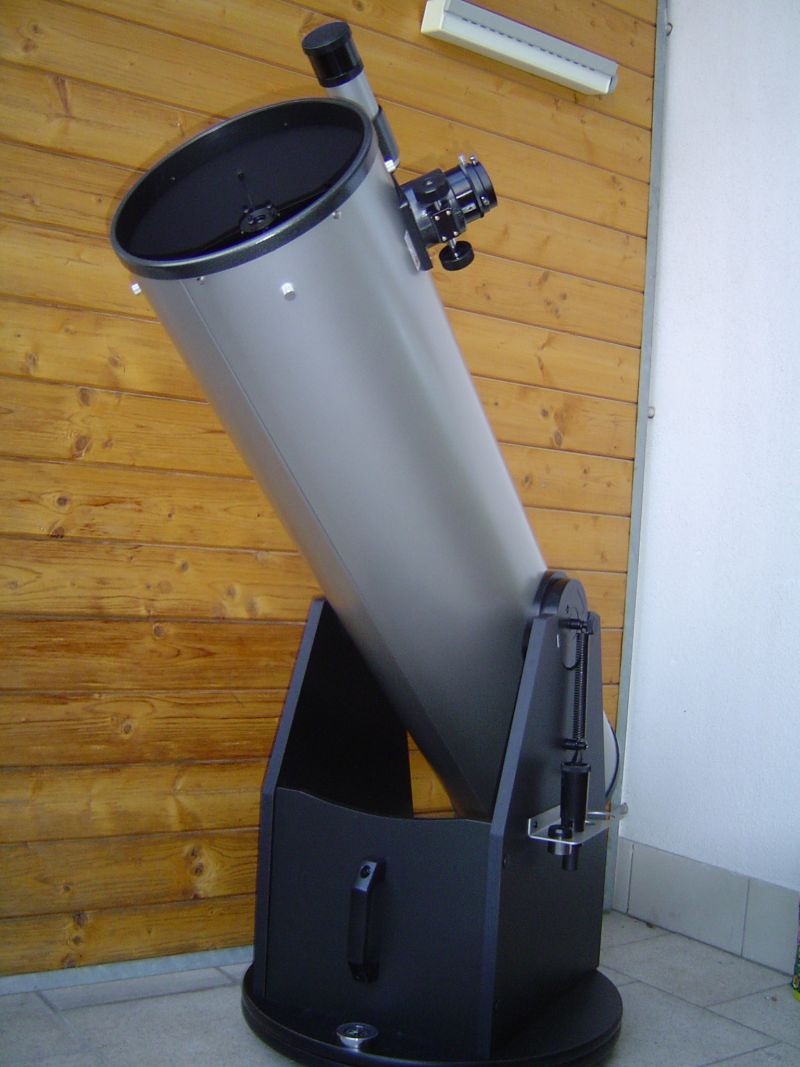
Credit: first uploaded on the English-speaking Wikipedia under the same filename
Why alt-az is loved for visual observing
- Fast setup: No polar alignment. Level the tripod (helpful though not mandatory), power on (if motorized), and center a star or two for GoTo alignment.
- Ergonomics: Comfortable viewing angles, especially with fork-mounted SCTs and Dobsonians.
- Stability per dollar: Dobsonian bases provide excellent stiffness for large apertures at modest cost.
- Simplicity: Manual alt-az mounts with slow-motion controls are easy to operate and maintain.
Tracking and field rotation
Motorized alt-az mounts can track targets by moving both axes simultaneously. For visual use, this is more than sufficient: a planet or nebula remains centered with minimal drift. However, because the mount’s axes are not aligned to the celestial pole, the image rotates slowly in the eyepiece during long observations. For visual, this is mostly irrelevant.
For imaging, the story changes. Over long exposures, field rotation smears stars. Solutions include:
- Add a wedge under a fork mount, converting it to an equatorial orientation (see EQ advantages).
- Use a field derotator to compensate by rotating the camera.
- Keep exposures short for planetary video or electronically assisted astronomy (EAA), where stacks mitigate rotation.
Where alt-az shines
- Public outreach where speed, simplicity, and safety are paramount.
- Deep-sky visual with large-aperture Dobsonians.
- Planetary observing where tracking keeps planets centered for high power viewing.
- EAA and short-exposure imaging at modest focal lengths.
If you primarily want effortless visual sessions, especially in light-polluted backyards or when traveling, an alt-az mount is often the most satisfying choice. For long-exposure imaging, see the caveats in Use Cases and Recommendations.
Key Mount Selection Criteria: Capacity, Stability, and Usability
Choosing between equatorial and alt-az is only part of the story. Mount performance depends on more than axis orientation. Consider the following criteria before committing to a mount class and model.
Payload capacity and moment arm
- Rated capacity: Manufacturers provide a maximum payload rating, often for visual use. Imaging imposes stricter requirements due to longer exposure times and sensitivity to vibration.
- Rule of thumb for imaging: Keep total imaging payload at roughly 50–70% of the mount’s rated capacity to preserve tracking performance. This includes the optical tube, guidescope or off-axis guider, cameras, filter wheel, and any accessories.
- Moment arm: A long tube (e.g., a long-focus refractor or Newtonian) exerts more torque than a compact SCT of the same weight. The distribution of mass matters as much as the number on a scale.
Stiffness, damping, and tripod or pier
- Stiffness: Thicker legs, wider tripod spreaders, and solid connections reduce flexure.
- Damping time: After a tap on the tube, vibrations should die quickly. Shorter damping improves high-power viewing and guiding stability.
- Tripod vs pier: Piers improve stability and reduce meridian flip clearance issues; tripods are portable and adjustable.
Drive mechanics and precision
- Worm gear + wheel: A common drive in RA/Dec axes. Smoothness, precision machining, and lubrication influence periodic error (see Mechanics and Performance).
- Belt vs spur transfer: Belts can reduce backlash and gear noise compared to spur gears.
- Strain wave (harmonic) drives: Compact high-torque drives with low backlash; can have different periodic characteristics than worm gears.
Alignment, control, and software ecosystem
- GoTo accuracy depends on alignment quality, mechanical rigidity, and model pointing algorithms.
- Connectivity: Consider hand controller, mobile apps, Wi‑Fi, USB, and control via common astronomy software.
- Plate solving: Automates pointing and centering for imaging workflows.
- Guiding support: Compatibility with guiding software and guide cameras improves long-exposure tracking on EQ mounts.
Portability, power, and ergonomics
- Weight and breakdown: Can you carry it in one trip? How many components?
- Power requirements: Voltage, connectors, and battery life in the field.
- Latitude adjustments: Are the bolts comfortable and robust? This matters for polar alignment.
- Eyepiece height: Alt-az Dobsonians keep the eyepiece accessible; long refractors on tall tripods demand step stools.
Budget and upgrade path
- Initial vs long-term cost: A stable mount can outlast several telescopes.
- Modularity: Swapping tripods, adding encoders, or upgrading saddles and dovetails can extend usefulness.
As you weigh these criteria, refer back to Use Cases and Recommendations for typical setups that match real observing goals.
Use Cases and Recommendations: Visual, Planetary, EAA, and Imaging
There is no single “best” mount, only a best mount for a given purpose and context. The following scenarios illustrate how equatorial and alt-az mounts map to different observing and imaging styles.
Casual visual observing and travel

Artist: Wutthichai Charoenburi
- Alt-az manual: A small refractor or Maksutov on a lightweight alt-az head is ideal for quick sessions or travel. Slow-motion controls and a sturdy tripod are key.
- Alt-az GoTo: Adds automated pointing and tracking, good for beginners in light-polluted skies who want help finding targets.
- Pros: Minimal setup, intuitive motion, portability. Cons: Not optimized for long-exposure imaging.
Deep-sky visual with medium to large apertures
- Dobsonian (alt-az): Excellent bang for the buck. Premium bearings and good balance yield very smooth manual tracking; add tracking or an equatorial platform for convenience.
- Pros: Aperture, stability, and cost efficiency. Cons: Bulk, and tracking additions add complexity.
High-power lunar and planetary observing
- Alt-az with tracking or EQ: Smooth tracking is essential at high magnification. Fork-mounted SCTs and compact Maksutovs excel ergonomically.
- Pros: Comfortable viewing, no field rotation issues for visual. Cons: For planetary imaging, alt-az is fine since exposures are short; EQ not required, though it simplifies orientation and later processing.
Electronically Assisted Astronomy (EAA)
- Alt-az GoTo shines for EAA at moderate focal lengths with short sub-exposures. Stacked short subs minimize field rotation artifacts.
- EQ mounts still help with longer subs or narrowband filters.
- Pros: Rapid feedback and real-time views on a screen. Cons: Cable management and software complexity, especially on EQ rigs.
Deep-sky astrophotography (long exposure)
- Equatorial mounts are the norm. Accurate polar alignment, guiding, and low periodic error are critical.
- Payload budget: Keep the total imaging load at 50–70% of rated capacity; long focal lengths need stiffer mounts.
- Pros: No field rotation, consistent framing, better guiding behavior. Cons: Heavier, requires meridian flips (on GEMs), longer setup.
Fork-mounted SCTs: alt-az vs wedge
- Alt-az fork: Superb for visual; simple two-star alignment and comfortable ergonomics.
- With a wedge: Converts to equatorial behavior for imaging to avoid field rotation. Adds setup complexity and weight; see FAQ on when a wedge is worth it.
Compact and travel imaging mounts
- Small EQ trackers: Designed for camera lenses and small refractors. Great for wide-field imaging; limited capacity and focal length.

A cheap electric equatorial mount (aka “sky tracker”), model iOptron SkyTracker Pro, with a camera attached and a lens (Canon EOS R50 + Canon RF 100–400 mm F5.6–8 IS USM)
Artist: HiyoriX
- Harmonic drive EQ mounts: Offer high capacity-to-weight ratios; periodic behavior differs from worm drives, discussed in Mechanics.
General recommendation patterns
- Visual-first beginners: Start with an alt-az (manual or GoTo) with a small refractor or a Dobsonian.
- Planetary observers and casual imagers: Alt-az with tracking works well; consider EQ if you plan to dive into long-exposure deep-sky.
- Committed deep-sky imagers: Invest in an EQ mount with a realistic payload margin, good tripod/pier, and guiding support.
Already own a scope? Match the mount to your tube’s focal length and weight, then review Selection Criteria to fine-tune your choice.
Setup Procedures: Step-by-Step for EQ and Alt-Az Alignment
Good setup habits boost performance more than many realize. The following checklists emphasize reliability and repeatability, regardless of mount type.
Universal preparation steps
- Site choice: Choose firm ground; avoid soft soil that settles under tripod feet.
- Leveling: Level the tripod for consistent alignment. While perfect level isn’t required for EQ accuracy, it simplifies adjustments; for alt-az, it improves GoTo pointing.
- Balance: Ensure the optical tube is balanced in both axes. For GEMs, balance RA with counterweights and Dec with dovetail position.
- Cable management: Route cables to prevent snags during slews and meridian flips (see GEM trade-offs).
Equatorial mount setup (visual or imaging)
- Rough polar alignment:
- Set the latitude scale to your site latitude.
- Point the RA axis roughly towards the celestial pole (Polaris in the north; Sigma Octantis region in the south, though it’s fainter).
- Mount balancing:
- With clutches released, balance RA by sliding counterweights until the shaft stays put when moved.
- Balance Dec by sliding the telescope in its saddle until it doesn’t swing toward one end.
- Fine polar alignment:
- Use the polar scope’s reticle or a camera-based alignment routine.
- If needed, perform a short drift alignment to refine altitude and azimuth.
- Pointing model or star alignment:
- Build a multi-star model for GoTo accuracy. Plate solving can automate this for imagers.
- Guiding (imaging):
- Calibrate your guide software, choose a modest guide rate, and ensure exposure times average out seeing.
Alt-az mount setup (visual, planetary, or EAA)
- Level the tripod and secure all clamps.
- Balance the optical tube if your mount allows clutches and adjustments.
- Two-star or multi-star alignment:
- Center the first star with a low-power eyepiece, then refine at high power or with a reticle eyepiece for best precision.
- Repeat for additional stars across the sky to improve GoTo pointing.
- Focus and tracking: Verify tracking by watching a target at moderate magnification; adjust backlash compensation or rate settings if available.
Tip: Build a personal checklist and keep it in your accessory case. Consistency in steps—from leveling to balance and alignment—improves results more than any single accessory upgrade.
Example alignment flow (pseudo-steps)
# Alt-az GoTo alignment

1. Level tripod

2. Power on mount

3. Date/time/location check

4. Select two-star alignment

5. Slew to first star; center; confirm

6. Slew to second star; center; confirm

7. Sync on a nearby test object; verify pointing
For EQ imaging, add polar alignment refinement and guiding calibration as in the Equatorial setup steps above.
Mechanics and Performance: Periodic Error, Backlash, and Drives
A mount’s performance is defined by the precision and smoothness of its mechanical parts and control electronics. Understanding a few key terms helps you interpret specifications and set realistic expectations.

Artist: myyorgda
Periodic error (PE)
Periodic error is the repeatable tracking error caused by imperfections in drive gears, especially the worm gear in RA. As the worm turns, small variations in tooth spacing and roundness cause the mount to speed up or slow down, producing a cyclical drift in RA.
- Typical ranges: Consumer-level worm-driven EQ mounts commonly show tens of arcseconds of uncorrected PE per worm cycle; higher-precision mounts aim for lower values, sometimes in the single-digit arcseconds. Actual values vary by design, manufacturing, and adjustment.
- Correction: Periodic error correction (PEC) records the error cycle and plays back a compensating signal. Autoguiding also corrects RA drift in real time, reducing the impact of PE on long exposures.
PE matters mainly for long-exposure imaging. For visual use or short exposures, smoothness and stability matter more than the exact arcsecond number.
Backlash
Backlash is the slack or play when reversing direction in a gear train. You feel backlash when you press a button and the object doesn’t move immediately until the gears re-engage.
- Effects: Makes fine centering and guiding less responsive, especially in declination corrections during imaging.
- Mitigation: Proper gear meshing, belt drives, and software settings (backlash compensation). Balancing slightly “east-heavy” on GEMs helps keep gears loaded in one direction in RA.
Harmonic (strain wave) drives vs worm gears
Harmonic drives offer high torque and low backlash in a compact package. Their periodic behavior differs from worm gears, sometimes showing characteristic peaks at higher frequencies. Autoguiding strategies may need shorter guide exposures to keep up with faster error components.
- Pros: Excellent capacity-to-weight ratios, minimal backlash, portable EQ mounts.
- Cons: Different periodic profiles; cost; some models may have more pronounced high-frequency components that require tuned guiding.
Encoders and closed-loop systems
- High-resolution encoders on RA (and Dec) measure position directly, enabling precise tracking and pointing corrections.
- Dual encoders can allow manual push-to movement without losing GoTo alignment, handy on alt-az mounts.
- Closed-loop tracking leverages encoders to reduce drift, complementing or reducing reliance on guiding for modest focal lengths.
Guiding fundamentals for EQ imaging
- Guide scope vs off-axis guider (OAG): OAG eliminates differential flexure between guide and imaging scope at longer focal lengths.
- Calibration: Perform near the celestial equator and meridian for robust RA/Dec movement measurement.
- Guide rate and exposure: Balance responsiveness to periodic error with seeing conditions; shorter exposures respond to faster error, longer exposures average out turbulence.
These concepts help you interpret claims such as “sub-arcsecond guiding.” In practice, real-world guiding depends on seeing, balance, payload, and how well you executed the steps in Setup Procedures.
Maintenance and Care: Keeping Your Mount Smooth and Accurate
Even a well-built mount benefits from basic care. Good habits prevent performance drift and extend the life of gears and bearings.
Routine checks
- Fasteners: Periodically check that tripod bolts, saddle clamps, and mounting hardware are snug.
- Balance and clutches: Avoid overtightening; proper balance reduces wear and strain on motors.
- Cables: Inspect for stress points and abrasion; re-route to prevent snags during slews.
Lubrication and adjustments
- Gears: Quality mounts ship with appropriate lubrication. If you consider re-greasing or adjusting mesh, follow manufacturer guidance; improper adjustments can worsen performance.
- Belt tension: If user-serviceable, keep within recommended ranges; too tight induces bearing wear, too loose adds backlash.
Environmental protection
- Dew and dust: Use covers and store in a dry place. Wipe dew from exposed metal surfaces after sessions.
- Temperature: Extreme cold thickens grease and can affect display and battery performance; allow time for acclimation.
Firmware and software
- Updates: Keep firmware and control software current to benefit from bug fixes and improved pointing models.
- Backups: Save custom profiles, PEC curves, and guiding configurations to restore quickly after updates.
Regular care amplifies the benefits discussed in Mechanics and Performance, ensuring that precision parts keep performing as designed.
Frequently Asked Questions
Can I use an alt-az mount for astrophotography?
Yes—within limits. Alt-az mounts are excellent for planetary imaging, where exposures are fractions of a second and you stack video frames. For deep-sky imaging, alt-az mounts suffer from field rotation during longer exposures. You can mitigate by using very short exposures (as in EAA), adding a field derotator, or converting a fork mount with a wedge to create an equatorial orientation. If your goal is traditional long-exposure deep-sky imaging with sub-exposures measured in minutes, an equatorial mount is the standard choice.
Do I need a wedge for a fork-mounted SCT?
For visual observing, no. A fork-mounted SCT in alt-az mode is comfortable, quick to align, and tracks well for visual and planetary work. If you intend to do long-exposure deep-sky imaging, a wedge tilts the fork into an equatorial configuration to eliminate field rotation. This adds setup complexity, weight, and the need for polar alignment. Many observers start in alt-az for visual and planetary imaging, then add a wedge only when deep-sky imaging becomes a priority.
Final Thoughts on Choosing the Right Telescope Mount
Your telescope mount shapes every session. If you crave simplicity and quick views, an alt-az mount delivers effortless setup and intuitive operation. If you’re plotting long-exposure deep-sky images or want the sky to glide on a single axis, an equatorial mount is the right foundation. Either way, prioritize stability, realistic payload margins, and repeatable alignment.

Artist: Gustaaf Prins from Haarlem, The Netherlands
As you decide, revisit the core differences in Equatorial vs Alt-Azimuth Explained and the practical checklists in Setup Procedures. Match your choice to your goals, not just a spec sheet, and remember that a great mount can serve multiple telescopes over years of observing.
Want more practical, research-backed guides like this? Subscribe to our newsletter to get future articles on mounts, optics, and observing strategies delivered to your inbox—and explore related topics across our archive.