
Table of Contents
- What Is Dark Matter in Modern Astrophysics?
- Galaxy Rotation Curves: The Flat-Line Evidence
- Gravitational Lensing and Colliding Clusters
- Cosmic Microwave Background and the Large-Scale Structure
- Dark Matter Candidates: From WIMPs to Axions
- How Scientists Search for Dark Matter
- Alternatives to Dark Matter and Modified Gravity
- Small-Scale Structure Puzzles and Baryonic Feedback
- Modeling the Cosmic Web with N-Body Simulations
- Frequently Asked Questions
- Final Thoughts on Choosing the Right Dark Matter Model
What Is Dark Matter in Modern Astrophysics?
Dark matter is the name astrophysicists give to a dominant but invisible component of the Universe that reveals itself only through gravity. It neither emits nor absorbs light in any measurable way, yet its gravitational pull shapes the motions of stars in galaxies, bends light from distant quasars, seeds the formation of galaxy clusters, and leaves imprints on the cosmic microwave background (CMB). By most modern estimates, dark matter makes up about 85% of all matter and roughly a quarter of the total energy budget of the cosmos, with the remainder split between ordinary (baryonic) matter and dark energy.

Artist: CTIO/NOIRLab/DOE/NSF/AURA Image Processing: T.A. Rector (University of Alaska Anchorage/NSF NOIRLab) & M. Zamani (NSF NOIRLab)
This concept is not new. In the 1930s, Fritz Zwicky studied the Coma Cluster and inferred that visible galaxies could not supply enough mass to hold the cluster together—he invoked “dunkle Materie,” or dark matter. Decades later, in the 1970s, Vera Rubin and Kent Ford measured unexpectedly flat rotation curves in spiral galaxies, demonstrating that the outer stars orbited too fast to be held in place by visible matter alone. Today, multiple independent lines of evidence—from galaxy rotation curves to gravitational lensing and CMB anisotropies and large-scale structure—converge on the same conclusion: most matter is “dark.”
When astrophysicists say “dark matter,” they typically mean a new, non-baryonic form of matter that is cold or at least not relativistic during structure formation. “Cold” here refers to particles moving slowly compared to the speed of light at early times, which allows small-scale density fluctuations to survive and collapse into the cosmic web we observe. Competing hypotheses—modified gravity, warm dark matter, self-interactions, or exotic primordial remnants—are explored vigorously, but the prevailing cosmological model, known as ΛCDM (Lambda Cold Dark Matter), continues to explain a striking array of observations with remarkable economy.
In this article, we synthesize the strongest evidence, outline leading particle candidates, and review the methods used to detect dark matter directly and indirectly. Along the way, we examine challenges on small scales and the role of baryonic physics, and we describe how powerful N-body simulations forecast the cosmic web. If you want an integrated, technically grounded picture of dark matter in the modern era, start with the observational pillars—the sections on rotation curves, lensing, and the CMB—and then explore candidates and search strategies in Dark Matter Candidates and How Scientists Search for Dark Matter.
Galaxy Rotation Curves: The Flat-Line Evidence
In a galaxy governed only by its visible matter, we would expect orbital speeds to decline with distance from the center: the farther a star is from the galactic bulge, the more slowly it should revolve, following a rough Keplerian falloff once past most of the mass. The Newtonian expectation can be summarized as:
v(r) = \sqrt{G M(r) / r}
Here, M(r) is the mass enclosed within radius r. If most mass were concentrated near the luminous disk, M(r) would saturate at large r, and v(r) would drop like 1/\sqrt{r}. Instead, surveys of spiral galaxies show that rotation curves remain flat well beyond the optical disk: stellar and gas tracers indicate that v(r) is approximately constant for large r. This implies that M(r) continues to rise linearly with radius, as though the galaxy sits inside a massive, extended halo of unseen matter.

Artist: Soonclaim
Key observational points include:
- Flat rotation curves in spirals: The velocities of HI gas and stars at tens of kiloparsecs remain high, incompatible with luminous matter alone.
- Low Surface Brightness (LSB) galaxies: These systems are especially dark-matter dominated, with rotation curves that are difficult to explain without a substantial halo component.
- Tully–Fisher and baryonic Tully–Fisher relations: The empirical correlation between a galaxy’s rotation speed and its luminosity (or baryonic mass) connects dynamics to mass in a way that any successful theory must reproduce.
Within the ΛCDM framework, halos are often described by the Navarro–Frenk–White (NFW) density profile, which arises approximately in collisionless, cold dark matter simulations. While NFW has a characteristic “cusp” at the center, the outer regions naturally produce enough mass at large radii to keep rotation curves flat. Some galaxies, particularly dwarfs and LSBs, appear to prefer cored profiles rather than cuspy ones—this is part of the cusp–core challenge. However, the broad, ubiquitous flatness of rotation curves has been one of the first and most enduring pieces of evidence indicating that galaxies sit in large, invisible mass halos.
Rotation curves are a doorway into the halo: by mapping velocity as a function of radius, astronomers infer not only the mass of the galaxy but the distribution of matter at scales well beyond the visible disk.
Rotation curve evidence is surprisingly robust across galaxy morphologies and sizes, and remains a foundational argument for dark matter alongside lensing and cosmology. For an independent, geometry-based handle on the mass distribution, see the section on Gravitational Lensing.
Gravitational Lensing and Colliding Clusters
Einstein’s general relativity predicts that mass curves spacetime and deflects light. When a foreground mass distribution sits along the line of sight to a background galaxy or quasar, it can act as a gravitational lens, warping or magnifying the background light. This effect comes in several flavors:
- Strong lensing: Producing multiple images, arcs, or Einstein rings around massive galaxies or clusters.
- Weak lensing: Subtle, statistical distortions (shear) in the shapes of background galaxies across wide fields, revealing the mass distribution in the foreground.
- Microlensing: Short-timescale brightening due to compact objects passing in front of a background star.
Both strong and weak lensing map the total mass—luminous and dark—without assuming dynamical equilibrium. Measurements show that galaxies and, especially, massive clusters require far more mass than is visible in stars and gas. Weak-lensing surveys over large areas trace filamentary structures that match the cosmic web predicted by ΛCDM.
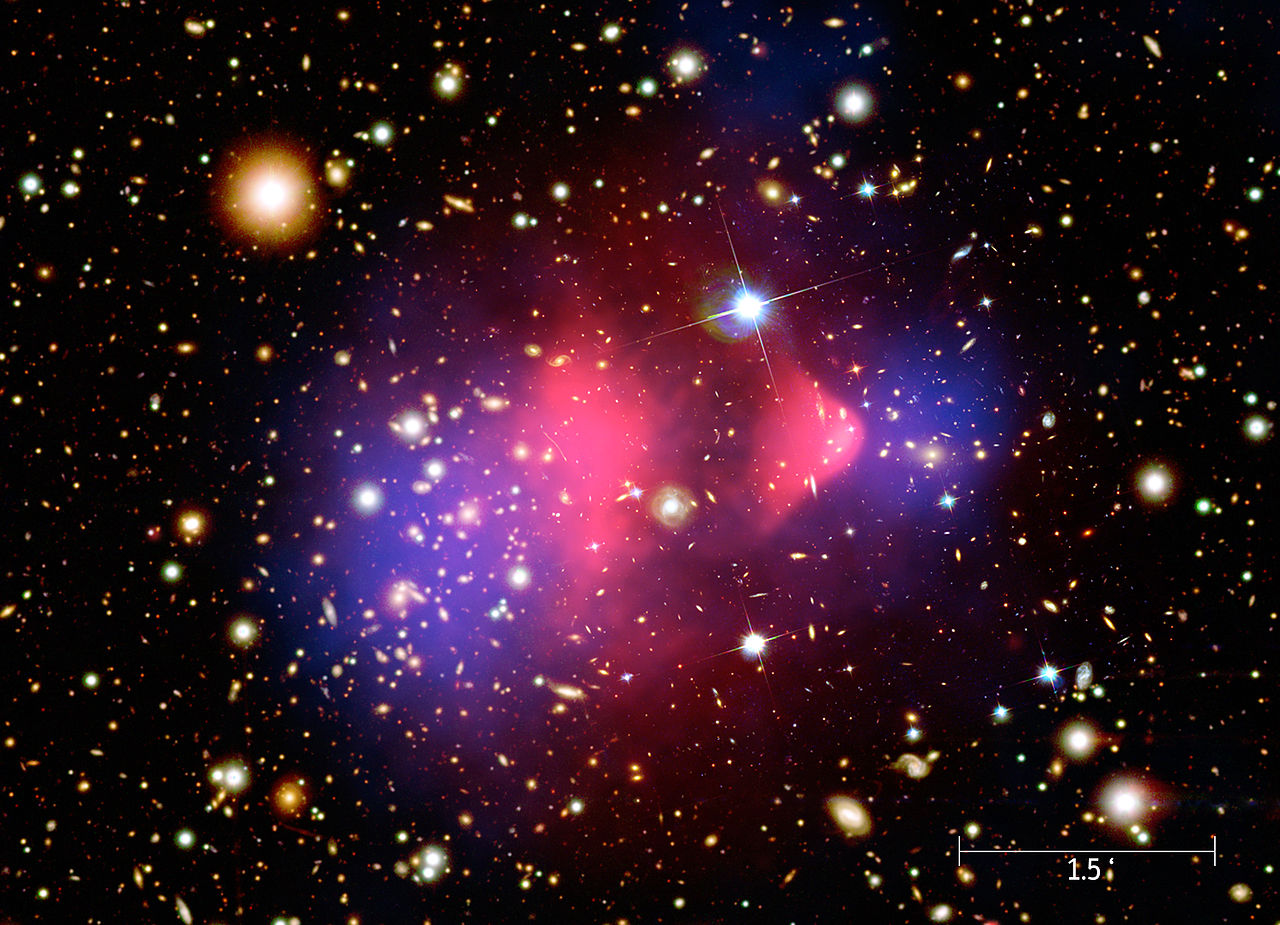
A striking case study involves colliding galaxy clusters. In the famous “Bullet Cluster,” the hot intracluster gas—ordinarily the most massive baryonic component—was slowed by ram pressure during a high-speed collision, while the galaxies (and a collisionless mass component) passed through more easily. Weak-lensing mass maps show peaks aligned with the galaxies rather than the X-ray-bright gas. This spatial separation is naturally explained if most mass is in a collisionless dark matter component, which does not experience drag the way gas does. Similar offsets have been seen in other mergers, providing a geometric, dynamical argument for dark matter that is difficult to reproduce with modified gravity alone unless extra unseen mass is also introduced.
Artist: NASA/CXC/M. Weiss
Gravitational lensing also constrains the inner density profiles of halos and the abundance of substructure (small satellite halos) by looking at flux anomalies and image distortions in strong lenses. These data complement galaxy dynamics and feed directly into simulation-based models of the halo mass function and subhalo abundance. They further connect to potential signals in indirect detection, because enhanced densities in subhalos can boost expected annihilation rates for particle dark matter models.
Cosmic Microwave Background and the Large-Scale Structure
The cosmic microwave background is relic radiation from about 380,000 years after the Big Bang, when electrons and protons combined to form neutral hydrogen and the Universe became transparent. Tiny temperature fluctuations in the CMB encode the initial conditions for structure formation and the composition of the Universe. Satellite missions such as WMAP and Planck have measured these anisotropies with exquisite precision.

Artist: ESA and the Planck Collaboration
In the CMB power spectrum, a series of acoustic peaks reflects oscillations in the photon–baryon fluid prior to recombination. The relative heights and positions of these peaks depend sensitively on the amounts of baryons, radiation, dark matter, and dark energy. In particular:
- Dark matter density: The inferred cold dark matter density parameter (often written as Ωch2) is well constrained by the CMB’s acoustic peak pattern. Analyses consistently indicate a substantial non-baryonic matter component.
- Odd–even peak structure: Baryons enhance compressions relative to rarefactions, affecting the locus of odd versus even peaks. The observed pattern requires a baryon fraction far below the total matter fraction, implying additional non-baryonic mass—dark matter.
- Damping tail and lensing of the CMB: Small-scale power and the smoothing induced by lensing provide independent consistency checks on the matter content and clustering amplitude.
On later timescales and larger scales, galaxy surveys map the large-scale structure (LSS) of the Universe. The same acoustic physics imprinted in the CMB leaves a baryon acoustic oscillation (BAO) feature in the galaxy correlation function. Redshift surveys reveal the BAO scale and growth of structure in ways that, combined with CMB data, strongly favor a ΛCDM cosmology with cold dark matter. Meanwhile, weak-lensing (cosmic shear) surveys and cluster counts constrain the amplitude of matter clustering—often summarized by parameters like σ8 and S8. Several lensing surveys report slightly lower clustering amplitudes than those inferred from Planck CMB analyses, an active area of investigation that may involve systematics, baryonic physics, or new physics, but does not remove the need for dark matter.
Crucially, cosmology disfavors hot dark matter—like Standard Model neutrinos, which move near light speed in the early Universe—because their large free-streaming lengths would erase small-scale structure. The observed abundance of small galaxies and the detailed shape of the matter power spectrum require a cold or at least relatively warm component. The Lyman-α forest (absorption features in quasar spectra) further constrains the small-scale power spectrum, placing lower bounds on the mass of warm dark matter candidates. These cosmological constraints inform the viable particle models described in Dark Matter Candidates and the target parameter space for detection efforts.
Dark Matter Candidates: From WIMPs to Axions
What is dark matter made of? Several broad classes of candidates are actively studied, each with distinct theoretical motivations and experimental signatures.
Weakly Interacting Massive Particles (WIMPs)
WIMPs are hypothetical particles with masses typically in the GeV–TeV range that interact via the weak force (or similarly feeble interactions) and gravity. A key appeal of WIMPs is the “WIMP miracle”: a particle with weak-scale interactions naturally freezes out from the hot early Universe with a relic abundance comparable to the observed dark matter density, assuming s-wave annihilation with a cross section on the order of 3 × 10⁻²⁶ cm3 s−1. WIMPs appear in many extensions of the Standard Model, notably supersymmetry (neutralinos) and extra-dimensional models.
Experimental searches target WIMPs via three routes: nuclear-recoil signals in underground detectors (direct detection), annihilation/decay products (indirect detection), and missing energy signatures at colliders. As null results push cross-section limits lower, interest has broadened to sub-GeV masses and non-standard interactions; still, the WIMP framework remains a prime template for experimental design.
Axions and Axion-Like Particles (ALPs)
Axions were proposed originally to solve the strong-CP problem in quantum chromodynamics. If sufficiently light and produced non-thermally, axions can behave as cold dark matter, with typical mass ranges in the micro-eV to milli-eV regime for QCD axions. They couple weakly to photons, enabling haloscope experiments (microwave cavities in strong magnetic fields) to search for the resonant conversion of axions into photons. Broader axion-like particles (ALPs) populate a wider parameter space and also motivate helioscope and light-shining-through-a-wall experiments.
Sterile Neutrinos
Sterile neutrinos are hypothetical neutrino states that do not interact via the weak force. A keV-mass sterile neutrino can act as warm dark matter, suppressing small-scale structure relative to ΛCDM. Production mechanisms and X-ray decay constraints carve out viable regions of parameter space. While intriguing for some small-scale structure issues, stringent bounds from X-ray observations and the Lyman-α forest apply.
Ultralight (Fuzzy) Dark Matter
Ultralight axions with masses around ~10−22 eV have de Broglie wavelengths on kiloparsec scales, potentially smoothing out small-scale structure and producing solitonic cores in halos. This “fuzzy” dark matter scenario is testable via Lyman-α forest data and galaxy dynamics, with ongoing debate about its viability across all relevant scales.
Self-Interacting Dark Matter (SIDM)
If dark matter experiences significant self-interactions (elastic scattering) with cross sections on the order of 0.1–1 cm2 g−1, halo cores can be less cuspy and more spherical, potentially addressing some small-scale tensions. Merging cluster observations (like the Bullet Cluster) constrain the self-interaction strength but still allow interesting ranges. SIDM can coexist with a broad range of particle models.
Compact Objects and Primordial Black Holes (PBHs)
Massive Astrophysical Compact Halo Objects (MACHOs)—such as brown dwarfs or stellar remnants—were once considered candidates. However, microlensing surveys and other constraints show that stellar-mass compact objects cannot account for all dark matter. Primordial black holes formed in the early Universe remain a topic of interest in specific mass windows, but they are tightly constrained by microlensing, CMB, and dynamical effects and, if present, are likely to be only a subdominant fraction.
Each candidate class carries its own suite of experimental tests. The ongoing, multi-pronged search discussed in How Scientists Search for Dark Matter leverages these differences to probe wide swaths of parameter space.
How Scientists Search for Dark Matter
Detecting dark matter requires extreme sensitivity and clever background rejection. Experiments target its gravitational fingerprints, its potential scattering off normal matter, and its possible annihilation or decay products.
Direct Detection: Nuclear Recoils and Electron Signals
Direct detection experiments attempt to measure tiny energy deposits produced when a dark matter particle scatters off a nucleus (or, in some cases, an electron) in an underground detector. Shielded from cosmic rays and natural radioactivity as much as possible, these instruments use multiple channels—scintillation light, ionization charge, and phonons—to identify candidate events and discriminate against backgrounds.
- Noble liquid time projection chambers: Dual-phase xenon detectors (e.g., XENON, LUX, LZ, PandaX) and argon-based experiments (e.g., DarkSide) have set some of the strongest limits on WIMP–nucleon cross sections across a wide mass range.
- Cryogenic solid-state detectors: Experiments like SuperCDMS measure phonons and ionization in ultra-cold crystals, probing low-mass dark matter with excellent energy resolution.
- Annual modulation tests: The Earth’s motion around the Sun leads to a predicted annual modulation in event rates. While the DAMA/LIBRA experiment reported a persistent modulation, independent detectors using similar target materials have not confirmed the signal.
As sensitivities improve, direct detection experiments approach the “neutrino floor,” where solar and atmospheric neutrino interactions become an irreducible background. New strategies—directional detection, novel target materials, and multi-scatter signatures—aim to push beyond this boundary and test previously inaccessible parameter spaces, including sub-GeV masses with electron recoils or Migdal effect searches.
Axion Searches: Haloscopes and Beyond
Axion haloscopes (e.g., ADMX and related efforts) use high-quality microwave cavities immersed in strong magnetic fields to convert ambient halo axions into photons at a frequency set by the axion mass. By tuning the cavity and scanning in frequency, these experiments probe narrow mass ranges with exquisite sensitivity. Additional concepts—including dielectric haloscopes and broadband detectors—expand coverage to different masses and couplings. Helioscopes search for axions generated in the Sun, complementing galactic dark matter searches.
Indirect Detection: Looking for Annihilation or Decay
If dark matter annihilates or decays into Standard Model particles, it could produce detectable signals such as gamma rays, cosmic-ray antimatter (positrons or antiprotons), or neutrinos. Observations target astrophysical environments with high dark matter densities and relatively low backgrounds:
- Dwarf spheroidal galaxies: These Milky Way satellites are dark-matter dominated and have low intrinsic gamma-ray backgrounds, making them prime targets for instruments like Fermi-LAT and ground-based Cherenkov telescopes.
- Galactic Center and clusters: High-density regions can enhance annihilation rates, though complex astrophysical backgrounds complicate interpretation.
- Solar and terrestrial capture: Dark matter captured by the Sun or Earth could annihilate to neutrinos, searched for by neutrino telescopes.
So far, no unambiguous, statistically unassailable signal of particle dark matter has emerged. Instead, increasingly sensitive null results set upper limits on cross sections and lifetimes, chipping away at parameter space and guiding theory.
Collider Searches: Missing Energy at the Energy Frontier
Collider experiments, notably at the Large Hadron Collider, look for events with significant missing transverse energy—potentially indicating invisible particles recoiling against visible jets, photons, or vector bosons. While originally motivated by supersymmetric WIMP candidates, these mono-X searches now constrain a variety of simplified models and effective field theory frameworks. Complementarity with direct and indirect searches is key: together, they probe different interaction types and mass ranges, ensuring that viable models face a coordinated suite of tests.
The bottom line is one of healthy scientific tension: cosmological and astrophysical data strongly motivate dark matter, while particle physics experiments continue to narrow the field of viable candidates. This interplay is a hallmark of progress and a driver for innovative experimental design.
Alternatives to Dark Matter and Modified Gravity
Could gravity itself be different on galactic or cosmological scales? Several frameworks propose modifying gravity rather than introducing new matter. Among them:
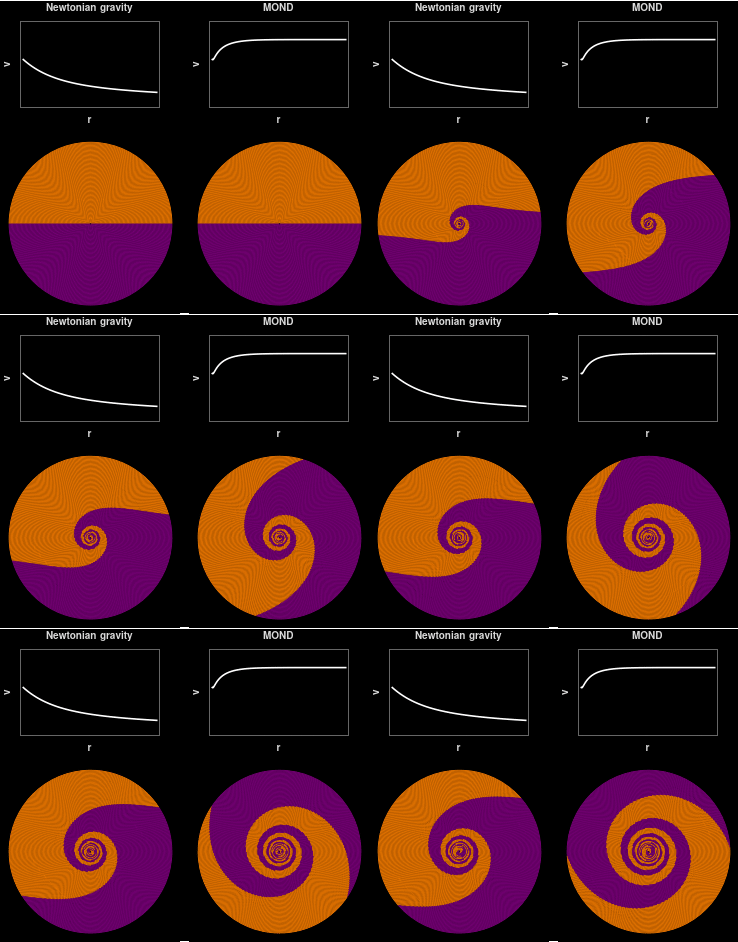
- MOND (Modified Newtonian Dynamics): Introduces a characteristic acceleration scale below which Newton’s laws are altered. It can fit many galaxy rotation curves with fewer free parameters than halo models, capturing regularities like the baryonic Tully–Fisher relation.
- TeVeS and relativistic extensions: To be cosmologically viable, a relativistic theory is needed. Tensor–vector–scalar theories attempt to provide a relativistic completion of MOND-like behavior.
- Modified gravity in cosmology: Broad classes of theories (e.g., f(R) gravity, scalar–tensor models) alter cosmic expansion or the growth of structure.
Artist: Jacopo Bertolotti
Despite elegant features, modified gravity faces challenges:
- Clusters and lensing: Accounting for the mass budget in galaxy clusters and reproducing systems like the Bullet Cluster often requires adding unseen mass similar to dark matter, undercutting the original motivation.
- CMB and large-scale structure: Detailed fits to the CMB power spectrum and BAO typically prefer a collisionless matter component. Modified gravity alone struggles to reproduce the full set of precision cosmology observables without reintroducing dark matter-like components.
- Constraints from gravitational waves: The near-light-speed propagation of gravitational waves observed in multimessenger events rules out or tightly constrains many gravity modifications that predict different speeds.
Modified gravity remains an active research area with important insights into galaxy phenomenology. It has sharpened questions about halo–galaxy connections and inspired tests that also strengthen the case for dark matter. Even if a modified-gravity model matches some galactic observations, the combined weight of rotation curves, lensing, and cosmological data continues to point toward an unseen mass component.
Small-Scale Structure Puzzles and Baryonic Feedback
Although ΛCDM fits large-scale observations with outstanding success, it faces several so-called small-scale challenges at the level of individual galaxies and subhalos. These issues are areas of ongoing research where the combination of baryonic physics and possible dark matter microphysics plays a critical role.
- Cusp–core problem: Dark-matter-only simulations tend to produce cuspy central densities (e.g., NFW profiles), whereas many dwarf and LSB galaxies appear to have shallower, cored profiles.
- Missing satellites problem: Early simulations predicted more subhalos around a Milky-Way-mass galaxy than the number of observed satellite galaxies.
- Too-big-to-fail problem: The most massive predicted subhalos seem too dense to host the known bright satellites in some simulations.
Progress here depends on two broad avenues:
Baryonic Feedback and Galaxy Formation Physics
When simulations include gas cooling, star formation, supernova feedback, stellar winds, and black hole feedback, the halo’s central potential can fluctuate and, in some cases, transform cusps into cores. Reionization can suppress star formation in small halos, reducing the number of luminous satellites even if dark subhalos exist. Observationally, deeper surveys continue to uncover faint satellites, narrowing the original discrepancy. Moreover, the mapping between subhalos and visible galaxies is stochastic and environment-dependent, so one must compare mock surveys to real data carefully.
Dark Matter Microphysics
Alternative dark matter models can also mitigate small-scale tensions:
- Warm dark matter: Free-streaming suppresses the formation of the smallest halos, potentially addressing the missing satellites issue, though stringent bounds from the Lyman-α forest limit how warm it can be.
- Self-interacting dark matter (SIDM): Scattering can isotropize velocities and create cores while leaving large scales unchanged for suitable cross sections.
- Ultralight (fuzzy) dark matter: Quantum pressure on kiloparsec scales may produce cored density profiles; tests include stellar kinematics in dwarfs and Lyman-α constraints.
It is plausible that some combination of realistic baryonic physics and allowed ranges of dark matter properties reconciles small-scale observations with ΛCDM’s large-scale triumphs. As numerical models improve and data sets grow—especially from integral-field spectroscopy of dwarfs and deep weak-lensing surveys—expect sharper tests of the ideas described here. Many of these results tie directly to the halo modeling discussed in Modeling the Cosmic Web.
Modeling the Cosmic Web with N-Body Simulations
To predict structure formation from the near-uniform early Universe to the richly structured cosmos of today, astrophysicists run large-scale N-body simulations. These models evolve a vast number of particles forward in time under gravity (and, in hydrodynamic simulations, gas physics) to generate halos, filaments, and voids.
The core Newtonian evolution in a comoving frame can be written schematically as:
\ddot{\mathbf{x}} + 2H\dot{\mathbf{x}} = -\nabla_\mathbf{x} \Phi(\mathbf{x}, t)
with the potential \Phi satisfying Poisson’s equation:
\nabla^2 \Phi = 4\pi G \bar{\rho}_m a^2 \delta(\mathbf{x}, t)
Here, H is the Hubble parameter, a the scale factor, \bar{\rho}_m the mean matter density, and \delta the matter overdensity. From these ingredients, gravity amplifies fluctuations, producing a cosmic web whose statistical properties match galaxy surveys and weak-lensing maps.
Several approaches enrich the predictive power of simulations:
- Hydrodynamics and feedback: State-of-the-art runs incorporate gas cooling, star formation, supernovae, and active galactic nuclei feedback, which influence halo structure and observable galaxy properties.
- Halo occupation modeling (HOD) and abundance matching: These techniques assign galaxies to halos and subhalos based on mass, concentration, or assembly history, bridging theory and observation by reproducing galaxy clustering statistics.
- Emulators and fast approximations: Machine learning and perturbation-theory-based methods accelerate parameter scans by emulating expensive simulations.
Simulations provide essential context for interpreting the CMB and LSS, for designing indirect detection strategies (e.g., estimating substructure boosts), and for exploring how variants like warm or self-interacting dark matter alter the halo mass function or internal profiles. They also quantify the impact of baryons on lensing and clustering—vital for extracting precise cosmological parameters from surveys.
As computational power and algorithms advance, simulations increasingly resolve the regime where small-scale puzzles reside, allowing sharper, more direct comparisons to stellar kinematics in dwarf galaxies and to strong-lensing constraints on substructure. The synergy between better models and richer data sets is closing the loop between theory and observation.
Frequently Asked Questions
Is dark matter just black holes we cannot see?
Black holes and other compact objects—collectively MACHOs—were a natural early guess. However, microlensing surveys towards the Magellanic Clouds and the Galactic bulge, constraints from wide binaries and dynamics, and the impact of compact objects on the CMB all limit how much of the dark matter could be in stellar-mass black holes or similar objects. Primordial black holes are still considered in specific mass ranges with many constraints, but current evidence indicates they cannot make up all of the dark matter across most masses. If they exist, they likely contribute only a fraction.
Could neutrinos explain dark matter?
Standard Model neutrinos are too light and too fast in the early Universe—they behave as hot dark matter, which would wash out small-scale structure contrary to what we observe. They do contribute to the overall energy density, and cosmological data constrain their total mass. Hypothetical sterile neutrinos with keV-scale masses are a different story: they could act as warm dark matter under certain production mechanisms, but they are constrained by X-ray searches and the small-scale power spectrum. In short, known neutrinos cannot be the dark matter; certain sterile neutrino models remain possible but are tightly bounded.
Final Thoughts on Choosing the Right Dark Matter Model
Astrophysics and cosmology form a cohesive, mutually reinforcing case for dark matter. Flat rotation curves testify to massive, extended halos around galaxies. Gravitational lensing maps mass directly, revealing invisible structures and dramatic offsets in merging clusters that argue strongly for a collisionless component. The CMB’s acoustic peaks, BAO measurements, and the growth of large-scale structure quantify the dark matter density and support ΛCDM’s central premises.
On the microphysical side, the field has diversified beyond the classic WIMP. While no definitive particle has been detected yet, upper limits have carved clear signposts through parameter space, motivating a broader search: ultralight axions, self-interactions, warm candidates, and even narrow primordial black hole windows. Complementary strategies—direct detection, indirect searches, and collider experiments—ensure wide coverage, and sophisticated simulations translate particle properties into testable astrophysical signatures.

Artist: ScienceDawns
What, then, is the “right” dark matter model? Today’s best choice is the one that most efficiently explains the widest breadth of data without undue complexity. For many purposes, ΛCDM with cold, collisionless dark matter remains that model. At the same time, there are legitimate small-scale questions and intriguing anomalies that deserve creative, carefully tested ideas. As new surveys deliver higher-precision maps of the Universe—and as detection experiments push towards the neutrino floor—the next few years will be decisive.
Whether you are an observer, theorist, or simply a curious reader, the frontier is open. Explore the references signposted in sections on candidates and search methods, and keep an eye on upcoming results from CMB polarization, weak-lensing surveys, and deep spectroscopic campaigns. If you found this overview useful, consider subscribing to our newsletter for updates on dark matter research, astrophysics insights, and future deep dives into the science that illuminates the unseen Universe.