
The Summer Triangle: A Deep Guide to Vega, Deneb, and Altair
The Summer Triangle—anchored by the bright stars Vega, Deneb, and Altair—is a vast, season-spanning asterism that helps observers unlock the Milky Way’s richest star fields. Whether you are a beginner learning the sky or an experienced observer planning deep-sky targets, this comprehensive guide brings together asterism lore, stellar science, observing techniques, and astrophotography workflows.

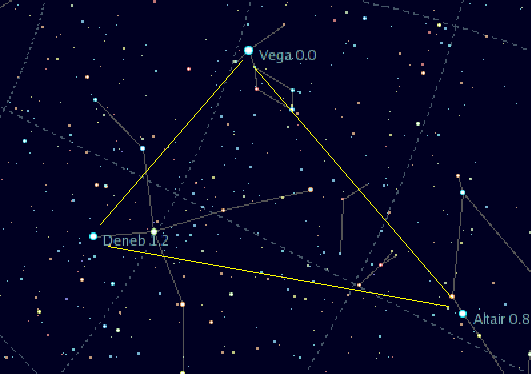
Artist: Tomruen at en.wikipedia
Table of Contents
- What Is the Summer Triangle Asterism?
- How to Find Vega, Deneb, and Altair from Any Sky
- Stellar Science: Why Vega, Deneb, and Altair Shine
- Lyra, Cygnus, and Aquila: Constellations and Deep-Sky Targets
- The Milky Way Through the Summer Triangle
- Observing Tips, Light Pollution Workarounds, and Filters
- Astrophotography Targets and Workflow in the Summer Triangle
- Cultural History and Naming: From Navigator’s Guide to Broadcast Star
- Seasonal Planning and Altitude by Latitude
- Frequently Asked Questions
- Final Thoughts on Exploring the Summer Triangle
What Is the Summer Triangle Asterism?
The Summer Triangle is one of the most widely recognized asterisms in the night sky, composed of three first-magnitude stars: Vega in the constellation Lyra (the Lyre), Deneb in Cygnus (the Swan), and Altair in Aquila (the Eagle). An asterism is a recognizable star pattern that is not a formal constellation; instead, it’s a sky landmark formed from stars that often belong to different constellations. The Summer Triangle spans a huge swath of sky and is visible across much of the world, especially prominent in the northern summer and early autumn evenings.
There are several reasons the Summer Triangle has captivated observers for generations:
- Brightness & accessibility: Each star is bright enough to see easily with the naked eye, even under moderate light pollution.
- Seasonal guide: The triangle arches over the Milky Way and marks the northern summer sky. In the Southern Hemisphere, it appears low in the north during the local winter months.
- Gateway to deep-sky treasures: Inside and around the Triangle are planetary nebulae, supernova remnants, open clusters, rich star clouds, and striking double stars, especially in Cygnus, Lyra, and Aquila.
Although the Summer Triangle is not listed among the official 88 constellations recognized by the International Astronomical Union (IAU), it functions like a giant signpost. New observers can learn it early on and then use it to navigate more intricate patterns—particularly the Lyra parallelogram near Vega, the Northern Cross pattern within Cygnus, and the line of stars through Altair formed with Tarazed (Gamma Aquilae) and Alshain (Beta Aquilae).
For reference, these stars lie approximately at the following J2000 coordinates (rounded): Vega RA 18h36m, Dec +38.8°; Altair RA 19h51m, Dec +8.9°; Deneb RA 20h41m, Dec +45.3°. The triangle’s orientation slowly changes during the night as Earth rotates, and season-to-season due to our orbit around the Sun, which shifts the time each star is visible in darkness.
How to Find Vega, Deneb, and Altair from Any Sky
Artist: Jim Thomas
Finding the Summer Triangle is a straightforward but rewarding exercise in star-hopping. Below are practical strategies for different skies and latitudes.
1) Start with Vega: the beacon of summer
Vega is typically the first of the trio to catch your eye after dusk in northern summer. It’s a striking white-blue star high in the east or near overhead by mid-evening in June–August at mid-northern latitudes. To zero in on Lyra once you’ve found Vega:
- Look for a small parallelogram of stars adjacent to Vega—that distinctive shape marks Lyra’s main figure.
- Between the two brighter stars of that parallelogram, Sheliak (Beta Lyrae) and Sulafat (Gamma Lyrae), lies the famous Ring Nebula (M57), a planetary nebula visible in small telescopes under good conditions.
2) Trace the Northern Cross inside Cygnus to land on Deneb
Once Vega is secured, sweep northeast to find the broad spread of Cygnus. The star Deneb sits at the tail of the celestial swan and at the top of the Northern Cross asterism. The long bar of the cross runs through Sadr (Gamma Cygni) down to Albireo (Beta Cygni), while the crossbar extends left–right across Sadr’s field.
- Look for a dense river of unresolved starlight passing right through Cygnus: this is the Milky Way, brightest in a dark location.
- Deneb will appear somewhat fainter than Vega but still among the brightest stars in the sky. It anchors the northern end of the Summer Triangle.
3) Slide southeast to locate Altair flanked by Tarazed and Alshain
From Deneb, drop down the Milky Way’s flow to reach Altair in Aquila. Altair is distinguished by two nearby companions: Tarazed (Gamma Aquilae), an orange-hued giant, and Alshain (Beta Aquilae), making a near-straight line with Altair. This trio helps confirm you’ve found the correct bright star in a more sparsely populated region compared to Cygnus.
4) Light-polluted skies: use geometry and timing
Under city lights, the Milky Way may be invisible or barely perceptible, but the Summer Triangle still punches through:
- Memorize the shape: Vega at the western corner, Deneb to the north, Altair to the south. This right-skewed triangle is broad but asymmetric.
- In June at mid-northern latitudes, Vega rises earliest in the evening, followed by Deneb and then Altair; by August–September the Triangle is high by dusk, making it easier to spot all three quickly.
- Use a star chart or mobile sky app to match the orientation, and proceed to nearby showpieces like M57, Albireo, or the Veil Nebula when conditions allow.
5) Southern Hemisphere observers
From about 30° south latitude, the Summer Triangle appears low in the northern sky during your winter evenings (June–August). Altair rides highest of the three; Vega and Deneb remain much lower, with Deneb skimming the horizon at some latitudes and failing to rise at more southerly sites (south of roughly 45°S). Plan observations for clear, stable air near the northern horizon and consider binoculars to help distinguish the pattern.
Later sections like Seasonal Planning and Altitude by Latitude and Observing Tips expand on timing, altitude, and gear for different conditions.
Stellar Science: Why Vega, Deneb, and Altair Shine
The stars of the Summer Triangle are all luminous and nearby by cosmic standards (except Deneb), but their scientific interest goes far deeper. Together, they sample diverse stellar types and evolutionary stages, from a fast-spinning main-sequence star to a distant, evolved supergiant.
Vega (Alpha Lyrae): a bright, nearby A-type star
Vega is an A-type main-sequence star roughly 25 light-years from Earth. Long used as a photometric standard in optical astronomy, Vega historically anchored the zero-point for visual magnitude calibrations. Although modern systems are more complex, Vega’s role as a reference star remains part of astronomy’s bedrock.
- Spectral type: A0 V (a hot, white-blue star whose visible spectrum shows strong hydrogen Balmer lines).
- Rotation and orientation: Vega is a rapid rotator and is observed nearly pole-on. This geometry leads to gravity darkening—the equator is cooler and dimmer than the poles due to centrifugal effects.
- Debris disk: Infrared observations have revealed excess emission from a debris disk around Vega, evidence of dust and likely the remnants of planet formation processes. While not a direct planet detection, it has made Vega a touchstone for circumstellar disk studies.
- Future pole star: Due to Earth’s axial precession (~26,000-year cycle), Vega will come relatively close to the celestial north pole in roughly 12,000–14,000 years, becoming a prominent “North Star” in that era.
Deneb (Alpha Cygni): a distant, luminous supergiant
Deneb is one of the most luminous stars visible to the naked eye, an A-type supergiant with a distance estimate of roughly a few thousand light-years (commonly quoted around 2,600 light-years, but with significant uncertainty). Its true luminosity depends sensitively on distance; taking typical estimates, Deneb shines hundreds of thousands of times more brightly than our Sun.
- Evolutionary stage: As a massive, evolved star, Deneb is expected to end its life in a core-collapse supernova in the far future on astronomical timescales.
- Pulsations: Deneb belongs to a class of supergiants that can show small-amplitude variations due to stellar pulsations and atmospheric dynamics.
- Astrophysical importance: Deneb’s properties inform models of massive star evolution, stellar winds, and how such stars shape the interstellar medium with radiation and outflows.
Altair (Alpha Aquilae): a fast-spinning, oblate star
Altair is an A-type main-sequence star about 16–17 light-years away. It rotates rapidly, making the star noticeably oblate—its equatorial radius is larger than its polar radius. This flattening, measured through interferometry, leads to gravity darkening similar to Vega’s, with a cooler, dimmer equatorial zone and a hotter, brighter pole.
- Spectral type: Approximately A7 V, placing it slightly cooler than Vega but still a hot, white-blue star.
- Rapid rotation: Altair’s rotation period is less than a day, contributing to its pronounced oblateness.
- Visibility: Its proximity and brightness make it a favorite calibration and imaging target for optical interferometers and high-resolution instruments.
Together, these three stars illustrate key astrophysical themes—angular momentum in young, massive stars; the sensitivity of observed properties to viewing geometry; and the life cycles of stellar heavyweights. You can appreciate the science with an eyepiece: split delicate doubles in Lyra and witness color contrasts in Cygnus, all while bearing in mind the stellar physics at work above you. For object suggestions, jump to Lyra, Cygnus, and Aquila: Constellations and Deep-Sky Targets.
Lyra, Cygnus, and Aquila: Constellations and Deep-Sky Targets
Once the Summer Triangle is identified, observers often drill down into the constellations that host its vertices. Each offers a rich menu of visual and astrophotography targets, from planetary nebulae to supernova remnants and dark nebulae. Use the triangle’s geometry to hop efficiently between highlights.
Lyra’s gems: the Ring Nebula and the double-double

Artist: NASA, ESA, and C. Robert O’Dell (Vanderbilt University)
- Ring Nebula (M57): Between Sheliak (Beta Lyrae) and Sulafat (Gamma Lyrae) lies one of the most famous planetary nebulae in the sky. Even a small telescope under decent conditions reveals a smoke-ring appearance. Moderate magnification sharpens the ring; under darker skies, subtle variations and a faint interior glow become apparent.
- Epsilon Lyrae (the Double-Double): Near Vega, this celebrated system appears as a close pair in binoculars or a small telescope. With higher magnification and steady air, each of the two components resolves into a pair—four stars in all. Splitting both pairs is a satisfying test of optics and seeing.
- Beta Lyrae (Sheliak) variability: Beta Lyrae is a prototype for a class of interacting binaries. Its brightness varies as the stars eclipse and distort one another. Observing its changes over nights to weeks connects directly to stellar evolution and mass transfer physics.
Cygnus: the Northern Cross, Albireo, and vast nebulae
- Albireo (Beta Cygni): This brilliant color-contrast double (gold and blue) is a perennial favorite for small telescopes. It’s an optical double—the two stars don’t appear to be gravitationally bound—but their vivid color difference makes for a memorable sight.
- Sadr Region (Gamma Cygni): The field around Sadr is sprinkled with emission nebulae and dark lanes; wide-field binoculars or a low-power telescope with a narrowband filter can reveal nuanced structure against the Milky Way’s background glow.
- North America Nebula (NGC 7000) and the Pelican Nebula (IC 5070): Located near Deneb, these vast emission nebulae come alive in wide-field views and shine in narrowband astrophotography (Hα, OIII). Visually, a UHC or OIII filter under dark skies can help tease out the nebulosity as a soft, mottled glow.
- Veil Nebula (NGC 6960, NGC 6992/95, Pickering’s Triangle): The remnant of an ancient supernova in Cygnus is one of the finest filamentary nebula complexes. A good OIII filter can transform the view, especially of the Eastern and Western arcs and the delicate central filaments.

NGC 6960, the Western Veil (Witch’s Broom), is part of the Veil Nebula in Cygnus — a cloud of heated and ionized gas and dust. This three-frame mosaic uses RGB with narrowband Hα and OIII data to enhance filamentary detail.
Artist: Ken Crawford - Crescent Nebula (NGC 6888): A wind-blown bubble from a massive, evolved star (a Wolf-Rayet progenitor), NGC 6888 is subtle visually but responds well to OIII filters and is stunning in narrowband images.
- Open Cluster M39: A loose, bright open cluster northeast of Deneb, visible in binoculars and small telescopes as a scattering of stars that stands out well against the Milky Way background.
Aquila: Altair’s line and dark nebulae
- Altair, Tarazed, and Alshain: This straight line of stars helps confirm you’ve pinned down Altair. Tarazed is an orange giant that provides a striking color contrast next to blue-white Altair.
- Barnard’s E (B142/B143): Near Tarazed sit two overlapping dark nebulae that form a distinctive E-shaped silhouette against the rich star fields. They’re challenging visually, but in dark skies with binoculars or a rich-field scope, the shape becomes apparent as a void in the starry background.
- Planetary Nebula NGC 6781: In northern Aquila, this round, low-surface-brightness planetary nebula rewards patient observers and benefits from OIII or UHC filters. It is a satisfying target once you’ve acclimated to finding fainter objects near bright Altair.
Many more targets lie just outside the triangle’s strict borders—like the Scutum Star Cloud or the Wild Duck Cluster (M11) in neighboring Scutum—making the Summer Triangle a launchpad for entire nights of exploration. Pair this section with The Milky Way Through the Summer Triangle for a bigger-picture understanding of what you’re seeing.
The Milky Way Through the Summer Triangle
Through the Summer Triangle, the Milky Way is not a single object but a layered vista of luminous star fields, star-forming regions, dark clouds of dust, and ancient remnants of stellar death. Observing it teaches core concepts of galactic astronomy.
- Cygnus Rift (Great Rift): The swath of darkness running along the Milky Way here is due to interstellar dust that blocks starlight. Rather than an absence of stars, the Rift is a colossal lane of extinction silhouetted against a bright star background.
- Star clouds and extinction: Moving your gaze from Aquila toward Cygnus, you are looking along a spiral arm toward the inner galaxy. Dense star clouds flanked by dark lanes produce high-contrast mottling. Averted vision helps your eye integrate faint structure.
- H II regions and emission nebulae: Ionized hydrogen (H II) regions like those near Deneb and Sadr mark active star formation. Narrowband filters isolate emission lines (Hα at 656.3 nm, [O III] at 495.9/500.7 nm), dramatically increasing contrast for visual observers and imagers.
- Supernova relics: The Veil Nebula is a web of shock-heated gas from an ancient supernova explosion. Its existence woven into the Milky Way’s fabric is a reminder that death and rebirth are constant in our galaxy.
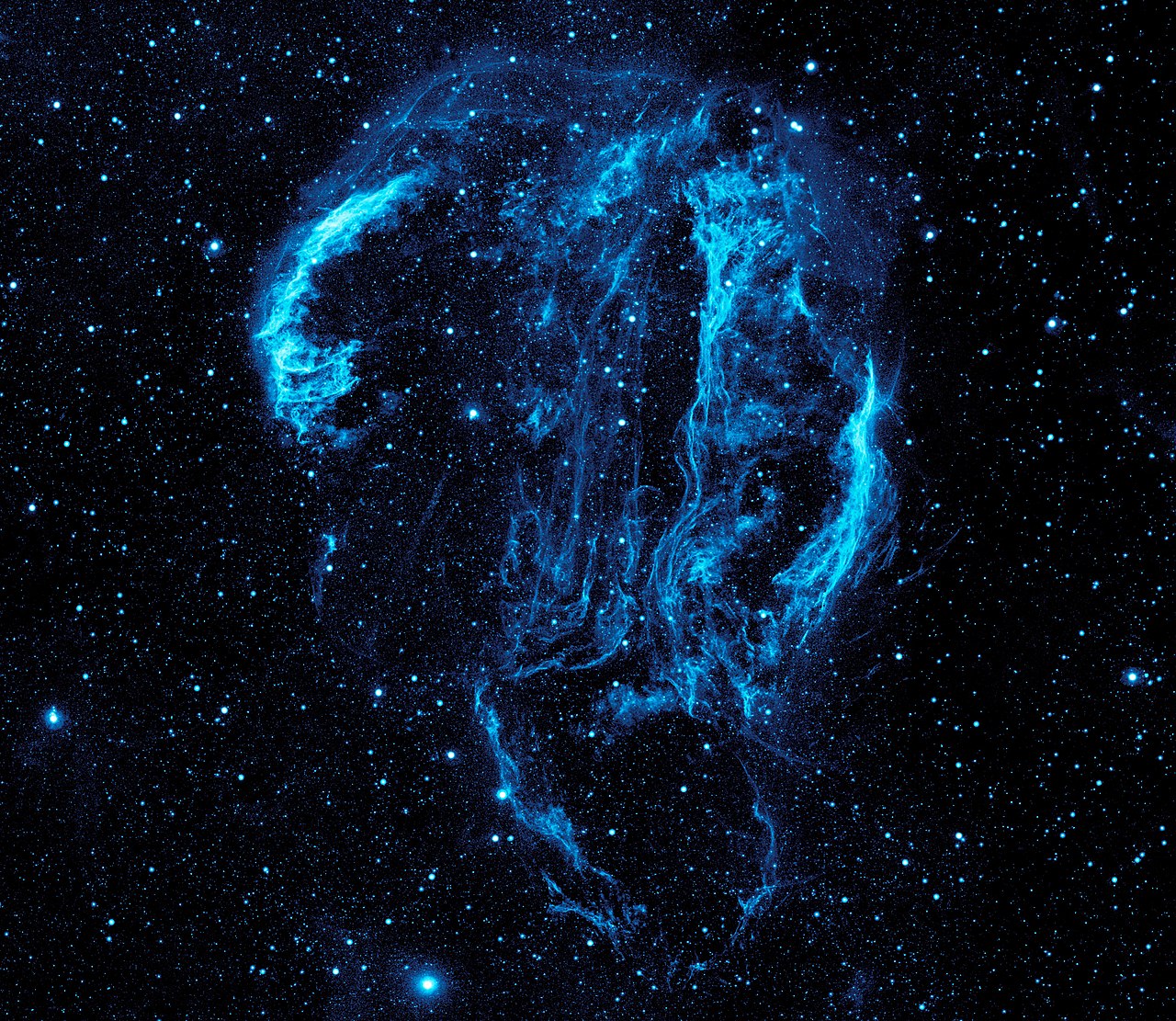
Ultraviolet image of the Cygnus Loop (Veil Nebula) showing wispy tendrils of hot dust and gas, a supernova remnant about 1,500 light-years away in Cygnus.
Artist: NASA/JPL-Caltech
On a perfectly dark, moonless night, the Milky Way through the Triangle can look almost textured, like smoke with bright granules. This impressionistic view arises because you are integrating light from innumerable distant suns, laced with dust that carves voids and contours. For those new to dark-sky observing, a target-rich pass through the Triangle often becomes the moment the galaxy feels three-dimensional.
Observing Tips, Light Pollution Workarounds, and Filters
The Summer Triangle rewards every level of equipment, from naked-eye stargazing to advanced backyard telescopes. Here are tips to maximize your sessions, with cross-links to relevant topics in deep-sky targets and astrophotography.
Get oriented and pace yourself
- Start wide: Spend a few minutes naked-eye or with binoculars absorbing the Milky Way’s brighter and darker zones. This helps calibrate your expectations for what telescopes will reveal and identify promising subfields.
- Use a simple observing plan: For example, Lyra (M57, Epsilon Lyrae) → Cygnus (Albireo, Veil, North America) → Aquila (Barnard’s E, NGC 6781). Keep notes; even bullet points help build familiarity.
- Protect your night vision: Use a dim red light and give your eyes 20–30 minutes to dark adapt before tackling fainter nebulae.
Binoculars and small scopes go far
- Binoculars (7×50, 10×50): Excellent for mapping the Milky Way texture, framing the North America Nebula region, and locating bright doubles like Albireo. A monopod or recliner reduces shake.
- Small telescopes (80–130 mm): Resolve the Double-Double, bring out the smoke ring in M57, and start to hint at the Veil’s arcs with a filter. Rich-field eyepieces (wide true field) help with large nebulae.
- Medium/large apertures: More light really helps the Veil’s fine filaments, the faint glow of NGC 6781, and texture in the Sadr region. Wide-field 2-inch eyepieces can reveal surprising breadth in emission complexes.
Filters: when and why
- UHC (Ultra High Contrast): Broadly useful for brightening emission nebulae like the North America and Pelican under dark skies; also aids the Veil.
- OIII (Oxygen-III): Often the single most effective visual filter on the Veil Nebula arcs and NGC 6888. It boosts contrast dramatically by isolating [O III] emission.
- Hβ (Hydrogen-beta): More specialized, sometimes enhances particular nebula substructures; less general-purpose than UHC or OIII for the Triangle’s common targets.
Light pollution tactics
- Choose targets wisely: Under bright urban skies, focus on stellar showpieces (Albireo, Epsilon Lyrae, the Lyra parallelogram) and brighter planetary nebulae (M57). Save delicate emission nebulae for darker sites or use filters.
- Optimize timing: Observe when targets are near the meridian (highest altitude) to minimize atmospheric extinction and glare from horizon light domes.
- Shield and adapt: Use physical light shields, wear a hood, and avoid glancing at screens. Short breaks help your eyes recover sensitivity.
Remember to pair these practices with the seasonal guidance in Seasonal Planning so you observe the Triangle when it’s positioned best for your location.
Astrophotography Targets and Workflow in the Summer Triangle
The Summer Triangle is a cornerstone of northern-hemisphere astrophotography, welcoming both wide-field and high-resolution projects. The sheer variety of objects—from large H II regions to small, high-surface-brightness planetaries—means you can build a portfolio here alone.
Wide-field projects
- Milky Way mosaic through Cygnus: A camera lens between 24–85 mm can capture the Cygnus Rift, the North America/Pelican complex, the Sadr region, and star clouds in Aquila in a single frame or short mosaic.
- North America + Pelican: A 135–200 mm lens or a short refractor frames these together beautifully. Consider a dual-band or narrowband filter under light pollution for clean separation of Hα and [O III] structure.
- Veil Nebula complex: A 200–400 mm focal length can isolate the Eastern and Western Veil, or include Pickering’s Triangle. OIII and dual-band filters are especially effective.

Hubble WFC3 view of the Veil Nebula highlighting fine filaments of ionised gas. Emissions from doubly ionised oxygen (blue), ionised hydrogen and nitrogen (red) are enhanced with updated processing.
Artist: ESA/Hubble & NASA, Z. Levay
Small-telescope, high-impact targets
- Ring Nebula (M57): Short focal lengths will render it small but distinct; longer focal lengths (600–1500 mm) can capture the ring and inner details with ample integration time.
- Crescent Nebula (NGC 6888): Responds beautifully to narrowband imaging; Hα highlights shells and arcs, while [O III] illuminates the shock fronts.
- NGC 6781 in Aquila: A subtle but pleasing round planetary nebula that rewards longer exposures and careful background control.
- Albireo: A delightful color target; short exposures prevent star bloat, emphasizing the gold–blue contrast.
Acquisition and processing tips
- Tracking and framing: An equatorial mount or a star tracker handles wide-field work well. Ensure good polar alignment for longer subs. For mosaics, overlap frames generously (20–30%) to simplify stitching.
- Filters and cameras: One-shot-color (OSC) cameras paired with dual-band filters can thrive under suburban skies; monochrome cameras with Hα, [O III], and [S II] filters provide even greater control over contrast and color mapping.
- Sub-exposure strategy: Balance sub length against sky brightness to avoid clipping highlights. For emission nebulae with narrowband filters, longer subs are often practical; for broadband targets (e.g., star fields), shorter subs help manage gradients and star saturation.
- Calibration frames: Darks, flats, and bias (or dark flats) are essential for clean data. Flats are especially important to correct vignetting on wide-field lenses and refractors.
- Gradient control: Expect light pollution gradients across the Milky Way. Use gradient reduction tools during processing and consider dithering to suppress fixed-pattern noise.
- Color balance and star control: For mixed narrowband/broadband projects, experiment with star removal/replacement workflows to emphasize nebulosity while preserving natural star colors.
For a beginner-friendly progression, start with a 50 mm wide-field of the Cygnus star clouds, then step up to a 135–200 mm lens for the North America region, and finally target M57 or the Veil with a small refractor. This laddered approach builds skills incrementally.
Cultural History and Naming: From Navigator’s Guide to Broadcast Star
The Summer Triangle’s stars have deep roots in skywatching traditions around the world, and the asterism itself rose to modern prominence in the twentieth century through star charts, magazines, and broadcasts that emphasized practical sky navigation.
- Arabic star names: The names of the Triangle’s stars trace to Arabic: Vega from a phrase meaning “the falling (eagle)” or “the swooping one,” Altair from “the flying (eagle),” and Deneb from “tail,” alluding to the tail of a bird—in this case, the swan of Cygnus.
- East Asian folklore: In Chinese tradition, Altair (Niulang) and Vega (Zhinü) are lovers separated by the Milky Way, with a bridge formed by magpies allowing them to meet. The broader Cygnus region is associated with this “magpie bridge” asterism in various interpretations. The story is celebrated during the Qixi festival.
- Navigation and modern popularization: Pilots and navigators have long used bright asterisms for orientation. In the mid-20th century, popular astronomy communicators helped cement the name “Summer Triangle” in the public lexicon, especially in the UK and Europe, and it quickly spread due to its ease of recognition and seasonal utility.
These cultural threads underscore why the Triangle resonates: it is both practical and poetic, tied to myths of reunion and to the pragmatic art of wayfinding under a dark sky.
Seasonal Planning and Altitude by Latitude
Planning your Summer Triangle sessions benefits from a bit of spherical astronomy. The triangle’s stars are best when high in the sky; your latitude and the season determine their altitude at culmination.
Rules of thumb and timing
- Northern Hemisphere (mid-latitudes): From about 30°N to 50°N, the Triangle dominates summer evenings (June–September). By late August and September, it stands nearly overhead at mid-evening.
- High northern latitudes: Deneb becomes circumpolar for many northerly observers, and Vega is nearly so above roughly 51°N. Altair still dips below the horizon daily at most latitudes except the far north.
- Southern Hemisphere: Visible low in the northern sky during local winter evenings (June–August). Deneb is low and may not rise at more southerly sites (south of roughly 45°S).
Estimating maximum altitude
The altitude of a star at meridian transit (when it’s highest) is approximately:
// Altitude at culmination (degrees)
// phi = observer latitude (positive north), dec = star declination
alt = 90 - abs(phi - dec)
Using this approximation:
- At 40°N: Vega (~+38.8°) culminates near 88.8° (virtually overhead), Deneb (~+45.3°) near 85.3°, Altair (~+8.9°) near 58.9°.
- At 20°N: Vega ~68.8°, Deneb ~64.7°, Altair ~78.9°.
- At 0° (Equator): Vega ~51.2°, Deneb ~44.7°, Altair ~81.1°.
- At 30°S: Vega ~21.2° in the north, Deneb ~14.7° (very low), Altair ~51.1°.
These are idealized maxima; true values vary slightly with refraction and precise coordinates, but they capture why midsummer evenings at mid-northern latitudes are so favorable for the Triangle. For best results, combine altitude awareness with the practical tactics in Observing Tips.
Frequently Asked Questions
Is the Summer Triangle a constellation?
No. The Summer Triangle is an asterism—a recognizable pattern of stars not formally recognized as a constellation. Its three vertices lie in different constellations: Vega in Lyra, Deneb in Cygnus, and Altair in Aquila. Asterisms are common navigational tools for stargazers because they are easy to spot and remember, much like the Big Dipper in Ursa Major.
Can I see the Summer Triangle from the Southern Hemisphere?
Yes, from many southern latitudes—but it appears low in the northern sky during the Southern Hemisphere’s winter months. Altair is easiest to see, while Vega and especially Deneb may be challenging and, in far-southern locations (around 45°S or further south), Deneb may not rise at all. A clear northern horizon and steady air help tremendously.
Final Thoughts on Exploring the Summer Triangle
The Summer Triangle is more than a seasonal signpost. It is a living classroom for stellar astrophysics, a gateway to breathtaking nebulae and star fields, and a cross-cultural thread woven through the human experience of the night. New observers can learn to find Vega, Deneb, and Altair quickly and then branch out to celebrated showpieces like the Ring Nebula, Albireo, the Veil, and the North America Nebula. Advanced amateurs can leverage the same fields for narrowband imaging, mosaics, and careful visual studies of faint structures.
As you plan your sessions, remember the essentials: observe when the Triangle is high, protect your night vision, and use filters to boost contrast when appropriate. With patience and practice, you will find that each return to this asterism reveals deeper layers of the Milky Way’s story.
If you enjoyed this deep dive, explore our other sky guides and consider subscribing to our newsletter for upcoming articles on constellations, star lore, and practical observing and imaging tips.