
Table of Contents
- What Is Dark Matter and How It Differs from Ordinary Matter?
- The Strongest Evidence for Dark Matter Across Scales
- Leading Dark Matter Candidates: WIMPs, Axions, and Beyond
- How Dark Matter Shapes Galaxies, Clusters, and the Cosmic Web
- How Scientists Are Searching: Direct, Indirect, and Collider Approaches
- Alternatives to Dark Matter: Modified Gravity and Hybrid Ideas
- Simulations and Structure Formation in the ΛCDM Universe
- Data You Can Explore and Simple DIY Calculations
- Frequently Asked Questions
- Final Thoughts on Understanding Dark Matter
What Is Dark Matter and How It Differs from Ordinary Matter?
Dark matter is the name we give to the majority of matter in the universe that does not emit, absorb, or reflect light. It interacts gravitationally—shaping the motions of stars within galaxies, the dynamics of galaxy clusters, and the growth of cosmic structure—but it does not engage in ordinary electromagnetic interactions the way atoms do. In cosmological accounting, observations of the cosmic microwave background (CMB) and large-scale structure indicate a universe composed of roughly 5% ordinary (baryonic) matter, about 25–27% dark matter, and about 68–70% dark energy. While dark energy drives the accelerated expansion of space, dark matter is the unseen mass that binds galaxies and clusters together and seeds the filamentary skeleton of the cosmic web.

Attribution: ESA and the Planck Collaboration
Ordinary matter—protons, neutrons, electrons—forms stars, planets, gas, and dust. It radiates across the electromagnetic spectrum. Dark matter, by contrast, appears to be nonbaryonic and is largely collisionless, meaning its particles pass through one another (and through baryonic matter) with negligible non-gravitational scattering. It is also “dark” because it neither shines nor blocks light in a direct way; we infer its presence via gravitational effects. For clarity, dark matter is not the same as black holes, although certain mass ranges of primordial black holes are considered as a possible (but constrained) contributor.
Dark matter can be classified by its thermal properties in the early universe:
- Cold dark matter (CDM): Particles that were nonrelativistic (moving slowly) when they decoupled from the primordial plasma. CDM best fits the observed growth of structure and underpins the standard cosmological model, ΛCDM.
- Warm dark matter (WDM): Particles with velocities between hot and cold cases. WDM can suppress very small-scale structures and has been proposed to address certain small-scale tensions.
- Hot dark matter (HDM): Relativistic particles (e.g., ordinary neutrinos) at decoupling. Pure HDM cannot explain the observed galaxy-scale structure because it erases small-scale fluctuations too efficiently.
Cosmological measurements (e.g., from Planck’s CMB maps) point toward a CDM-like component as the dominant form. But the exact identity—whether a new particle such as a WIMP or axion, or some more exotic component—remains unknown. Later sections will explore the observational evidence, the leading candidates, and how active experiments aim to detect it in several complementary ways.
The Strongest Evidence for Dark Matter Across Scales
Multiple, independent lines of evidence at different cosmic scales converge on the conclusion that substantial mass is present that cannot be explained by the luminous matter we see. These observations interlock to form a coherent picture.
Galaxy Rotation Curves: Flat Speeds Far from the Center
In spiral galaxies, stars and gas rotate around the center. If most of the mass were concentrated where the light is (the stellar disk and bulge), orbital speeds should decline with radius beyond the visible edge, following roughly a Keplerian drop-off (v ∝ r−1/2). Observations, systematically expanded by Vera Rubin and collaborators, found that rotation curves remain flat or even rise slightly out to large radii. This implies that the enclosed mass continues to grow with radius well beyond the visible stellar disk—consistent with an extended, approximately spherical dark matter halo.

Attribution: Soonclaim
Flat rotation curves are among the most accessible pieces of evidence; they can be measured with 21-cm observations of neutral hydrogen (HI) and optical emission lines from ionized gas. The mismatch between the light profile and the mass profile is robust across many spiral galaxies. A dark halo that dominates the mass budget at large radii explains this naturally and sets the stage for halo models used in galaxy dynamics.
Galaxy Cluster Dynamics and Zwicky’s “Missing Mass”
Fritz Zwicky, in the 1930s, studied the Coma cluster and found that galaxies within the cluster were moving too fast to be gravitationally bound by the visible mass alone. Applying the virial theorem, he deduced the presence of substantial “missing mass.” Modern measurements using optical spectroscopy, X-ray observations of intracluster gas, and gravitational lensing confirm that galaxy clusters contain far more mass than accounted for by stars and hot gas. The extra binding mass behaves like collisionless dark matter, creating deep potential wells that confine millions-degree plasma observed in X-rays.
Gravitational Lensing: Mapping Mass Directly
Einstein’s general relativity predicts that mass curves spacetime, bending light. This effect allows astronomers to “see” mass concentrations via gravitational lensing, even if that mass is dark. Lensing comes in two regimes:
- Strong lensing: Produces multiple images, arcs, or Einstein rings of background galaxies. Modeling the lens geometry yields precise mass maps of galaxy clusters and massive galaxies.
- Weak lensing: Statistically distorts the shapes of many background galaxies, revealing the distribution of mass on larger scales.
One famous case is the “Bullet Cluster” (1E 0657−56), a pair of colliding clusters. The X-ray emitting gas (ordinary baryons) is slowed by drag and lags behind, while the lensing mass peaks are offset—aligned with the collisionless components (galaxies and dark matter). This separation demonstrates that most of the mass is in a component that interacts very weakly with itself and with baryons, supporting a collisionless dark matter interpretation.

Attribution: User:Mac_Davis
Cosmic Microwave Background and Early-Universe Imprints
The CMB’s tiny temperature anisotropies (measured by experiments such as WMAP and Planck) encode precise information about the universe’s content shortly after the Big Bang. The pattern of acoustic peaks in the angular power spectrum can only be fit if a substantial nonbaryonic matter component is present. Models without dark matter cannot simultaneously fit the observed peak heights and spacings. The inferred dark matter density from the CMB is consistent with that required to explain galaxy and cluster dynamics today, a key cross-check that links the early universe to the present-day cosmos.
Large-Scale Structure, BAO, and the Cosmic Web
Galaxy surveys map the large-scale distribution of matter, revealing a filamentary network—voids, sheets, filaments, clusters—known as the cosmic web. The statistical properties of this distribution, including the baryon acoustic oscillation (BAO) scale, match predictions of a universe dominated by cold dark matter with a cosmological constant (ΛCDM). If the universe contained only ordinary matter, pressure forces in the primordial plasma would have suppressed small-scale structures too strongly and changed the clustering pattern in ways that conflict with what we observe.
Dwarf Galaxies and Satellite Populations
Many dwarf spheroidal galaxies orbiting the Milky Way and Andromeda are remarkably dark-matter dominated, as inferred from their velocity dispersions. Their high mass-to-light ratios strongly suggest the presence of dark halos. The abundance and internal structure of these systems provide important tests: their kinematics, star formation histories, and spatial distributions calibrate models of dark matter and baryonic feedback, connecting to discussions in How Dark Matter Shapes Galaxies.
All of these lines of evidence reinforce one another: galaxy scales (rotation curves); cluster scales (X-ray and lensing); all-sky cosmology (CMB, BAO); and the detailed properties of low-mass galaxies. A single, consistent dark matter component explains them well.
Leading Dark Matter Candidates: WIMPs, Axions, and Beyond
Although the gravitational fingerprints of dark matter are clear, its microphysical identity remains one of the most compelling open problems in physics. Several well-motivated candidates have emerged from particle physics and cosmology. These candidates are constrained by astrophysical observations and ever-more-sensitive experiments, as reviewed in How Scientists Are Searching.
Weakly Interacting Massive Particles (WIMPs)
WIMPs are hypothetical particles with masses from a few GeV to multiple TeV that interact via forces of comparable strength to the weak nuclear force. Their appeal stems partly from the “WIMP miracle”: a particle with weak-scale interactions naturally freezes out of thermal equilibrium in the early universe with a relic abundance close to the observed dark matter density. This elegant coincidence motivated decades of searches.
Supersymmetric theories (SUSY) once offered natural WIMP candidates (e.g., the neutralino), but null results at the Large Hadron Collider (LHC) and in direct-detection experiments have pushed the allowed parameter space to weaker interactions, heavier or lighter masses, and more complex models. Nonetheless, WIMPs remain a key target, with limits now probing very small interaction cross-sections and exploring new signatures like inelastic scattering or isospin-violating couplings.
Axions and Axion-Like Particles (ALPs)
Axions were originally proposed to solve the strong CP problem in quantum chromodynamics (QCD). If sufficiently light and produced non-thermally in the early universe (e.g., via the misalignment mechanism), axions can form a cold dark matter condensate. The “QCD axion” has a relationship between its mass and coupling; axion-like particles (ALPs) relax that relation and open a broader parameter space.
Axion searches use resonant microwave cavities (e.g., haloscopes such as ADMX) to convert axions from the Galactic halo into photons in a strong magnetic field. Solar axion helioscopes and light/shining-through-walls experiments probe complementary couplings. Over the last several years, haloscopes have begun reaching sensitivity in parts of the QCD axion parameter space in the microelectronvolt mass range, with new techniques extending to higher and lower masses.
Sterile Neutrinos
Sterile neutrinos are hypothetical neutrinos that interact with the Standard Model only through mixing with active neutrinos. If they have keV-scale masses, they behave as warm dark matter. Decays of sterile neutrinos could produce a narrow X-ray line—searches for a ~3.5 keV line in galaxy clusters and galaxies have reported tentative signals in some analyses, but the interpretation remains under debate with mixed results. Constraints from structure formation and X-ray observations restrict the allowed mixing angles and masses.
Self-Interacting Dark Matter (SIDM)
In SIDM, dark matter has sizable self-scattering cross-sections (e.g., σ/m ∼ 0.1–1 cm2/g) that can alter the internal structure of halos, potentially creating constant-density cores in dwarf galaxies. Bullet-cluster-like systems limit strong velocity-independent self-interactions at cluster scales, but velocity-dependent models can evade those bounds while affecting galaxy scales. SIDM is a phenomenological framework rather than a single particle—concrete realizations involve new dark forces or mediators.
Ultralight (Fuzzy) Dark Matter
Ultralight axions with masses around 10−22 eV have de Broglie wavelengths on kiloparsec scales, leading to quantum pressure that suppresses small structures and produces cored central densities in halos. This “fuzzy” dark matter can impact Lyman-α forest statistics and dwarf galaxy structure, providing observational tests. Current constraints challenge the simplest fuzzy models at the canonical mass, but broader parameter ranges and mixed scenarios remain active research topics.
MACHOs and Primordial Black Holes (PBHs)
Massive Compact Halo Objects (MACHOs)—such as faint stars, brown dwarfs, white dwarfs, neutron stars, or black holes—were once considered as candidates. Microlensing surveys (e.g., towards the Magellanic Clouds) constrained MACHOs of stellar masses to be a subdominant fraction of the halo. Black holes formed primordially in the early universe (PBHs) remain a potential dark matter component for some mass windows, but lensing, CMB, dynamical, and gravitational-wave constraints limit the fractions over wide ranges. PBHs cannot constitute all of dark matter across most mass ranges, though niche windows are still explored.
Each candidate class leads to distinct experimental strategies and astrophysical signatures. As we push limits in one area, viable space shrinks—or new regions open—motivating a diversified search program described in How Scientists Are Searching.
How Dark Matter Shapes Galaxies, Clusters, and the Cosmic Web
Dark matter’s gravitational influence dominates the mass budget of galaxies and clusters, setting the stage for how baryons cool, form stars, and assemble visible structures. Understanding this influence illuminates why galaxies look the way they do—and provides tests of dark matter properties.
Dark Matter Halos: Profiles and Concentrations
In ΛCDM cosmology, dark matter collapses under gravity into bound structures called halos. Numerical N-body simulations predict characteristic density profiles, such as the Navarro–Frenk–White (NFW) profile: ρ(r) ∝ 1/[r (1 + r/rs)2], with scale radius rs and concentration parameters that correlate with halo mass and formation history. Observationally inferred profiles from galaxy rotation curves and strong lensing broadly support cuspy profiles at large scales, though inner slopes in dwarfs remain debated (the core–cusp tension).
Feedback processes—supernova explosions and active galactic nuclei (AGN)—can redistribute baryons and transfer energy to dark matter via gravitational coupling, softening cusps into cores. This makes small-scale structure a sensitive probe of both dark matter microphysics and astrophysical processes, a recurring theme in Simulations and Structure Formation.
Rotation Curves and Baryonic Contributions
At small radii, baryons can dominate the gravitational potential in massive spirals and elliptical galaxies. Disentangling the contributions of stars, gas, and dark matter requires stellar population modeling (to estimate mass-to-light ratios), gas dynamics, and assumptions about halo profiles. Empirical relations—like the (radial) acceleration relation—link observed accelerations to those predicted by baryons, hinting at regularities in galaxy formation. Whether these relations arise naturally within ΛCDM via feedback and disk-halo coupling or point to modified dynamics is part of the active discourse described in Alternatives to Dark Matter.
Dwarf Galaxies: Laboratories for Dark Matter Physics
Dwarf spheroidals have low baryonic content but high velocity dispersions, implying large dark matter fractions. Tensions such as “too-big-to-fail” (the apparent deficit of dense subhalos compared to simulations) and diversity in rotation curves challenge simple halo models. SIDM, WDM, and strong baryonic feedback each offer potential resolutions, and current surveys continue to find ultra-faint dwarfs that refine the census of substructure.
Galaxy Clusters and the Baryon Budget
Clusters, the largest gravitationally bound structures, have dark matter halos of 1014–15 solar masses. They contain hot intracluster gas (observed in X-rays) and galaxies, but the total mass, precisely mapped via gravitational lensing, exceeds the baryonic mass by a wide margin. Collisions between clusters, like the Bullet Cluster, demonstrate that the dominant mass component behaves as near-collisionless matter on these scales, limiting strong self-interactions that would otherwise produce observable drag or offsets.

Attribution: ScienceDawns
The Cosmic Web
On tens to hundreds of megaparsecs, matter arranges into a cosmic web of filaments feeding clusters, with voids in between. This pattern is a hallmark prediction of CDM-based structure formation and is observed in galaxy redshift surveys and weak lensing maps. The web’s growth rate and geometry are sensitive to both the expansion history (dark energy) and the amount and nature of dark matter—a synergy exploited by multi-probe cosmological analyses that combine lensing, clustering, and CMB data.
How Scientists Are Searching: Direct, Indirect, and Collider Approaches
Because dark matter is identified by its gravity but appears inert electromagnetically, discovering its particle identity requires creative strategies. Three primary approaches—direct detection, indirect detection, and collider production—probe complementary aspects of candidate models. Gravitational probes and astrophysical observations add crucial constraints.
Direct Detection: Looking for Tiny Nuclear Recoils
Direct-detection experiments are designed to observe the rare scattering of a dark matter particle from a nucleus in a terrestrial detector. Candidates like WIMPs would produce keV-scale nuclear recoils. Key technologies include cryogenic detectors (measuring phonons and ionization), dual-phase noble-liquid time projection chambers (liquid xenon or argon), and bubble chambers.
- Xenon-based detectors (e.g., XENON1T, XENONnT, LUX, LZ) have set world-leading limits on spin-independent WIMP-nucleon cross-sections over a broad mass range, pushing sensitivities down to roughly 10−47–10−48 cm2 near tens of GeV.
- Germanium and silicon cryogenic detectors (e.g., SuperCDMS) excel at low-mass WIMP searches by measuring athermal phonons.
- Argon detectors (e.g., DarkSide) leverage pulse-shape discrimination to distinguish nuclear recoils from electron-recoil backgrounds.
As sensitivities improve, experiments approach the “neutrino floor,” where coherent neutrino–nucleus scattering becomes an irreducible background. Advanced background rejection, directional detection concepts, and target complementarity help maintain discovery potential below this floor.
Indirect Detection: Astrophysical Messengers
Indirect searches look for the byproducts of dark matter annihilation or decay—gamma rays, cosmic rays (positrons, antiprotons), and neutrinos. Dense dark matter environments such as the Galactic Center, dwarf spheroidal galaxies, and galaxy clusters are favored targets. Instruments include gamma-ray telescopes (e.g., Fermi-LAT), atmospheric Cherenkov arrays, neutrino observatories, and cosmic-ray experiments like AMS-02.
- Dwarf spheroidals: Their high mass-to-light ratios and low astrophysical backgrounds yield strong constraints on annihilation cross-sections. Null detections thus far set stringent limits for popular channels.
- Galactic Center excess: A “GeV excess” of gamma rays has been reported by some analyses; interpretations include unresolved millisecond pulsars or dark matter annihilation. The consensus remains unsettled, with active debate.
- Cosmic-ray anomalies: Features in the positron fraction measured by AMS-02 stimulated dark matter interpretations, but pulsar and propagation models can also account for the data.
For decaying dark matter, X-ray and gamma-ray line searches probe sterile neutrinos and other candidates. Mixed and model-dependent systematics complicate interpretations, so cross-correlation with other messengers and targets is essential.
Collider Searches: Missing Energy Signatures
Particle colliders like the LHC can potentially produce dark matter particles if they couple to Standard Model fields. Because dark matter would escape detectors unseen, searches focus on events with significant “missing transverse energy” balanced by a recoiling object (a jet, photon, or weak boson)—the so-called mono-X signatures. Complementing direct and indirect searches, collider bounds limit couplings and masses for specific models, though translating constraints requires ultraviolet-complete frameworks or effective field theory with care about kinematic validity.
Axion Experiments: Haloscopes, Helioscopes, and More
Axion haloscopes such as ADMX use high-Q microwave cavities in strong magnetic fields to resonantly convert axions into photons. Tuning the cavity frequency scans axion masses over time. New concepts—dielectric haloscopes, lumped-element resonators, and nuclear magnetic resonance techniques—extend reach across micro- to millielectronvolt masses. Helioscopes aim at solar axions; light-shining-through-walls experiments test photon–axion oscillations in the lab.
Gravitational and Astrophysical Probes
Even if non-gravitational couplings are vanishingly small, gravity always couples. Weak lensing surveys, stellar streams, and strong-lensing substructure can reveal the population of low-mass halos, constraining warm or fuzzy dark matter models. Precision measurements of the Lyman-α forest power spectrum test the free-streaming scale of dark matter. Cluster collisions limit self-interactions, and ultra-diffuse galaxies, satellite counts, and rotation curve diversity jointly sharpen the small-scale picture. These techniques tie back to the core questions in candidate physics and to the predictive framework in Simulations and Structure Formation.
Alternatives to Dark Matter: Modified Gravity and Hybrid Ideas
Given how well gravity accounts for observed phenomena when dark matter is included, some researchers investigate whether changes to gravity itself could obviate the need for unseen mass. Modified Newtonian Dynamics (MOND) and relativistic extensions represent major efforts in this direction, with both successes and challenges.
MOND and the Acceleration Scale
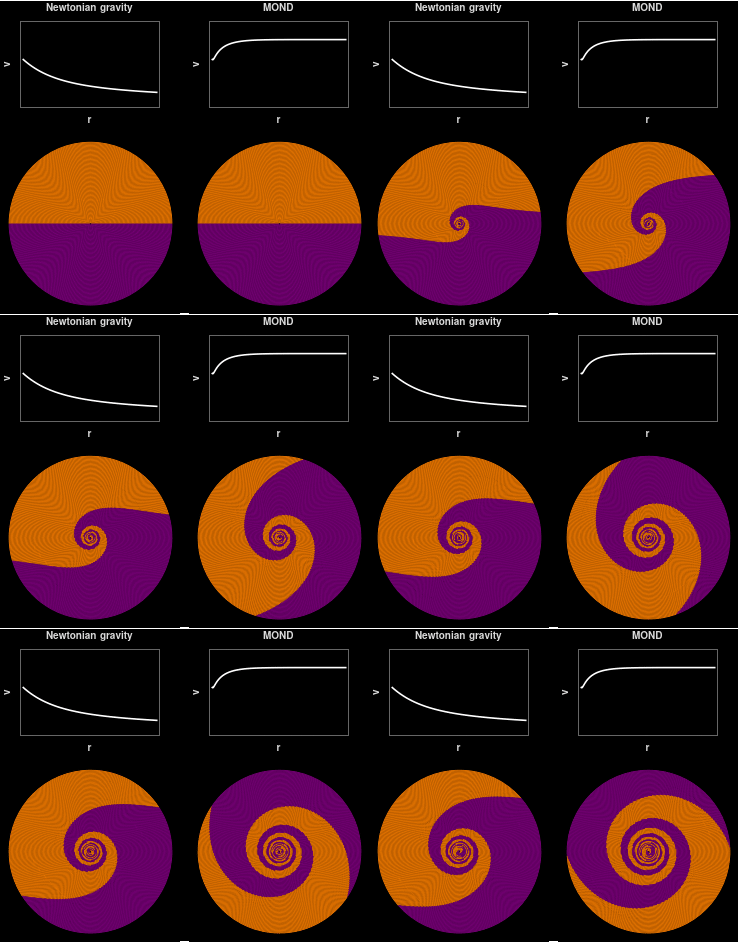
MOND postulates that Newton’s second law or the law of gravity changes in the regime of very low acceleration, below a characteristic scale a0 (~10−10 m s−2). In the MOND regime, effective dynamics can reproduce flat galaxy rotation curves without dark halos and can explain empirical relations that tie baryons to kinematics. However, MOND in its original nonrelativistic form is not a full theory; relativistic extensions are needed to address lensing and cosmology.
Attribution: Jacopo Bertolotti
Relativistic Extensions and Cosmological Tests
TeVeS (Tensor–Vector–Scalar theory) and related frameworks aim to embed MOND-like dynamics within a relativistic theory. While these can mimic some galaxy-scale phenomena, fitting the CMB power spectrum and cluster lensing without additional unseen components has proven difficult. Often, even modified gravity models require some form of additional dark component (e.g., sterile neutrinos) to match all data. This converges back toward the multi-probe consistency that ΛCDM achieves with a single cold dark matter component plus dark energy.
Hybrid and Emergent Approaches
Other ideas, such as emergent gravity or superfluid dark matter, attempt to produce MOND-like phenomenology within a dark sector with novel interactions or states of matter. These can reproduce certain galactic regularities while retaining a particle component that participates in cosmological structure formation. The space of possibilities remains active but constrained: success requires simultaneously matching galaxy rotation curves, gravitational lensing, cluster dynamics, CMB anisotropies, and the cosmic web.
While modified gravity offers intriguing insights into galactic dynamics, the broad suite of observations—from the Bullet Cluster lensing map to the CMB peaks—currently favors dark matter as a distinct, nonbaryonic component. Nonetheless, alternatives sharpen tests and guide new observations that probe the boundaries of ΛCDM.
Simulations and Structure Formation in the ΛCDM Universe
Large-scale cosmological simulations reveal how tiny quantum fluctuations in the early universe grow via gravity to form galaxies, clusters, and the cosmic web. In the ΛCDM model, dark matter drives this growth while dark energy controls the expansion rate. Simulations connect fundamental parameters to observables, enabling end-to-end tests of cosmology and galaxy formation.
Initial Conditions and the Power Spectrum
Inflationary cosmology predicts a nearly scale-invariant spectrum of primordial fluctuations. The matter power spectrum P(k) quantifies how variance is distributed over spatial scales (wavenumbers k). Cold dark matter retains small-scale power, enabling hierarchical structure formation (“bottom-up”): small halos collapse first and merge into larger systems. The BAO feature imprinted in the power spectrum provides a standard ruler observed in galaxy surveys.
N-Body Simulations and Halo Statistics
Collisionless N-body simulations evolve billions of dark matter particles under gravity to form halos and subhalos. They predict halo mass functions (abundances versus mass), concentration–mass relations, merger rates, and substructure properties. Press–Schechter theory and extensions (e.g., Sheth–Tormen) provide analytic baselines for halo abundances. High-resolution runs reveal dense substructure within halos—key for tests using strong lensing flux anomalies and stream perturbations that probe halo populations down to very low masses.
Hydrodynamics and Baryonic Feedback
To connect to galaxy observables, simulations must include gas cooling, star formation, chemical enrichment, and feedback from supernovae and AGN. These processes can flatten inner dark matter profiles, drive outflows that regulate star formation, and shape disks and bulges. Differences among simulation suites reflect different subgrid models but converge on broad trends: baryons matter for inner-halo structure and for scaling relations, yet dark matter dominates total halo mass and the cosmic web morphology.
Signatures of Non-Standard Dark Matter
Warm or fuzzy dark matter suppresses small-scale power, reducing the number of low-mass halos and altering their internal structures. SIDM modifies halo density profiles and subhalo survivability. These changes propagate to observable statistics: satellite counts, lensing substructures, Lyman-α forest suppression, and rotation curve shapes. Thus, simulations become laboratories to test candidate physics against a network of observations.
Cosmic Shear and Multi-Probe Inference
Weak lensing (cosmic shear) surveys map the large-scale mass distribution by measuring correlated distortions of background galaxy shapes. Combined with galaxy clustering and CMB lensing, this data constrains the amplitude and growth of structure. Any deviation from ΛCDM growth—whether due to modified gravity or dark sector physics—would imprint scale- and redshift-dependent signatures in these statistics. Cross-correlation across probes mitigates systematics and elevates robustness.
Data You Can Explore and Simple DIY Calculations
You do not need a particle detector to gain intuition about dark matter. Public data and basic models let you replicate some classic inferences—from galaxy rotation curves to halo mass profiles. This section highlights accessible steps and a simple code example.
Public Data Resources
- Galaxy rotation curves: Many published rotation curves are available in astronomy databases and supplementary materials. Even without raw data, reconstructed curves exist for well-studied spirals, allowing you to compare baryonic contributions to total rotation.

The rotation curve of Andromeda Galaxy
Attribution: Kot Da Vinchi - Gravitational lensing maps: Visualizations from strong-lensing clusters and weak-lensing surveys show how mass bends light. While quantitative modeling requires specialized tools, qualitative patterns—arcs, multiple images—convey the presence of concentrated mass.
- CMB power spectra: Plots from WMAP and Planck illustrate the acoustic peaks that lock in cosmological parameters, including dark matter density. Interactive cosmology calculators demonstrate how changing parameters shifts peak heights and positions.
A Minimal Rotation Curve Model
The idea behind rotation curves is straightforward: the circular velocity vc(r) reflects the enclosed mass M(<r) via vc2(r) = G M(<r)/r. Below is a minimal Python example that builds a toy rotation curve from a baryonic disk plus a simple isothermal halo. This is not a fit to real data but illustrates how luminous matter alone often undershoots observed velocities at large radii unless a halo is included.
import numpy as np
import matplotlib.pyplot as plt

G = 4.30091e-6  # kpc (km/s)^2 / Msun

# Exponential disk parameters (toy)
M_disk = 5e10      # Msun
R_d = 3.0          # kpc (scale length)

# Isothermal halo parameters (toy)
vh = 180.0         # km/s (asymptotic)
rc = 5.0           # kpc (core radius)

r = np.linspace(0.1, 40, 400)

# Disk contribution (approximation using Freeman disk peak behavior)
# For a better treatment, use Bessel functions; here we use a simple toy profile.
M_disk_enclosed = M_disk * (1 - np.exp(-r/R_d) * (1 + r/R_d))
vc_disk = np.sqrt(G * M_disk_enclosed / r)

# Isothermal halo circular velocity profile
vc_halo = vh * np.sqrt(1 - (rc/r) * np.arctan(r/rc))

vc_total = np.sqrt(vc_disk**2 + vc_halo**2)

plt.figure(figsize=(6,4))
plt.plot(r, vc_disk, label='Disk (baryons)')
plt.plot(r, vc_halo, label='Isothermal halo (DM)')
plt.plot(r, vc_total, label='Total', linewidth=2)
plt.xlabel('Radius (kpc)')
plt.ylabel('Circular velocity (km/s)')
plt.legend()
plt.tight_layout()
plt.show()
Try changing M_disk, R_d, vh, and rc to see how baryons versus halo parameters change the curve. You will find that increasing the halo’s asymptotic velocity vh primarily lifts the outer rotation speed, while the disk mass more strongly affects the inner rise. This mirrors actual analyses that combine stellar population models (to set disk mass-to-light ratios) with halo parameterizations such as NFW or cored isothermal profiles, connecting back to rotation-curve evidence and halo structure.
Reading Lensing Mass Maps
Strong-lensing images are dramatic: elongated arcs and multiple images form near critical curves. By comparing lens models with and without a concentrated mass component, you can see how additional mass shifts image positions and stretches arcs. In weak lensing, plots of the shear two-point correlation function or convergence (κ) maps reveal mass concentrations statistically. Linking these maps to the underlying halo population is a powerful consistency check for dark matter-dominated structure.
Frequently Asked Questions
Is dark matter just black holes?
Black holes—especially those formed from dying stars—cannot make up the bulk of dark matter because microlensing surveys, dynamical constraints, and other observations limit the fraction of the halo composed of such compact objects. Primordial black holes (PBHs) formed in the early universe are still considered in certain mass windows, but a combination of lensing, cosmic microwave background, gravitational-wave, and astrophysical limits rules out PBHs as all of the dark matter across most masses. PBHs could still exist and contribute a subdominant component, but the evidence points to a predominantly nonbaryonic particle-like dark matter.
Could dark matter just be neutrinos?
Ordinary (active) neutrinos are known to exist and have tiny masses, but as hot dark matter they remain too fast-moving in the early universe. Pure hot dark matter would wash out small-scale structure, contradicting observations. While active neutrinos do contribute a small fraction to the total matter density, they cannot make up the dominant dark matter component. Hypothetical sterile neutrinos with keV-scale masses are a potential warm dark matter candidate, but they are tightly constrained by X-ray searches and structure formation measurements.
Final Thoughts on Understanding Dark Matter
Dark matter is a remarkably successful idea that explains a vast range of cosmic phenomena—from the flat rotation curves of galaxies and the binding of clusters to the precise pattern of CMB anisotropies and the sprawling cosmic web. The consistency across scales and epochs is a key strength of the ΛCDM framework. Yet the microscopic identity of dark matter—WIMP, axion, sterile neutrino, or something more exotic—remains unknown. The lack of a definitive non-gravitational detection so far has not weakened the astrophysical case; instead, it has refined theories and pushed experiments to unprecedented sensitivity.
In the coming years, complementary efforts will keep tightening the net: direct-detection experiments will press into the neutrino background and beyond with innovative discrimination; indirect searches will combine multi-messenger data sets and sophisticated modeling; collider experiments will probe higher energies and subtle signatures; and astrophysical probes—from strong-lensing substructure to Lyman-α forest measurements—will map the halo population down to ever smaller scales. Simulations will continue to turn microphysics into predictions for galaxies and structure, illuminating how feedback and dark matter physics entwine to shape observable systems.
As you follow this evolving story, remember that dark matter is not a single “fact” but a network of interlocking evidence, models, and measurements. The interplay among observations, candidate physics, and search strategies forms a self-consistent whole—one that will either pinpoint a discovery or force a profound revision of our understanding. If you enjoyed this deep dive, consider subscribing to our newsletter to get future articles on cosmology, galaxies, and the frontiers of astrophysics delivered to your inbox.