
Table of Contents
- What Is Portable Deep‑Sky Astrophotography with a Star Tracker?
- Essential Gear: Cameras, Lenses, Star Trackers, and Tripods
- Planning the Night: Targets, Seasons, Light Pollution, and Moon Phase
- Exposure Basics: F‑ratio, ISO, Exposure Time, and Signal‑to‑Noise
- Accurate Polar Alignment and Mount Balance Techniques
- Capture Workflow: Sequencing, Dithering, and Calibration Frames
- Stacking and Processing: From Raw Lights to a Clean, Calibrated Image
- Choosing Lenses for Nebulae and the Milky Way (14–135 mm)
- Common Problems and Diagnoses: Trails, Rotation, Gradients, and Tilt
- Field Safety, Battery Management, Dew Control, and Ethical Imaging
- Frequently Asked Questions
- Final Thoughts on Choosing the Right Star‑Tracked Setup
What Is Portable Deep‑Sky Astrophotography with a Star Tracker?
Portable deep‑sky astrophotography is the practice of capturing faint celestial objects—such as nebulae, galaxies, and star clusters—using lightweight, travel‑friendly gear. The core of this approach is a star tracker, a compact, motorized device that rotates your camera in sync with Earth’s rotation. By following the apparent motion of the night sky, a tracker allows much longer exposures than a static tripod would permit, increasing your signal and making dim structures visible.

Artist: NASA/JPL-Caltech
Compared with larger equatorial mounts and telescopes, a tracker‑and‑camera setup offers three powerful advantages:
- Portability: You can hike to darker skies and set up quickly.
- Wide fields: Short lenses (14–135 mm) frame extended nebulae, the Milky Way, and multi‑object fields beautifully.
- Affordability and simplicity: You can begin with a DSLR or mirrorless camera you may already own and add astrophotography techniques step by step.
In this guide, we walk through the complete workflow—from gear selection to stacking and processing. We also explain how to optimize exposure and ISO, and we show you how to perform accurate polar alignment so you can make the most of your time under the stars.
Essential Gear: Cameras, Lenses, Star Trackers, and Tripods
You can start deep‑sky imaging with a modest kit. The right combination of stability, tracking accuracy, and optical quality will determine how far you can push your exposures and how clean your results will be.
Camera: DSLR or Mirrorless
- Sensor size: Full‑frame sensors collect more light and offer wider fields at a given focal length. APS‑C works very well, too—simply account for the crop factor when planning compositions.
- Raw capture: Ensure your camera can save raw files (.CR2, .NEF, .ARW, .RAF, .DNG, etc.) to preserve dynamic range and color fidelity.
- Live view and manual controls: Focusing on stars requires live view zoom and the ability to set manual exposure, ISO, and white balance.
- ISO behavior: Many modern sensors are close to “ISO‑invariant,” meaning you can often shoot at moderate ISOs and brighten in post without severe penalties. We discuss settings in Exposure Basics.
Lenses: Fast, Sharp, and Controlled
- Focal range: 14–35 mm is ideal for the Milky Way and very large nebulae; 50–135 mm isolates smaller nebulae and star fields; 135–200 mm begins to frame compact targets like the North America Nebula or Rho Ophiuchi more tightly.
- Aperture (f‑ratio): Faster lenses (f/1.4–f/2.8) collect more light but may show coma, astigmatism, and vignetting wide open. Stopping down by 1–2 stops often sharpens stars and reduces aberrations.
- Manual focus and solid focus ring: Smooth, repeatable focus matters more than autofocus for stars.
- Filters: Light‑pollution suppression or multi‑band filters can help under bright skies, especially for emission nebulae. Be aware of color shifts and reduced continuum light for galaxies and reflection nebulae.
Star Trackers: Portable Right Ascension Drives
Star trackers are compact right ascension (RA) drives that sit between your tripod and camera. They typically offer:
- Polar scope or electronic alignment aid for aligning the RA axis with the celestial pole.
- Weight capacity ranging from a light camera and prime lens up to a small telephoto and guiding accessories. Stay within the manufacturer’s payload rating (many imagers keep total weight to ~50–70% of the rated capacity for better performance).
- Tracking rates for sidereal, lunar, and solar motion. Use sidereal for deep‑sky imaging.

Artist: NASA
Some trackers add a declination (DEC) bracket, fine‑adjustment base, and even optional autoguiding. For wide‑field work at ≤135 mm, unguided tracking with good polar alignment is usually sufficient. For longer focal lengths, a declination bracket and careful balance become important, and optional guiding can extend exposure times reliably.
Tripod and Head
- Tripod: A sturdy, low‑flex tripod minimizes vibration. Avoid fully extending the center column if possible.
- Ball head or panoramic head: You may mount the camera on a ball head attached to the tracker’s DEC bracket for framing. A panoramic clamp can simplify panning without upsetting balance.
Accessories
- Intervalometer or in‑camera timer for automated sequences.
- Dew mitigation: Dew heaters, lens hoods, or chemical hand warmers secured around the lens barrel.
- Power: Spare batteries or external power banks (with appropriate couplers) to last through long sessions.
- Red headlamp to preserve night vision.
- Polar alignment aids: Smartphone apps or reticle charts to position Polaris (North) or Sigma Octantis helpers (South) correctly.
Planning the Night: Targets, Seasons, Light Pollution, and Moon Phase

Artist: ESO/Yuri Beletsky
Planning maximizes your sky time and ensures you’re aiming at targets that fit your focal length, season, and conditions. Good plans cover the target’s altitude, timing, and how the Moon and artificial light might affect contrast.
Seasonality and Altitude
- Milky Way core (Sagittarius/Scorpius): Best from late spring through summer in the Northern Hemisphere; winter in the Southern Hemisphere.
- Autumn and spring galaxies: Objects in Andromeda, Triangulum, and Virgo rise high in fall and spring evenings. Altitude matters: higher is better to reduce atmospheric extinction and distortion.
- Winter emission nebulae: Orion, Rosette, and the California Nebula dominate winter nights in the North.
Check that your chosen target reaches at least 30–40 degrees above the horizon for several hours. Imaging near the meridian (due south in the Northern Hemisphere; due north in the Southern Hemisphere) often provides the highest elevation and best transparency.
Light Pollution and Transparency
- Bortle scale: Darker sites (lower Bortle numbers) offer much higher contrast. If you’re in bright suburbs or cities, consider emission nebulae with narrowband‑style filters designed for broadband cameras; for galaxies and reflection nebulae, darker skies make a larger difference.
- Transparency and seeing: For wide‑field imaging, transparency (clarity) affects results more than seeing (steadiness). Dry, clear nights with low humidity reduce haze and skyglow scatter.
- Weather: High clouds can be invisible to the naked eye but scatter light strongly. Satellite cloud maps help diagnose this risk.
Moon Phase and Timing
- New Moon to thin crescent: Best for faint galaxies and reflection nebulae.
- Gibbous to full Moon: Better suited to bright star fields, clusters, or lunar/planetary work. For deep‑sky scenes, keep the Moon below the horizon when possible.
- Target timing: Start imaging after astronomical twilight ends. Note that for high declination targets, you can sometimes image through partial Moonlight if the target is on the opposite side of the sky from the Moon.
Before you head out, make a structured plan for the night: a list of targets with time windows, desired exposure settings, and frame counts. Define a primary target and at least one backup. If conditions shift, you’ll be ready to pivot. This prework pairs naturally with your capture workflow so you don’t spend dark time troubleshooting.
Exposure Basics: F‑ratio, ISO, Exposure Time, and Signal‑to‑Noise
Astrophotography is a game of signal‑to‑noise ratio (SNR). Your goal is to collect as many signal photons from the target as possible while reducing noise from the sky background, read noise, thermal noise, and fixed patterns. A star tracker lets you stretch exposure time significantly, which drives SNR gains.
F‑ratio and Photons
- F‑ratio (f-number): At a given sensor and exposure, f/2 gathers four times as many photons per unit area as f/4. However, stopping down by one stop often improves star shapes and edge sharpness. Balance speed against optical quality.
- Vignetting and flats: Fast lenses usually vignette, leading to darker corners. You can correct this with flat frames.
Exposure Time: How Long Is Long Enough?
Without tracking, the classic “500 rule” offers a rough shutter time estimate to avoid star trailing on full‑frame sensors: 500 divided by focal length in millimeters. Modern high‑resolution sensors and pixel densities often need a stricter rule, such as NPF. With a star tracker, you can push exposures to 1–4 minutes or longer at 14–135 mm if your polar alignment is accurate and your setup is well balanced.
Rule of thumb: Start with 60–120 s at 50 mm, 120–180 s at 35 mm, and 180–240 s at 24 mm on a well‑aligned tracker. Evaluate star shapes at 100% and adjust.
Field rotation becomes negligible if the RA axis is close to the true celestial pole, but misalignment produces short‑arc rotation around the frame center. See Accurate Polar Alignment and Mount Balance for alignment techniques that directly impact exposure length.
ISO and Dynamic Range
- Starting points: For many DSLRs and mirrorless cameras, ISO 800–1600 is a reliable starting range for deep‑sky imaging. The ideal choice is camera‑specific; test your camera to find the sweet spot that balances read noise and dynamic range.
- Histogram placement: Aim for the sky background peak to be roughly 1/4 to 1/3 from the left edge of the histogram. If it’s clipped to the left, increase exposure length or ISO; if it’s near the right, reduce exposure or ISO.
- ISO invariance: If your camera is close to ISO‑invariant, you can prioritize exposure time (for more photons) and keep ISO moderate to preserve highlights in star cores.
Stacking and SNR
When you stack N sub‑exposures (lights), random noise averages down roughly as 1/sqrt(N) while the signal adds linearly. If a single 2‑minute exposure yields a noisy image, stacking thirty 2‑minute exposures (for an hour of total integration) improves SNR by about √30 (~5.5×), revealing fainter detail. The key is to collect many consistent frames and calibrate them with darks, flats, and biases (explained in Capture Workflow).
NPF Rule (for reference)
For non‑tracked exposures, the NPF rule accounts for aperture, pixel size, and declination. While trackers make NPF largely irrelevant, it’s useful for comparison. A simplified pseudocode form looks like:
# Simplified NPF pseudocode for max exposure (seconds)
# p = pixel pitch (micrometers), N = f-number, f = focal length (mm)
# K constants vary with acceptance of trailing; using a common form:
T_max ≈ ( (35 * N) + (30 * p) ) / (f)  # for wide-angle
With tracking, you replace this time limit by your tracker’s alignment accuracy and mechanical performance. Test incrementally: increase exposure until you see elongation, then step back to the last clean value.
Accurate Polar Alignment and Mount Balance Techniques
Polar alignment aligns your tracker’s rotation axis (RA) with the celestial pole so stars remain stationary relative to your camera during long exposures. Small errors translate into elongated stars or field rotation. Good alignment is the difference between 30‑second frames and multi‑minute frames at the same focal length.
Leveling and Rough North/South
- Level the tripod: Start with a well‑leveled tripod to keep adjustments predictable. A small bubble level on the tripod crown helps.
- Set latitude: Most tracker bases have a latitude scale. Dial in your site latitude as a starting point.
- Rough azimuth: Use a compass (account for magnetic declination) or polar‑finder app to point the RA axis roughly toward true north (Northern Hemisphere) or true south (Southern Hemisphere).
Using a Polar Scope Reticle
- Find Polaris or the asterism near the south celestial pole: In the North, you’ll place Polaris at a precise clock position on the reticle; in the South, you’ll align using reference stars near Octans according to your reticle or app.
- Reticle orientation: Some trackers require you to rotate the RA axis to match the reticle “clock” with the sky. A smartphone app can display the correct hour angle for Polaris.
- Fine adjustments: Use the tracker’s azimuth and altitude knobs—make small, smooth moves to place the pole star precisely on the reticle mark.
Electronic Alignment Aids
Some trackers or third‑party accessories offer electronic polar alignment tools. These can be especially helpful in light‑polluted areas or when Polaris is obstructed. Follow the device’s routine to minimize residual error.
Balance and Flexure
- RA balance: If your setup allows, slightly east‑heavy balance (counterweight side a touch heavier) can reduce backlash. For lightweight trackers, follow manufacturer guidance—some prefer neutral balance.
- DEC balance: If using a DEC bracket and longer lenses, slide the camera plate to balance front‑to‑back so the lens doesn’t tip.
- Cable management: Route cables so they don’t tug as the tracker slews. Strain relief prevents subtle star elongation from cable drag.
Re‑check alignment if you knock the tripod, change lenses, or reframe drastically. Your maximum clean exposure time depends directly on your polar alignment quality—one more reason to master this skill before optimizing exposure times.
Capture Workflow: Sequencing, Dithering, and Calibration Frames
A repeatable capture workflow saves time and produces consistent data for stacking. Think in terms of three components: target frames (lights), calibration frames (darks, flats, biases), and smart sequencing (including any dithering).
Sequencing Lights
- Frame and focus: Compose the shot using high ISO (e.g., 6400) and short test exposures (5–10 s). Use live view at maximum magnification to focus on a bright star. Once sharp, lock focus with tape if necessary.
- Set exposure: Choose exposure length and ISO based on your tests and sky brightness. Keep the histogram’s sky peak 1/4 to 1/3 from the left.
- Run a series: Capture 30–120+ lights, depending on your time and target brightness. Consistency matters more than any single frame’s perfection.
Dithering for Cleaner Stacks
Dithering is the practice of moving the pointing slightly between frames to shift fixed pattern noise and hot pixels around the sensor. Stacking algorithms then reject these patterns. On simple tracker setups without guiding, you can:
- Manual dither: Nudge the ball head a tiny amount every 5–10 frames, keeping the target centered overall.
- Built‑in or external control: Some trackers or apps can automate small RA/DEC offsets between exposures.
If dithering isn’t available, you can still reduce hot pixels and walking noise via robust calibration and rejection methods—but dithering yields a noticeable improvement in many cases.
Calibration Frames: Darks, Flats, and Biases
- Darks: Taken with the same exposure length, ISO, and temperature as your lights, but with the lens cap on. Darks model thermal signal and hot pixels. For DSLR/mirrorless work where temperature varies, you can capture darks at the session end and build a small library across common exposure times.
- Flats: Short exposures (typically 0.5–2 s) at the same focus and aperture as your lights, using a uniformly illuminated source (dawn sky, flat panel, or white T‑shirt over the lens pointed at a bright, even surface). Flats correct vignetting and dust motes. Aim for a histogram peak around 1/2 to 2/3 from the left—avoid clipping.
- Bias (offset) frames: The shortest possible exposures at your chosen ISO with the lens cap on. Bias frames capture the camera’s readout pattern. Some stacking tools now prefer “dark flats” (short darks matching flat exposure) in place of biases; follow your software’s guidance.
White Balance and File Management
- White balance: Set a fixed white balance (e.g., daylight) for preview consistency; raw processing will handle color later.
- File organization: Create folders for Lights, Darks, Flats, and Bias/DarkFlats per target/session. Good naming saves headaches in stacking.
Stacking and Processing: From Raw Lights to a Clean, Calibrated Image

Artist: Martin Bernardi
Stacking software calibrates, aligns, and integrates your frames into a single high‑SNR master. The basic flow is similar across tools, though the names differ slightly. Below is a general workflow compatible with popular programs.
Calibration and Registration (Alignment)
- Load data: Add your Light, Dark, Flat, and Bias/DarkFlat frames.
- Calibrate: The software subtracts darks/bias and divides flats to correct fixed patterns, vignetting, and dust shadows.
- Register (align): The program detects stars and aligns all frames to a common reference. Good alignment is essential, especially if you manually dithered.
Integration (Stacking)
- Rejection algorithms: Use sigma‑clipping or winsorized clipping to reject outliers (satellite trails, hot pixels). Dithering enables more effective rejection.
- Weighting: Some tools weight frames by quality (FWHM, star count, sky background). Excluding poor frames (clouds, shake) strengthens your result.
- Output: Produce a 16‑bit or 32‑bit floating‑point master stack for further processing.
Post‑Stack Processing Steps
- Background extraction/gradient removal: Light pollution produces gradients. Use background models to subtract them. Sample carefully to avoid subtracting real nebulosity.
- Color calibration: Set a neutral white reference using stellar photometry methods if available, or use background neutralization followed by color balance. Be wary of heavy filtering that skews colors.
- Nonlinear stretch: Apply curves/levels or a generalized hyperbolic stretch to bring faint details out of the linear master. Stretch gradually and protect highlights.
- Noise reduction: Apply noise reduction after an initial stretch. Use masks to protect stars and structure. Multi‑scale techniques can preserve sharp edges while smoothing backgrounds.
- Star control: If stars dominate, consider gentle star reduction. Avoid halos and ringing artifacts; subtlety maintains a natural look.
- Color saturation and contrast: Increase saturation selectively in nebulosity and the Milky Way band. Use local contrast enhancements sparingly to avoid crunchy textures.
- Final crop and framing: Crop edges with registration artifacts or stacking mismatches. Keep enough field to tell the story of your target.
Suggested Software Paths
- Beginner‑friendly stacking: DeepSkyStacker (Windows) or Sequator (Windows) handle calibration, alignment, and stacking with straightforward interfaces.
- Cross‑platform with powerful tools: Siril (Windows/Mac/Linux) offers scripts, photometric color calibration, and gradient removal. A Siril‑centric flow: run a preprocessing script, then background extraction, photometric color calibration, stretch, and final tweaks.
- Advanced workflows: Several commercial suites add sophisticated tools. Regardless of software, the fundamentals above remain the same.
Remember: a well‑captured, properly calibrated dataset is far easier to process than a problematic one. If you struggle in post, revisit your capture workflow and alignment next time out.
Choosing Lenses for Nebulae and the Milky Way (14–135 mm)
Your lens choice shapes both your composition and the technical demands on tracking accuracy. Below are practical focal length bands, their strengths, and example targets to help you plan sessions.
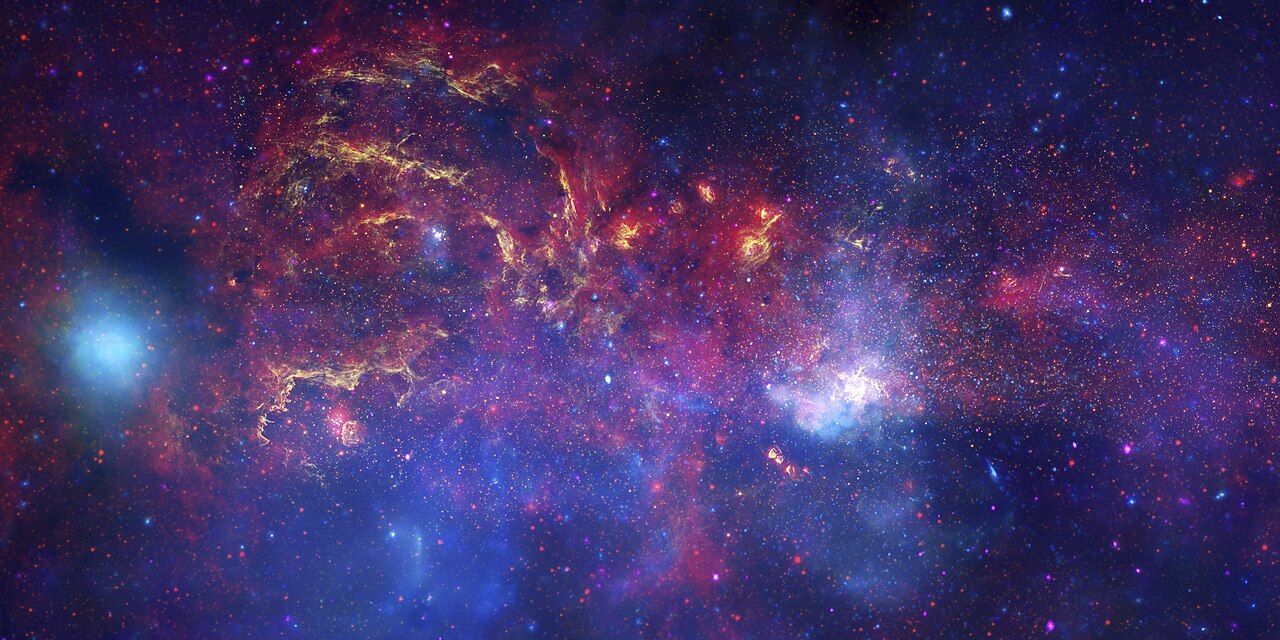
Artist: NASA/JPL-Caltech/ESA/CXC/STScI
14–24 mm: Expansive Milky Way Landscapes
- Use case: Wide Milky Way arcs over landscapes; large nebular complexes as part of the Galactic plane.
- Pros: Long exposures (3–4 minutes) are commonly achievable with good alignment. Compositions are forgiving; stars are small.
- Watch for: Coma and sagittal astigmatism wide open. Stop down 1–2 stops for cleaner corners.
28–35 mm: Structured Galactic Fields
- Use case: Denser Milky Way regions, Rho Ophiuchi complex, Cygnus wall, and bright nebulae groupings.
- Pros: Still tolerant of minor alignment errors; field is wide enough for context yet tight enough to show structure.
- Watch for: Edge aberrations on fast primes; vignetting requiring good flats.
50–85 mm: Feature‑Rich Nebulae and Star Clouds
- Use case: North America and Pelican Nebulae, the Heart and Soul pair, Orion’s Belt and Sword, Carina’s extended complex (Southern Hemisphere).
- Pros: Excellent balance between field size and detail; 60–180 s exposures on a tracker are common with clean stars.
- Watch for: Focus precision becomes critical. Use live view and a Bahtinov mask if available.
105–135 mm: Tight Nebula Framing and Bright Galaxies
- Use case: California, Rosette, Lagoon/Trifid pair, Andromeda (M31) on APS‑C, and the Rho Ophiuchi core with higher detail.
- Pros: Rich detail emerges with sufficient integration time; stars are large enough to judge tracking precisely.
- Watch for: Tracking accuracy and balance are now more demanding. Keep exposures to what your alignment supports; consider shorter subs but more of them.
Prime lenses often outperform zooms for stars, but many modern zooms are usable stopped down. Test your lens at various apertures, examine corner stars at 100%, and pick the best compromise between speed and star quality.
Common Problems and Diagnoses: Trails, Rotation, Gradients, and Tilt
Even with planning and care, astrophotography throws curveballs. Diagnose issues by their visual symptoms and correct them at the source where possible.
Star Elongation and Trailing
- Consistent direction across the frame: Usually tracking error or periodic error. Reduce exposure time slightly, improve polar alignment, or lighten the payload. If your tracker allows, consider guiding at longer focal lengths.
- Radial elongation around a center point: Field rotation from poor polar alignment. Re‑align carefully; verify your reticle position and tighten all knobs.
- Random smears in individual frames: Wind gusts, tripod vibration, or cable snags. Shield the setup from wind, lower the tripod, and secure cables.
Soft Stars or Focus Drift
- Temperature change: Focus shifts as the lens cools. Re‑check focus every 30–60 minutes, especially with fast lenses.
- Inexact focus routine: Use live view at 10× on a bright star or a Bahtinov mask. For repeatability, mark the focus ring position with tape.
Uneven Background or Gradients
- Vignetting and dust: Correct with flats. Ensure flats match focus and aperture used for lights.
- Light pollution gradients: Use background extraction tools post‑stack. Rotate your setup to avoid bright local lights entering the lens.
- Moonlight or twilight: Adjust session timing to keep the Moon below the horizon for faint targets. Increase total integration to compensate.
Walking Noise and Fixed Pattern Residuals
- Symptoms: Faint streaky patterns across the stack, especially in the direction of dithering absence.
- Fix: Introduce dithering, increase the number of lights, and ensure proper dark/bias calibration. Robust rejection (sigma clipping) helps during stacking.
Tilt and Coma
- Asymmetric corner stars: One corner stretches differently than the opposite one—indicates sensor tilt or lens decentering.
- Mitigation: Check that the camera is firmly mounted and square. Stop down the lens slightly. If using filter adapters or extension tubes, ensure they seat evenly.
Field Safety, Battery Management, Dew Control, and Ethical Imaging
Spending long hours in the dark requires forethought. A smooth, safe session means you can focus on data quality instead of discomfort or risk.
Personal and Equipment Safety
- Site awareness: Scout locations in daylight. Note terrain hazards, wildlife considerations, and property boundaries. Obtain permissions where necessary.
- Lighting: Use a red headlamp and avoid bright white lights that can compromise your dark adaptation (and others’).
- Clothing and comfort: Dress in layers. Bring water, snacks, and a first‑aid kit. Let someone know where you’ll be and when you plan to return.
Power Planning
- Batteries: Cold reduces capacity. Keep spares warm in an inner pocket. For very long sessions, consider external power with a dummy battery adapter.
- Power budgeting: Trackers, dew heaters, and cameras all draw power. Estimate total consumption and bring a margin of at least 30–50% beyond your plan.
Dew and Optics Care
- Dew prevention: Gentle heat from a dew strap or chemical warmers around the lens hood can keep the front element above the dew point.
- Lens cleaning: Avoid wiping a dewed lens—evaporation can leave mineral spots. Use heat to clear, then clean with proper lens fluid and microfiber only if needed.
Ethical Imaging
- Light etiquette: Use minimal light and shielded light sources. Be considerate of other observers.
- Leave no trace: Pack out all trash, avoid trampling sensitive terrain, and respect wildlife.
- Data honesty: Represent your processing steps clearly if you share or publish images. Avoid misleading composites without disclosure.
Frequently Asked Questions
Do I need a modified camera to capture emission nebulae?
No—you can photograph bright emission nebulae with an unmodified DSLR or mirrorless camera. However, the standard internal IR‑cut filter in many cameras reduces sensitivity to deep red hydrogen‑alpha (H‑α) light at 656.3 nm. A “modified” camera removes or replaces that filter to transmit more H‑α, making red nebulosity easier to capture. If you’re not ready to modify, focus on brighter targets (e.g., Orion) and increase total integration time. Narrowband‑style filters designed for broadband cameras can also enhance contrast under light‑polluted skies, though they may shift color balance and reduce starlight. For strategies to work around light pollution, see Planning the Night and Stacking and Processing.
What ISO is best for deep‑sky astrophotography?
There’s no single ISO that is “best” for every camera. A practical starting point is ISO 800–1600 for many DSLRs and mirrorless bodies. The right choice depends on your camera’s read noise and dynamic range characteristics, as well as your sky brightness. Use your histogram as a guide: aim to place the background peak around 1/4 to 1/3 from the left. If star cores clip (blow out), reduce ISO or exposure time. If the background is pinned to the left, increase exposure or ISO. For a deeper explanation of how ISO interacts with noise and exposure length, revisit Exposure Basics.

Artist: NASA/JPL-Caltech/S. Stolovy (Spitzer Science Center/Caltech)
Final Thoughts on Choosing the Right Star‑Tracked Setup
Portable deep‑sky astrophotography blends astronomy with craft. With a modest kit—a solid tripod, a reliable star tracker, a camera and fast lens—you can record faint nebulae, galaxies, and sprawling Milky Way structures from surprisingly accessible locations. The keys to success are straightforward: plan targets that match your focal length and season, nail polar alignment, collect ample calibrated data using a consistent capture workflow, and integrate your frames with careful stacking and processing. Each improvement compounds: better alignment yields longer subs; longer subs and more total time raise SNR; good calibration and dithering suppress noise; and thoughtful processing reveals the subtle details your data contains.
Start simple, iterate often, and keep notes. If your first session produces soft or noisy results, that’s part of the learning curve—use what you’ve learned to refine the next outing. As your skills grow, you can expand to longer focal lengths, add guiding, or explore specialized filters and cameras. For now, the portable star‑tracked approach gives you a powerful, flexible path into the deep‑sky universe.
If you enjoyed this guide and want more practical astrophotography walkthroughs—gear tips, seasonal target planners, and processing tutorials—subscribe to our newsletter. You’ll get new articles and techniques delivered right when clear skies are on the horizon.