
Table of Contents
- What Is Dark Matter in Astrophysics?
- The Observational Evidence for Dark Matter
- How Astronomers Map Dark Matter Today
- Leading Dark Matter Candidates and Their Physics
- The State of Dark Matter Searches in 2024
- Alternatives to Particle Dark Matter: MOND and Beyond
- What Dark Matter Does for Cosmology and Galaxy Formation
- Upcoming Surveys and Missions to Watch
- How to Interpret Headlines About “Dark Matter Found”
- Frequently Asked Questions
- Final Thoughts on Understanding Dark Matter
What Is Dark Matter in Astrophysics?
Dark matter is the name astrophysicists give to the invisible mass that reveals itself only through gravity. It neither emits nor absorbs light in any detectable way, yet it shapes the motions of stars in galaxies, determines how galaxy clusters are bound together, and seeds the vast cosmic web traced by galaxies across billions of light-years. In today’s standard cosmological model (often called Lambda Cold Dark Matter or ΛCDM), dark matter accounts for roughly 85% of all matter and about a quarter of the universe’s total energy budget. Baryonic matter—everything made of protons, neutrons, and electrons—makes up only about 5% of cosmic contents.

When people ask “what is dark matter,” there are two intertwined answers:
- Phenomenological: It is whatever unseen mass explains a suite of gravitational phenomena that ordinary matter and known physics cannot account for alone.
- Physical: It could be one or more new forms of matter—particles beyond the Standard Model, or in some proposals, compact astrophysical objects—whose collective behavior is cold (slow-moving) and collisionless on cosmological scales.
Because the gravitational evidence is overwhelming, the live questions are less about whether dark matter exists and more about what it is, how it interacts, and how we can detect it. Throughout this article, we’ll connect the core lines of evidence to concrete experimental searches and the emerging frontier of surveys that are mapping dark matter with exquisite precision. If you want to jump straight to experiments, see The State of Dark Matter Searches in 2024; for alternatives to dark matter, skip to Alternatives to Particle Dark Matter: MOND and Beyond.
The Observational Evidence for Dark Matter
Several independent lines of observation point to dark matter. Crucially, they span an enormous range in scale—from individual galaxies to the entire observable universe—forming a mutually reinforcing picture.
Galaxy Rotation Curves: Flat Where They Should Fall
In spiral galaxies, stars and gas clouds orbit the center. If most mass were concentrated in luminous material, orbital speeds would rise near the center and then decline at large radii like planets in the Solar System. Instead, since the 1970s, observers have measured flat rotation curves: orbital speeds remain roughly constant out to radii where visible matter thins dramatically. The simplest explanation is an extended halo of invisible mass enveloping each galaxy.

This is not a single-galaxy quirk. Flat or slowly declining rotation curves are widespread in spirals of all sizes, and even in many dwarf galaxies once you account for their particular structures and gas dynamics. The dark matter halo framework naturally explains this trend without fine-tuning galaxy by galaxy.
Galaxy Clusters: Mass That Light Alone Can’t Count
Galaxy clusters—the largest gravitationally bound structures—provide a second, independent window. Mass estimates from three methods all broadly agree and all point to significant unseen mass:
- Dynamical masses from the speeds of galaxies orbiting within a cluster.
- X-ray observations of hot intracluster gas, which sits in the cluster’s gravitational potential well.
- Gravitational lensing, where the cluster’s mass deflects background light.
These techniques consistently show clusters contain far more mass than luminous galaxies and hot gas account for. The shortfall is explained by a dominant dark matter component.
Gravitational Lensing: Mapping Invisible Mass with Light
Einstein’s general relativity predicts that mass curves spacetime, bending light. This gravitational lensing is now a precision tool to measure total mass—including dark matter—regardless of how it shines. Strong lensing produces dramatic arcs and multiple images of background galaxies. Weak lensing induces tiny, coherent distortions in background galaxy shapes across the sky. Both methods reveal dark matter maps in galaxies and clusters.
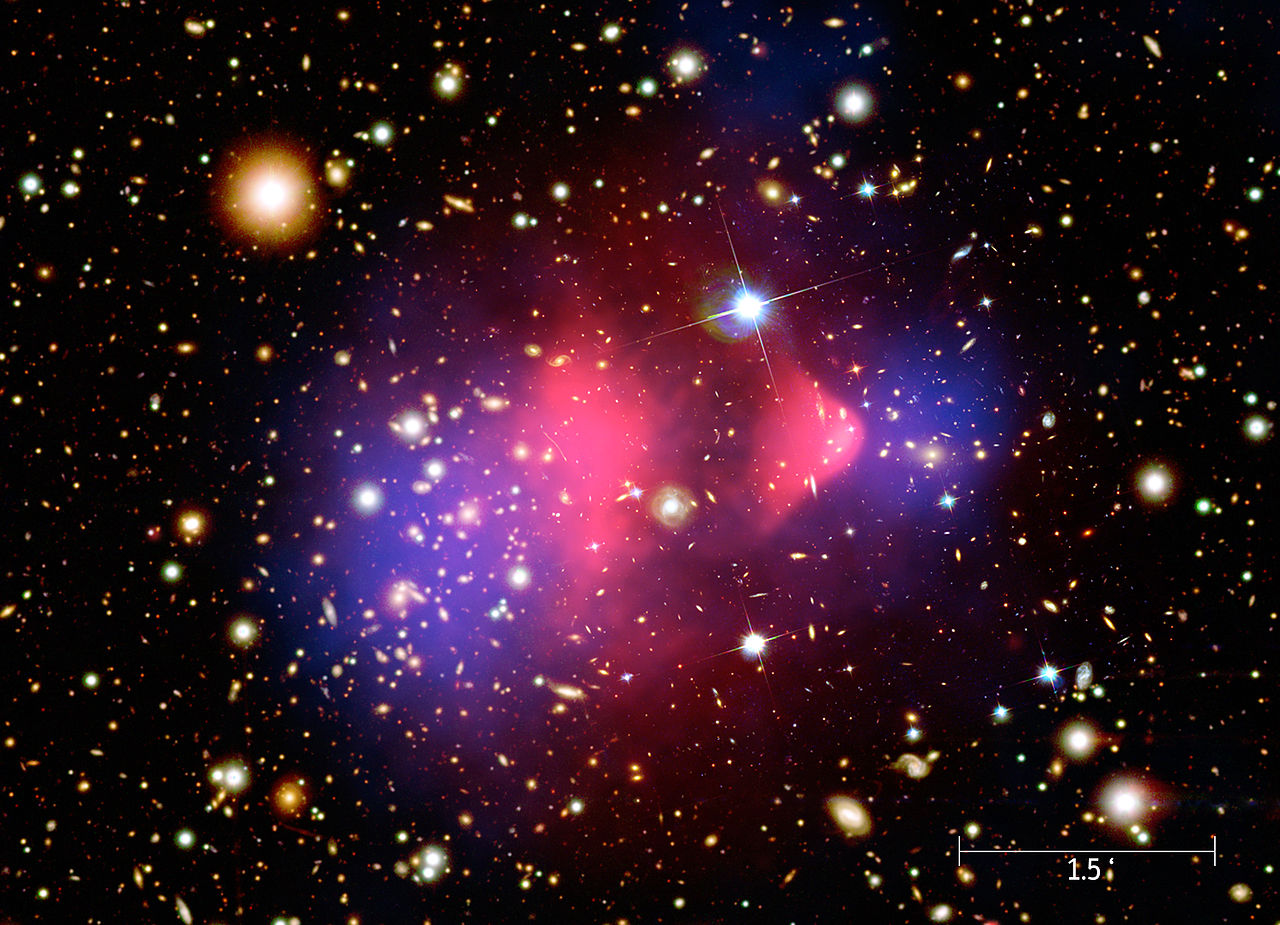
One famous case is the Bullet Cluster, a collision between two clusters. X-ray maps show the hot gas (ordinary matter) collided and slowed down, while lensing maps locate most of the mass offset from the gas and nearer the galaxies. This separation is naturally explained if the dominant mass is collisionless dark matter. See Alternatives to Particle Dark Matter for why this is challenging for modified gravity alone.
Cosmic Microwave Background and Baryon Acoustic Oscillations

The cosmic microwave background (CMB) is a snapshot of the early universe when it was about 380,000 years old. The pattern of temperature fluctuations encodes the densities of constituents like baryons, photons, and dark matter. Analyses of the CMB, together with maps of baryon acoustic oscillations (BAO) in the distribution of galaxies, point to a universe where non-baryonic dark matter is essential to fit the data self-consistently.
In particular, the CMB power spectrum requires a matter component that is not tightly coupled to radiation in the early universe. The inferred amounts of baryons and dark matter are in excellent agreement with big bang nucleosynthesis constraints and with large-scale structure surveys. In other words, the CMB doesn’t merely allow dark matter; it demands it within the standard cosmological framework.
Structure Formation: Building the Cosmic Web
Computer simulations of structure formation start from tiny fluctuations in the early universe and evolve them forward under gravity. Models with cold, collisionless dark matter (CDM) grow structure hierarchically: small halos form first and merge into larger halos. This naturally produces the filamentary cosmic web we observe. Without dark matter—or with only baryons coupled to photons for too long—structure growth would be too slow to form galaxies as early as we see them.
Across galaxy scales, cluster scales, and cosmological scales, multiple independent measurements converge on the need for dark matter. This convergence is a hallmark of a robust scientific inference.
For how we turn these clues into maps, see How Astronomers Map Dark Matter Today. For implications for galaxies and the Milky Way, jump to What Dark Matter Does for Cosmology and Galaxy Formation.
How Astronomers Map Dark Matter Today
Because dark matter doesn’t glow, we infer it from gravitational effects. Modern surveys use several complementary mapping techniques.
Weak Gravitational Lensing (Cosmic Shear)
Weak lensing measures subtle distortions in the shapes of vast numbers of background galaxies. By averaging these “shears” over many galaxies and correcting for telescope and atmospheric effects, astronomers build 2D and even 3D (tomographic) maps of mass. These maps are sensitive to the growth of structure over time and thus to dark matter’s clustering and dark energy’s influence.
Recent and ongoing weak-lensing surveys include the Dark Energy Survey (DES), the Kilo-Degree Survey (KiDS), the Hyper Suprime-Cam (HSC) survey, and the European Space Agency’s Euclid mission, launched in 2023. Each survey refines our picture of how dark matter clumps and connects galaxies into filaments.
Galaxy–Galaxy Lensing
By correlating the positions of foreground galaxies with weak-lensing shear of background galaxies, astronomers measure the average dark matter halo profiles around galaxies as a function of mass, type, and redshift. This technique bridges cosmology and galaxy evolution by connecting luminous galaxies to their underlying halos.
Strong Lensing and Mass Modeling
In strong lensing, the positions, shapes, and time delays of multiple images provide high-fidelity constraints on the projected mass distribution of the lensing galaxy or cluster. With careful modeling, this reveals fine-grained features of the dark matter distribution, including potential substructure (small dark halos) unaccompanied by stars.
Dynamical Tracers in the Milky Way
Within our Galaxy, surveys like Gaia map positions, velocities, and orbits of stars. Stellar streams—remnants of disrupted dwarf galaxies and clusters—act as seismographs of the Milky Way’s gravitational potential. Gaps and perturbations in these streams can indicate encounters with dark subhalos, providing a test of dark matter’s small-scale clumpiness. Meanwhile, the overall velocity distribution of stars and gas constrains the local dark matter density relevant for terrestrial detection experiments (see The State of Dark Matter Searches in 2024).
CMB Lensing
The CMB’s path from the early universe to our telescopes is deflected by intervening mass. CMB lensing maps—constructed from characteristic correlations in the microwave background—offer a complementary way to trace large-scale dark matter back to high redshift.
From Maps to Models
These mapping methods inform parameterized models of dark matter halos (e.g., Navarro–Frenk–White or NFW profiles) and more flexible, non-parametric reconstructions. For a simple illustration of how halo models translate into observable rotation curves, see the code example in What Dark Matter Does for Cosmology and Galaxy Formation.
Leading Dark Matter Candidates and Their Physics
While the gravitational evidence is secure, the microphysical identity of dark matter is still unknown. Here are the principal categories under active investigation.
WIMPs (Weakly Interacting Massive Particles)
WIMPs are hypothetical particles with masses roughly from a few GeV to many TeV, interacting via forces no stronger than the weak nuclear force. A key appeal is the thermal relic idea: if a new particle species was in thermal equilibrium in the early universe and later “froze out,” the remaining abundance can naturally match the observed dark matter density for weak-scale interactions. This is sometimes called the “WIMP miracle.”
WIMPs could be produced at particle colliders, scatter off nuclei in sensitive detectors on Earth, or annihilate/decay to produce Standard Model particles that telescopes might detect. Decades of effort have progressively pushed down the allowed interaction strengths, especially for spin-independent scattering on nuclei, but large swathes of viable models remain unconstrained, including those with suppressed interactions or complex dark sectors.
Axions and Axion-Like Particles (ALPs)
Axions were originally proposed to solve the strong CP problem in quantum chromodynamics (QCD). If sufficiently light and produced non-thermally, axions can be excellent cold dark matter candidates. Their interactions with photons are ultra-weak, but in a strong magnetic field, axions can convert into photons at a frequency set by the axion mass. Haloscope experiments exploit this with tunable microwave cavities or broadband resonators, searching for a faint narrow spectral line above thermal noise.
Axion-like particles (ALPs) generalize the concept beyond the strict QCD axion relation between mass and coupling, opening a large parameter space probed by laboratory, astrophysical, and cosmological tests.
Sterile Neutrinos
Sterile neutrinos are hypothetical neutrinos that do not interact through the weak force, only via gravity and mixing with active neutrinos. Masses in the keV range could produce warm dark matter, affecting small-scale structure formation. They can decay on cosmological timescales, potentially producing X-ray lines—an idea sparked by reported hints of a 3.5 keV line in some galaxies and clusters. Analyses have offered conflicting interpretations, and no consensus detection has emerged.
MACHOs and Primordial Black Holes
Massive astrophysical compact halo objects (MACHOs) are things like faint stars, brown dwarfs, or black holes in galactic halos. Microlensing surveys have placed strong limits on the abundance of typical stellar-mass MACHOs, showing they cannot make up the bulk of dark matter. Primordial black holes (PBHs), formed in the early universe rather than from stellar collapse, remain a speculative possibility over restricted mass ranges, but microlensing, CMB, and gravitational-wave observations significantly limit their allowed contribution across many masses.
You’ll find how each candidate is being pursued experimentally in The State of Dark Matter Searches in 2024, and why some alternatives to particles struggle to match all evidence in Alternatives to Particle Dark Matter.
The State of Dark Matter Searches in 2024
Efforts to detect dark matter span laboratories deep underground, telescopes in space and on mountaintops, and particle colliders. Here’s a tour of the main approaches and representative experiments as of 2024.
Direct Detection: Looking for Tiny Nuclear Recoils
Direct-detection experiments aim to measure the recoil energy when a dark matter particle scatters off an atomic nucleus. To reduce backgrounds, detectors are placed deep underground and use ultra-clean materials and veto systems.
- Noble-liquid detectors like LZ, XENONnT, and PandaX-4T use large volumes of liquid xenon to detect scintillation and ionization from rare recoil events. Their latest results set world-leading limits on spin-independent WIMP–nucleon scattering over a wide mass range, strongly constraining “vanilla” WIMP scenarios.
- Cryogenic detectors such as SuperCDMS measure both phonons and ionization in semiconductor crystals to reach sensitivity to low-mass WIMPs. Installations at SNOLAB are designed to probe sub-GeV masses with sophisticated phonon sensing.
- Argon-based detectors including DarkSide-20k aim to scale up detector mass with excellent pulse-shape discrimination, offering complementary sensitivity and systematics to xenon-based experiments.
So far, these experiments have not observed a statistically significant signal attributable to dark matter. Instead, they have placed increasingly stringent upper limits on interaction cross-sections, which guide model building and the design of next-generation detectors.
Indirect Detection: Searching for Annihilation and Decay Products
If dark matter annihilates or decays into Standard Model particles, telescopes can look for excesses in gamma rays, cosmic rays, or neutrinos from regions where dark matter density is high.
- Gamma rays: The Fermi Large Area Telescope has observed the sky for over a decade. Stacked observations of dwarf spheroidal galaxies—dark matter–dominated and relatively free from astrophysical backgrounds—set strong constraints on WIMP annihilation cross-sections, excluding the canonical thermal value for some masses and channels. Ground-based Cherenkov telescopes (e.g., H.E.S.S., MAGIC, VERITAS) probe higher energies.
- Cosmic rays: The AMS-02 instrument on the International Space Station precisely measures cosmic-ray fluxes, including positrons and antiprotons. An observed positron excess has motivated dark matter interpretations, but pulsars and other astrophysical sources are challenging to rule out, and current data do not require dark matter.
- Neutrinos: IceCube and other neutrino observatories can search for neutrinos from dark matter annihilation in the Sun or Earth, where dark matter might accumulate by scattering and become gravitationally trapped.
No unambiguous indirect-detection signal has been confirmed to date. Instead, these observations provide complementary constraints on annihilation and decay rates.
Collider Searches: Making Dark Matter in the Lab
At the Large Hadron Collider (LHC), proton–proton collisions might produce dark matter particles, which would escape the detector unseen. The telltale signature is missing transverse energy recoiling against a visible particle (a jet, photon, or vector boson). Experiments also search for new mediators or supersymmetric partners.
So far, ATLAS and CMS have not observed statistically significant excesses attributable to dark matter or supersymmetry, placing limits on simplified models and on invisible decays of the Higgs boson. As luminosity increases, these searches continue to probe smaller couplings and higher mass scales, especially when interpreted together with direct and indirect limits.
Axion and ALP Experiments: Listening for a Whisper
Axion haloscopes exploit the axion–photon coupling via resonant microwave cavities in strong magnetic fields. Several initiatives probe complementary frequency ranges and use quantum techniques to beat traditional noise limits.
- ADMX has achieved sensitivity to benchmark QCD axion models over parts of the microelectronvolt mass range by scanning frequency bands with high-Q cavities and quantum-limited amplifiers.
- HAYSTAC pioneered the use of squeezed-vacuum states to reduce measurement noise below the standard quantum limit, extending sensitivity in challenging mass ranges.
- MADMAX aims to probe higher-mass axions (tens to hundreds of microelectronvolts) using a dielectric haloscope concept.
- DMRadio and related experiments target ultralight axions and dark photons at lower frequencies with lumped-element resonators.
Laboratory searches are complemented by astrophysical bounds (e.g., stellar cooling, supernova energy loss) and by cavity- and helioscope-style experiments with different couplings. To date, no definitive axion signal has been observed, but substantial, well-motivated parameter space remains to be explored.
Primordial Black Holes: Gravitational Probes and Constraints
If primordial black holes constitute some fraction of dark matter, they could reveal themselves via microlensing of background stars, dynamical effects on stellar systems, or signatures in the CMB. Surveys like OGLE and EROS have set strong microlensing bounds over a broad mass range, and cosmic microwave background constraints limit early-accretion scenarios. Gravitational-wave detections of binary black hole mergers have revived interest in PBH formation pathways, but current bounds generally restrict PBHs to being at most a subdominant fraction of dark matter across many decades in mass.
For a discussion of how to evaluate claimed signals and null results, see How to Interpret Headlines About “Dark Matter Found”.
Alternatives to Particle Dark Matter: MOND and Beyond
The success of general relativity on many scales and the consistency of the dark matter picture with diverse data motivate particle dark matter. Still, alternatives have been proposed, especially to address galaxy-scale phenomena.
MOND (Modified Newtonian Dynamics)
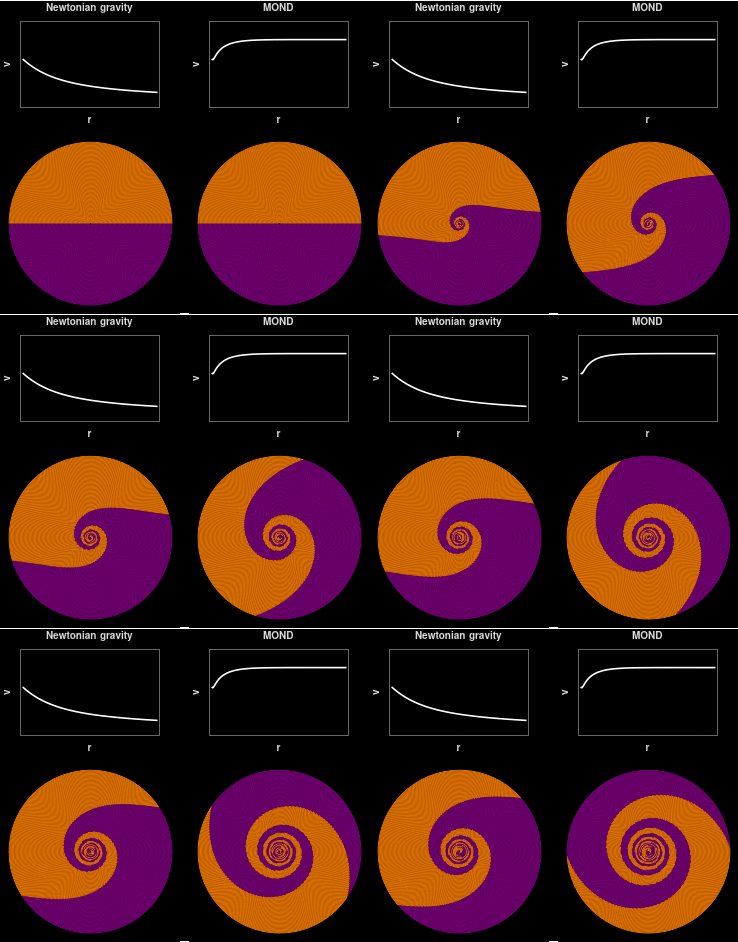
MOND posits that Newton’s law of gravity or inertia changes at very low accelerations, yielding flat galaxy rotation curves without invoking unseen mass. MOND phenomenology captures some galaxy scaling relations (like the radial acceleration relation) with fewer free parameters than some halo models. However, MOND is not a relativistic theory by itself, and its extensions struggle to explain cluster-scale lensing—including systems like the Bullet Cluster—and the cosmological data encoded in the CMB power spectrum without adding some form of unseen matter anyway.
Relativistic Extensions and Emergent Gravity
Theories like TeVeS (Tensor–Vector–Scalar gravity) attempt to provide a relativistic MOND-like framework. Others propose emergent gravity scenarios. These models are creative and insightful but face significant challenges fitting the full suite of cosmological observations—especially the precise CMB anisotropies, BAO measurements, and structure growth—without reintroducing dark components resembling dark matter.
Superfluid or Self-Interacting Dark Matter
Rather than abandoning dark matter, some models modify its interactions. Self-interacting dark matter (SIDM) can alter halo inner density profiles, potentially addressing small-scale tensions (like galaxy cores). In some proposals, dark matter condenses into a superfluid phase in galaxies, producing MOND-like behavior while preserving cosmological successes of ΛCDM. These ideas are active areas of research, guided by both astrophysical constraints and particle-physics plausibility.
For how these models connect to observations in galaxies, see What Dark Matter Does for Cosmology and Galaxy Formation.
What Dark Matter Does for Cosmology and Galaxy Formation
Dark matter underpins the modern picture of structure formation. It collapses early, forming halos that attract and cradle baryons, which then cool and form stars and galaxies. The resulting halo–galaxy connection drives many patterns in galaxy evolution.
ΛCDM as the Working Framework
In ΛCDM, dark matter is cold and collisionless, and dark energy (Λ) drives the late-time accelerated expansion. With a small set of parameters constrained by the CMB, BAO, supernovae, and other probes, ΛCDM successfully reproduces the galaxy clustering on large scales, the lensing signal statistics, and many aspects of the cosmic web morphology.
Small-Scale Tensions and Baryonic Physics
While successful on large scales, several “small-scale challenges” test our understanding:
- The cusp–core problem: Collisionless simulations predict cuspy inner density profiles in halos, whereas some dwarf and low-surface-brightness galaxies appear to have flatter, cored profiles. Feedback from supernovae and active galactic nuclei can redistribute matter and flatten profiles in some cases, complicating simple comparisons.
- Missing satellites: Early simulations predicted more dark subhalos than observed dwarf galaxies around the Milky Way. Improved observations continue to discover ultra-faint dwarfs, and baryonic processes can suppress star formation in small halos, narrowing the gap.
- Too big to fail: The largest predicted subhalos in simulations appear too dense to host the brightest observed Milky Way dwarfs, but baryonic effects and selection biases again modulate the severity of the tension.
These issues motivate precision tests of dark matter microphysics and of how feedback shapes galaxies, rather than being definitive falsifications of ΛCDM.
A Toy Rotation Curve from an NFW Halo
To connect halo models to observables, here’s a minimal Python-like snippet illustrating how one might compute a circular velocity profile for a galaxy embedded in an NFW halo plus a simple exponential disk. This is not production code, just a conceptual guide.
# Pseudocode for an NFW halo + exponential disk rotation curve
import numpy as np
G = 4.30091e-6  # gravitational constant in (kpc/solar_mass)*(km/s)^2

# NFW halo parameters
M200 = 1e12     # halo mass in solar masses
c = 10          # concentration parameter
R200 = 210      # kpc, approximate virial radius for Milky Way-like halo
rs = R200 / c   # scale radius

# compute rho_s from M200, c
f = np.log(1 + c) - c/(1 + c)
rho_s = M200 / (4*np.pi*rs**3 * f)

def M_nfw(r):
    x = r/rs
    return 4*np.pi*rho_s*rs**3*(np.log(1 + x) - x/(1 + x))

# Exponential disk
M_disk = 6e10   # stellar disk mass
Rd = 3.0        # kpc, scale length

def M_disk_enclosed(r):
    # Approximate enclosed mass for a thin exponential disk
    y = r/(2*Rd)
    return M_disk*(1 - (1 + y)*np.exp(-2*y))

def Vc(r):
    Mtot = M_nfw(r) + M_disk_enclosed(r)
    return np.sqrt(G*Mtot/r)

r = np.linspace(0.5, 50, 200)  # kpc
vc = Vc(r)                     # km/s
Real analyses fit such models to observed curves, include bulges, gas, and non-circular motions, and marginalize over uncertainties. Still, the qualitative result is robust: an extended halo can keep rotation curves flat at large radii where luminous matter alone would predict a decline. For observational mapping techniques, revisit How Astronomers Map Dark Matter Today.
The Milky Way’s Dark Halo
For local experiments, the local dark matter density—the amount of dark matter near the Sun—is a key parameter. It is often estimated to be around 0.3–0.4 GeV/cm³, though measurements depend on assumptions about the Galaxy’s mass distribution and stellar kinematics. With Gaia’s precise astrometry, constraints continue to improve, and stellar streams are offering new, independent checks on the halo’s shape and substructure.
Upcoming Surveys and Missions to Watch
Even without a laboratory detection, astronomy and cosmology are poised to sharpen the dark matter picture through massive surveys that map structure and lensing with unprecedented precision.
- Vera C. Rubin Observatory (LSST): Set to begin its wide-field survey in the mid-2020s, Rubin will image the southern sky repeatedly over a decade. Its weak-lensing and supernova samples will refine measurements of structure growth and the matter power spectrum, informing both dark matter and dark energy models.
- Euclid (ESA): Launched in 2023, Euclid will map billions of galaxies to measure weak lensing and galaxy clustering over a large fraction of the sky, producing 3D dark matter maps and precise BAO measurements.

The Bullet Cluster is made up of two galaxy clusters that are colliding, one moving through the other, about 3.7 billion light-years away in the constellation Carina. These galaxy clusters act as gravitational lenses, magnifying the light of background galaxies. This phenomenon makes the Bullet Cluster a compelling piece of evidence supporting the existence of dark matter. This image was taken with the 570-megapixel U.S. Department of Energy-fabricated Dark Energy Camera (DECam), mounted on the U.S. National Science Foundation Víctor M. Blanco 4-meter Telescope at Cerro Tololo Inter-American Observatory (CTIO), a Program of NSF NOIRLab. View the Zoomable image to explore this stunning galaxyscape in more detail. Artist: CTIO/NOIRLab/DOE/NSF/AURA Image Processing: T.A. Rector (University of Alaska Anchorage/NSF NOIRLab) & M. Zamani (NSF NOIRLab) - Nancy Grace Roman Space Telescope (NASA): Planned for launch in the latter half of the 2020s, Roman will conduct high-resolution, wide-field imaging and spectroscopy from space, enabling precise weak-lensing measurements and microlensing surveys that also constrain compact dark matter candidates.
- DESI: The Dark Energy Spectroscopic Instrument is creating a detailed 3D map of the universe via millions of galaxy and quasar redshifts, refining BAO and redshift-space distortion measurements that probe structure growth.
- Simons Observatory and CMB-S4: These next-generation CMB projects will measure CMB polarization and lensing with exquisite sensitivity, improving constraints on the matter distribution at high redshift and on neutrino properties that subtly influence structure.
- Gaia and successor astrometry: Future Gaia data releases and proposed next-generation astrometric missions can map stellar orbits and streams with higher precision, constraining the Milky Way halo’s shape and substructure down to smaller mass scales.
These surveys interlock: lensing maps from Euclid and Roman, time-domain discoveries and WL from Rubin, spectroscopic anchors from DESI, and high-redshift lensing from CMB experiments. Together they will either tighten the case for cold, collisionless dark matter or expose cracks pointing to new physics. For how to read news from such surveys, see How to Interpret Headlines About “Dark Matter Found”.
How to Interpret Headlines About “Dark Matter Found”
Dark matter is a high-stakes pursuit, so headlines can be breathless. Here’s a checklist to evaluate claims critically.
- Is the significance robust? A 3-sigma excess is interesting but not discovery-level. Systematic uncertainties, background modeling, and the look-elsewhere effect can inflate apparent significance.
- Is it consistent across multiple channels? A gamma-ray excess, a direct-detection hint, and a collider signal pointing to compatible masses and couplings would be very compelling. Single-channel hints often fade with more data.
- Are there plausible astrophysical or instrumental explanations? Pulsars, supernova remnants, or data systematics often mimic signals. Independent instruments and analyses help sort genuine effects from artifacts.
- Does it fit with cosmology? Any claimed dark matter particle must be consistent with the relic abundance, CMB, structure formation, and bounds from other experiments. Cross-consistency is a powerful filter.
Null results are also important. As experiments like LZ or XENONnT improve sensitivity without finding a signal, they reshape the viable parameter space, inform theory, and guide the next generation of detectors (see The State of Dark Matter Searches in 2024). Science advances on both detections and constraints.
Frequently Asked Questions
Is dark matter definitely a particle?
We know dark matter through gravity. The simplest and most successful framework posits a new particle (or particles) beyond the Standard Model. Compact astrophysical objects and modified gravity have been proposed, but surveys and lensing constraints limit the former, and fitting the full suite of cosmological data without dark matter is challenging for the latter. That said, within the particle hypothesis there is rich diversity: WIMPs, axions, sterile neutrinos, and more complex dark sectors remain viable in parts of parameter space.
Could dark matter be detected on Earth soon?
It’s possible but not guaranteed. Direct-detection experiments continue to push to lower cross-sections and lower masses, axion searches are rapidly adding quantum-enhanced techniques and broader coverage, and collider luminosities are climbing. A discovery could arrive as an unexpected anomaly or as a confluence of signals across channels. Even if no detection occurs soon, forthcoming surveys like Euclid, Rubin, and Roman will sharpen complementary gravitational constraints that can point toward or away from certain classes of models.
Final Thoughts on Understanding Dark Matter
Dark matter sits at the nexus of astrophysics, cosmology, and particle physics. Its gravitational fingerprints are everywhere: in the swirling edges of spiral galaxies, in the binding mass of clusters, in the primordial ripples of the CMB, and in the scaffolding of the cosmic web. The question is no longer whether something unseen shapes the universe—but what that something is.
As of 2024, direct and indirect searches have not delivered a smoking gun, but the landscape is far from exhausted. WIMP parameter space remains open in nontrivial regions; axion experiments are breaking technical barriers; and astrophysical and cosmological observations are entering a precision era. Meanwhile, alternatives to simple cold, collisionless dark matter—whether modified-gravity ideas or interacting and superfluid dark sectors—are driving creative theory and testable predictions.
The next decade will likely decide whether dark matter reveals itself in the lab or continues to be inferred gravitationally with ever-greater fidelity. Either outcome will transform our understanding of fundamental physics and the cosmos. If you’re eager to follow this unfolding story, explore our related deep dives on lensing, galaxy formation, and particle searches, and subscribe to our newsletter to get future articles and survey updates straight to your inbox.