
Table of Contents
- What Is Dark Matter and Why Galaxy Rotations Demand It?
- Observational Evidence: From Rotation Curves to the Cosmic Web
- Gravitational Lensing and Mass Maps of the Invisible Universe
- Cosmic Microwave Background and Large-Scale Structure Constraints
- Leading Dark Matter Candidates: WIMPs, Axions, Sterile Neutrinos, and More
- How We Search for Dark Matter: Direct, Indirect, and Collider Approaches
- Small-Scale Challenges: Cores, Cusps, and the Role of Baryonic Feedback
- Alternatives and Hybrids: Modified Gravity and Self-Interacting Dark Matter
- Interpreting Signals: Statistics, Systematics, and Null Results
- Key Experiments and Missions to Watch This Decade
- Frequently Asked Questions
- Final Thoughts on Choosing the Right Dark Matter Model
What Is Dark Matter and Why Galaxy Rotations Demand It?
Dark matter is a form of matter that does not emit, absorb, or reflect light, yet exerts gravitational influence on visible matter, radiation, and the large-scale structure of the Universe. In the standard cosmological model—often called Lambda–Cold Dark Matter (ΛCDM)—dark matter provides the gravitational scaffolding upon which galaxies and galaxy clusters form and evolve. Although it does not interact via the electromagnetic force, dark matter reveals itself through gravity. The central question is not whether there is additional mass, but what its nature is.
The first strong clues came from galaxies themselves. Spiral galaxies rotate: stars and gas orbit their centers, and their orbital velocities can be mapped as a function of radius to produce a rotation curve. If only the observed luminous matter were present, gravity would weaken with distance, and the orbital speed would decline outside the bright stellar disk. Instead, many galaxies show flat rotation curves, where the speed remains roughly constant far beyond the visible matter. This implies that mass continues to increase with radius, as though each galaxy sits in a massive, extended halo of non-luminous material.
In simple terms, a circular orbit at radius r has velocity v(r) = sqrt(G M(r) / r). If M(r) became constant beyond the disk, the velocity should fall as v ∝ r^{-1/2}. The persistent flatness of observed curves points to M(r) ∝ r across large radii, consistent with an unseen halo enveloping the galaxy. This basic inference has been corroborated across a wide range of galaxy types and masses.

Beyond individual galaxies, galaxy clusters—enormous structures containing hundreds to thousands of galaxies—also display mass discrepancies. Early mass estimates from galaxy motions within clusters indicated far more mass than the luminous matter could account for. X-ray observations of hot intracluster gas and gravitational lensing analyses further confirm a dominant, unseen mass component. Together, these lines of evidence indicate that the bulk of matter in the cosmos is dark, with the latest precision cosmology measurements suggesting roughly five times more dark matter than ordinary (baryonic) matter.
While modified gravity proposals attempt to explain some observations without invoking dark matter, the cumulative evidence—from galaxy scales to the largest observable structures—favors a matter component that is cold (i.e., composed of relatively slow-moving particles in the early Universe), non-baryonic, and gravitationally attractive. As we will see, this conclusion is reinforced by cosmic microwave background data, gravitational lensing, and the observed pattern of galaxy clustering.
Observational Evidence: From Rotation Curves to the Cosmic Web
The case for dark matter does not hinge on any single data set, but on a network of observations that collectively form a coherent picture:
- Galaxy rotation curves: Measured via 21-cm neutral hydrogen lines or optical spectroscopy, these curves remain flat or even rise in the outer regions, requiring extended halos of mass. Dwarf galaxies, in particular, show prominent mass discrepancies even at small radii.
- Galaxy cluster dynamics: The velocities of galaxies orbiting within clusters, combined with the hydrostatic equilibrium of hot X-ray emitting gas, suggest far more mass than stars and gas alone can provide.
- Gravitational lensing: Both strong and weak lensing reveal the distribution of matter—even when no light is present. Lensing maps consistently show mass concentrations offset from the visible light, especially in merging systems.
- Cosmic Microwave Background (CMB) anisotropies: The pattern of acoustic peaks in the CMB power spectrum demands a substantial non-baryonic matter component to explain the relative heights and positions of the peaks.
- Large-scale structure and baryon acoustic oscillations (BAO): The distribution of galaxies and the imprinted BAO scale align with cold dark matter predictions for how structure grows from early fluctuations to the present-day cosmic web.
Consider the Interacting-Bullet-type cluster systems—pairs of clusters in the process of colliding. X-ray maps show the hot, collisional intracluster gas lagging behind during the merger, while gravitational lensing maps trace the dominant mass component passing through with little interaction. This separation between gas (ordinary matter) and lensing mass is hard to reconcile without a collisionless or weakly self-interacting dark matter component.
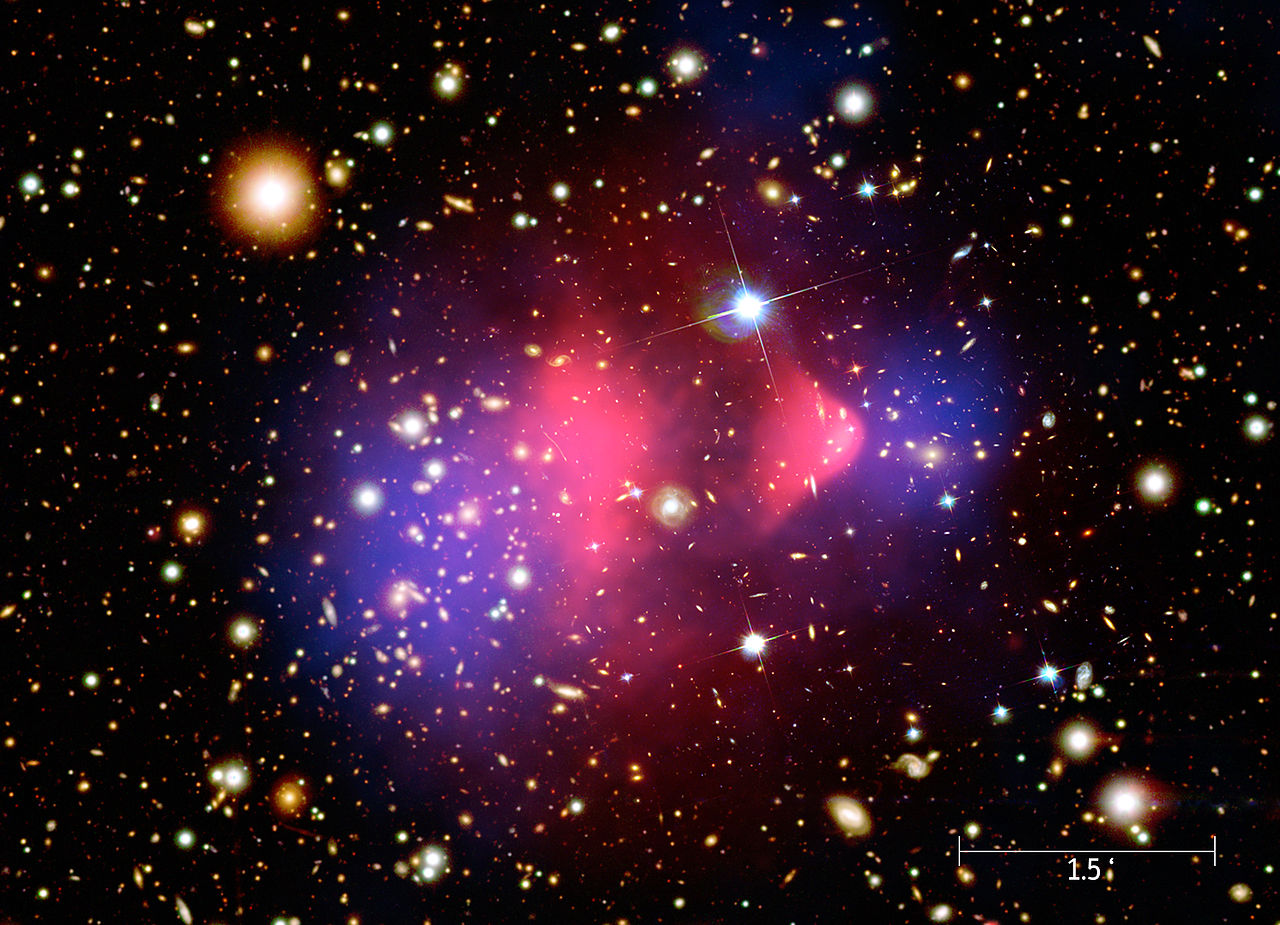
Scale: Full image is 7.5 arcmin wide, 5.4 arcmin high — Artist: NASA/CXC/M. Weiss
On cosmic scales, N-body simulations starting from initial conditions constrained by the CMB produce a filamentary network of matter: dense nodes that host clusters, sheets, and filaments where galaxies reside, and vast voids. Observations of galaxy clustering and weak lensing shear correlations agree broadly with this picture, providing independent checks on the dark matter paradigm.
Even within galaxies, independent tracers such as satellite galaxy dynamics, stellar streams, and gas kinematics converge on the presence of extended halos. While baryonic effects (e.g., stellar feedback, gas inflows/outflows) can reshape the inner mass distribution, they do not eliminate the need for halos themselves. These complementary observations are developed more in the sections on gravitational lensing and CMB and large-scale structure.
Gravitational Lensing and Mass Maps of the Invisible Universe
Gravitational lensing offers a powerful, geometry-based way to measure mass distributions, regardless of their composition. Mass curves spacetime; as light from background galaxies passes by foreground structures, it is deflected. By quantifying those distortions, astronomers reconstruct mass maps—tangible images of the invisible matter.
There are two principal regimes:
- Strong lensing: Produces multiple images, arcs, or Einstein rings of background sources. The precise shapes and positions of these features tightly constrain the projected mass within the lensing region.
- Weak lensing: Most lines of sight experience subtle, percent-level shears in galaxy shapes. By statistically averaging shapes over large ensembles of galaxies, we infer the foreground matter distribution on scales from galaxies to the full sky.

Strong lensing lets us probe the inner mass profiles of galaxies and clusters, measure substructure, and test whether halos follow profiles like Navarro–Frenk–White (NFW). Weak lensing, by contrast, is the workhorse for cosmology: it maps the growth of structure over cosmic time, constrains the matter density parameter (Ωm), and measures the amplitude of mass fluctuations (commonly denoted σ8 or the related S8 parameter). Joint analyses with galaxy clustering—cosmic shear, galaxy–galaxy lensing, and redshift-space distortions—provide cross-checks and reduce systematics.
Merging clusters serve as a particularly vivid illustration. In these systems, the luminous gas—detectable via its X-ray emission—collides and slows, while the primary mass component inferred from lensing can pass through more freely. The spatial offset between these components indicates that the dominant mass is not bound to baryons and does not interact strongly other than gravitationally. Such observations are consistent with cold or weakly self-interacting dark matter, although current data leave room to constrain, rather than completely rule out, modest levels of self-interaction.
Lensing is complementary to other probes discussed in CMB and large-scale structure, because it directly senses mass regardless of its dynamical state. This complementarity is invaluable when turning observational signals into parameters of cosmological models and properties of candidate particles.
Cosmic Microwave Background and Large-Scale Structure Constraints
The cosmic microwave background (CMB) is the relic radiation from the hot early Universe, last scattered about 380,000 years after the Big Bang. Tiny temperature anisotropies across the sky encode the seeds of all future structure. In the angular power spectrum of these anisotropies—the variance of temperature fluctuations as a function of angular scale—distinct acoustic peaks arise from baryon–photon oscillations in the primordial plasma.

Dark matter influences both the positions and heights of these peaks. Unlike baryons, which were tightly coupled to photons before recombination, dark matter did not feel radiation pressure and could start clumping earlier. This additional gravitational component changes how the oscillations propagate. Fitting the observed spectrum requires a dark matter density consistent with about a quarter of the total energy density today (with dark energy making up most of the rest, and baryons a smaller fraction).
Crucially, CMB data are not isolated. As the Universe expands, tiny initial perturbations grow under gravity into the observed web of galaxies and clusters. Large-scale structure (LSS) surveys map these galaxies in three dimensions, revealing the distribution of matter. Imprinted in this distribution is the baryon acoustic oscillation (BAO) scale—a standard ruler that helps measure the cosmic expansion history. The success of ΛCDM in simultaneously explaining the CMB, BAO, and the galaxy power spectrum is a non-trivial consistency test that any alternative must also pass.
LSS also provides measures of the growth rate of structure via redshift-space distortions, and of the matter distribution via weak lensing shear and galaxy–galaxy lensing. Together with the CMB, these probes constrain the sum of neutrino masses, the fraction of matter that is cold versus warm or hot, and the amplitude of matter clustering. While ongoing work examines small tensions between some low-redshift clustering measurements and CMB-inferred parameters, the overarching picture remains that dark matter is required and predominantly cold.
For readers interested in how these constraints inform particle physics candidates, see Leading Dark Matter Candidates and for how experiments try to detect them, see How We Search for Dark Matter.
Leading Dark Matter Candidates: WIMPs, Axions, Sterile Neutrinos, and More
Astronomical evidence strongly supports the existence of dark matter, but it does not by itself reveal the particle’s identity. Several well-motivated candidates emerge from particle physics and cosmology, each with distinct properties and experimental signatures.
Weakly Interacting Massive Particles (WIMPs)
WIMPs arise in many extensions of the Standard Model, where a new stable particle interacts via forces no stronger than the weak nuclear force. A classic motivation is the thermal freeze-out scenario: in the hot early Universe, WIMPs were in equilibrium with ordinary matter; as expansion cooled the plasma, the WIMPs’ annihilation rate fell below the Hubble expansion rate, leaving a relic abundance. Remarkably, for weak-scale masses and cross sections, this abundance is close to the observed dark matter density—often called the “WIMP miracle.”
WIMP masses are typically considered in the GeV–TeV range. They would be cold, non-relativistic at decoupling, and collisionless to a good approximation. Their experimental signatures include nuclear recoils in underground detectors (direct detection), missing energy signatures at colliders, and annihilation or decay products—such as gamma rays or antimatter—in astrophysical environments (indirect detection).
Axions and Axion-Like Particles (ALPs)
Axions were originally proposed to solve the strong CP problem in quantum chromodynamics (QCD), not to explain dark matter. However, QCD axions produced via non-thermal mechanisms (e.g., misalignment) are natural cold dark matter candidates. Axions couple extremely weakly to photons and matter; these couplings enable resonant conversion in strong magnetic fields, which experiments exploit with high-Q microwave cavities, dielectric haloscopes, and helioscopes. Axion-like particles generalize the idea beyond strict QCD axion relations, broadening the accessible mass–coupling parameter space.
Sterile Neutrinos
Sterile neutrinos are hypothetical right-handed neutrinos that interact only via gravity and mixing with active neutrinos. With keV-scale masses, they could constitute warm dark matter, potentially suppressing structure on small scales. Decay into an active neutrino and an X-ray photon would produce a narrow X-ray line; extensive searches continue to test such signatures. The viability of sterile neutrinos as the dominant dark matter depends on their production mechanism and compatibility with structure formation constraints.
Ultralight (Fuzzy) Dark Matter
Ultralight scalars with masses around 10−22 eV have de Broglie wavelengths on kiloparsec scales, leading to quantum pressure that suppresses structure below those scales. This scenario can produce cored density profiles in small galaxies and a distinctive interference pattern in halos. Observables include halo core sizes, dynamics of stellar streams, and Lyman-α forest constraints on small-scale power.
Self-Interacting Dark Matter (SIDM)
SIDM introduces a non-gravitational interaction between dark matter particles, potentially mediated by new light force carriers. Cross sections of order 0.1–10 cm2 g−1 may alleviate some small-scale tensions by transferring heat within halos, softening central cusps into cores. Cluster-scale constraints from merging systems and halo shapes limit the allowed cross sections, possibly favoring velocity-dependent interactions.
Other proposals include composite dark matter, hidden-sector models with complex dynamics, primordial black holes in restricted mass ranges, and inelastic dark matter. Each scenario must thread multiple observational needles: abundance, clustering, astrophysical signals, and laboratory tests.
How We Search for Dark Matter: Direct, Indirect, and Collider Approaches
Because dark matter interacts weakly (if at all) with ordinary matter, detecting it requires exquisitely sensitive experiments that minimize backgrounds from cosmic rays, radioactivity, and environmental noise. Searches proceed along three complementary fronts:
Direct Detection
Direct detection aims to observe rare collisions between dark matter particles in the Galactic halo and target nuclei or electrons in underground detectors. Key strategies include:
- Nuclear recoils: Time projection chambers filled with liquefied noble gases (e.g., xenon or argon) detect scintillation and ionization from nuclear recoils. Cryogenic detectors measure tiny phonon and ionization signals.
- Electron recoils: For lighter dark matter, scattering off electrons or absorption of ultralight bosons may be more effective, prompting new detector materials and readout techniques.
- Background suppression: Experiments operate deep underground, use ultra-pure materials, and apply powerful discrimination algorithms to separate potential signals from backgrounds.
Despite increasingly stringent sensitivity, no unambiguous signal has been confirmed. Null results translate into upper limits on interaction cross sections as a function of mass. The frontier is now approaching the so-called neutrino floor, where solar, atmospheric, and supernova neutrinos produce an irreducible background that will require new techniques to overcome.
Indirect Detection
Indirect searches look for products of dark matter annihilation or decay: gamma rays, neutrinos, or cosmic-ray antiparticles. Promising targets include:
- Dwarf spheroidal galaxies: These satellite galaxies have high mass-to-light ratios and low astrophysical backgrounds, making them prime targets for gamma-ray searches.
- Galactic center: A region with high dark matter density, though complex astrophysical sources complicate interpretation.
- Galaxy clusters and diffuse backgrounds: Stacked analyses and spectral features (e.g., gamma-ray lines) help separate potential dark matter signals from conventional sources.
Cosmic-ray experiments measure positron and antiproton fluxes, testing models that predict excesses. Neutrino observatories monitor the Sun and Earth for neutrinos from captured dark matter annihilation. To date, tentative hints have not withstood combined scrutiny across instruments and wavelengths; the field emphasizes cross-corroboration and careful modeling of astrophysical sources.
Collider Searches
High-energy colliders can produce dark matter candidates if they are kinematically accessible and couple to Standard Model particles. The telltale signature is missing transverse energy in events where visible particles recoil against invisible ones. Complementary channels include monojet, monophoton, or multijet events with missing energy. Collider limits are most model-dependent, but when combined with direct and indirect searches, they paint a comprehensive picture of viable parameter space.
Across all approaches, the guiding philosophy is complementarity: what one method cannot see, another might. For example, axion haloscopes target different mass ranges and couplings than WIMP detectors. Unified interpretations demand the kind of statistical caution emphasized in Interpreting Signals.
Small-Scale Challenges: Cores, Cusps, and the Role of Baryonic Feedback
While ΛCDM succeeds on large scales, a set of small-scale challenges arises when comparing high-resolution simulations with galaxy observations. These include:
- Cusp–core problem: Simulations with collisionless cold dark matter often produce steep central density profiles (“cusps”) in low-mass halos, while some dwarf and low-surface-brightness galaxies appear to have shallower “cores.”
- Too-big-to-fail: Simulations predict a population of dense subhalos that, if they hosted stars, would be observable as bright satellites. Observations of the Milky Way and Andromeda historically showed fewer bright satellites than expected with such densities.
- Missing satellites problem: Early simulations produced many more low-mass subhalos than the number of known dwarf satellite galaxies; subsequent surveys have discovered numerous ultra-faint dwarfs, reducing—but not necessarily eliminating—the tension.
It is now clear that baryonic physics—gas cooling, star formation, supernova feedback, radiation pressure, and reionization—plays a decisive role in shaping the inner mass distribution of galaxies and in determining which halos host luminous galaxies. Energy injection from star formation can drive outflows that redistribute both gas and dark matter, producing flatter inner profiles. Stellar feedback can also lower central halo densities, helping to reconcile simulations with observed kinematics.
Moreover, selection effects and observational systematics matter. Measuring galaxy rotation curves (especially in dwarfs) is complicated by non-circular motions, inclination uncertainties, and pressure support from turbulence. Stellar kinematics in small systems can be anisotropic, and interloper contamination can bias inferred mass profiles. Improved data quality, larger samples, and better modeling continue to refine these comparisons.
Alternative dark matter models—such as ultralight, warm, or self-interacting dark matter—offer different pathways to addressing small-scale discrepancies. However, any alternative must also reproduce the successes of ΛCDM on large scales and respect constraints from the CMB, Lyman-α forest, and lensing. The emerging view is that a combination of complex baryonic feedback and, possibly, subtle dark-sector physics may ultimately be needed to fully explain the diversity of galaxy inner profiles.
Alternatives and Hybrids: Modified Gravity and Self-Interacting Dark Matter
Given that we infer dark matter’s presence primarily through gravity, theorists have explored whether a different gravitational law could explain some observations without unseen mass. The most prominent example is Modified Newtonian Dynamics (MOND), which posits a change in the effective gravitational acceleration below a characteristic scale. MOND and its relativistic extensions can fit rotation curves of spiral galaxies with few parameters and offer intriguing scaling relations. However, challenges arise in galaxy clusters—where additional unseen mass is still needed—and in reproducing the full suite of cosmological data, including the CMB and large-scale structure.
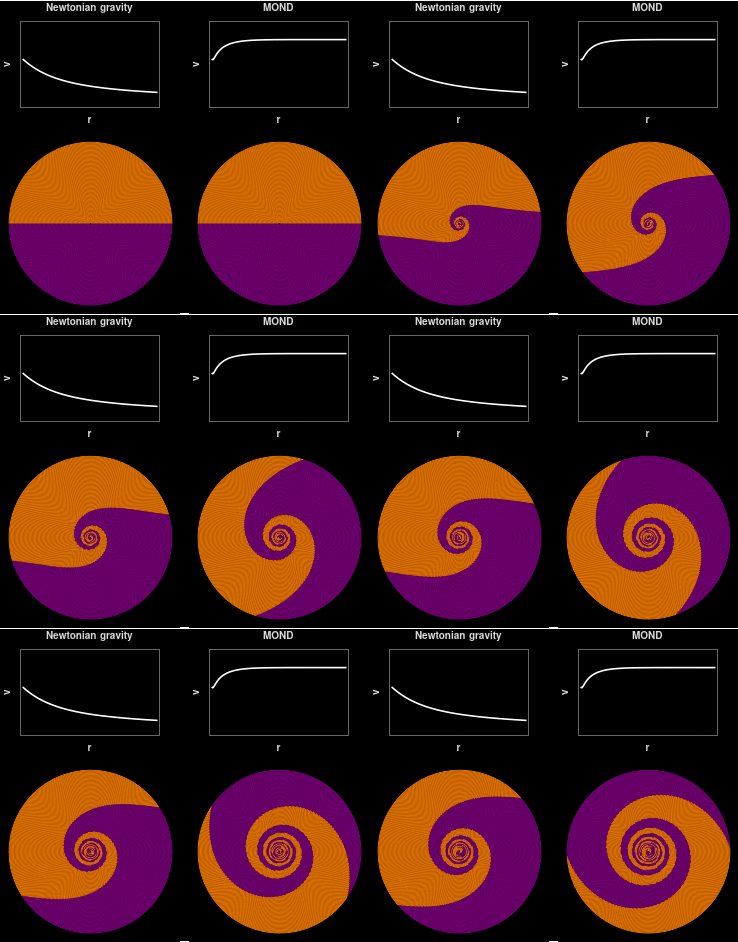
The observed behaviour is explained by assuming that Newton’s second law (F=m a) is modified for very small values of a. — Artist: Jacopo Bertolotti
More general frameworks, such as tensor–vector–scalar theories or emergent gravity proposals, attempt to embed MOND-like behavior into relativistic theories. While they can capture certain galactic phenomenology, they often struggle to match cosmological observations as precisely as ΛCDM does. Moreover, lensing in colliding clusters presents a hurdle: the separation between the lensing mass peaks and the baryonic gas is more naturally explained by an additional matter component than by a purely modified gravitational law.
Hybrid approaches acknowledge that dark matter probably exists but may have richer dynamics than a collisionless fluid. Self-interacting dark matter (SIDM), discussed in Leading Candidates, introduces particle–particle scattering in the dark sector. This scattering can equilibrate halo inner regions, leading to cores rather than cusps, with the interaction strength possibly depending on velocity. Such models can alleviate small-scale tensions while preserving large-scale ΛCDM successes if parameters are chosen appropriately, but are bounded by cluster-scale constraints and halo shape measurements.
In short, alternatives and hybrids serve as useful laboratories to test how robust our inferences are. They motivate new observations and more careful modeling, especially in regimes where baryonic processes and dark-sector physics may intertwine.
Interpreting Signals: Statistics, Systematics, and Null Results
Dark matter research lives at the frontier of sensitivity, where signals are faint and backgrounds can masquerade as discoveries. This makes statistical rigor and systematic control essential.
- Look-elsewhere effect: Scanning many masses, couplings, or sky regions inflates the chance of a random fluctuation mimicking a signal. Proper trial-factor accounting is crucial when quoting significances.
- Background modeling: In indirect detection, astrophysical sources (e.g., pulsars, supernova remnants) can produce gamma rays and cosmic rays. Templates and spectral models must be validated, and uncertainties propagated.
- Calibration and stability: Direct detectors calibrate nuclear and electron recoil responses with dedicated sources and monitor environmental parameters to ensure long-term stability.
- Replication: A robust detection should appear across different instruments, targets, and analysis pipelines. Cross-corroboration helps disentangle signal from systematic artifacts.
Null results, far from being failures, are science in action. Each improved limit sculpts the viable parameter space for dark matter models, guiding theory toward more predictive directions and pushing experimental techniques forward. In the case of WIMPs, for example, direct-detection upper limits now probe cross sections orders of magnitude below early expectations. This has stimulated interest in alternative mass ranges (sub-GeV), new detection channels (e.g., phonon excitations, magnons, polaritons), and entirely different candidates such as axions and ultralight fields.
Statistical best practices—blind analyses, open data where feasible, and independent pipelines—are increasingly adopted across the field. As large surveys and experiments come online, these norms will only grow in importance. For a sense of what’s on the horizon, see Key Experiments and Missions.
Key Experiments and Missions to Watch This Decade
The next decade will bring a wave of instruments that sharpen dark matter constraints and expand discovery potential across mass scales and interaction types:
- Underground direct detection: New liquid-noble and cryogenic detectors aim to increase target mass and discrimination, pushing sensitivities closer to the neutrino background. Parallel efforts target sub-GeV masses using novel materials and sensor concepts.
- Axion searches: Resonant haloscopes extend into higher frequencies with improved cavities and quantum-limited amplifiers; dielectric haloscopes pursue complementary mass windows. Helioscopes continue to test axion–photon couplings via solar axion searches.
- Gamma-ray and cosmic-ray observatories: Ground-based gamma-ray telescopes and space-based instruments monitor candidate regions like dwarf spheroidal galaxies and the Galactic center, searching for spectral features and spatial morphologies indicative of dark matter.
- Neutrino observatories: Large-volume detectors probe dark matter annihilation in the Sun and Earth, offering unique sensitivity to spin-dependent interactions and capture scenarios.
- Large-scale structure surveys: Deep, wide-field optical/near-infrared surveys map weak lensing shear and galaxy clustering, tightening constraints on matter clustering and the growth of structure.

The Bullet Cluster is made up of two galaxy clusters that are colliding, one moving through the other, about 3.7 billion light-years away in the constellation Carina. These galaxy clusters act as gravitational lenses, magnifying the light of background galaxies. This phenomenon makes the Bullet Cluster a compelling piece of evidence supporting the existence of dark matter. This image was taken with the 570-megapixel U.S. Department of Energy-fabricated Dark Energy Camera (DECam), mounted on the U.S. National Science Foundation Víctor M. Blanco 4-meter Telescope at Cerro Tololo Inter-American Observatory (CTIO), a Program of NSF NOIRLab. View the Zoomable image to explore this stunning galaxyscape in more detail.
— Artist: CTIO/NOIRLab/DOE/NSF/AURA Image Processing: T.A. Rector (University of Alaska Anchorage/NSF NOIRLab) & M. Zamani (NSF NOIRLab) - CMB experiments: Next-generation CMB polarization and lensing measurements will refine the matter content and neutrino mass constraints, and test for ultra-light fields via imprints on small-scale anisotropies.
- Stellar and galactic probes: High-precision astrometry, spectroscopy, and time-domain surveys trace stellar streams, satellite galaxies, and halo substructures, providing independent tests of halo profiles and subhalo abundance.
This multi-pronged program reflects the complementarity emphasized throughout this article: different experiments probe different slices of parameter space and are sensitive to different systematics. Together, they maximize the odds of discovery—or, failing that, of definitively excluding large classes of models.
Frequently Asked Questions
Does dark matter interact with anything besides gravity?
It may, but if so, the interactions must be very weak. The absence of electromagnetic interactions explains why dark matter neither emits nor absorbs light, making it “dark.” Many candidates do have feeble couplings to Standard Model particles—this is what direct and indirect detection experiments and colliders are testing. Self-interactions within the dark sector are also possible, as in SIDM models. Current constraints from astrophysics and laboratory searches limit how strong any such interactions can be.
Could dark matter just be normal matter we can’t see, like black holes or cold gas?
Ordinary matter—protons, neutrons, and electrons—is constrained by Big Bang nucleosynthesis and the CMB, which fix the cosmic baryon density. The observed gravitational effects require much more matter than these constraints allow, indicating a predominantly non-baryonic component. Compact dark objects like black holes have also been constrained by microlensing and other observations, leaving only limited mass ranges viable for making up the bulk of dark matter. Cold gas would interact with light and be detectable in emission or absorption; it cannot account for the missing mass at the required levels.
Final Thoughts on Choosing the Right Dark Matter Model
Across independent lines of evidence—galaxy rotation curves, cluster dynamics, gravitational lensing, the CMB, and large-scale structure—the case for dark matter is compelling. The ΛCDM framework captures this evidence with a simple, predictive model: a cold, non-baryonic, nearly collisionless component that seeds the formation of cosmic structure. On small scales, the interplay between baryonic feedback and potential dark-sector physics remains an active frontier, motivating both better simulations and targeted observations.
As you evaluate candidate explanations, keep three principles in mind:
- Coherence across scales: A viable model must reproduce galactic, cluster, and cosmological observations simultaneously.
- Complementarity of probes: Direct, indirect, collider, and astrophysical tests are all essential; a persuasive signal should echo across methods.
- Statistical rigor: Claims should survive blind analyses, background scrutiny, and independent replication.
With new surveys and detectors coming online, the next few years will be decisive for wide swaths of parameter space. Whether discovery arrives via a resonant axion signal, a nuclear recoil above background, a sharp gamma-ray line, or a pattern in cosmological data, it will reshape our understanding of matter and forces. If you found this deep dive useful, explore related topics in cosmology and particle astrophysics, and consider subscribing to our newsletter to get future articles, experiment updates, and expert explainers delivered to your inbox.