
Table of Contents
- What Is the Orion Constellation?
- How to Find Orion in the Night Sky from Any Latitude
- Meet Orion’s Brightest Stars: Betelgeuse, Rigel, and the Belt
- Deep-Sky Wonders in Orion: Nebulae, Clusters, and Dark Structures
- Science Behind Orion: Star Formation, Stellar Evolution, and Feedback
- Cultural History and Mythology of Orion across Civilizations
- Observing Guide: Binoculars, Small Telescopes, and Naked-Eye Tips
- Orionids Meteor Shower: When and How to Watch
- Frequently Asked Questions
- Final Thoughts on Exploring the Orion Constellation
What Is the Orion Constellation?
The Orion constellation is one of the most recognizable patterns in the night sky, visible from both hemispheres and packed with bright, color-contrasting stars and dramatic nebulae. Centered roughly around right ascension 5h and declination 0°, Orion straddles the celestial equator, making it a truly global sky marker. For visual observers, Orion is a winter icon in the Northern Hemisphere and a summer-to-autumn fixture in the Southern Hemisphere. For scientists, it is a textbook example of a nearby, active star-forming region. And for sky-curious newcomers, Orion is an ideal gateway to learn foundational sky-hopping and stargazing skills.
At its core, Orion is an asterism-rich constellation defined by a distinct hourglass shape. The three nearly straight stars of Orion’s Belt—Alnitak, Alnilam, and Mintaka—anchor the figure, while the luminous supergiants Betelgeuse (reddish) and Rigel (blue-white) light up its opposite corners. Just beneath the Belt lies the Sword, home to the Orion Nebula (M42), a glowing cloud of gas and dust where new stars are being born. As we explore Orion’s brightest stars, deep-sky objects, observing techniques, and cultural history, you’ll see why it’s a perennial favorite for beginners and experts alike.

Artist: Rogelio Bernal Andreo
If you want to jump straight to practical tips on seeing Orion tonight, visit the how to find Orion section and the detailed Observing guide. If you’re eager to learn the science of star birth happening behind the glow of M42, head to Science Behind Orion.
How to Find Orion in the Night Sky from Any Latitude
Because Orion lies on the celestial equator, it’s visible from virtually every inhabited latitude on Earth. In the Northern Hemisphere, Orion rises in the east on autumn evenings, dominates the south during winter, and sets in the west by spring. In the Southern Hemisphere, Orion stands high during the summer months and is oriented upside-down compared to the northern view—an instructive reminder that the sky’s appearance flips with your perspective.
Use these steps and cues to spot the constellation quickly:
- Look for three bright stars in a short, straight line. These are the Belt stars—Alnitak, Alnilam, and Mintaka. They’re your compass to almost everything in Orion.
- Above the Belt (northward for Northern Hemisphere observers; below for Southern Hemisphere observers), find the orange-red glow of Betelgeuse. Diagonally opposite is the intense blue-white Rigel.
- Drop down from the Belt to a small vertical trio of fainter stars. In dark skies the middle one looks fuzzy to the naked eye—this is the Orion Nebula region in the Sword.
Star-hopping from Orion opens the sky:
- Follow the Belt downward and left (southeast for Northern Hemisphere viewers) to reach Sirius in Canis Major—brightest star in the night sky.
- Trace the Belt upward and right (northwest for Northern Hemisphere viewers) to hit Aldebaran in Taurus and the Hyades cluster, with the Pleiades (M45) not far beyond.
- Connect Betelgeuse and Rigel; the line points roughly toward Procyon (Canis Minor) on one side and the constellation Eridanus on the other.
Seasonal timing helps: in the Northern Hemisphere, Orion reaches the meridian (highest point) around local midnight in December and around 9–10 p.m. in January. In the Southern Hemisphere, Orion is well-placed from late spring through summer evenings. For a deeper dive into how to position binoculars and small telescopes for the best views, continue to the Observing Guide.
Meet Orion’s Brightest Stars: Betelgeuse, Rigel, and the Belt
Orion’s stars illustrate stellar diversity in color, luminosity class, and evolutionary stage. The stark contrast between Betelgeuse’s warm hue and Rigel’s icy-blue light is easily noticeable with unaided eyes, offering a vivid lesson in stellar temperatures and life cycles. Meanwhile, the Belt stars are massive, hot, and luminous, with lifespans measured in only a few million years—cosmic sprinters when compared to Sun-like stars.
Key designations often seen on charts and in catalogs include: α Ori (Betelgeuse), β Ori (Rigel), ζ Ori (Alnitak), ε Ori (Alnilam), δ Ori (Mintaka). Below are brief, observer-focused profiles of the most famous members.
Betelgeuse (Alpha Orionis)
Betelgeuse is a red supergiant of spectral type roughly M1–M2 Ia-ab. Its swollen, convective atmosphere makes it variable in brightness, and its angular diameter is large enough to be resolved by modern interferometers. Distance estimates have improved with recent measurements, placing Betelgeuse at roughly ~550 light-years from Earth. Its changing light output is a complex interplay of pulsations and surface activity, with occasional dust ejections that can dramatically affect its appearance.
In late 2019 and early 2020, Betelgeuse underwent the well-publicized “Great Dimming.” High-resolution observations support the view that a significant dust outflow, likely linked to surface activity, partially obscured the star along our line of sight. Betelgeuse will eventually end its life as a supernova, but there’s no evidence it’s imminent on human timescales. For more on stellar evolution and feedback from massive stars, see Science Behind Orion.
Rigel (Beta Orionis)
Rigel is a blue-white supergiant of spectral type roughly B8 Ia and one of the most luminous stars visible to the naked eye. It sits about ~860 light-years away and is part of a multiple star system. Rigel’s high mass means it’s using its nuclear fuel at a breakneck pace; its brilliant output comes with a short lifespan compared with smaller stars. Observers often note that Rigel’s glow appears almost electric blue, especially in contrast with Betelgeuse’s ruddy tone across the constellation’s diagonal.
Orion’s Belt: Alnitak, Alnilam, Mintaka
The three stars of the Belt are among the most familiar sights in the sky. All are hot, massive, and luminous—and, crucially, relatively young.
- Alnitak (Zeta Orionis): A multiple star system with an O-type primary roughly ~1,200–1,300 light-years away. It floods nearby interstellar gas with ultraviolet radiation, helping light up the Flame Nebula (NGC 2024) and the glowing backdrop that reveals the Horsehead Nebula.
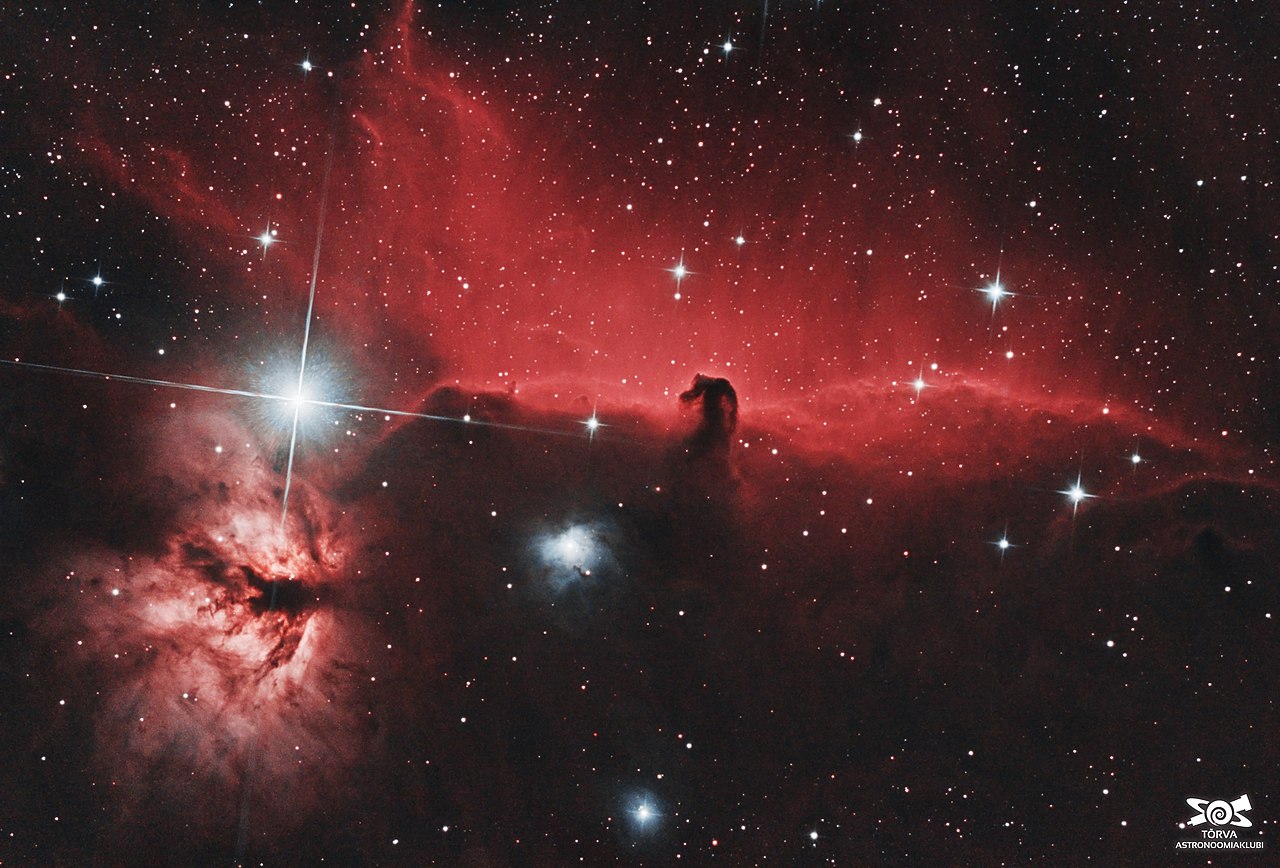
Horsehead and Flame nebula in Orion
Artist: Taavi Niittee - Alnilam (Epsilon Orionis): A B0 Ia supergiant near the center of the Belt, lying around ~2,000 light-years distant. It’s one of the most luminous stars visible to the naked eye and outshines many of its neighbors despite its greater distance.
- Mintaka (Delta Orionis): Another multiple system, near the celestial equator (declination close to 0°), making it helpful for understanding celestial coordinates. Its distance is on the order of ~1,200 light-years.
These massive stars are embedded in and around the Orion OB1 association, an extended network of hot, young stars that have shaped the surrounding interstellar medium. For a closer look at how their radiation sculpts nebulae and triggers subsequent star formation, see Science Behind Orion.
Deep-Sky Wonders in Orion: Nebulae, Clusters, and Dark Structures
Orion is a deep-sky showcase, packed with emission nebulae, reflection nebulae, young clusters, and dark, dusty lanes that carve complex silhouettes against glowing backgrounds. Even in modest binoculars the region around Orion’s Sword looks spectacular under dark skies. The highlights below are presented in an observer-friendly order, starting with naked-eye to binocular objects and progressing to features best attempted with larger telescopes and specialty filters.
The Orion Nebula (M42) and De Mairan’s Nebula (M43)
The Orion Nebula (M42) is the archetypal star-forming region and arguably the most famous deep-sky object. It’s a sprawling H II region—a cloud of ionized hydrogen energized by the intense ultraviolet radiation of newly formed, massive stars. At a distance of roughly ~1,340 light-years, M42 is also among the closest massive star nurseries to Earth.

Artist: NASA, ESA, M. Robberto (Space Telescope Science Institute/ESA) and the Hubble Space Telescope Orion Treasury Project Team
To the north of M42 is De Mairan’s Nebula (M43), separated visually by a dark dust lane. M43 is physically part of the same complex but appears as a distinct patch of nebulosity in binoculars and telescopes. Within the luminous core of M42 lies the compact Trapezium Cluster (Theta1 Orionis), a small group of bright, hot stars whose wind and radiation carve cavities and shock fronts in the surrounding gas. On steady nights, small telescopes can resolve several components of the Trapezium; in larger instruments, additional faint members become apparent.
Even with the naked eye in a dark sky, the Sword looks misty; averted vision can make the Orion Nebula’s glow more obvious. Binoculars (7×50, 8×42, or 10×50) reveal a winged or fan-like shape. Small telescopes at low to medium magnification show layered structure and brightness gradients. Under excellent transparency, nebula filters (UHC or O III) enhance the contrast, though very high magnification can dim the extended glow. For practical gear and technique tips, see the Observing Guide.
Running Man Nebula (NGC 1977, 1973, 1975)
Just north of M42/M43 lies a striking complex of reflection nebulae collectively known as the Running Man Nebula (NGC 1977, 1973, 1975). While emission nebulae glow by their own light (thanks to ionized gas), reflection nebulae shine by reflecting starlight off dust grains, often giving them a soft blue hue. The Running Man’s contours form a human-like shape in long-exposure images; visually, you’ll likely notice a gentle haze surrounding embedded stars. Medium-sized telescopes and dark skies help bring out the contrast in this area.
Horsehead Nebula (Barnard 33) and the Flame Nebula (NGC 2024)
Near the Belt star Alnitak resides one of the most famous dark nebulae in the sky: the Horsehead Nebula (Barnard 33). It’s a dense, dusty finger of interstellar matter silhouetted against the bright emission of IC 434. Adjacent to Alnitak is the Flame Nebula (NGC 2024), a brilliant, structured emission and reflection nebula complex. While these objects are photogenic, they are also challenging visually: the Horsehead in particular is notoriously subtle, typically needing large aperture and an H-beta filter under excellent dark-sky conditions. The Flame, by contrast, is more accessible in moderate telescopes, though light pollution will wash out its intricate detail.
Barnard’s Loop and the Orion Molecular Cloud Complex
The Orion region is threaded by large-scale structures formed by cycles of stellar birth and death. Among the grandest is Barnard’s Loop, a vast, faint arc of hydrogen emission encircling much of Orion’s Belt and Sword. It’s part of the larger Orion Molecular Cloud Complex, a sprawling assemblage of cold gas and dust that includes the Orion A and Orion B clouds. These contain embedded clusters, dark nebulae, and a zoo of young stellar objects (YSOs) in various stages of formation.
From a backyard perspective, Barnard’s Loop is a test of sky quality and visual technique. Under pristine, moonless skies it can be hinted at with wide-field optics and sometimes a narrowband filter; however, it’s generally beyond the reach of urban observers. Still, its existence helps tie together the visible pieces of Orion into a coherent picture: a neighborhood where massive stars have energized, sculpted, and sometimes blown apart the very clouds that once birthed them. The physical relationships among M42, the Belt region, and these large-scale shells are discussed further in Science Behind Orion.
Other Field Highlights
- NGC 1980 and Iota Orionis: A bright star and associated nebulosity south of M42; nice in binocular fields.
- Sigma Orionis: A compact multiple star system near the Horsehead field; a favorite split for small telescopes that also serves as a signpost when searching that area.
- LDN 1630/1641: Dark nebula designations you might see on charts; they are part of Orion’s dusty lanes that shape the region’s dramatic silhouettes.
Science Behind Orion: Star Formation, Stellar Evolution, and Feedback
Beyond its visual beauty, Orion is a natural laboratory for studying how stars are born, evolve, and influence their environments. Much of Orion’s complexity stems from the interplay between cold molecular clouds, intense ultraviolet radiation from massive stars, and the shock waves that ripple through the interstellar medium.
From Cold Clouds to Protostars
Star formation begins in cold, dense pockets of molecular gas and dust, typically at temperatures around 10–20 K. In Orion, these reservoirs reside in the Orion A and Orion B molecular clouds, and along dark filaments in the Sword and Belt regions. Under gravity’s pull, overdensities collapse into protostars—young objects still gathering mass from their envelopes and disks. Astronomers categorize these early stages (Class 0, Class I, etc.) by their spectral energy distributions and by direct imaging in infrared and submillimeter wavelengths.

Artist: ESO/J. Emerson/VISTA
In M42, observations have revealed protoplanetary disks (often called “proplyds”)—disks of dust and gas around young stars. These disks are the raw material for planet building. However, the intense radiation and stellar winds from nearby massive stars can photoevaporate or erode outer disk material, influencing the timeline and architecture of emerging planetary systems.
The Trapezium and Ionized Cavities
The compact Trapezium Cluster in the heart of M42 showcases how a handful of massive, hot stars can dominate their environment. Their ultraviolet light ionizes hydrogen in the surrounding nebula, causing it to emit the characteristic red glow of hydrogen-alpha along with other emission lines. The result is an H II region—a volume of space where electrons and protons recombine after being separated by energetic photons. Expanding bubbles and cavities within M42 attest to the power of stellar winds and radiation-driven flows. For visual observers, these processes translate to the wispy, winged texture seen at the eyepiece.

Artist: (c) NASA, ESA, CSA / Science leads and image processing: M. McCaughrean, S. Pearson, CC BY-SA 3.0 IGO
Orion OB1 Association and Sequential Star Formation
Orion’s Belt and Sword belong to the larger Orion OB1 association, a set of subgroups of hot, young O- and B-type stars that formed at slightly different times and locations within the complex. Astronomers identify several subgroups (often labeled OB1a, OB1b, OB1c, OB1d). While the details are an active area of research, the overall picture is that feedback from one generation of massive stars—via winds, radiation, and supernovae—compresses gas in neighboring regions, potentially triggering the next round of star formation. This sequential star formation helps explain the spatial distribution and ages of clusters across Orion.
Barnard’s Loop and Supernova Feedback
Barnard’s Loop is a visible sign of past energetic events. Its large, arcing filament of ionized gas likely traces the cumulative effects of multiple stellar winds and supernova explosions that originated in Orion’s OB associations. Although the detailed origin of the Loop is still studied, it exemplifies how massive stars inject energy into the interstellar medium, driving turbulence, shock fronts, and expanding shells that influence where the next stars will form. These grand arcs and cavities are common in star-forming regions across the Milky Way, but Orion’s proximity makes them particularly accessible to detailed observation.
Stellar Lifecycles on Display: From Blue Supergiants to Red Supergiants
Orion’s brightest stars gift observers a living diagram of stellar evolution. Rigel, a blue supergiant, burns its fuel rapidly and will evolve off the main sequence on timescales of only a few million years. Betelgeuse, already a red supergiant, is in a later evolutionary stage, having exhausted hydrogen in its core and expanded enormously. These short-lived giants enrich their surroundings with heavy elements via stellar winds and, eventually, supernovae—seeding the interstellar medium with the building blocks of future stars and planets.
Cultural History and Mythology of Orion across Civilizations
Orion’s bright pattern has been recognized by cultures around the world, and its story varies widely with local traditions. While the Greek mythology is most familiar in Western sky lore, many interpretations exist.
- Greek tradition: Orion is the mighty hunter, often depicted with a club and a lion skin, accompanied by his hunting dogs (Canis Major and Canis Minor). In one tale, Orion boasts that he can kill every animal on Earth, prompting Earth to send a scorpion to stop him. As a result, Orion and Scorpius are placed on opposite sides of the sky—when one rises, the other sets.
- Ancient Mesopotamia: The constellation was associated with a figure known as the “True Shepherd” (linked to the heavenly shepherd of Anu), reflecting the region’s pastoral heritage and astronomical traditions that date back millennia.
- Ancient Egypt: Orion was associated with Osiris in some interpretations. Discussions about alignments between Orion’s Belt and the pyramids at Giza have been popularized, though such claims remain debated and are not universally accepted by archaeologists and historians. It’s best to treat those correlations as hypotheses rather than established fact.
- Chinese astronomy: Stars in Orion, especially the Belt, are tied to the asterism Shen (“Three Stars”). Chinese sky lore organizes the night into lunar mansions, and parts of Orion play roles in these ancient star maps and calendars.
This cultural variety underlines a broader truth: bright, distinctive star patterns like Orion act as canvases onto which civilizations project narratives, calendars, and navigational aids. As you learn to navigate the sky using Orion’s Belt and its neighbors, you’re participating in a human tradition that stretches across history and geography. For practical navigation using Orion, revisit How to Find Orion.
Observing Guide: Binoculars, Small Telescopes, and Naked-Eye Tips
Orion offers something at every scale of observing, from naked-eye constellation gazing to rich binocular sweeps and rewarding telescopic details. The following tips focus on visual observation, helping you make the most of whatever sky conditions and equipment you have.
Timing, Location, and Sky Conditions
- Best months: In the Northern Hemisphere, December through February are prime; in the Southern Hemisphere, Orion is best centered in summer evenings.
- Moon phase: Aim for moonless nights to bring out faint nebulosity. Even a first-quarter Moon can dull the more delicate features around M42 and the Belt.
- Transparency and seeing: Good transparency makes diffuse nebulae pop; steady seeing helps resolve fine structure in the Trapezium Cluster and split tight multiple stars.
Naked-Eye Highlights
- Note the color contrast between Betelgeuse and Rigel.
- Test your sky: Can you perceive the faint glow in Orion’s Sword? Under truly dark skies, M42 appears as a delicate haze.
- Practice sky-hopping: Use the Belt to find Sirius and Aldebaran, then continue to the Pleiades.
Binocular Observing
- Recommended sizes: 7×50, 8×42, and 10×50 offer bright, wide fields ideal for sweeping Orion’s complex regions.
- Targets: The Orion Nebula (M42) is the star of the show—look for its winged shape. The Running Man may be hinted as a soft glow. Try the field around Alnitak to see the Flame as a faint haze in dark skies.
- Technique: Use a tripod or stabilizing brace for steadier views. Employ averted vision—look slightly off to the side of the object to engage more light-sensitive rods in your eye.
Small Telescope Advice
- Moderate magnification (50–120×) is often ideal for M42, balancing field of view and detail.
- Filters: A UHC filter can enhance nebular contrast on M42. An O III filter can emphasize specific emission features. For the Horsehead, an H-beta filter is often recommended, though aperture, darkness, and experience matter most.
- Targets to split: Try Sigma Orionis and components of the Trapezium (Theta1 Orionis A–D; larger scopes can tease out E and F under steady air).
Rule of thumb: If M42’s “fish-mouth” dark lane is starkly visible and the Trapezium’s four main stars are pinpoint-sharp at moderate power, your sky and seeing are working in your favor.
Practical Field Checklist
- Allow 20–30 minutes for dark adaptation; use a red-light flashlight to protect night vision.
- Consult a star chart or reliable sky app but don’t forget to look up and compare pattern-to-pattern—an essential skill for building celestial intuition.
- Dress warmly in layers; winter Orion sessions can be cold and breezy.
- Carry a notebook to sketch or log observations—recording details helps you notice subtleties you might otherwise miss.
For more about the physical processes behind what you’re seeing, return to Science Behind Orion. If you’re out during autumn, you might also catch the Orionids meteor shower.
Orionids Meteor Shower: When and How to Watch
The Orionids are an annual meteor shower active in October, peaking roughly around October 20–22 in most years. The radiant—the point in the sky from which meteors appear to emerge—lies in the constellation Orion, typically near the region of the Club above Betelgeuse. The Orionids originate from debris shed by Comet 1P/Halley. While the peak rates vary by year, a typical zenithal hourly rate (ZHR) for the Orionids is on the order of a few tens per hour under ideal dark-sky conditions.
How to observe:
- Best time: After midnight to pre-dawn, when the radiant is higher and the geometry favors more meteors.
- View without optics: Meteors streak across wide swaths of sky. A reclining chair, a warm sleeping bag, and patience are your best tools.
- Choose a dark site and avoid bright lights. Let your eyes adapt, and keep scanning. Meteors can appear anywhere in the sky, though their paths trace back to Orion.
The Orionids provide a seasonal bonus for Orion enthusiasts, linking the constellation’s visual splendor with the dynamic, evolving Solar System debris environment. Plan your session around the Moon’s phase; a bright Moon can severely cut meteor counts.
Frequently Asked Questions
Will Betelgeuse explode soon?
Short answer: There’s no sign it will explode anytime soon on a human timescale. Betelgeuse is a red supergiant and will eventually end as a core-collapse supernova, but predicting the exact timing is not currently possible. Observed dimmings, including the prominent event in late 2019–early 2020, have strong evidence for being caused by dust and stellar surface activity rather than imminent core collapse. When Betelgeuse does go supernova—whether tomorrow or in hundreds of thousands of years—it will be an extraordinary astronomical event, but not a danger to life on Earth due to its distance (roughly on the order of 550 light-years).
What’s the best month to see the Orion Nebula?
In the Northern Hemisphere, the Orion Nebula is best placed from December through February, when it culminates in the evening. In the Southern Hemisphere, it’s well situated during the summer months. Aim for a moonless, transparent night, and start with low to moderate magnification in a small telescope or binoculars. Use a UHC or O III filter to improve contrast if your sky has some light pollution. For gear and technique tips, check the Observing Guide.
Final Thoughts on Exploring the Orion Constellation
Orion is a complete sky curriculum all by itself. With just your eyes you can learn to navigate by asterisms, compare stellar colors, and trace celestial geometry across the seasons. With binoculars you can drift through glowing nebulae, reflection veils, and dark serpentine dust; with a small telescope you can dive into the heart of an H II region, resolve multiple stars, and watch the Orion Nebula breathe with structure under different magnifications and filters. Alongside this visual bounty, Orion is also an astronomical treasure chest: a living lab where we study star birth, feedback, and the life cycles of massive stars, all near enough to parse in detail.
As you plan your next night out, consider building a mini-observing program around Orion: find the Belt quickly from your yard; use the Sword to judge your sky’s quality; sweep the Running Man; attempt the Flame; and, under a dark sky, test your mettle on the Horsehead with an H-beta filter. Whether you’re watching the streaks of the Orionids or chasing the tight points of the Trapezium, you’re following in the footsteps of countless skywatchers who found both science and story in these stars.

Artist: ESA/Euclid/Euclid Consortium/NASA image processing by J.-C. Cuillandre (CEA Paris-Saclay) G. Anselmi
If you enjoyed this guide and want more practical sky tours, science explainers, and seasonal targets, subscribe to our newsletter. We’ll send new observing tips, constellation deep-dives, and timely reminders for upcoming celestial events straight to your inbox—so you’re always ready when the sky puts on a show.