In modern cosmology, dark matter is the name we give to a form of matter that does not emit, absorb, or reflect light, yet exerts gravity and shapes the large-scale structure of the universe. It is called “dark” because it is invisible to telescopes across the electromagnetic spectrum; it is called “matter” because it clusters under gravity and appears to behave as a non-relativistic mass component—what physicists often label “cold” matter. The term is a concise placeholder for a deeper puzzle: a dominant mass component that we have so far inferred only indirectly.
n
Multiple, independent astronomical observations show that the gravitational pull in galaxies, galaxy clusters, and the cosmic web is too strong to be explained by the visible matter—stars, gas, and dust—alone. Rather than being a single line of evidence, the case for dark matter is a consilience of many clues. As discussed in The Multiple Lines of Evidence for Dark Matter, these clues span galaxy rotation curves, gravitational lensing, the dynamics of galaxy clusters, the pattern of temperature fluctuations in the cosmic microwave background (CMB), and the growth of structure from the early universe to today.
nn
n nSuperimposed mass density contours, caused by gravitational lensing of dark matter. Photograph taken with Hubble Space Telescope. — Artist: User:Mac_Davisn
n
nn
The current “standard model” of cosmology, often called Lambda–Cold Dark Matter (ΛCDM), encapsulates these ideas. In this framework, the cosmic energy budget today is roughly:
n
Dark energy (Λ): ~70%nDark matter (cold): ~25%nOrdinary (baryonic) matter: ~5%nRelativistic species (photons + neutrinos): <1%n
n
These numbers are approximate and drawn from precise measurements of the CMB and large-scale structure, with small uncertainties that are not important for our qualitative discussion here. What matters is that most of the mass–energy in the universe is invisible, and the “ordinary” baryons that make up stars, planets, and people are only a minor fraction of the whole.
n
Dark matter’s defining properties, as used in cosmology, are simple but powerful:
n
n
Gravitates: It contributes to the gravitational potential that shapes orbits, light deflection, and structure growth.
n
Dark (electromagnetically neutral): It does not couple to light in ways that would make it glow or absorb in telescopes.
n
Cold or nearly cold: It moves slowly enough (non-relativistically) in the early universe to seed the bottom-up buildup of structure.
n
Long-lived or stable: It persists from the early universe to the present.
It is a strength of the dark matter hypothesis that it is not tuned to fit just one observation; rather, it emerges from diverse and mutually reinforcing measurements. Here are the major pillars.
nn
1) Galaxy rotation curves
n
In spiral galaxies, the orbital speed of stars and gas can be measured by the Doppler shift of spectral lines. If most of a galaxy’s mass were concentrated where the light is—near the luminous disk—then orbital speeds should rise near the center and fall in the outskirts, much like planets in the solar system. Instead, many spirals show flat or slowly rising rotation curves far beyond the visible disk. The natural explanation is that galaxies are embedded in massive, extended dark matter halos supplying extra gravity at large radii.
n
This evidence is not anecdotal; surveys have mapped rotation curves across many galaxies of different masses and surface brightnesses. While the exact halo profile is a subject of study, the qualitative need for a dark component persists across the population. The outer parts of galaxies orbit too fast to be held together by visible matter alone.
nn
2) Galaxy clusters and the “missing mass” problem
n
Even earlier than detailed galaxy rotation curves, studies of clusters of galaxies revealed a mass discrepancy. The galaxies in a cluster move rapidly in the cluster’s gravitational potential. When you estimate the cluster’s total mass from the galaxies’ motions (via the virial theorem), you find far more mass than can be accounted for by the starlight of the member galaxies. Independent estimates from the X-ray–emitting hot gas that suffuses clusters—whose temperature and distribution trace the depth of the potential well—lead to the same conclusion: clusters are dominated by an unseen mass component.
n
Crucially, clusters also act as natural gravitational lenses, bending the light from background galaxies. Lensing does not care whether matter is luminous or dark; it is a direct probe of the total mass distribution. Maps of clusters constructed from weak and strong lensing show mass concentrations that exceed what baryons alone can provide. This cross-check is a powerful anchor for the dark matter picture.
nn
3) Gravitational lensing across scales
n
Gravitational lensing—the deflection of light by mass predicted by general relativity—reveals the presence of mass independent of its luminosity. On galaxy scales, lensing can magnify and distort distant sources; on cluster scales, it can produce arcs and multiple images; statistically, it can weakly shear the shapes of many background galaxies. All of these lensing signals consistently imply that galaxies and clusters are embedded in halos that are much more massive than their visible components. In special systems, such as merging galaxy clusters, lensing maps even show a spatial offset between the peaks of the total mass and the hot gas (which is collisional). This morphological separation is difficult to reproduce without a collisionless dark component.
nn
n nWhat’s large and blue and can wrap itself around an entire galaxy? A gravitational lens mirage. Pictured above, the gravity of a luminous red galaxy (LRG) has gravitationally distorted the light from a much more distant blue galaxy. More typically, such light bending results in two discernible images of the distant galaxy, but here the lens alignment is so precise that the background galaxy is distorted into a horseshoe — a nearly complete ring. Since such a lensing effect was generally predicted in some detail by Albert Einstein over 70 years ago, rings like this are now known as Einstein Rings. Although LRG 3-757 was discovered in 2007 in data from the Sloan Digital Sky Survey (SDSS), the image shown above is a follow-up observation taken with the Hubble Space Telescope’s Wide Field Camera 3. Strong gravitational lenses like LRG 3-757 are more than oddities — their multiple properties allow astronomers to determine the mass and dark matter content of the foreground galaxy lenses. (citation from APOD) — Artist: ESA/Hubble & NASA; derivative work: Bulwersatorn
n
nn
4) Cosmic microwave background (CMB) anisotropies
n
The CMB encodes a snapshot of the universe when it was about 380,000 years old—long before galaxies formed. The statistical pattern of temperature and polarization fluctuations across the sky is sensitive to the contents of the universe. The observed angular power spectra are well described by ΛCDM with a significant cold dark matter component. Baryons alone cannot reproduce the detailed sequence of acoustic peaks and their relative heights. The CMB therefore provides early-universe support for dark matter that is independent of late-time galaxy dynamics.
nn
n nThis map of the Cosmic Microwave Background radiation, imprinted on the sky when the universe was 370,000 years old, shows tiny temperature fluctuations that correspond to regions of slightly different densities. — Artist: ESA and the Planck Collaborationn
n
nn
5) Large-scale structure and the cosmic web
n
In ΛCDM, small density fluctuations grow over time, with dark matter providing the primary scaffolding for structure formation. Cosmological simulations that include cold dark matter naturally produce a cosmic web of filaments and nodes reminiscent of observed galaxy distributions. Observational probes, including galaxy clustering, weak lensing, and the Lyman-alpha forest in quasar spectra, are consistent with the growth history expected from a universe with a dominant cold dark matter component. The detailed match between simulations and the observed statistical properties of structure on large scales is one of the model’s great successes.
nn
6) Bullet-like merging clusters
n
In some dramatic systems where two galaxy clusters collide, the hot gas (the primary baryonic component by mass) interacts and slows down, emitting X-rays, while the galaxies and any collisionless dark matter components pass through more freely. By mapping the total mass via gravitational lensing and the gas via X-ray observations, astronomers find a separation: lensing mass peaks are closer to the galaxies than to the slowed gas. This geometry is consistent with a primarily collisionless dark component and is challenging to explain with modified gravity alone. While each cluster has its own complexities, the broad pattern reinforces the dark matter hypothesis.
nn
n nComposite image showing the galaxy cluster 1E 0657-56, better known as bullet cluster. The image in background showing the visible spectrum of light stems from Magellan and Hubble Space Telescope images. The pink overlay shows the x-ray emission (recorded by Chandra Telescope) of the colliding clusters, the blue one represents the mass distribution of the clusters calculated from gravitational lens effects. Scale: Full image is 7.5 arcmin wide, 5.4 arcmin high — Artist: NASA/CXC/M. Weissn
n
nn
nn
Standing together, these lines of evidence build a robust case. No single observation alone would be definitive, but the ensemble across cosmic time and scale strongly favors a dark, non-luminous mass component. For readers who want to understand the broader implications, the next section, How Dark Matter Shapes the Universe We See, ties these observations into a cosmic story.
nn
How Dark Matter Shapes the Universe We See
n
Dark matter is more than a bookkeeping device. It is the backbone of cosmic structure. In the ΛCDM framework, the evolution of the universe unfolds roughly as follows:
n
n
Early fluctuations: Tiny primordial fluctuations in density—seeded in the very early universe—are imprinted in the CMB. Dark matter, being pressureless and not coupled to radiation, starts to clump as soon as it can, while baryons remain tied to the photon bath until recombination.
n
Halo formation: Over time, small dark matter clumps (halos) collapse first, then merge into larger structures. This bottom-up (hierarchical) growth is a hallmark of cold dark matter.
n
Galaxy assembly: Baryons fall into dark matter potential wells, cool radiatively, and condense to form stars and galaxies within halos. Feedback from stars and black holes regulates this process, but the overall scaffolding is set by the dark halos.
n
Cosmic web: On large scales, matter forms filaments and nodes. Galaxies and clusters trace this web, with voids in between. Dark matter dominates the mass budget that shapes these patterns.
n
n
The result is a universe where dark matter halos host galaxies, with halo mass being a primary driver of a galaxy’s environment and evolution. Several specific consequences are worth highlighting:
n
n
Halo–galaxy connection: Empirical relations, such as abundance matching, connect galaxy stellar mass to halo mass statistically, implying an efficiency peak in converting baryons to stars in halos of intermediate mass.
n
Dwarf galaxies and substructure: ΛCDM predicts that halos contain many subhalos. Some host dwarf galaxies; others may be dark. The census of satellites around the Milky Way has grown, and dynamical studies of dwarf spheroidal galaxies indicate large mass-to-light ratios, consistent with dark matter domination.
n
Lensing substructure: Even subhalos with few or no stars can betray themselves via slight anomalies in the fluxes and positions of strongly lensed images, offering a direct probe of the dark matter small-scale power spectrum.
n
Cluster-scale structure: On the largest bound scales, dark matter anchors clusters and their intracluster media, governing assembly histories and the thermal state of hot gas.
n
n
While the large-scale successes of ΛCDM are striking, there are ongoing discussions about small-scale challenges—how well the model reproduces the inner density profiles of dwarf galaxies, the exact abundance of subhalos, and the diversity of rotation curve shapes in low-mass galaxies. Many of these tensions may reflect complex baryonic physics (supernova feedback, tides, and gas dynamics) within the dark matter halos. Others have motivated consideration of alternative dark matter properties, such as self-interactions or wave-like behavior, as we explore in What If Dark Matter Is Not a Particle? Alternatives and Tests.
nn
Leading Dark Matter Candidates and Theories
n
“Dark matter” is a phenomenological label; the underlying particle (or non-particle) identity is unknown. Several well-motivated candidates arise from extensions of known physics. Here are the leading contenders and ideas.
nn
Weakly Interacting Massive Particles (WIMPs)
n
WIMPs are hypothetical particles with masses roughly from a few GeV to TeV scales, interacting via forces weaker than electromagnetism. They are motivated in part by the “thermal relic” idea: a particle with weak-scale interactions naturally freezes out of the hot early universe with an abundance close to the observed dark matter density. This coincidence—sometimes called the “WIMP miracle”—makes them compelling targets.
n
Many theories beyond the Standard Model of particle physics, such as certain supersymmetric models, provide WIMP-like candidates. The null results so far from direct, indirect, and collider searches have pushed WIMP parameter space increasingly into corners with lower interaction cross sections or more complex interactions. Nevertheless, WIMPs remain a benchmark for experimental design, as detailed in How We Search.
nn
Axions and axion-like particles (ALPs)
n
Axions were originally proposed to solve a puzzle in quantum chromodynamics (QCD), but they are also excellent dark matter candidates. If produced non-thermally in the early universe (e.g., via the “misalignment mechanism”), axions with micro-eV to milli-eV masses can make up cold dark matter. Axions couple very weakly to photons, allowing searches that attempt to convert dark matter axions into microwave photons in resonant cavities inside strong magnetic fields. Variants called ALPs can inhabit a broad mass–coupling parameter space and arise in other theoretical frameworks.
nn
Sterile neutrinos
n
Sterile neutrinos are hypothetical neutrino species that interact only through gravity and possibly via mixing with active neutrinos. With keV-scale masses, they would constitute “warm” dark matter, with a slightly larger free-streaming length than cold dark matter. Such particles can leave signatures in X-ray observations through rare radiative decays, and they would affect small-scale structure. Reports of an unidentified X-ray line at around 3.5 keV in some observations sparked interest in a sterile neutrino interpretation, but the origin of this feature remains debated, with analyses yielding mixed results and no consensus.
nn
Self-interacting dark matter (SIDM)
n
SIDM is not a specific particle, but a class of models where dark matter has sizable interactions with itself. The right level of self-interaction could decrease the central densities of halos (creating cores) and reduce the diversity problems in small galaxies, while leaving large-scale structure largely unchanged. Constraints from merging clusters and galaxy dynamics typically limit the self-interaction cross-section to around the order of 1 cm²/g or below, depending on velocity scale, providing useful targets for model builders.
nn
Ultralight (fuzzy) dark matter
n
In fuzzy dark matter scenarios, the dark matter is an ultralight boson (mass ~10⁻²² eV or higher). The de Broglie wavelength of such particles is kiloparsec-scale, endowing halos with wave-like properties and potentially creating central cores that mitigate some small-scale tensions. Constraints from the Lyman-alpha forest and galaxy formation push the viable mass range upward; still, the idea remains an active area of study, connecting cosmology with novel quantum phenomena on galactic scales.
nn
MACHOs and compact objects
n
Massive Compact Halo Objects (MACHOs)—such as brown dwarfs, faint stars, or black holes—were once considered plausible dark matter candidates. Gravitational microlensing surveys have shown that such compact baryonic objects cannot account for the bulk of dark matter over a wide mass range. Interest has reemerged in primordial black holes (PBHs) formed in the early universe, which are non-baryonic; however, constraints from microlensing, dynamical effects, and the CMB limit the fraction of dark matter that PBHs can provide across many mass windows.
nn
Each of these candidates brings distinct detection strategies. The next section, How We Search, explores the suite of experiments designed to reveal the particle nature of dark matter—or to rule out increasingly large swaths of parameter space.
nn
How We Search: Direct, Indirect, and Collider Experiments
n
Because dark matter does not shine, discovering its identity requires creative experiments that look for faint, rare signatures. The search program spans underground detectors, space-based telescopes, ground-based gamma-ray observatories, particle colliders, and precision astrophysical measurements. Here are the main fronts.
nn
Direct detection: Waiting for a rare recoil
n
Direct detection experiments aim to observe the tiny recoil of a nucleus (or electron) when a passing dark matter particle scatters in the detector. To reduce backgrounds, these experiments are placed deep underground, shielded from cosmic rays, and use ultra-pure materials with exquisite instrumentation. A leading technology employs dual-phase liquid xenon time-projection chambers. Notable efforts include:
n
n
Xenon-based searches: Experiments using multi-ton liquid xenon targets have set some of the world’s most stringent limits on WIMP–nucleon scattering, pushing sensitivity to spin-independent cross sections on the order of 10⁻⁴⁸ cm² around tens of GeV mass scales.
n
Germanium and silicon detectors: Cryogenic detectors can probe lower-mass dark matter by measuring tiny energy deposits with high resolution.
n
New channels: Emerging technologies target electron recoils and ultra-low thresholds to search for sub-GeV dark matter.
n
n
As sensitivity increases, a new background looms: the “neutrino floor,” where coherent neutrino–nucleus scattering produces irreducible backgrounds that mimic WIMP signals. Surpassing this floor is not impossible, but it will require directional detectors or other clever discrimination techniques.
nn
Indirect detection: Looking for annihilation or decay products
n
Indirect detection searches the sky for excesses of gamma rays, antimatter, or neutrinos that might result from dark matter particles annihilating or decaying. Targets include the Galactic Center, dwarf spheroidal galaxies (which have high dark matter content and low astrophysical backgrounds), galaxy clusters, and the isotropic gamma-ray background. Instruments and strategies include:
n
n
Space-based gamma-ray telescopes: These look for spectral features or spatial distributions consistent with dark matter models.
n
Ground-based Cherenkov telescopes: Arrays sensitive to very-high-energy gamma rays probe heavier dark matter scenarios and look for extended emissions.
n
Cosmic-ray detectors: Satellite-based instruments measure positron and antiproton fluxes, testing models of annihilation/decay while contending with complex astrophysical backgrounds.
n
Neutrino observatories: Large-volume detectors monitor for neutrinos potentially produced by dark matter captured and annihilating in the Sun or Earth.
n
n
Interpreting potential signals in indirect searches is challenging because many astrophysical processes—pulsars, supernova remnants, cosmic-ray interactions—can mimic the signatures. Careful modeling and cross-correlation with multiple targets are essential.
nn
Collider searches: Making dark matter in the lab
n
If dark matter couples to Standard Model particles at accessible energies, particle colliders can produce it directly. However, because dark matter would pass through detectors unseen, searches focus on events with large missing transverse energy balanced by a visible particle—so-called “mono-X” signatures (e.g., a monojets or monophotons). Colliders also search for new mediator particles that could connect dark matter to quarks and leptons. While no conclusive signals have appeared, collider bounds help map out viable models and can complement direct and indirect results.
nn
Axion and ALP searches: Turning dark into light
n
Axion haloscopes aim to detect dark matter axions in the Milky Way halo by converting them into microwave photons within a high-Q resonant cavity permeated by a strong magnetic field. By tuning the cavity to scan over frequencies corresponding to possible axion masses, these experiments sweep narrow bands of parameter space with extraordinary sensitivity. Other strategies include dielectric haloscopes, NMR-based searches targeting nuclear spin couplings, and “light-shining-through-a-wall” experiments for ALPs. Over the past several years, haloscopes have begun to probe the theoretically favored coupling ranges in parts of the micro-eV mass window.
nn
Astrophysical probes of small-scale structure
n
Beyond laboratory experiments, astrophysical tests of dark matter properties probe how it clumps on small scales:
n
n
Strong-lensing substructure: Minute perturbations by dark subhalos alter the brightness and positions of lensed images, testing the predicted subhalo mass function.n n nALMA’s Long Baseline Campaign has produced a spectacularly detailed image of a distant galaxy being gravitationally lensed, revealing star-forming regions — something that has never been seen before at this level of detail in a galaxy so remote. The new observations are far more detailed than any previously made of such a distant galaxy, including those made using the NASA/ESA Hubble Space Telescope, and reveal clumps of star formation in the galaxy equivalent to giant versions of the Orion Nebula. The left panel shows the foreground lensing galaxy (observed with Hubble), and the gravitationally lensed galaxy SDP.81, which forms an almost perfect Einstein Ring, is hardly visible. The middle image shows the sharp ALMA image of the Einstein ring, with the foreground lensing galaxy being invisible to ALMA. The resulting reconstructed image of the distant galaxy (right) using sophisticated models of the magnifying gravitational lens, reveal fine structures within the ring that have never been seen before: Several dust clouds within the galaxy, which are thought to be giant cold molecular clouds, the birthplaces of stars and planets. — Artist: ALMA (NRAO/ESO/NAOJ)/Y. Tamura (The University of Tokyo)/Mark Swinbank (Durham University)n
n
n
n
Stellar streams: Tidal streams from disrupted star clusters in the Milky Way halo are flimsy and can be “rippled” by encounters with dark subhalos, leaving gaps and spurs that encode substructure.
n
Dwarf galaxies: The abundance, internal dynamics, and star-formation histories of dwarf satellites provide sensitive laboratories for dark matter’s nature and for baryonic feedback processes.
n
n
Taken together, these observational strategies probe whether dark matter is cold, warm, self-interacting, or wave-like, and whether there are deviations from the standard collisionless paradigm on kiloparsec scales.
nn
What If Dark Matter Is Not a Particle? Alternatives and Tests
n
Given the absence of a definitive particle detection so far, it is healthy to explore alternatives and extensions. Here are key ideas and how they fare against the data.
nn
Modified gravity frameworks (e.g., MOND)
n
Modified Newtonian Dynamics (MOND) proposes that Newton’s law changes at very low accelerations, in a way that can account for the flat rotation curves of galaxies without invoking dark matter. MOND and related relativistic extensions can fit some galaxy-scale observations with remarkable economy. However, explaining the full suite of evidence—from cluster mass discrepancies and the morphology of merging clusters, to the CMB power spectrum and lensing statistics—has proven difficult without reintroducing an additional unseen mass component. Thus, while modified gravity offers insights into empirical regularities (like scaling relations for galaxy dynamics), it has not superseded the need for dark matter across cosmic scales.
nn
Self-interacting dark matter
n
As outlined in Leading Dark Matter Candidates and Theories, allowing dark matter to scatter with itself can address some small-scale structure tensions by transferring heat in halo cores. Constraints from cluster mergers and halo shapes limit the permissible cross sections, and the allowed range can be velocity-dependent. SIDM is a viable variant of the dark matter hypothesis rather than an alternative to having dark matter at all.
nn
Ultralight (fuzzy) dark matter
n
When dark matter is so light that its quantum wavelength is macroscopic, wave effects suppress small-scale structure and can create soliton-like cores in galaxy centers. Tension arises with observations of the intergalactic medium—specifically, the Lyman-alpha forest—which disfavors too much small-scale suppression. Viable models navigate this by choosing masses that preserve enough small-scale power while still offering distinct predictions testable with high-resolution galaxy observations and lensing.
nn
Primordial black holes
n
Black holes formed in the early universe (PBHs) can, in principle, act as dark matter without being baryonic. However, microlensing surveys strongly limit the abundance of compact objects across much of the relevant mass range, and additional constraints from cosmic microwave background anisotropies (through accretion effects), dynamical heating of stellar systems, and gravitational-wave observations further restrict how much of the dark matter could be in PBHs. Current bounds allow at most a subdominant fraction in many mass windows, with ongoing work refining the picture.
nn
The upshot is that while modified gravity alone struggles to explain cosmological data sets in unison, variations in dark matter’s microphysics—self-interaction, ultralight mass, composite structure—remain plausible and testable. Future observations of small-scale structure, precise lensing, and laboratory searches will help discriminate among these possibilities.
nn
Common Misconceptions About Dark Matter
n
Because dark matter is invisible and unfamiliar, it is fertile ground for misconceptions. Here are clarifications to some recurring confusions.
nn
n
“Dark matter is just regular matter hidden in black holes or faint stars.” Compact baryonic objects cannot make up the bulk of dark matter, as microlensing and cosmic nucleosynthesis constraints rule them out across broad mass ranges. The dominant dark matter must be non-luminous and, by most evidence, non-baryonic.
n
“It’s all an accounting trick to fix bad theories.” The inference of dark matter comes from multiple, independent observations across methods and epochs, not from patching a single anomaly. While the identity is unknown, the gravitational evidence is consistent and strong. See The Multiple Lines of Evidence for Dark Matter.
n
“If we can’t detect it directly, it probably isn’t real.” Many established phenomena were inferred long before direct detection (e.g., neutrinos). The absence of a signal in specific experiments tells us where dark matter is not; it does not negate the astrophysical evidence that it exists.
n
“Dark matter doesn’t interact at all.” Dark matter certainly interacts gravitationally. The question is whether it also has non-gravitational interactions with itself or with baryons. Experimental bounds constrain these possibilities but have not eliminated them. See How We Search.
n
“Modified gravity has already replaced dark matter.” Modified gravity can capture some galaxy-scale regularities, but struggles to reproduce lensing in merging clusters, the full CMB anisotropy pattern, and other cosmological data without additional dark components. See Alternatives and Tests.
n
nn
How to Interpret Headlines About Dark Matter Discoveries
n
Dark matter research often generates eye-catching news. Here’s how to read such headlines critically and constructively.
nn
n
“New particle excess hints at dark matter.” Ask: Is the excess statistically significant after accounting for trial factors? Does it appear in multiple, independent data sets or instruments? Are astrophysical backgrounds well modeled? Cross-checks across different channels (gamma rays, cosmic rays, neutrinos) and targets (dwarf galaxies versus the Galactic Center) are crucial.
n
“Detector observes candidate dark matter events.” Direct detection experiments sometimes report events above expected backgrounds. Scrutinize: Is there a clear spectral or annual modulation signature? Can instrumental effects mimic the signal? Have other experiments with similar sensitivity seen consistent signatures or set contradictory limits?
n
“Collider finds missing energy events.” Missing energy is a generic signature of invisible particles, not necessarily dark matter. Consider whether a theoretical framework connects the collider signal to relic abundance, and whether the same parameters are allowed by direct and indirect bounds.
n
“Dark matter ruled out.” Usually, this means a specific model or parameter space was excluded, not the entire dark matter paradigm. Headline phrasing can be broader than warranted; the details matter.
n
nn
Scientific understanding advances by converging evidence. The most convincing dark matter claim will likely involve a coherent story spanning an astrophysical signal, a compatible laboratory detection, and consistency with cosmology. Until then, null results are invaluable: they tell us where not to look and sharpen our theoretical expectations.
nn
Frequently Asked Questions
n
Is dark matter just an accounting trick for gravity we don’t understand?
n
No. General relativity has passed many stringent tests across scales, from the solar system to gravitational waves. While the possibility of new gravitational physics remains open, the specific patterns of evidence—such as lensing maps of merging clusters, the CMB power spectrum, and the large-scale structure of the universe—are naturally and parsimoniously explained by adding a non-luminous matter component. Modified gravity models have difficulty matching the complete data set without reintroducing additional unseen mass.
nn
Could dark matter interact with light after all?
n
By definition, dark matter does not strongly interact with light; otherwise, we would have seen it in emission or absorption. However, some models allow for extremely weak couplings to photons. For example, axions can convert to photons in magnetic fields, and dark matter might have tiny electric millicharges in certain scenarios. Experimental and astrophysical limits severely constrain such couplings. Practically, for the purposes of galaxy dynamics and cosmology, dark matter behaves as electromagnetically neutral.
nn
Final Thoughts on Understanding Dark Matter
n
Dark matter sits at the intersection of astrophysics, cosmology, and particle physics. Its gravitational fingerprints are stamped across the universe: in whirling galaxies, in the silhouettes of lensed arcs around clusters, in the rippled pattern of the CMB, and in the foam-like cosmic web. The ΛCDM framework, which includes cold dark matter and dark energy, captures these phenomena with remarkable economy and predictive power.
n
Yet the identity of dark matter remains one of science’s most profound open questions. The last decade has delivered increasingly sensitive searches across complementary frontiers—underground detectors pushing into the neutrino background, telescopes mapping structure with unprecedented precision, collider experiments closing windows on simple models, and axion haloscopes venturing into theoretically motivated territories. So far, nature has been coy. That is not failure; it is progress by exclusion, carving away the space of possibilities and guiding us toward the truth.
n
Looking ahead, the path to discovery likely lies in convergence—a consistent laboratory signal corroborated by astrophysical observations and compatible with cosmological constraints. Whether dark matter turns out to be a WIMP, an axion-like particle, an ultralight boson, a sterile neutrino, or something we have not yet imagined, the tools to find it are in hand and improving.
nn
n nThe Bullet Cluster is made up of two galaxy clusters that are colliding, one moving through the other, about 3.7 billion light-years away in the constellation Carina. These galaxy clusters act as gravitational lenses, magnifying the light of background galaxies. This phenomenon makes the Bullet Cluster a compelling piece of evidence supporting the existence of dark matter. This image was taken with the 570-megapixel U.S. Department of Energy-fabricated Dark Energy Camera (DECam), mounted on the U.S. National Science Foundation Víctor M. Blanco 4-meter Telescope at Cerro Tololo Inter-American Observatory (CTIO), a Program of NSF NOIRLab. View the Zoomable image to explore this stunning galaxyscape in more detail. — Artist: CTIO/NOIRLab/DOE/NSF/AURA Image Processing: T.A. Rector (University of Alaska Anchorage/NSF NOIRLab) & M. Zamani (NSF NOIRLab)n
n
nn
If this exploration sharpened your understanding, consider diving into related topics within our archive—like gravitational lensing, the cosmic microwave background, and galaxy formation—which interlock with the dark matter narrative. And if you would like more accessible, research-grounded articles like this in your inbox, subscribe to our newsletter. We publish weekly deep dives that connect the latest observations and experiments to the big questions shaping our view of the universe.

 n
n n
n n
n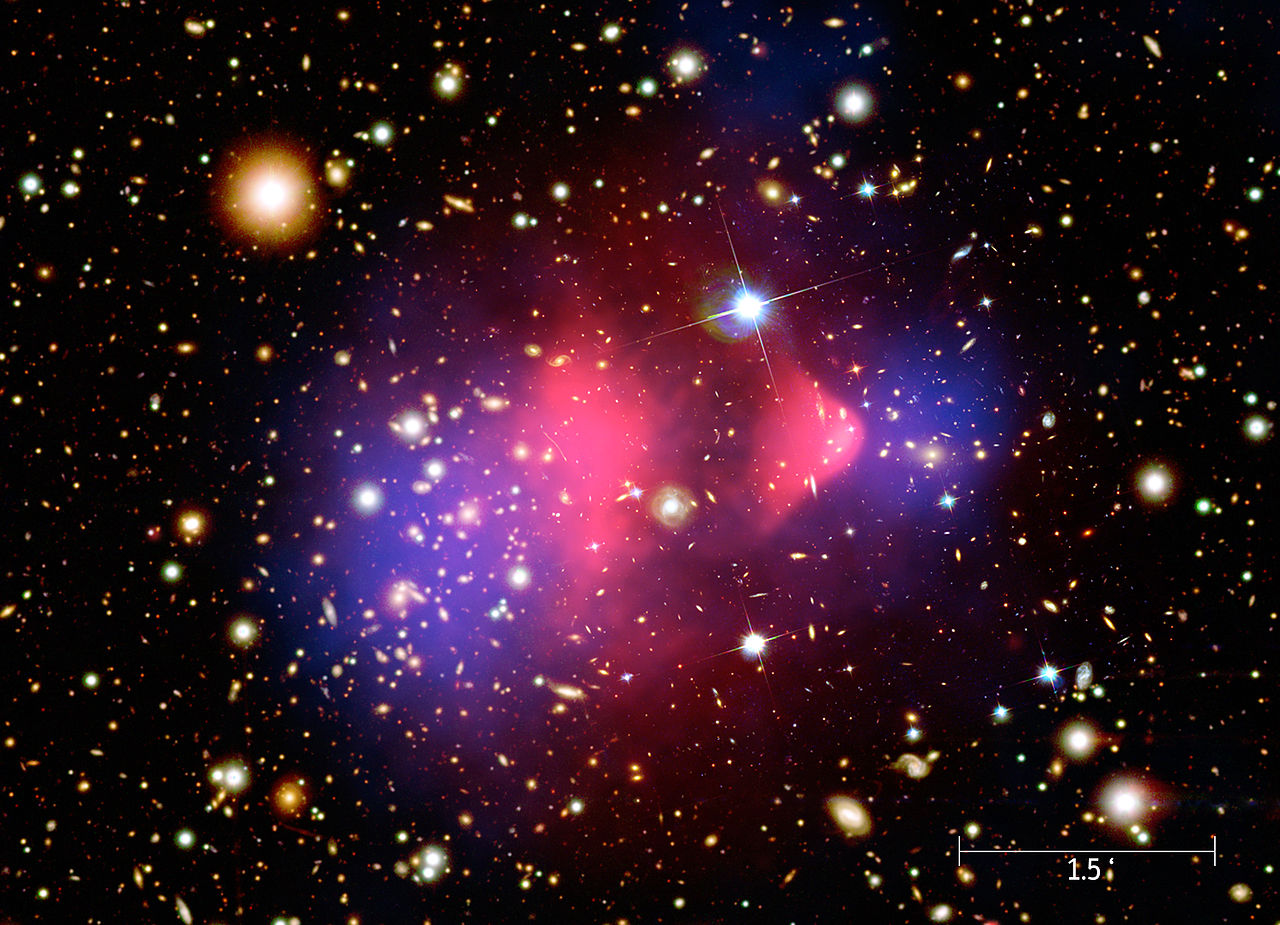 n
n n
n n
n