
Table of Contents
- What Is the Summer Triangle Asterism?
- Meet the Stars: Vega, Deneb, and Altair
- How to Find the Summer Triangle From Any Sky
- Seasons, Latitudes, and Sky Positions
- Deep-Sky Treasures Inside the Summer Triangle
- Cultural and Historical Context of the Triangle
- Observing Tips, Light Pollution, and Seeing the Milky Way
- Astrophotography Guide: Capturing the Summer Triangle
- Related Asterisms and Seasonal Sky Markers
- Frequently Asked Questions
- Final Thoughts on Exploring the Summer Triangle
What Is the Summer Triangle Asterism?
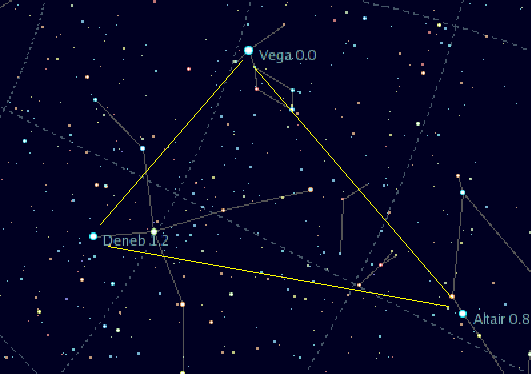
The Summer Triangle is one of the most recognizable patterns in the night sky. It is not a constellation but an asterism—a prominent star pattern composed of bright stars from different constellations. Its three vertices are Vega in Lyra, Deneb in Cygnus, and Altair in Aquila. Because these stars are bright and well spaced, they serve as a large, easy landmark for skywatchers learning the summer night sky in the Northern Hemisphere.

Artist: Tomruen at en.wikipedia
Unlike official constellations recognized by the International Astronomical Union (IAU), asterisms are informal groupings. The Summer Triangle cuts across the constellations of Lyra (the Lyre), Cygnus (the Swan), and Aquila (the Eagle). When the nights are short and warm, roughly from June through October, the Triangle rides high in the evening sky for mid-northern latitudes. It also appears from much of the Southern Hemisphere, though lower in the northern sky and during that region’s winter and early spring months.
Beyond its beauty, this asterism is a celestial gateway. Within and around the Triangle lie some of the most beloved telescopic and binocular targets: the Ring Nebula, the Double Double, the Dumbbell Nebula, the colorful double star Albireo, and sweeping lanes of the Milky Way’s star clouds and dark dust rifts. If you are planning a first tour of the summer Milky Way, start with the Triangle and then work your way toward the attractions summarized in Deep-Sky Treasures Inside the Summer Triangle.
This guide walks through what the Summer Triangle is, how to find it, when it’s best seen, and how to make the most of your observing sessions—whether you’re under urban skies or a pristine dark-sky site. It also covers practical imaging tips in Astrophotography Guide and a quick cultural tour in Cultural and Historical Context.
Meet the Stars: Vega, Deneb, and Altair
Each vertex of the Summer Triangle is a bright star with distinctive physical properties and stories. Understanding them adds depth to your view and helps anchor your mental map of the sky.
Vega (Alpha Lyrae)
Vega is the brightest of the three, shining at about magnitude 0.0–0.03. Located approximately 25 light-years from Earth, Vega is an A0 V main-sequence star—hot, white, and relatively young. Historically, Vega has served as a cornerstone of astronomical photometry; for decades, the visual magnitude system was anchored so that Vega’s magnitude was defined to be approximately zero. In modern practice, magnitude zero points are more precisely calibrated across many standard stars and passbands, but the association remains part of astronomical heritage.
Vega anchors the small constellation Lyra, which contains some classic targets near the Triangle’s western side. One of them is Epsilon Lyrae, the famed “Double Double,” a multiple star system close to Vega, discussed in Deep-Sky Treasures. Another is the Ring Nebula (M57), a planetary nebula nestled between Beta and Gamma Lyrae.
Vega also has a role in Earth’s long-term celestial mechanics. Due to the slow wobble of Earth’s axis (axial precession), the identity of the North Star changes over millennia. In about 12,000–14,000 years, Vega will be positioned near the north celestial pole, becoming a future “pole star.”
Deneb (Alpha Cygni)
Deneb is the dimmest of the three by apparent magnitude (about 1.25) but is intrinsically the most luminous. It is a blue-white supergiant of spectral type A2 Ia. Its exact distance remains the subject of measurement and modeling, but a commonly cited figure places it roughly around 2,600 light-years away, with noteworthy uncertainty. Even with that uncertainty, Deneb is among the most luminous stars visible to the naked eye from Earth.
Deneb marks the tail of Cygnus, the Swan, and the top of the “Northern Cross,” one of the more prominent asterisms embedded in Cygnus. The Milky Way passes straight through Cygnus, making Deneb a beacon for exploring rich star fields, dark nebulae, and emission nebulosity. Not far from Deneb are the large and faint North America Nebula (NGC 7000) and the Pelican Nebula (IC 5070). These are discussed in Deep-Sky Treasures alongside tips for filter use and sky conditions.

Artist: KPNO/NOIRLab/NSF/AURA/Adam Block
Altair (Alpha Aquilae)
Altair lies about 16.7 light-years away in the constellation Aquila, the Eagle. It is an A-type main-sequence star around magnitude 0.76. Altair spins rapidly—its rotation period is on the order of 9 hours—which makes the star oblate (flattened at the poles and bulging at the equator). Rapid rotation also leads to “gravity darkening,” where the equatorial regions appear cooler and dimmer than the poles when observed with high-resolution techniques such as optical interferometry.
Because Altair sits much closer to the celestial equator than Vega or Deneb, it is visible from almost all inhabited latitudes. Its position makes it especially useful when confirming you have the correct triangle oriented in the sky. If you can find Vega and follow a long, slightly southeastward line of bright stars, the one that sits lowermost for most northern observers is typically Altair.
How to Find the Summer Triangle From Any Sky
Finding the Summer Triangle is straightforward once you have a couple of reference points and a sense of orientation. Whether you are under city lights, suburban skies, or a dark rural site, the steps below can help you track it down. For seasonal and latitude-specific timing, see Seasons, Latitudes, and Sky Positions.
Northern Hemisphere (mid-latitudes)
- Face east in the early evening of late spring to early summer (May–June). You should see a bright, bluish-white star rising—this is usually Vega.
- As the night progresses toward mid-summer, look high overhead around 10–11 p.m. local time. Vega will be near the zenith. From Vega, look for a very bright star toward the southeast—that is Altair. Farther north and a bit east from Vega, find Deneb.
- Connect Vega–Altair–Deneb. Their spacing creates a large scalene triangle spanning a big portion of the sky. This is the Summer Triangle.
- Verify orientation by identifying Cygnus (a cross-shaped pattern with Deneb at the top) and Lyra (a small parallelogram of stars next to Vega). If you see a bright line of the Milky Way cutting through the triangle, you’ve got the right region.
Artist: Jim Thomas
Southern Hemisphere (mid-latitudes)
- Look toward the northern sky during your winter and early spring months (June–September). Altair will often be the easiest to spot since it is closer to the celestial equator.
- Find Vega low in the northern sky and Deneb even lower (or not visible at all from far southern latitudes). When all three are above the horizon, form the triangle with Vega to the northwest, Altair to the northeast, and Deneb higher and slightly eastward compared with Vega.
- Because the Triangle never climbs high for southern observers, observing tips like choosing a clear northern horizon and observing when targets culminate (transit the local meridian) are critical.
Using a Planisphere or App
A planisphere or astronomy app can quickly confirm the triangle’s position for your date, time, and latitude. Set your location and time, then toggle constellation lines. Look for Lyra, Cygnus, and Aquila, and identify the three bright stars. The triangle will be obvious once you’ve found these constellations.
After you locate the Triangle, use it as a launching point to star-hop to nearby objects described in Deep-Sky Treasures. If you are practicing navigation under light pollution, start with binoculars to pick out fainter patterns before moving to a telescope.
Seasons, Latitudes, and Sky Positions
The Summer Triangle is visible for months and from a wide range of latitudes, but its placement and visibility change with season and observer location. Understanding those changes helps you plan the best time to observe or photograph this asterism.
Seasonal Highlights
- Late spring (May–June, Northern Hemisphere): Vega rises in early evening; Deneb and Altair follow. By midnight, the triangle is well formed in the east.
- Midsummer (July–August): The Triangle is prominent in the early evening. Around 10–11 p.m., Vega is often near the zenith at mid-northern latitudes, with Deneb to the north and Altair to the south. This is prime time for sweeping the Milky Way through Cygnus and Aquila.
- Early autumn (September–October): Still high and well placed after dusk at mid-northern latitudes, with excellent transparency when cool, dry air returns. Great months for low-humidity imaging and long binocular sessions.
- Southern Hemisphere (June–September): Visible lower in the northern sky during your winter evenings. Altair tends to be the most elevated; Vega and Deneb sit lower toward the horizon.
Latitude Limits and Circumpolarity
Because Vega and Deneb are both northerly stars, their visibility depends strongly on latitude:
- Southern visibility limit: Vega (declination about +39°) is not visible south of roughly 51°S. Deneb (declination about +45°) is not visible south of roughly 45°S. Altair (declination about +9°) is visible from nearly everywhere except the highest Antarctic latitudes. Consequently, the full triangle cannot be seen from locations south of about 51°S.
- Circumpolar behavior (Northern Hemisphere): A star is circumpolar if your latitude exceeds 90° minus its declination. Deneb becomes circumpolar around 45°N and higher; Vega becomes circumpolar around 51°N and higher. Altair, being closer to the celestial equator, is not circumpolar for most observers. If you live at high northern latitudes, you can see the Triangle for more of the night across its season.
Transit Times and Planning
At any given location, each star reaches its maximum altitude when it transits the local meridian. Observing near transit gives you the best chance for steady, clear views because you’re looking through less atmosphere. Plan your session so that the object of interest—say, the Ring Nebula or the North America Nebula—is highest in the sky during your observing window. See Deep-Sky Treasures for targets and Observing Tips for planning strategies.
Deep-Sky Treasures Inside the Summer Triangle
Within and around the Summer Triangle are some of the most rewarding targets for binoculars and telescopes. A few are visible even from suburban skies; others need very dark conditions and sometimes nebula filters. Use this section as a target list and a set of star-hopping pointers.
Lyra: The Ring Nebula and the Double Double
- Ring Nebula (Messier 57): A planetary nebula between Beta (Sheliak) and Gamma (Sulafat) Lyrae. In small telescopes (60–100 mm), it appears as a small, smoke-ring-like glow. Moderate to high magnification helps reveal the annular shape. Under suburban skies, it is still accessible due to its surface brightness; under dark skies, the ring stands out sharply. Narrowband filters (O III or UHC) can improve contrast.

This new image shows the dramatic shape and colour of the Ring Nebula, otherwise known as Messier 57. From Earth’s perspective, the nebula looks like a simple elliptical shape with a shaggy boundary. However, new observations combining existing ground-based data with new NASA/ESA Hubble Space Telescope data show that the nebula is shaped like a distorted doughnut with a rugby-ball-shaped region of lower-density material slotted into its central gap.
Artist: NASA, ESA, and C. Robert O’Dell (Vanderbilt University)
- Epsilon Lyrae (the Double Double): Near Vega lies a famous multiple-star system. A small telescope splits the wide pair; larger apertures and steady seeing reveal that each component is itself a close double. It’s an excellent test of optics and atmospheric steadiness.
Cygnus: Star Clouds, Dark Lanes, and Color
- Albireo (Beta Cygni): A jewel-like color-contrast double at the beak of the Swan, showing warm gold and cool blue hues. It’s a perennial showpiece in small telescopes and even in stabilized binoculars. While often described as a binary, modern measurements suggest the components may not be gravitationally bound; regardless, they make a striking visual pair.
- North America Nebula (NGC 7000) and Pelican Nebula (IC 5070): Large emission nebulae near Deneb. They are faint to the unaided eye but are detectable as milky patches in binoculars from very dark sites. With a wide-field telescope and a narrowband filter (such as H-alpha or UHC), the outlines become more apparent. Astrophotographers can capture the iconic “Gulf of Mexico” shape with deep exposures and appropriate filters.
- Cygnus Star Cloud and the Great Rift: Sweep binoculars along the Milky Way through Cygnus to see dense star fields interrupted by prominent dark lanes known as the Great Rift. These are not empty spaces but cool interstellar dust clouds obscuring the background stars.
Aquila and Vulpecula: Planetary Nebulae and Asterisms
- Dumbbell Nebula (Messier 27): Located in Vulpecula, inside the Triangle’s bounds, the Dumbbell is one of the brightest planetary nebulae. In small telescopes, it shows an elongated, apple-core or dumbbell shape. Narrowband filters significantly enhance contrast. Under dark skies, it’s a breathtaking sight at moderate magnification.
- Brocchi’s Cluster (Collinder 399), the “Coathanger”: A striking binocular asterism in Vulpecula. It is not a true star cluster but a chance alignment of stars that resembles an upside-down coat hanger. Use low magnification or binoculars to see the shape clearly.
- Scutum Star Cloud (nearby): Just south of Aquila and a bit outside the Triangle’s strict boundary lies a richly populated stretch of the Milky Way in Scutum. If you’re scanning the region, this makes a beautiful add-on to your Triangle tour.
For many of these objects, picking the right time and altitude is as important as choosing the right eyepiece. Observing near transit improves clarity, and applying the techniques described in Observing Tips can make challenging targets like NGC 7000 more attainable.
Cultural and Historical Context of the Triangle
The Summer Triangle’s stars carry centuries of star lore and language. Appreciating that background adds a human dimension to your stargazing.
Names and Meanings
- Vega derives from an Arabic phrase often translated as “the falling eagle” or “the swooping vulture” (from al-nasr al-wāqiʿ), reflecting how different cultures connected the star with birds.
- Altair comes from Arabic for “the flying eagle” (al-nasr al-ṭāʾir), again evoking avian imagery consistent with its constellation, Aquila.
- Deneb is rooted in an Arabic word for “tail,” marking the tail of the celestial Swan (Cygnus). Several stars in the sky share versions of “Deneb” in their names, typically associated with a tail in various constellations.
East Asian Folklore
Vega and Altair are central in East Asian stories, notably the Chinese Qixi and the Japanese Tanabata festivals. In these tales, a weaver (Vega) and a cowherd (Altair) are separated by the River of Heaven (the Milky Way) and permitted to meet once a year. The narrative underscores how conspicuously the Milky Way runs between the two stars in summer skies. Deneb, while visually prominent in the sky, is not universally a central figure in these stories; interpretations vary by region and tradition.
The Northern Cross and Navigational Use
In European and American traditions, Deneb anchors the Northern Cross in Cygnus, used as a seasonal signpost for late summer and early fall evenings. The Summer Triangle itself has long served as a navigational landmark for finding the Milky Way’s brightest northern section. Today, it remains an indispensable guide for amateur observers planning binocular sweeps and telescope sessions across the star-rich fields of the northern Milky Way.
Observing Tips, Light Pollution, and Seeing the Milky Way
Whether you’re aiming for a casual glance or a deep, all-night tour, a handful of best practices can dramatically improve what you see. These tips are especially valuable for drawing out the Milky Way and the subtler nebulae and star clouds within the Summer Triangle.
Dark Adaptation and Equipment
- Dark adaptation: Give your eyes 20–30 minutes to adapt to darkness. Avoid white light; if you must use a light, choose a dim red flashlight to preserve night vision.
- Binoculars first: A 7×50 or 10×50 binocular excels at revealing broad structure—star clouds, open clusters, and the Milky Way’s dust lanes. Binoculars also make it easier to hop between bright stars and patterns before switching to a telescope.
- Small telescopes are powerful: A 60–100 mm refractor or a 4–6 inch reflector can show the Ring Nebula, the Dumbbell, and the Double Double—especially when you use moderate magnifications and good eyepieces.
- Filters: For emission nebulae like NGC 7000 and the Dumbbell, a narrowband filter (UHC or O III) can significantly increase contrast. These filters dim stars but boost nebular emission lines, making faint structures more apparent.
Light Pollution, Transparency, and Seeing
- Light pollution: In urban areas, the Milky Way may be invisible to the unaided eye. However, bright stars like Vega, Altair, and Deneb still punch through. Use binoculars to recover more structure, and consider short drives to darker suburbs or rural areas when possible.
- Transparency vs. seeing: Transparency (clarity) matters for wide-field views of star clouds and nebulae; seeing (steadiness) matters for close double-star splitting and planetary nebula detail. Check both conditions before planning your target list.
- Plan around the Moon: Moonlight washes out faint nebulosity. For the best views of the Milky Way through the Triangle, observe during a new Moon window. For bright doubles like Albireo and Epsilon Lyrae, the Moon is less of a problem.
Star-Hopping Strategy
- Start with the vertices: Center Vega, then hop to the parallelogram of Lyra for M57. From Deneb, trace the cross of Cygnus; from Altair, follow Aquila’s line of stars to find attractive binocular fields.
- Use averted vision: Look slightly to the side of faint objects; the more sensitive parts of your retina can pick up subtle glows better than direct vision.
- Observe objects near transit: Consult a sky chart or app to see when your target is highest. For example, plan NGC 7000 for when Deneb culminates to minimize atmospheric absorption.
If you’re planning an imaging session, combine these tips with the capture strategies in Astrophotography Guide. If your focus is visual observing, the target list in Deep-Sky Treasures offers a well-rounded tour for a night—or a season.
Astrophotography Guide: Capturing the Summer Triangle
The Summer Triangle is a fantastic subject for beginners and experienced imagers alike. Its bright stars and dense Milky Way backdrop make it an inviting wide-field composition. With modest gear—a camera, a tripod, and a fast lens—you can produce satisfying results. Add a tracking mount and narrowband filters, and the region becomes a deep-sky playground.
Wide-Field Landscapes (Unguided)
- Lens and framing: A 14–35 mm lens on a full-frame camera (or the equivalent field of view on a crop sensor) can frame the entire Triangle and the Milky Way running through Cygnus and Aquila.
- Exposure starting points: Use the “500 rule” as a rough guide to limit star trailing: maximum shutter in seconds ≈ 500 / (focal length × crop factor). For example, a 24 mm lens on a full-frame camera allows about 20 seconds. Newer rules (such as the NPF rule) provide more accurate limits, especially for high-resolution sensors.
- ISO and aperture: Start around ISO 1600–3200 and a wide aperture (f/1.8–f/2.8 if your lens supports it). Take several frames and adjust based on your histogram to avoid clipping highlights in bright stars like Vega.
- Stacking: Capture multiple exposures for stacking. Aligning and integrating frames reduces noise and enhances faint Milky Way detail. Consider separate exposures for the foreground if doing a landscape composite.
Tracked Wide-Field and Telephoto
- Star tracker: A portable equatorial tracker allows multi-minute exposures at 35–85 mm without trails, revealing rich nebulae and star clouds along Cygnus. Balance and polar alignment are key to sharp results.
- Targets and framing ideas: At 50–135 mm, frame Deneb + North America Nebula; at 85–200 mm, isolate NGC 7000 and IC 5070. Around 400–600 mm, the Ring Nebula (M57) and Dumbbell Nebula (M27) become detailed subjects.
- Filters: Under light pollution, a dual- or tri-band narrowband filter for one-shot color cameras can enhance nebulosity without sacrificing star color too much. For monochrome setups, capture H-alpha, O III, and S II to construct high-contrast images.

Artist: Chuck Ayoub
Focusing, Calibration, and Processing
- Focusing: Use live view at high magnification on a bright star like Vega. A Bahtinov mask helps achieve precise and repeatable focus.
- Calibration frames: Darks, flats, and bias (or dark flats) improve the signal-to-noise ratio and correct vignetting and dust shadows. These are especially helpful when shooting faint emission nebulae around Deneb.
- Color and contrast: Be conservative with saturation and curves to preserve star colors and avoid clipping highlights. Masking techniques can protect bright stars while boosting nebula detail.
For more region-specific ideas, revisit the target menu in Deep-Sky Treasures. If your aim is primarily visual, the guidelines in Observing Tips will still apply to planning your imaging sessions.
Related Asterisms and Seasonal Sky Markers
Learning a few additional asterisms can make seasonal sky navigation intuitive. The Summer Triangle pairs naturally with several other patterns and constellations that rise or set in step with the seasons.
- Northern Cross: Embedded in Cygnus, with Deneb at the top. It’s an easy pattern to trace once you find the Triangle and helps in locating Albireo at the base of the cross.
- Great Square of Pegasus: Rising in the east during late summer evenings, it heralds the autumn sky. From the Summer Triangle, shift your gaze eastward to find the Square’s large diamond-like outline.
- Summer Milky Way band: Not an asterism per se, but the bright spine of the Milky Way spanning through Scutum, Aquila, and Cygnus forms a seasonal landmark. Use it to orient to nearby constellations like Sagitta and Vulpecula inside the Triangle’s bounds.
- Winter Triangle (for contrast): On the opposite side of the year, the Winter Triangle—Betelgeuse, Sirius, and Procyon—defines the winter sky the way the Summer Triangle defines summer evenings. Recognizing both helps anchor your annual observing rhythm.
Including these patterns in your mental star map makes it easier to “hop” between seasons and to locate the constellation backbones that support your deep-sky hunting. For practical scanning techniques, see Observing Tips.
Frequently Asked Questions
Is the Summer Triangle visible from the Southern Hemisphere?
Yes, at most inhabited southern latitudes—especially between the equator and about 45°S—you can see at least part of the Summer Triangle during your winter and early spring months. Altair is easily seen; Vega and Deneb ride lower and may be obstructed by terrain or haze. South of roughly 51°S, Vega stays below the horizon, so the full triangle is not visible. If you are between 45°S and 51°S, Deneb may be very low or below your northern horizon, while Altair and Vega are visible at different times of night.
What is the difference between a constellation and an asterism?
A constellation is an officially recognized region of the sky with defined boundaries set by the IAU; every point in the sky belongs to one of 88 constellations. An asterism is a prominent pattern of stars that is not an official constellation. The Summer Triangle is an asterism composed of bright stars from three different constellations: Lyra (Vega), Cygnus (Deneb), and Aquila (Altair). Other familiar asterisms include the Northern Cross (within Cygnus) and the Big Dipper (within Ursa Major).
Final Thoughts on Exploring the Summer Triangle
The Summer Triangle is more than three bright stars. It’s a reliable seasonal beacon, a launching pad into the Milky Way’s richest northern sectors, and a reminder that simple patterns can guide us to vast celestial complexity. With Vega as your anchor, Deneb as your gateway to Cygnus’s star clouds and emission nebulae, and Altair ushering you into Aquila and Vulpecula, the Triangle lays out a complete curriculum for summer stargazing.
From city sidewalks, you can still trace the triangle and split showpiece doubles like Albireo with modest optics. From dark-sky sanctuaries, the Milky Way spills through the Triangle in luminous detail, punctuated by the Ring and Dumbbell nebulae and cut by the Great Rift’s dark lanes. Whether your goal is a quiet visual tour or a detailed imaging project, plan around transit times, apply careful dark adaptation, and lean on narrowband filters when tackling faint nebulae. For ideas and planning strategies, revisit Deep-Sky Treasures and Observing Tips.
As you continue exploring, consider building a seasonal practice—pair the Summer Triangle with the Great Square of Pegasus as autumn arrives, then trade it for the Winter Triangle months later. If you enjoyed this guide, subscribe to our newsletter for future articles covering constellations, deep-sky planning, and observing techniques tailored to each season.