
Table of Contents
- What Is a Dobsonian Telescope and How It Works
- Aperture, Focal Length, and Focal Ratio Explained
- Classic, Truss, Tabletop, and GoTo Dobsonians
- Mounts, Bearings, and Motions in Dobsonians
- Mirrors, Optical Quality, and Collimation
- Eyepieces, Finders, and Essential Accessories
- Portability, Setup, and Storage Considerations
- What You Can See: Deep-Sky, Planets, and Double Stars
- Budget Tiers and Value Shopping Tips
- Maintenance, Cleaning, and Common Upgrades
- Observing Techniques and Star-Hopping Tips
- Frequently Asked Questions
- A Practical Checklist for Comparing Dobsonians
- Final Thoughts on Choosing the Right Dobsonian Telescope
What Is a Dobsonian Telescope and How It Works
A Dobsonian telescope is a Newtonian reflector placed on a simple, alt-azimuth, box-style mount. Popularized by the late John Dobson in the 1960s and 1970s, this design emphasizes large aperture, portability, and low cost. Instead of a complex equatorial mount, the Dobsonian uses a ground board and a cradle with smooth bearings, enabling the observer to “push to” celestial targets by hand. The result is an instrument that delivers excellent light-gathering power per dollar, ideal for visual deep-sky observing and casual planetary viewing.

Artist: AlanJWylie at English Wikipedia
At the heart of a Dobsonian is a parabolic primary mirror that collects light and brings it to focus. A small flat secondary mirror redirects the focused beam out the side of the tube to an eyepiece. This optical configuration is the classic Newtonian reflector, and the “Dobsonian” part refers to the mount philosophy: low center of gravity, robust, and user-friendly. Because the design minimizes expensive components like precision gear trains, a Dobsonian can scale to large apertures—10, 12, 16 inches and beyond—without becoming prohibitively expensive compared to other telescope types.

Artist: Tmoore at English Wikipedia
Dobsonians excel at visual astronomy under dark skies, but they can also perform well in suburban settings for bright targets like the Moon, planets, and double stars. While Dobsonians are not the first choice for long-exposure astrophotography (due to alt-az field rotation and manual tracking) they can support real-time viewing, planetary imaging, and electronically assisted astronomy with the right accessories and expectations. If your primary goal is to see faint galaxies, nebulae, and star clusters, a Dobsonian is one of the most cost-effective paths to deep-sky observing.
In this guide, we’ll demystify all the critical choices—aperture, focal ratio, mounts, mirrors, eyepieces, and upgrades—so you can confidently select the right Dobsonian for your observing goals. When reading about specifications, you can jump ahead to aperture and focal ratio basics, or explore how different configurations compare in design variants and mount mechanics.
Aperture, Focal Length, and Focal Ratio Explained
The most important number in a Dobsonian’s specification sheet is the aperture—the diameter of the primary mirror. Aperture determines how much light the telescope gathers and how much resolution it can theoretically achieve. Larger mirrors collect exponentially more light: compared to a 6-inch (150 mm), an 8-inch (203 mm) gathers nearly 80% more light; a 10-inch (254 mm) gathers roughly 180% more. That extra light turns faint fuzzies into recognizable structures and resolves more stars in clusters.
Two other key specs are focal length and focal ratio (f/number). Focal length is the distance over which light is brought to focus. Focal ratio is focal length divided by aperture (for instance, 1200 mm focal length divided by 200 mm aperture equals f/6). These numbers affect magnification, image scale, and the telescope’s sensitivity to optical aberrations and collimation.
- Focal ratio and Dobsonians:
- f/4–f/5 (fast): wider fields, shorter tubes, better for sweeping the Milky Way. Requires precise collimation and high-quality eyepieces to control edge-of-field aberrations and coma.
- f/5–f/6 (moderate): a popular balance for 8–12 inch Dobsonians—good image sharpness, manageable tube length, and reasonable demands on eyepieces.
- f/7–f/8 (slow): narrower field, longer tube, often easier on eyepieces and can yield excellent planetary views with simple designs. Less common in large apertures due to bulk.
- Magnification: Magnification is
M = F_scope / F_eyepiece. A 1200 mm scope with a 10 mm eyepiece gives 120×. You’ll change magnification by swapping eyepieces, not by adjusting the scope’s optics. - Exit pupil: Exit pupil is
EP = Aperture / M. For comfortable visual observing, exit pupils from ~0.5 mm (high-power planetary) to ~5–6 mm (low-power deep-sky sweeping) are common. - True field of view (TFOV): A rule of thumb is
TFOV ≈ AFOV / M, where AFOV is the eyepiece’s apparent field of view. Wider AFOV eyepieces deliver larger true fields at the same magnification.
When deciding on aperture and focal ratio, think about your skies and observing goals. If you have frequent access to dark sites and crave galaxies and nebulae, prioritize aperture. If you lean toward lunar and planetary observing from a backyard, a moderate aperture with a slightly slower focal ratio can make collimation and eyepiece performance more forgiving. For more on balancing these traits with real-world use, see portability and setup considerations.
Classic, Truss, Tabletop, and GoTo Dobsonians
Dobsonians come in several formats, each with trade-offs in cost, portability, and capability. The underlying optical design is a Newtonian reflector; the variations mainly involve tube construction and the mount’s feature set.
Classic Solid-Tube Dobsonians
These are the archetypal “big-tube on a box” telescopes. In the 6–10 inch range, a solid-tube design is robust, affordable, and quick to set up. The tube shields stray light well, and the base is simple to assemble. Many classic Dobs in the 8-inch, f/6 range are considered sweet spots for beginners—portable enough to carry in two pieces, yet powerful enough for galaxies, nebulae, and planetary detail.
Truss and Collapsible Dobsonians
At 10 inches and above, a solid tube can become unwieldy. Truss-tube or collapsible designs reduce bulk by breaking the optical path into a rigid frame of poles that collapses for transport. These rigs are favorites among observers who regularly travel to dark skies. A shroud is often used to block stray light between the upper and lower assemblies. Expect to collimate more often than a solid tube, but reap the reward of larger apertures without needing a cargo van.

Artist: JamesStewart669
Tabletop Dobsonians
Tabletop Dobs are compact reflectors (typically 114–150 mm aperture) mounted on miniature alt-azimuth bases. They are exceptionally portable and perfect for small spaces or grab-and-go sessions. You’ll need a sturdy table or stool as a platform. While they won’t match the reach of larger Dobs, tabletop scopes can provide excellent views of the Moon, planets, bright deep-sky objects, and wide fields at low power.

Artist: Wutthichai Charoenburi
Push-To and GoTo Dobsonians
“Push-to” Dobsonians add digital setting circles and encoders to report position as you manually move the scope; a hand controller or phone app guides you to targets. “GoTo” Dobsonians add motorized slewing and tracking. GoTo simplifies object location and keeps objects centered, which is helpful for public outreach and high-power observing. The trade-offs include higher cost, heavier bases, and reliance on power. Keep in mind that alt-az GoTo Dobsonians are excellent for visual use but still exhibit field rotation for long-exposure imaging. If you’re curious about tracking mechanics, jump to mounts and bearings.
Mounts, Bearings, and Motions in Dobsonians
The Dobsonian mount is renowned for its stability and simplicity. Smooth, low-friction motion in altitude (up-down) and azimuth (left-right) encourages you to nudge the telescope as the sky drifts, keeping targets centered without fuss.
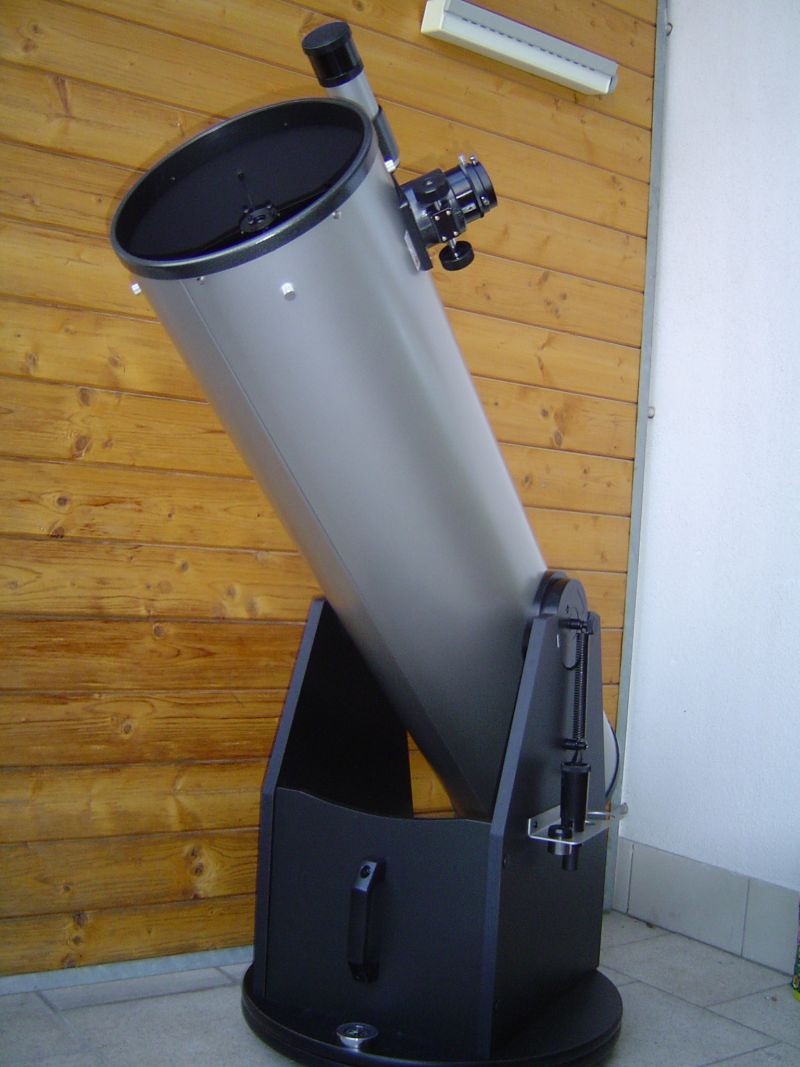
Attribution: Wikimedia Commons (author not specified)
- Altitude bearings: Large semicircular bearings distribute weight for buttery motion and reduce sensitivity to balance changes. Smaller bearings can work well with thoughtful friction management and counterweights.
- Azimuth bearing: A common approach is Teflon pads riding on a laminate (often Formica) with a central pivot. Some users experiment with lazy Susan turntables; while these can reduce stiction, they sometimes feel “too loose” and can introduce backlash. A carefully tuned Teflon-on-laminate surface often offers the best push-to control.
- Materials: Bases are typically plywood or particleboard. Plywood is generally lighter and more durable; particleboard is cheaper but sensitive to moisture.
- Balance: Heavy eyepieces, finders, and accessories shift the center of gravity. Adjustable altitude bearing positions, counterweights, or spring-tension systems keep the scope balanced across different eyepiece loads.
A well-tuned base makes a huge difference in the observing experience. If your current mount feels jerky, consider upgrading bearing surfaces or adding milk-jug washers to the azimuth pivot to fine-tune friction. For more user-friendly tweaks, see common upgrades.
Mirrors, Optical Quality, and Collimation
The primary mirror is your telescope’s engine. Modern mass-produced mirrors can deliver very good performance, especially in the 6–10 inch range, with many units easily supporting high-power planetary and lunar observing under steady atmospheric seeing. Key considerations include mirror figure (how accurately the mirror’s surface matches a paraboloid), surface smoothness, and coatings (usually aluminum with a protective overcoat).
Collimation—aligning the optical elements—is essential for Newtonians, especially at fast focal ratios. Fortunately, collimation is straightforward with simple tools and practice.
- Tools: Collimation cap, Cheshire/sight tube, laser collimator (preferably well-collimated itself), and optionally an autocollimator for fine-tuning.
- Steps (high-level):
- Center the secondary mirror under the focuser (rotation and offset). This step is mostly mechanical and infrequent.
- Use the secondary’s tilt screws to aim the focuser axis at the center of the primary’s center spot.
- Adjust the primary mirror’s collimation knobs to return the reflected laser/Cheshire image to center.
- Frequency: Solid-tube scopes may hold collimation for multiple sessions. Truss scopes often need a quick touch-up each setup.
Fast mirrors (e.g., f/4.5) exhibit coma—stars toward the edge of the field appear comet-like. High-quality eyepieces minimize off-axis aberrations, and a coma corrector can restore pinpoint stars across wide fields. Coma correctors are optional for narrower AFOV eyepieces and moderate focal ratios, but they’re a popular upgrade for wide-field, fast systems. For edge performance trade-offs, revisit aperture and focal ratio choices.
Rule of thumb: Accurate collimation and thermal equilibrium often matter more than mirror pedigree. A well-cooled, well-collimated mass-market mirror can outperform a premium optic that’s still shedding heat or out of alignment.
Eyepieces, Finders, and Essential Accessories
Eyepieces complete the optical chain. A basic Dobsonian kit typically includes one or two Plössl eyepieces, which are fine starters. As you observe more, you’ll likely add a few carefully chosen oculars to span low, medium, and high power.
- Low power, wide field: 25–35 mm eyepiece for sweeping star fields and framing larger nebulae. In fast scopes, choose eyepieces designed for f/5 or faster to keep edge stars clean.
- Medium power: 12–18 mm eyepiece for many galaxies, globular clusters, and nebulae with filters.
- High power: 5–10 mm eyepiece for lunar and planetary detail, double stars, and small planetary nebulae. Your local seeing conditions will set a practical upper limit.
- Barlow lens: A 2× Barlow doubles the magnification of your eyepiece set and can preserve eye relief on shorter focal lengths.
Finders help you get on target. A unity-power red-dot finder (RDF) or reflex sight is excellent for initial pointing, while a 50 mm optical finder or a right-angle, correct-image (RACI) finder provides magnification and a star-field view aligned with charts. Many observers use both: RDF to get close, RACI to nail the exact star hop. If you enjoy navigating manually, combine this with the techniques in star-hopping tips.
Filters are powerful for nebulae. Narrowband UHC and O III filters can dramatically improve contrast on emission nebulae by passing specific wavelengths while blocking much of the background skyglow. A neutral density or variable polarizer can improve lunar comfort. For solar observing, always use a certified, full-aperture solar filter that covers the front of the telescope—never observe the Sun without appropriate front-mounted filtration.
Other helpful accessories:
- Dew control (dew shield for the secondary, heaters for the finder), especially in humid climates.
- Cooling fan behind the primary mirror to speed thermal equilibration.
- Observing chair with adjustable height—comfort translates to better seeing of fine detail.
- Digital setting circles or encoder kits if you prefer push-to assistance without full GoTo.
- Coma corrector for fast scopes and wide-field eyepieces.
Portability, Setup, and Storage Considerations
A telescope you can easily deploy gets used more. Consider how you’ll move, store, and set up your Dobsonian before you buy.
- Weight and bulk: An 8-inch solid-tube Dob typically splits into a tube (~20–25 lb/9–11 kg) and base (~20–30 lb/9–14 kg). Truss designs reduce bulk but add setup steps.
- Transport: Will it fit in your car? Measure trunk openings and rear-seat dimensions. For truss scopes, factor in space for poles, upper cage, and base.
- Setup time: Solid tubes are fast—carry out, collimate if needed, observe. Trusses require assembly, collimation, and possibly shrouds and light baffles.
- Storage environment: Avoid damp basements or unventilated sheds. Dry, temperature-stable storage prolongs coatings and keeps bearings smooth.
- Cooling: Mirrored telescopes perform best when the mirror temperature matches ambient air. Running a small fan for 15–30 minutes (or more for thick mirrors and large apertures) reduces thermal plumes that soften images.
If you’re unsure how much setup you’ll tolerate, err toward portability. An 8-inch that’s used often will show you more than a 14-inch that rarely leaves the garage. For realistic expectations of what each aperture delivers, see what you can see.
What You Can See: Deep-Sky, Planets, and Double Stars
Dobsonians are visual powerhouses. Under a dark sky, aperture reveals structure in galaxies, texture in nebulae, and countless stars in clusters. Even under suburban skies, bright targets and clever use of filters can produce memorable views.
Deep-Sky Objects (DSOs)
- Open clusters: Even small Dobsonians showcase dozens to hundreds of stars in classic clusters. Wide fields pair beautifully with low-power eyepieces.
- Globular clusters: 8–10 inches begin to resolve the outer halos into individual stars under good seeing, with 12–16 inches revealing more granular cores.
- Nebulae: Emission nebulae respond well to UHC and O III filters. Planetary nebulae can pop at medium/high power.
- Galaxies: Aperture and dark skies are both vital. Larger Dobs reveal spiral structure, dust lanes, and satellite companions in popular galaxies when conditions cooperate.
Planets and the Moon
- Lunar detail: Craters, rilles, domes, and wrinkle ridges sharpen with steady seeing. Moderate to high magnifications are rewarding.
- Jupiter and Saturn: Cloud belts, the Great Red Spot, and Saturn’s rings with Cassini Division are attainable in modest apertures when collimation and cooling are optimal.
- Mars: During good oppositions, albedo features and polar caps become visible. Fast optics and precise collimation help at high power.
Double Stars
Dobsonians separate many doubles beautifully. Resolution depends on aperture and seeing. Slow, smooth tracking motions from a well-tuned base make the delicate nudge-and-hold routine enjoyable. For tips that boost success on tight pairs, see observing techniques.
Budget Tiers and Value Shopping Tips
One of the Dobsonian’s signature advantages is performance per dollar. Here’s how the landscape typically breaks down:
- Entry-level (tabletop or 6-inch solid tube): Affordable, quick to set up, and capable on bright DSOs and planets. Ideal for small spaces and first-time buyers.
- Mid-tier (8–10 inch solid tube): The best all-around balance of portability, cost, and capability. A common “first serious telescope” for many observers.
- Large aperture (12–16 inch and up, often truss): Transformative at dark sites. Larger mirrors demand more careful collimation, cooling, and transport planning.
Buying tips:
- Prioritize optics and mount smoothness over extra accessories. A sharp, well-figured mirror and stable base are foundational.
- Check ergonomics: Can you reach the focuser comfortably at typical observing altitudes? An adjustable chair can solve many issues, but extreme eyepiece heights can become cumbersome in very large apertures.
- Consider used markets: Dobsonians are durable. A well-maintained used scope can be excellent value. Inspect mirrors (no significant coating failure), base condition, and collimation hardware.
- Plan your eyepiece set carefully: A few good eyepieces matched to your focal ratio are more effective than a drawer of mismatched optics.
- Think long-term: If you anticipate dark-sky trips, a collapsible or truss design can future-proof your setup without committing to a giant solid tube today.
Maintenance, Cleaning, and Common Upgrades
Dobsonians are mechanically straightforward and easy to maintain. Keep mirrors clean enough (not spotless), bearings smooth, and collimation true.
Mirror Cleaning
Only clean when necessary—light dust usually doesn’t matter. When it’s time:
- Remove the primary mirror cell following the manufacturer’s instructions.
- Rinse with clean water to float off loose dust.
- Use a basin with distilled water and a few drops of mild dish soap. With freshly washed fingertips, very gently drag across the surface to lift grime. Avoid pressure.
- Rinse thoroughly with distilled water and allow to air-dry at an angle. Blot remaining droplets with optical tissue if needed.
Avoid scrubbing and paper products. Modern aluminum coatings are tough but can be scratched. Primary mirrors need cleaning far less often than many newcomers expect.
Collimation Hardware and Focuser
Many observers upgrade to knurled primary collimation knobs for tool-free adjustments. A smooth, well-aligned focuser (Crayford or rack-and-pinion) improves precision at high power. Linear-bearing or dual-speed focusers make fine focusing easier, especially on planets and doubles.
Bearing and Motion Upgrades
- Replace worn laminate with a known low-friction surface and fresh Teflon pads.
- Add washers or adjust the center bolt tension to tune azimuth friction.
- Consider counterweight systems or sliding altitude bearings to accommodate heavy eyepieces or binoviewers.
Light Control
Adding a shroud (for truss scopes) and internal flocking opposite the focuser can reduce stray light and enhance contrast, especially in urban backyards. A simple dew/light shield around the secondary can delay dew formation and improve performance.
For more ergonomic and targeting improvements, review finders and accessories and observing techniques.
Observing Techniques and Star-Hopping Tips
Your eyes and technique are as important as your optics. With a Dobsonian, skillful navigation and visual habits pay big dividends.
Dark Adaptation and Averted Vision
- Allow 20–30 minutes in darkness for your eyes to reach maximum sensitivity.
- Use red light sparingly. Even red light can erode dark adaptation if too bright.
- Employ averted vision: look slightly to the side of a faint object to engage more sensitive rods.
Star-Hopping Basics
Combine a wide-field eyepiece with a good atlas or app. Step from bright landmarks to fainter patterns, aligning what you see in the eyepiece with the chart.
- Start with a low-power eyepiece to maximize field of view.
- Use your RDF and RACI finders together: the RDF gets you on the right bright star, the RACI reveals the star field to make the final hop.
- Practice trajectory memory: note asterisms and angles while moving from one field to the next.
Managing Seeing and Magnification
- Start at moderate power, then increase until the image softens—then back off slightly.
- On nights of poor seeing, lower power often shows more detail than pushing magnification.
- Ensure your scope is thermally stable; see cooling considerations.
Filters and Contrast
For emission nebulae, try a UHC or O III filter at low to medium power. For lunar sessions, use a neutral density or variable polarizer to reduce glare. Under light pollution, filters help—but remember that dark skies remain the ultimate contrast booster. For a target-specific strategy, revisit what you can see.
Frequently Asked Questions
Can I do astrophotography with a Dobsonian?
Dobsonians are optimized for visual observing. Unguided alt-az mounts cause field rotation during long exposures. However, you can pursue planetary imaging with high-speed cameras and short exposures, lunar mosaics, and electronically assisted astronomy (EAA) for near real-time views. Some observers add an equatorial platform under the base for tracking, which enables longer exposures than an untracked mount but still isn’t a substitute for dedicated equatorial imaging rigs. If imaging is your primary goal, consider a different mount; if visual is your focus, a Dobsonian delivers exceptional value.
Is bigger always better?
Larger apertures reveal more under dark, steady skies, but bulk and setup complexity grow quickly. Many observers find an 8–10 inch solid-tube Dobsonian to be the best compromise for frequent use. If you have ready access to dark sites and can transport a larger scope comfortably, a 12–16 inch can be transformative. Ultimately, the “best” Dobsonian is the one you enjoy using often—review portability and budget tiers before deciding.
A Practical Checklist for Comparing Dobsonians
Use this checklist when evaluating options online or in-store. Copy it into a note and fill it out for each candidate scope.
{
  "Aperture": "__ mm ( __ in )",
  "FocalLength": "__ mm",
  "FocalRatio": "f/__",
  "TubeType": "Solid | Collapsible | Truss",
  "Base": "Plywood | Particleboard | Hybrid",
  "Weight": {
    "Tube": "__ lb/kg",
    "Base": "__ lb/kg"
  },
  "Finders": "RDF | Optical | RACI",
  "EyepiecesIncluded": ["__ mm", "__ mm"],
  "Focuser": "1.25 in | 2 in | Dual-speed",
  "BearingSurfaces": "Teflon-on-laminate | Other",
  "Features": "Push-to | GoTo | Manual",
  "PowerNeeds": "None | Battery | AC",
  "CollimationTools": "Cap | Cheshire | Laser",
  "AccessoriesPlanned": ["UHC", "OIII", "Barlow", "Chair"],
  "TransportFit": "Car model / dimensions",
  "Budget": "$__",
  "Notes": "Observing goals, sites, and constraints"
}
After you’ve filled out your comparisons, revisit the sections on aperture and focal ratio, design variants, and mount mechanics to understand how each choice aligns with your priorities.
Final Thoughts on Choosing the Right Dobsonian Telescope

Artist: James Stewart 669
The Dobsonian remains an iconic, democratizing design in amateur astronomy. By prioritizing light-gathering power and user-friendly mechanics, it delivers profound views of the deep sky at prices and sizes that many observers can manage. Selecting the right model comes down to a clear-eyed assessment of how and where you observe, the targets you dream about, and how much setup you can realistically enjoy.
If you’re starting out, a well-made 8-inch f/6 solid-tube Dobsonian is a proven, versatile choice. If you travel to dark skies and want to chase faint galaxies, consider a collapsible or truss design at 10–14 inches. Whatever you choose, invest in solid fundamentals: accurate collimation, thermal control, smooth bearings, and a thoughtful eyepiece set. These elevate even a modest scope into a high-performing instrument.
As you refine your skills, keep exploring techniques in observing, tune your setup with smart upgrades, and expand your targets with the guidance in what you can see. When you’re ready for the next step, revisit this guide and your comparison checklist to chart a confident upgrade path.
If you found this guide helpful, consider subscribing to our newsletter for in-depth observing tips, equipment reviews, and seasonal target lists. Clear skies—and happy hunting with your Dobsonian telescope.