
Table of Contents
- What Is Titan, Saturn’s Largest Moon?
- Physical and Orbital Properties of Titan at a Glance
- A Thick Nitrogen Atmosphere with Methane and Haze
- The Methane Weather Cycle: Clouds, Rain, Rivers, and Seas
- Polar Lakes and Kraken Mare: Bathymetry and Chemistry
- Dunes, Mountains, and Possible Cryovolcanoes: Surface Geology
- Inside Titan: Subsurface Ocean and Interior Structure
- Life’s Possibilities in Two Very Different Oceans
- From Voyager to Huygens and Cassini: What We Learned
- Dragonfly Rotorcraft: Instruments, Science Goals, and Timeline
- How to Observe Titan from Earth: Telescopes, Tips, and Timing
- Modeling Titan at Home: Simple Simulations and Open Data
- Frequently Asked Questions
- Final Thoughts on Exploring Titan, Saturn’s Ocean World
What Is Titan, Saturn’s Largest Moon?
Titan is Saturn’s largest moon and the second-largest natural satellite in the Solar System, only slightly smaller than Jupiter’s Ganymede. With a diameter of about 5,150 km, Titan is bigger than the planet Mercury. What makes Titan uniquely compelling, however, is not just its size: it is the only moon with a dense atmosphere and the only world besides Earth known to host stable liquids on its surface. Those liquids are not water; they are hydrocarbons—chiefly methane and ethane—forming lakes, seas, and rivers sculpted by a methane-based weather cycle.

Attribution: NASA / JPL / Space Science Institute
Scientists view Titan as two worlds at once: a frigid, hydrocarbon-rich surface with an active “methane hydrological” cycle, and a warm-enough interior ocean of water mixed with ammonia beneath an icy crust. This duality makes Titan central to questions about planetary climate, surface-atmosphere interactions, and the chemical pathways that may precede biology. In this article, we explore Titan from its atmosphere and weather to its geology and interior, survey the key discoveries from past missions, preview the NASA Dragonfly rotorcraft mission, and share practical advice on how to observe Titan with backyard telescopes.
Physical and Orbital Properties of Titan at a Glance
Titan orbits Saturn at a distance of roughly 1.22 million kilometers (semi-major axis) and completes one orbit in about 15.95 days. It is tidally locked, always showing the same face to Saturn. While the numbers below are compact, each connects to broader stories we will unpack in later sections such as atmospheric chemistry, methane weather, polar seas, and the interior ocean.
- Diameter: ~5,150 km (larger than Mercury)
- Mass: ~1.35 × 10²³ kg
- Surface gravity: ~1.35 m/s2 (~0.14 g)
- Average surface temperature: ~94 K (~−179 °C)
- Surface pressure: ~1.5 bar (about 50% higher than Earth’s)
- Atmosphere: Primarily nitrogen (N2) with methane (CH4) and trace organics
- Orbital period: ~15.95 Earth days (synchronous rotation)
- Eccentricity: Small but non-zero, enabling minor tidal flexing
Although distant and cold, Titan has proven to be an analog to Earth in surprising ways. Mountains, dunes, rivers, and seas echo familiar geomorphology, yet formed from different materials at different temperatures. The analogy is close enough that planetary scientists often describe Titan’s methane-based hydrologic system using the same vocabulary they apply to Earth’s water cycle.
A Thick Nitrogen Atmosphere with Methane and Haze
Titan’s most striking feature is its dense, nitrogen-dominated atmosphere. With a surface pressure around 1.5 bar and a column of air several times thicker than Earth’s, Titan’s sky scatters sunlight into an orange haze. This haze, generated by solar ultraviolet photons and energetic particles from Saturn’s magnetosphere, drives a rich photochemistry that polymerizes simple molecules into complex organics collectively called tholins.
Composition and structure
- Major components: N2 (dominant), CH4 (a few percent near the surface), with trace hydrocarbons (e.g., C2H6, C2H2) and nitriles (e.g., HCN, HC3N).
- Vertical layering: A lower troposphere where weather occurs, a stratosphere with strong photochemistry and aerosols, and a thermosphere/ionosphere where charged particle reactions forge large ions and aerosol precursors.
- Detached haze layers: Observed by Cassini as stratified layers hundreds of kilometers above the surface, variable with seasons.
Origins of nitrogen and methane
Isotopic evidence suggests Titan’s nitrogen likely originated from ammonia (NH3) that was dissociated and converted to N2 early in Titan’s history. Methane, continually destroyed by sunlight, must be resupplied. Potential reservoirs include outgassing from clathrate hydrates, cryovolcanic release, or slow diffusion from Titan’s interior. This replenishment problem is a key thread connecting geology with climate.
Winds, superrotation, and seasonal change
Titan’s winds are gentle near the surface but accelerate aloft, forming a superrotating atmosphere where high-altitude winds circle the globe faster than Titan rotates. Seasons unfold over Saturn’s 29.5-year orbit. Clouds migrate from one hemisphere to the other around equinoxes, and the polar regions—home to the major seas—experience long winters and summers that modulate evaporation, rain, and lake levels (see Polar Lakes and Kraken Mare).
The Methane Weather Cycle: Clouds, Rain, Rivers, and Seas
On Titan, methane fills the role of water on Earth. It evaporates, condenses into clouds, falls as rain, and flows to form rivers and lakes. Ethane—produced when methane is broken down and recombines—also accumulates as a more stable, less volatile component of surface liquids. Together, they power a hydrocarbon hydrological cycle.
Clouds and storms
- Convective methane clouds form in unstable atmospheric conditions, often tied to seasonal shifts.
- Large storm systems can span hundreds of kilometers, occasionally producing intense, localized rainfall.
- Detections of transient cloud outbursts and surface darkening events after storms point to rain-wetted terrain and flowing channels.
Rivers, channels, and deltas
Radar and near-infrared imaging have revealed dendritic river networks, braided channels, and delta-like deposits. Many channels feed the northern seas. The geomorphology is strikingly Earth-like despite the drastically different composition and temperature. Channel-incised terrain connects weather patterns in the atmosphere to surface processes such as lake filling, shoreline migration, and sediment transport.
Seasons drive the cycle
Titan’s long seasons load the polar regions with liquids. The north currently hosts the largest seas; the south has fewer lakes, with Ontario Lacus as a prominent example. Over decades, insolation changes and atmospheric circulation shift evaporation and precipitation patterns pole-to-pole, gradually redistributing hydrocarbons. Dragonfly’s measurements (see Dragonfly Rotorcraft) will help constrain these dynamics by sampling organic-rich surface materials and weather conditions across multiple sites.
Polar Lakes and Kraken Mare: Bathymetry and Chemistry
The jewels of Titan’s surface are its polar basins: scattered lakes and three enormous seas (maria) concentrated at high northern latitudes. The largest, Kraken Mare, is vast—comparable in area to terrestrial seas—while Ligeia Mare and Punga Mare are also extensive bodies of liquid. In the south, Ontario Lacus stands out as the most notable lake.

Attribution: NASA / JPL-Caltech / Agenzia Spaziale Italiana / USGS
How deep are Titan’s seas?
- Radar altimetry and signal attenuation measurements from Cassini indicate that Ligeia Mare reaches depths of hundreds of meters in places.
- Kraken Mare appears even deeper and more complex, with basins separated by sills and islands; parts of Kraken could be several hundred meters deep.
- Some lakebeds show evidence of evaporite-like deposits—residues left behind when liquid retreats—mapping the history of wet and dry cycles.
What are they made of?
Observations point to a mix dominated by methane (CH4), ethane (C2H6), and dissolved nitrogen (N2). Composition varies by basin and season. Ligeia Mare appears relatively methane-rich, while Kraken Mare likely contains more ethane—consistent with ethane’s higher stability against atmospheric destruction. Understanding composition is key to modeling evaporation and precipitation, the buoyancy of floating materials, and potential hazards or opportunities for future in situ vehicles.
Waves, tides, and “magic islands”
- Wave activity is generally low; Titan’s dense air and low gravity support wave formation, but winds are usually weak.
- Tidal forces from Saturn cause measurable changes in sea levels and currents.
- Transient radar-bright features—nicknamed “magic islands”—have appeared and vanished in Ligeia Mare, possibly due to waves, floating solids, bubbles, or changing surface roughness. Their recurrence highlights Titan’s dynamic surface-atmosphere coupling.

Attribution: NASA / Jet Propulsion Laboratory-Caltech / Agenzia Spaziale Italiana
Seas and lakes also serve as sensitive gauges of climate. By tracking shoreline position, surface roughness, and composition over time, researchers can infer variations in methane humidity, precipitation, and seasonal winds. These observations tie directly into the atmospheric circulation patterns discussed in A Thick Nitrogen Atmosphere.
Dunes, Mountains, and Possible Cryovolcanoes: Surface Geology
Beyond the polar seas lies a world of dunes, mountains, and enigmatic terrains. The equatorial belt is dominated by expansive longitudinal dune fields—dark, radar-smooth stripes recognizable across thousands of kilometers. These dunes run parallel to prevailing near-surface winds and are composed of organic-rich “sand” grains that likely form from the agglomeration and processing of atmospheric aerosols.
Dunes and winds
- Equatorial dunes can reach tens to hundreds of meters in height and hundreds of kilometers in length.
- Grain composition is thought to be complex organics (tholins) and possibly water-ice cores coated with organics.
- Their orientation encodes wind history, influenced by seasonal storms and atmospheric tides linked to Saturn. Matching dune orientation with circulation models helps refine the climate story in The Methane Weather Cycle.
Mountains, plateaus, and labyrinth terrains
Titan’s mountains are generally modest, often around a kilometer high or less, carved into water-ice bedrock that behaves like rock at Titan temperatures. Bright plateau regions such as Xanadu contrast with darker, dune-rich plains. Labyrinth terrains—tightly spaced, dissected ridges—may result from dissolution, erosion, or tectonic processes acting on organic-rich deposits.
Possible cryovolcanism
Several features (for example, the Sotra Patera/Doom Mons complex) have been interpreted as potential cryovolcanoes—sites where water-ammonia slurries or other volatiles may have erupted onto the surface. Conclusive proof remains elusive, but any cryovolcanism would have implications for methane replenishment and the exchange of materials between the interior ocean and surface.
Inside Titan: Subsurface Ocean and Interior Structure
Gravity data, rotational dynamics, and geomorphology converge on a compelling picture: Titan likely harbors a global, subsurface ocean. This ocean sits beneath an outer ice shell and above layers of high-pressure ices toward the deep interior. The ocean’s salinity and depth are constrained by Cassini-era measurements of Titan’s gravity field, rotation, and tidal response.
Layered interior
- Outer shell: Water-ice crust, tens of kilometers thick, overlies the ocean. Evidence such as surface librations suggests the shell is mechanically decoupled from the interior by this liquid layer.
- Subsurface ocean: Likely water mixed with ammonia or salts, reducing the freezing point and altering density.
- High-pressure ice phases: Beneath the ocean, water likely forms denser crystalline structures (e.g., ice V, VI) under Titan’s internal pressures.
- Core: A rocky core provides radiogenic heat that, together with tidal effects, helps maintain the ocean over geologic timescales.
Why a subsurface ocean matters
An ocean decouples the crust from the interior, enabling stress patterns, potential cryovolcanism, and perhaps episodic exchange of materials. For astrobiology, a water-based ocean offers the familiar solvent that life uses on Earth. Combined with Titan’s surface organics, this could create interfaces where prebiotic chemistry is stimulated—topics we explore in Life’s Possibilities.
Life’s Possibilities in Two Very Different Oceans
Titan presents two very different potential habitats: a surface environment with liquid hydrocarbons and a subsurface ocean of water-ammonia. Each environment suggests distinct chemistry and speculation about habitability.
Surface liquids as exotic solvents
- The idea: In cryogenic methane-ethane seas, could cell-like structures form from organic molecules? Laboratory modeling suggests some nitrogen-bearing molecules (e.g., acrylonitrile) could form membrane-like assemblies in liquid methane.
- Challenges: Metabolism and biochemistry would be fundamentally different in hydrocarbon solvents. Reaction rates are slower in the cold, and available energy gradients may be limited.
The interior ocean as a familiar solvent
- A subsurface water ocean offers a more Earth-analog environment for prebiotic chemistry.
- Potential energy sources include water-rock interactions (e.g., serpentinization) and radiogenic heat.
- If exchange occurs between the ocean and surface, complex organic material from the atmosphere could be delivered downward, adding feedstock for chemistry.
Importantly, there is no confirmed evidence of life on or within Titan. Observations such as apparent deficits of certain gases near the surface have sparked interest, but they do not constitute proof of biology. Missions like Dragonfly will instead search for chemical context: how far Titan’s chemistry has advanced along pathways that precede life as we know it—or life as we don’t yet know it.
From Voyager to Huygens and Cassini: What We Learned
Modern exploration of Titan spans flybys, orbiters, and a daring descent to the surface. Each mission has transformed Titan from a hazy enigma into a world with mapped seas, rivers, dunes, and complex atmospheric chemistry.
Voyager era: Discovery and first close looks
- Voyager 1 (1980) revealed Titan’s thick atmosphere and featureless orange shroud in visible wavelengths, redirecting its trajectory to prioritize Titan science.
- Voyager 2 (1981) provided additional context but did not fly by Titan as closely as Voyager 1.
Cassini-Huygens: A revolution in Titan science
The joint NASA/ESA/ASI Cassini-Huygens mission (2004–2017) changed everything:
- Huygens probe landing (January 14, 2005): After a parachute descent through the atmosphere, Huygens landed on a surface that appeared damp and strewn with rounded, ice “pebbles.” It measured winds, temperatures, methane humidity, and imaged valleys and channels from aloft. The probe operated on the surface for over an hour.
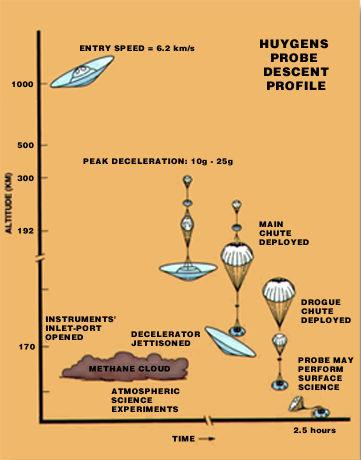
This picture illustrates the Huygens probe descent profile, beginning with the initial encounter with the Titan atmosphere and subsequent deceleration. As the probe slows, a small parachute is released which deploys the main probe parachute. Once the parachute is fully open the decelerator shield is jettisoned and the probe drifts toward Titan’s surface. About 40 km above the surface the main parachute is jettisoned and a smaller drogue chute carries the probe the remaining distance. Science data are continuously being transmitted by the probe to the orbiter during the probe’s 2.5-hour descent to the surface, for later relay to Earth. If the probe survives its impact of about 15 mph, a small science package may transmit up to 30 minutes of post-impact science data to the orbiter.
Attribution: NASA - Cassini orbiter: Conducted more than a hundred Titan flybys, mapping the surface with radar, near-infrared, and radio techniques. It characterized lakes and seas, discovered dunes and potential cryovolcanic features, and probed atmospheric composition from the lower atmosphere to the ionosphere.
- Seas confirmed: Radar imaging and specular reflections (“sunglint”) proved the presence of stable liquids on the surface at high latitudes.
- Dynamic atmosphere: Seasonal cloud shifts, storms, and variable haze layers were tracked over 13 years, catching Titan through almost half a Saturnian year.
“Huygens revealed a shore world of ice and organic sand, and Cassini showed it has lakes and seas. Titan is the most Earth-like place we have found—just colder, darker, and made of different stuff.”
What we still don’t know
- How exactly methane is replenished over geologic timescales.
- The detailed composition of dunes and the precise mechanisms forming organic sand.
- Whether cryovolcanism is active today.
- The salinity, stratification, and circulation of Titan’s seas.
- The chemistry at work in surface materials and how far along prebiotic pathways it has progressed.
These open questions set the stage for the next decade of Titan exploration, culminating in NASA’s Dragonfly rotorcraft mission and complementary observations from Earth and space-based telescopes.
Dragonfly Rotorcraft: Instruments, Science Goals, and Timeline
Dragonfly is a NASA mission designed to fly a nuclear-powered, dual-quadcopter rotorcraft to Titan’s surface. The mission will take advantage of Titan’s dense air and low gravity to fly from site to site, sampling a variety of terrains and conducting in situ analyses. Dragonfly’s mobility is a game-changer: instead of a single landing site, the craft can explore multiple locations, following the science where it leads.

Attribution: Steve Gribben/NASA/Johns Hopkins APL
Mission concept and mobility
- Dual-quadcopter configuration with eight rotors for redundancy and control.
- Powered by a Multi-Mission Radioisotope Thermoelectric Generator (MMRTG), enabling operation over many Titan days (each “day,” or Titan solar day, is about 16 Earth days).
- Flight operations planned in short hops under favorable wind and lighting, with most analysis performed while safely on the ground.
Science payload (high-level)

Attribution: NASA/JHUAPL/AGU
- Mass spectrometry to analyze organic molecules and isotopic ratios.
- Gamma-ray and neutron spectroscopy to probe elemental composition of the surface.
- Meteorological sensors to monitor temperature, pressure, winds, and methane humidity.
- Seismometer to search for quakes and constrain the interior structure.
- Imaging systems (including at near-infrared wavelengths) to characterize geology, map terrains, and scout flight paths.
Primary science questions
- How complex are Titan’s surface organics, and through what pathways did they form?
- What processes create dunes and other landforms in a hydrocarbon world?
- Is there evidence of cryovolcanism or exchange with the interior ocean?
- How do weather and climate vary by region and season?
Timeline and targets
- Launch is planned for the late 2020s (NASA has targeted 2028).
- Arrival at Titan is expected in the mid-2030s (around 2034), with operations spanning multiple Earth years.
- Initial landing region: the Shangri-La dunes near the bright, possibly ancient terrain called Selk crater—a site of interest for impact-generated chemistry and varied surface materials.
Dragonfly will directly address unknowns highlighted in From Voyager to Huygens and Cassini, tying together atmospheric photochemistry, surface processes, and potential prebiotic chemistry into a coherent picture.
How to Observe Titan from Earth: Telescopes, Tips, and Timing
Despite its distance, Titan is within reach of small telescopes. Its orange hue and orbital motion around Saturn make it a rewarding target for observers and imagers alike.
Visibility and brightness
- Titan’s apparent magnitude typically ranges around +8 to +9, varying with Saturn’s distance and illumination.
- Maximum angular separation from Saturn is about a few arcminutes (on the order of ~3′), making Titan easier to pick out from Saturn’s glare than inner moons like Enceladus.
- Titan completes one orbit around Saturn every 16 Earth days, so its position relative to the planet changes noticeably night-to-night.
What equipment do you need?
- Binoculars (50–70 mm): In exceptional conditions and with astronomical experience, you might glimpse Titan as a faint point near Saturn, but binoculars are generally challenging for this target.
- Small refractor (60–90 mm): Titan appears as a distinct starlike point; tracking its motion over several nights is a fun project.
- Medium telescope (130–200 mm): Titan is easy to spot, and its slight orange tint becomes more evident. With high magnification and steady seeing, the color is more apparent.
- Larger apertures (250 mm+): Enhanced color perception and better separation from Saturn’s glare, plus the chance to capture Titan in planetary imaging sessions.
Observing tips
- Target Saturn near opposition (when it is opposite the Sun in the sky), maximizing brightness and apparent size.
- Use star charts or mobile apps that show Saturn’s moon positions; Titan’s orbit is large and easy to follow.
- Try a modestly high magnification and a neutral-density or variable polarizing filter if Saturn’s glare overwhelms Titan.
- Note Titan’s changing position relative to Saturn over successive nights—a great introduction to orbital mechanics.
For imagers, stacking short video captures of Saturn can reveal Titan and sometimes other moons. While you won’t resolve Titan’s disk in backyard gear, you will join the centuries-long tradition of tracking planetary satellites, connecting directly to the exploration narratives described in mission history.
Modeling Titan at Home: Simple Simulations and Open Data
If you enjoy coding or data analysis, Titan offers a natural gateway to planetary science. You can model basic aspects of Titan’s orbit and visibility, analyze real mission datasets, or simulate simple climate elements using publicly available information.
Sample calculation: Titan’s maximum separation from Saturn
Roughly estimate Titan’s maximum angular separation as seen from Earth using simple geometry. If Saturn is D kilometers away and Titan’s orbital radius is a around 1.22 million kilometers, the small-angle approximation gives separation in radians as a/D. Converting to arcminutes provides a ballpark figure.
# Simple Python snippet to estimate Titan's maximum angular separation
# Inputs: a = Titan's orbital radius around Saturn (km)
#         D = Earth-Saturn distance (km)
# Output: separation in arcminutes (approx)

a = 1.22e6           # km, Titan semi-major axis around Saturn
D = 1.35e9           # km, example Earth-Saturn distance (~9 AU)
sep_rad = a / D      # small-angle approximation
sep_arcmin = sep_rad * 206265 / 60
print(f"Max separation ≈ {sep_arcmin:.1f} arcmin")
Try adjusting D to match Saturn’s current distance (your planetarium software will provide it). You’ll find results of a few arcminutes, consistent with the observational advice in How to Observe Titan.
Open data resources
- NASA Planetary Data System (PDS): Cassini-Huygens datasets, including radar, imaging, and spectrometry, for professional-grade analysis.
- JPL Horizons: Precise ephemerides to compute Titan’s position relative to Saturn and Earth.
- Amateur tools: Virtual Moon Atlas (for Moon), Stellarium, and smartphone apps can visualize Saturn’s satellites; though not all include Titan’s surface features, they are excellent for planning observations.
Frequently Asked Questions
Is Titan bigger than Mercury, and could it be a planet if it orbited the Sun?
Yes, Titan is larger in diameter than Mercury but less massive. If Titan orbited the Sun independently, its size and characteristics would likely qualify it as a dwarf-planet-scale body by informal comparison, but “planet” is a term defined by the International Astronomical Union (IAU) with specific orbital criteria. Titan is classified as a moon because it orbits Saturn.
Will Dragonfly look for life on Titan?
Dragonfly is not a “life detection” mission in the definitive sense. Instead, it seeks to analyze organic chemistry, environmental conditions, and geologic context to assess habitability and the extent of prebiotic chemical processes. By surveying multiple sites, measuring molecular complexity, and characterizing weather and surface properties, Dragonfly will clarify how far Titan’s chemistry has advanced—and where future life-detection efforts should focus.
Final Thoughts on Exploring Titan, Saturn’s Ocean World
Titan stands apart in the Solar System. It is a world with a sky thicker than Earth’s and a landscape patterned by rivers, dunes, and seas—yet cast in organics and methane rather than rock and water. Cassini-Huygens transformed Titan from a mysterious orange dot into a richly characterized planetary system in its own right, complete with an active atmosphere, evolving lakeshores, and a likely global ocean beneath the ice. Still, crucial questions remain: How is methane resupplied? Are cryovolcanoes active? What is the detailed composition and history of the dunes? How complex are Titan’s organic molecules, and do they approach the threshold of prebiotic chemistry?
NASA’s Dragonfly mission will bring us closer to answers by flying across diverse terrains and sampling their chemistry directly. In the meantime, observers can watch Titan pace around Saturn in a backyard telescope, connecting personal skywatching to a grand arc of exploration. If you found this deep dive useful, consider subscribing to our newsletter for future articles on planetary science and upcoming missions—and explore related topics on atmospheres, ocean worlds, and solar system weather right here on our site.