
Table of Contents
- What Is the Orion Constellation and Why It Matters?
- How to Find Orion in the Night Sky
- Key Stars of Orion: Betelgeuse, Rigel, and Beyond
- Deep-Sky Wonders: Orion Nebula, Horsehead, and More
- Inside the Orion Molecular Cloud Complex
- Observing Orion: Telescopes, Binoculars, and Naked-Eye Tips
- Astrophotography Tips for Capturing Orion’s Nebulae
- The Orionid Meteor Shower and Halley’s Comet Connection
- Cultural History and Myth Across Civilizations
- Current Science: Betelgeuse’s Dimming and Supernova Prospects
- Frequently Asked Questions
- Final Thoughts on Exploring the Orion Constellation
What Is the Orion Constellation and Why It Matters?
Orion is one of the most recognizable constellations in the night sky, straddling the celestial equator and visible from nearly every inhabited latitude on Earth. Its striking pattern of bright stars—highlighted by the three-star Belt—makes it a natural starting point for learning the sky. Beyond its visual appeal, Orion is a rich laboratory for modern astrophysics, home to active star formation, massive luminous stars, and iconic nebulae that reveal the life cycle of stars.

Situated on the celestial equator, Orion rises in the east during northern autumn, culminates on winter evenings, and sets in spring. In the Southern Hemisphere, it graces summer evenings. The constellation spans a large swath of sky—hundreds of square degrees—anchored roughly around right ascension ~5h and declination near the celestial equator (~0°). This near-equatorial placement ensures Orion is well placed for observers worldwide.
For astronomers, both amateur and professional, Orion offers multiple layers of discovery:
- A naked-eye pattern to learn celestial navigation and seasonal sky changes.
- Bright stars of varied types, from the cool red supergiant Betelgeuse to the blue supergiant Rigel.
- An entire star-forming complex, including the Orion Nebula (M42), that reveals how interstellar clouds collapse into newborn stars and planets.
- Dark nebulae and glowing emission regions that trace stellar winds, ultraviolet radiation, and shock fronts.
If you are new to stargazing, Orion is an ideal gateway. It helps you find neighboring constellations and bright stars across the sky. For a stargazing plan that prioritizes comfort and sky quality, see the observing guide. To dive into the massive star nursery tucked into Orion’s Sword, head to the section on deep-sky wonders and the Orion Molecular Cloud Complex.
How to Find Orion in the Night Sky
Because Orion sits on the celestial equator, it is visible from both hemispheres in their respective warm or cool seasons. Northern observers typically see Orion high in the south on winter evenings (December–February), while southern observers enjoy it on summer evenings.
Step-by-step star-hopping
- Locate the “Three Kings” or “Three Marys”—the three nearly equidistant stars aligned in a short diagonal. These are Alnitak, Alnilam, and Mintaka, known collectively as Orion’s Belt.
- Above the Belt (toward the north for northern observers; toward the zenith for many southern observers) sits reddish Betelgeuse, marking Orion’s shoulder.
- Below the Belt lies brilliant blue-white Rigel, Orion’s foot.
- Drop down from Alnitak (the leftmost Belt star as seen from mid-northern latitudes) to find Orion’s “Sword.” In small binoculars, the middle “star” of the Sword becomes a glowing patch: the Orion Nebula.
Use Orion to find other bright targets
- Extend a line through the Belt down and left (south-eastward for many northern observers) to reach Sirius in Canis Major, the brightest star in the night sky.
- Extend the Belt in the opposite direction to the reddish eye of Aldebaran in Taurus and onward to the Pleiades (M45).
- Draw a line from Betelgeuse to Bellatrix to frame Orion’s shoulders; extend outward to trace the Winter Hexagon asterism, a seasonal hallmark.

Timing matters: Orion becomes visible in the east after dusk in late autumn (Northern Hemisphere) and culminates around local midnight. By mid-winter, it stands high and due south a few hours after sunset. For the best contrast, consult the observing section for tips on dark adaptation and moon phases.
Key Stars of Orion: Betelgeuse, Rigel, and Beyond
Orion’s brightest stars are astrophysical landmarks. They span a range of spectral types, evolutionary states, and distances—together illustrating the diversity of stellar life cycles. Here are the standout members you can identify easily and learn from.
Betelgeuse (Alpha Orionis)
Betelgeuse is a red supergiant, a massive star nearing the end of its life. It shines with a ruddy hue and is among the largest visible stars in the sky when measured by physical diameter. Distance estimates place it on the order of several hundred light-years away, often cited around the mid-hundreds. As a cool, extended star with a convective envelope, Betelgeuse shows irregular variability: its brightness waxes and wanes on timescales of months to years as its surface evolves and it sheds material into space.
In late 2019 and early 2020, Betelgeuse dimmed dramatically, an event widely observed and studied. The prevailing explanation combines a temporary surface cooling and the creation of dust from ejected material along our line of sight. For a detailed discussion and what this means for its long-term fate, see Current Science: Betelgeuse’s Dimming.
Rigel (Beta Orionis)
Rigel is a blue supergiant, luminous and hot, with a spectral type in the late-B range. It often rivals Betelgeuse in brightness and marks Orion’s western foot. Rigel’s intense radiation illuminates surrounding dust and gas, creating reflection nebulae that photographers capture in long exposures. Physically, Rigel is far more luminous than the Sun, even though its apparent brightness is comparable to Betelgeuse because it lies at a significantly greater distance.
Bellatrix (Gamma Orionis)
Bellatrix, Orion’s right shoulder, is a bright, blue-white giant. Historically known as the “Amazon Star,” it provides a contrasting spectral type and evolutionary stage compared to Betelgeuse. While it appears near in the sky, its actual distance differs from other Orion stars because the constellation is a projection: the stars are not physically clustered, except for members of Orion’s genuine stellar associations near the Belt and Sword.
Saiph (Kappa Orionis)
Marking Orion’s eastern foot opposite Rigel, Saiph is a luminous blue supergiant. Despite its luminosity, Saiph appears slightly fainter due to distance and interstellar extinction. It helps define the large quadrilateral that frames Orion’s body.
Orion’s Belt: Alnitak, Alnilam, and Mintaka
The Belt stars are massive, hot, and distant. They belong to the Orion OB associations, groups of young, high-mass O- and B-type stars formed from the same giant molecular cloud complex. While each Belt star sits at a different distance, collectively they trace a region of intense star formation in the Orion arm of our Galaxy.
- Alnitak is associated with bright emission and reflection nebulae, including the Flame Nebula (NGC 2024). It is a multi-star system with strong ultraviolet output.
- Alnilam sits near the middle of the Belt and is extremely luminous. Its intense radiation helps ionize nearby interstellar gas, making the area around it photogenic in long exposures.
- Mintaka, on the Belt’s western end, is a multiple-star system easily split with large amateur telescopes under good seeing.
Several fainter, scientifically important systems also reside here. The Trapezium in the heart of the Orion Nebula (see Deep-Sky Wonders) is a compact multiple-star system that has become a benchmark for studying young, massive stars and the influence of ultraviolet radiation on surrounding gas and dust.
Deep-Sky Wonders: Orion Nebula, Horsehead, and More
Orion’s deep-sky objects are among the most observed and photographed targets in astronomy. They span a variety of types—emission nebulae, reflection nebulae, dark nebulae—and collectively offer a vivid, three-dimensional portrait of a star-forming environment.
The Orion Nebula (Messier 42 and Messier 43)
The Orion Nebula (M42) is a bright emission nebula located in Orion’s Sword, just south of the Belt. Visible to the naked eye as a fuzzy patch under dark skies, it transforms into a structured glow in binoculars and telescopes. M42 is part of a larger region of ionized hydrogen (H II region) energized by young, massive stars in the Trapezium Cluster. The nebula’s distance is often placed at roughly 1,300 to 1,400 light-years, making it one of the nearest massive star-forming regions to Earth.

Adjacent to M42 is M43 (de Mairan’s Nebula), separated by a dust lane. M43 is physically part of the same complex and contributes to the intricate layering of bright and dark features that observers can explore with moderate magnification.
The Running Man Nebula (NGC 1977, NGC 1975, NGC 1973)
Just north of M42 lies a trio of reflection nebulae collectively nicknamed the Running Man. In small scopes, you are more likely to see the star field; in larger scopes or in long-exposure images, the complex reveals blue reflection nebulosity and dark lanes carved into it. This region demonstrates how dust grains scatter starlight, preferentially reflecting blue light and giving reflection nebulae their characteristic hue.
The Horsehead Nebula (Barnard 33) and IC 434
The Horsehead Nebula is a dark nebula silhouetted against the bright emission curtain IC 434, located just south of Alnitak in Orion’s Belt. The horsehead silhouette—a dense clump of interstellar dust and gas—appears in long exposures and in larger telescopes under dark skies with a hydrogen-beta filter. While challenging visually, it is one of the most famous shapes in astrophotography. The glowing background emission arises from ionized hydrogen energized by nearby hot stars.
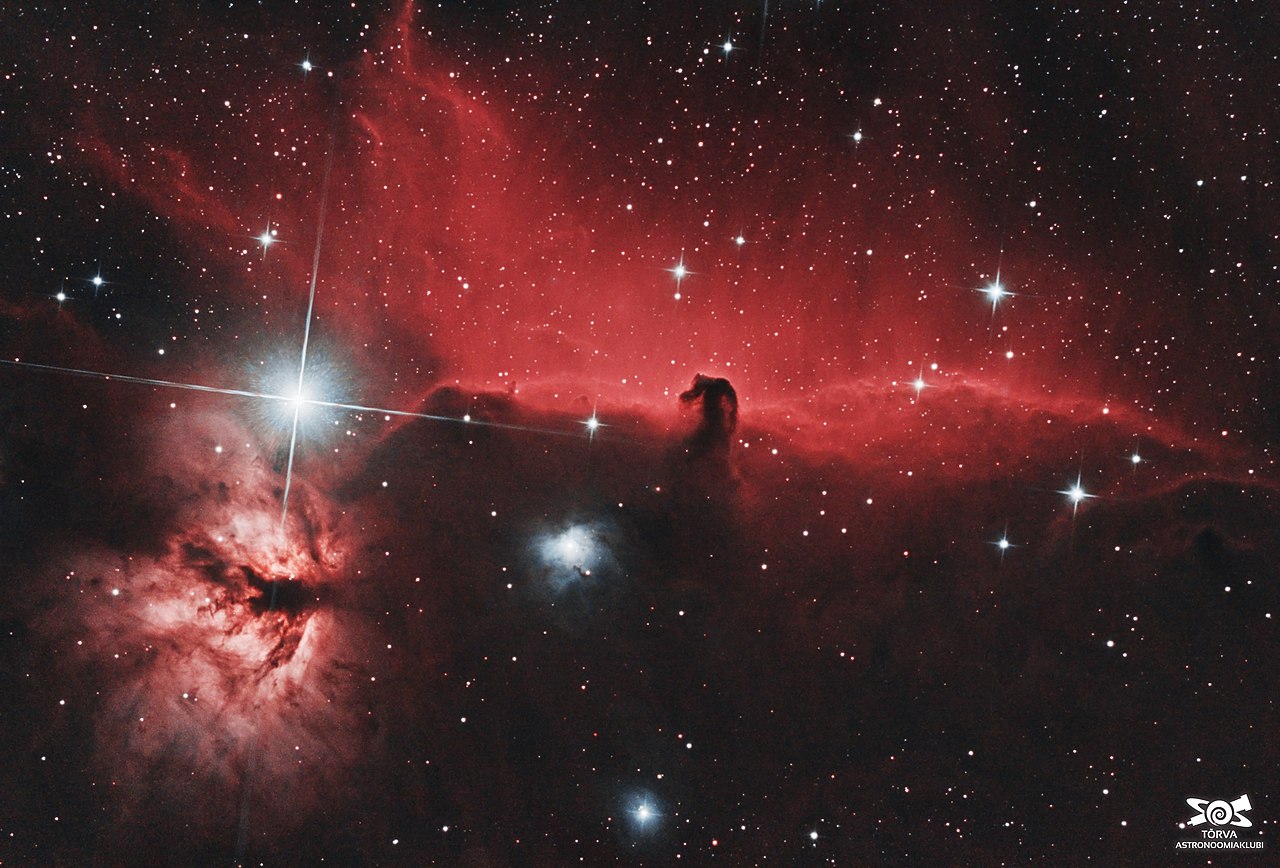
The Flame Nebula (NGC 2024)
Close to Alnitak, the Flame Nebula is an emission and reflection complex with dark dust lanes slicing through a luminous, flame-like glow. In visual observing, you will likely note a mottled veil near Alnitak; in images, the web of dust becomes dramatic. The nebula’s brilliance is powered by ultraviolet radiation from nearby O- and B-type stars.
Barnard’s Loop and the Orion-Eridanus Superbubble
Spanning tens of degrees across the sky, Barnard’s Loop is a faint, large arc of emission that partially encircles Orion’s major stars. It is likely part of the larger Orion-Eridanus superbubble, a vast cavity in the interstellar medium created by past episodes of stellar winds and supernova explosions from massive stars born in the Orion complex. Under very dark skies and with wide-field imaging or specialized filters, Barnard’s Loop becomes a sweeping, ethereal curve that gives context to the energetic history of this region.
These deep-sky targets illustrate the interplay of star birth and death: ultraviolet radiation, stellar winds, and supernova shock waves sculpt the gas and dust into filaments, globules, and cavities. For practical advice on seeing and imaging them, consult the observing guide and the astrophotography tips.
Inside the Orion Molecular Cloud Complex
Behind Orion’s bright stars lies one of the best-studied stellar nurseries in the Milky Way: the Orion Molecular Cloud Complex (OMC). This collection of cold, dense gas and dust stretches across much of the constellation, hosting clusters of young stars, protoplanetary disks, and jets that mark ongoing formation processes.

Structure and subregions
- OMC-1: The region immediately behind the Orion Nebula, rich in molecular gas and a hotbed of star formation. Here, astronomers study “proplyds” (protoplanetary disks) and the effects of intense ultraviolet radiation from massive stars on nearby infant solar systems.
- OMC-2/3: Dense filaments north of the Trapezium region, home to cold cores and deeply embedded protostars. Radio and submillimeter observations trace molecules like CO that reveal the dynamics of collapse and outflows.
- Lynds 1641 (L1641): A southern extension with more distributed star formation, containing numerous young stellar objects and reflection nebulae.
Star formation physics on display
The OMC allows astronomers to test star formation theories with a nearby sample. Key processes include:
- Gravitational collapse within dense cores, often triggered or influenced by nearby massive stars and their winds.
- Feedback from radiation and winds that both compress gas to form new stars and disperse clouds, halting further collapse in some regions.
- Protoplanetary disks that survive in harsh radiation fields, providing clues to how planetary systems may assemble near massive stars.
- Herbig–Haro objects and collimated jets that trace episodic accretion onto young protostars, visible as shocked knots when jets impact surrounding gas.
Because the OMC is relatively close in cosmic terms and spans a broad range of environments—from dense cores to exposed nebulae—it serves as a comprehensive case study for understanding how stars like the Sun, and also massive short-lived stars, come into being. Observational techniques across the spectrum—radio, submillimeter, infrared, optical—paint a layered picture that reveals different stages of the star formation timeline.
Observing Orion: Telescopes, Binoculars, and Naked-Eye Tips
Whether you have no equipment at all or a fully equipped backyard observatory, Orion rewards careful, patient observing. Here’s a practical guide to maximize what you see.
Naked-eye and binocular views
- Naked eye: Identify the Belt, Betelgeuse, and Rigel. Under dark skies, scan the Sword; you may glimpse the glowing patch of M42. Use Orion to navigate to Sirius, Aldebaran, and the Pleiades.
- Binoculars (7×50 to 10×50): Binoculars frame Orion’s Sword perfectly. Look for the nebulosity around M42 and M43 and the star-rich environment around the Running Man. Sweep near Alnitak for hints of the Flame Nebula; the Horsehead is typically beyond binocular reach visually, but photography will reveal it.
Small to medium telescopes
- Low power, wide field: Start with 25–40× to capture M42 and M43 together. You’ll see the nebula’s wing-like shape and central glow.
- Moderate power: At 80–150×, the Trapezium resolves into four bright stars (and more in excellent conditions). The nebula’s texture—striations and dark lanes—becomes apparent.
- Filters: A UHC or O III filter increases M42’s contrast, especially under light pollution. A hydrogen-beta filter can help with the Horsehead in larger apertures under very dark skies.
Observing conditions and technique
- Transparency vs. seeing: Nebulae benefit from high transparency (clarity) more than steady seeing. Pick nights after cold fronts or in dry conditions.
- Dark adaptation: Give your eyes 20–30 minutes away from bright light, and use a dim red light for charts.
- Moon phase: Observe faint nebulae during a new moon window; the Horsehead and Barnard’s Loop especially require dark skies.
- Thermal equilibrium: Let your telescope acclimate to the outdoor temperature to reduce tube currents and maximize contrast.
To plan a session that includes wide-field vistas and detailed looks at M42, combine the above tips with the imaging suggestions in the astrophotography section. If you’re timing a night around meteors, consult the Orionid meteor shower schedule and try to observe on a moonless morning.
Astrophotography Tips for Capturing Orion’s Nebulae
Orion is an astrophotographer’s playground. From wide-field shots showing the Belt, Sword, and Barnard’s Loop to high-resolution frames of the Orion Nebula’s core, you can tailor your approach to equipment and sky conditions.
Wide-field imaging (lenses and short refractors)
- Lenses: 24–85 mm on a tracking mount will capture the Belt, Sword, and surrounding dust fields. At 50 mm, aim for 10–60-second tracked exposures; stack many frames to build signal.
- Short refractors: A 250–500 mm focal length refractor will frame M42, the Running Man, and the Flame in one composition. Use guided exposures of 60–180 seconds as your sky conditions allow.
- Filters: A mild light-pollution filter can help in urban skies. Dual-band filters (Hα + O III) are popular with one-shot color cameras to isolate emission regions like IC 434 and M42’s ionized gas.
High-resolution nebula work

- Dynamic range: M42’s core is bright while the outer wings are faint. Combine short exposures (e.g., 5–15 seconds) for the core with longer ones (1–3 minutes) for the faint detail. This high dynamic range approach preserves the Trapezium without blowing out highlights.
- Calibration frames: Use darks, flats, and bias frames to reduce noise, vignetting, and dust motes. Proper calibration helps reveal delicate dust lanes and reflection nebulae.
- Dithering and stacking: Slightly shift the mount between exposures and use stacking software to suppress fixed-pattern noise and improve signal-to-noise ratio.
Targeting the Horsehead and Flame
- Framing: Center just south of Alnitak to include the Horsehead silhouette against IC 434 and the Flame Nebula to the east. Be mindful that Alnitak’s glare can cause reflections; adjust framing to minimize artifacts.
- Filters and exposure: Hydrogen-alpha sensitivity is key. Narrowband or dual-band filters enhance contrast against the bright background. Expect to gather more total integration time to bring out the dark Horsehead clearly.
Processing considerations
- Color balance: Reflection regions (bluish) and emission regions (reddish) coexist; avoid over-saturating one at the expense of the other.
- Noise control: Apply gentle noise reduction after stretching; preserve small-scale structures around the Trapezium and in the Flame’s dark lanes.
- Star size management: Star reduction tools can help highlight nebulosity, but keep stars natural to maintain context.
For visual observers transitioning to imaging, it’s helpful to scout targets at the eyepiece using the techniques in the observing guide. Then, use a tracking mount to experiment with short stacks before committing to long integrations.
The Orionid Meteor Shower and Halley’s Comet Connection
Every year in October, the Orionid meteor shower graces pre-dawn skies. The meteors originate from debris left by Comet 1P/Halley. As Earth crosses the comet’s dust stream, small particles burn in the upper atmosphere and create swift, sometimes bright streaks.
When and where to look
- Peak: Typically around October 20–22. Rates can be moderate, and peak nights vary slightly each year.
- Time of night: The hours after midnight toward dawn are best, when the radiant climbs higher and your observing location rotates into the meteoroid stream.
- Radiant: Near Orion’s Club. While meteors can appear anywhere in the sky, tracing their paths backward leads to a point in Orion.
Observing strategy
- Find a dark site: Minimize local light and check the lunar phase; moonlight can wash out fainter meteors.
- Get comfortable: Use a reclining chair, dress warmly, and give your eyes time to adapt.
- Look 40–60° away from the radiant: This vantage maximizes meteor length and visibility.
Even casual observers can enjoy the Orionids. If clouds intervene near the traditional peak, try a day or two before or after—the stream is broad enough to yield activity across several nights.
Cultural History and Myth Across Civilizations
Orion’s striking figure has inspired stories worldwide. While the Greek tradition envisions Orion as a hunter, other cultures frame the pattern differently, reflecting local geography, climate, and lore.
Greco-Roman tradition
In Greek mythology, Orion is a mighty hunter. Many variations of the myth exist, often involving Artemis and a scorpion; in one account, Scorpio the scorpion kills Orion, and the two are placed opposite each other in the sky—when one rises, the other sets. This seasonal dance mirrors the sky’s progression and offers an ancient explanation for why Orion dominates winter evenings while Scorpius commands summer nights (for northern observers).
Egypt and the Osiris association
Orion has been associated with Osiris in Egyptian tradition. The constellation’s bright stars and prominent position made it a natural focal point in the night sky along the Nile. Various scholarly discussions explore potential symbolic connections; as with many ancient alignments, claims range from conservative to speculative. It is prudent to distinguish well-supported cultural associations from broader, contested interpretations.
Mesopotamia and beyond
Babylonian records identify figures akin to a celestial shepherd or giant, likely tied to Orion’s pattern. Elsewhere, Indigenous peoples across the globe—including in the Americas, Australia, and the Pacific—interpret the Belt and Sword in diverse ways, from ceremonial symbols to hunting scenes. These interpretations underscore a common human impulse: to project meaning onto prominent celestial patterns as guides, calendars, and stories.
For modern observers, knowing this background enriches stargazing. When you trace the Belt toward Sirius or the Pleiades (see finding Orion), you’re participating in a tradition that spans centuries of navigation and seasonal timekeeping.
Current Science: Betelgeuse’s Dimming and Supernova Prospects
Betelgeuse’s unexpected dimming in 2019–2020 captured public attention and prompted an observational campaign across wavelengths. Was the star about to explode? The best evidence indicates a more nuanced story involving stellar surface behavior and circumstellar dust.
The Great Dimming explained
Betelgeuse is a semiregular variable, and changes in brightness are normal. However, the 2019–2020 event was unusually deep. Studies point to two contributing effects:
- Surface cooling: Large convection cells on Betelgeuse can create temporary cool patches. A cooler region emits less light, decreasing apparent brightness.
- Dust ejection: Material ejected from the star condensed into dust along our line of sight. This dust absorbs and scatters visible light, dimming the star while leaving infrared brightness less affected.
Imaging and spectroscopy during and after the event supported this combined scenario. Once the dust dispersed and the star’s surface conditions changed, Betelgeuse brightened again toward typical values.
Will Betelgeuse go supernova soon?
Betelgeuse will eventually end its life in a core-collapse supernova, as expected for massive stars. However, current understanding does not suggest an imminent explosion on human timescales. Estimates of timing remain broad, often expressed as thousands to hundreds of thousands of years. When it does explode, it will likely be a spectacular event easily visible in daylight, but it is not expected to pose a danger to Earth given its substantial distance.
For observers, Betelgeuse’s variability offers an opportunity: regularly estimate its brightness relative to nearby comparison stars and contribute to citizen-science databases. Use Rigel and Bellatrix as reference points and keep a log over months and years. This complements the practical pointers in the observing guide and adds a scientific dimension to your viewing.
Frequently Asked Questions
When is the best time to see Orion?
From mid-northern latitudes, Orion is best viewed on winter evenings (December through February), when it stands high in the south after dusk. It becomes visible in the east during autumn evenings and lingers into spring nights, setting earlier each week. In the Southern Hemisphere, Orion is prominent on summer evenings. For optimal views, aim for moonless nights and follow the tips in the observing guide.
Can Betelgeuse explode soon, and is it dangerous?
Betelgeuse is destined to go supernova, but current observations do not indicate it is imminent. The 2019–2020 dimming is best explained by surface changes and a dust cloud along our line of sight. When Betelgeuse eventually explodes, the event will be spectacular yet not hazardous to Earth because of the star’s distance. Until then, its variability remains a valuable subject for ongoing observation; see Current Science for details.
Final Thoughts on Exploring the Orion Constellation
Orion is more than a familiar seasonal pattern. It is a living tapestry of stellar evolution: massive blue stars blazing in the Belt, a red supergiant shedding layers as it ages, newborn suns igniting in the Orion Nebula, and sweeping arcs of gas tracing ancient explosions. For the newcomer, Orion is an easy anchor to learn the sky. For the seasoned observer, it is an inexhaustible source of fine structure and scientific curiosity.
To get the most from Orion, combine naked-eye orientation with binocular sweeps of the Sword, then spend unhurried time at the eyepiece on M42 and the Running Man. If you pursue imaging, plan a high dynamic range approach to capture both the Orion Nebula’s brilliant core and faint outer wings. Time a session around the Orionids and you’ll add a kinetic dimension to the vista.
As you revisit Orion across seasons and years, you’ll notice subtle changes—Betelgeuse’s variability, new imaging capabilities in your toolkit, or simply a deeper familiarity with the faint nebulosity that pervades the region. Keep exploring, share your observations, and consider subscribing to our newsletter for future articles on the night sky, observation strategies, and the latest research highlights. Clear skies!