
Table of Contents
- Introduction
- How to Find Orion and When to See It
- The Bright Stars of Orion
- Deep‑Sky Tour: Nebulae, Clusters, and Doubles
- Inside the Orion Molecular Cloud Complex
- Observing Guide: Naked Eye, Binoculars, Telescopes
- Star‑Hopping Routes and Practical Planning
- Science Highlights: From Proplyds to Superbubbles
- Myth, History, and Cultural Astronomy
- FAQs: Quick Answers for Observers
- Advanced FAQs and Troubleshooting
- Conclusion and Next Steps
Introduction
Few constellations are as instantly recognizable—or as rich in targets—as Orion the Hunter. Straddling the celestial equator and crowned by the brilliant pairing of Betelgeuse and Rigel, Orion is the gateway to the winter sky in the Northern Hemisphere and the summer sky in the south. This comprehensive guide blends practical observing advice with the astrophysics that makes the Orion region a cornerstone of modern stellar astronomy.
Whether you want to learn how to spot Orion’s Belt from a city sidewalk, pull detail from the Orion Nebula (M42) under dark rural skies, or understand how massive stars sculpt the interstellar medium, you’ll find step‑by‑step routes, context, and expert tips throughout. Use the seasonality and finding guide to plan your session, then jump to the deep‑sky tour for highlights. Curious about the physics? Explore the Orion Molecular Cloud Complex and science highlights. Finally, the FAQs and advanced FAQs address common questions like observing the Horsehead Nebula and Betelgeuse’s future.

How to Find Orion and When to See It
Orion sits astride the celestial equator, centered around right ascension ~5h and declination near 0°. That makes it visible from almost every inhabited latitude on Earth, riding high for mid‑latitudes and skimming the horizon only for the far north and far south.
Seasonality at a glance
- Northern Hemisphere: Best in the evening sky from December to February, culminating around 9–10 p.m. local time in mid‑January. It rises in the east on autumn evenings (October–November) and sinks in the west by spring (March–April).
- Southern Hemisphere: Orion dominates summer evenings from December through March. The figure appears upside‑down compared to northern views.
Pattern recognition
Start with the three nearly straight, evenly spaced stars of Orion’s Belt: Alnitak, Alnilam, and Mintaka. Below the Belt hangs the Sword, where a fuzzy “star” betrays the Orion Nebula. Framing the figure are the red supergiant Betelgeuse at the Hunter’s shoulder and blue‑white Rigel at the foot. Bellatrix and Saiph complete the main quadrilateral.

Use Orion to find other landmarks
- Trace the Belt downward (southeast in the Northern Hemisphere; northeast in the Southern) to the night’s brightest star, Sirius in Canis Major.
- Follow the Belt upward to Aldebaran and the Pleiades in Taurus.
- Connect Betelgeuse, Sirius, and Procyon to form the Winter Triangle.
Ready to explore? Jump ahead to the deep‑sky tour, or prepare gear by visiting the observing guide.
The Bright Stars of Orion
Orion showcases stellar evolution in plain sight, from young, massive blue stars to an evolved red supergiant nearing the end of its life. Distances below are rounded for readability; uncertainties exist for some evolved stars.
Betelgeuse (Alpha Orionis)
Betelgeuse is a red supergiant about 550 light‑years away. It is a semiregular variable whose brightness changes over months to years due to pulsations and surface activity. In late 2019 and early 2020, it experienced an unusual “Great Dimming,” now understood to be largely caused by dust formed from ejected material that temporarily obscured the star. Betelgeuse will eventually explode as a core‑collapse supernova, but the timescale is thought to be tens to hundreds of thousands of years—not imminent on human timescales. For observing, compare its orange‑red hue with Rigel’s blue‑white color to appreciate stellar temperature differences by eye.
Rigel (Beta Orionis)
Rigel is a luminous blue‑white supergiant roughly 860 light‑years away. At magnitude ~0, it rivals Betelgeuse as the constellation’s brightest star. Through a small telescope, Rigel reveals a faint companion star at close separation in good seeing, making it a classic test for optics and atmospheric steadiness.
Bellatrix (Gamma Orionis)
Bellatrix is a hot, blue giant about 250 light‑years distant, forming the other shoulder of Orion. Its steady brightness and position make it a useful alignment star for amateur go‑to mounts.
Saiph (Kappa Orionis)
Saiph marks the other foot of the Hunter and sits around 650 light‑years away. Its spectrum resembles Rigel’s but it appears fainter due to a combination of intrinsic luminosity and distance.
Orion’s Belt: Alnitak, Alnilam, and Mintaka
- Alnitak (Zeta Ori): About 800 light‑years distant; a massive multiple system. The Flame Nebula (NGC 2024) and the Horsehead Nebula (Barnard 33 silhouetted against IC 434) lie nearby.
- Alnilam (Epsilon Ori): The central Belt star and the most distant of the three, roughly 2,000 light‑years away. Its intense radiation illuminates dust lanes you can image at long focal lengths.
- Mintaka (Delta Ori): Around 1,200 light‑years away. A wide double for small scopes and a handy “pointer” to the celestial equator region.
Meissa (Lambda Orionis)
Meissa tops Orion’s head and sits near a broad ring of faint hydrogen emission often called the Lambda Orionis ring. The star is about 1,100 light‑years away and associated with a loose cluster visible in binoculars from dark sites.
These bright stars belong to larger groupings of young, massive stars known as the Orion OB1 association. Their ultraviolet light sculpts the gas and dust that make Orion such a rich deep‑sky field, previewed in the tour below and explained in depth in the molecular cloud section.
Deep‑Sky Tour: Nebulae, Clusters, and Doubles
Orion rewards observers at every aperture, from naked eye to large telescopes. The targets below are organized roughly from south to north and from easiest to more challenging. Use this section alongside the star‑hopping routes to plan an efficient sweep.
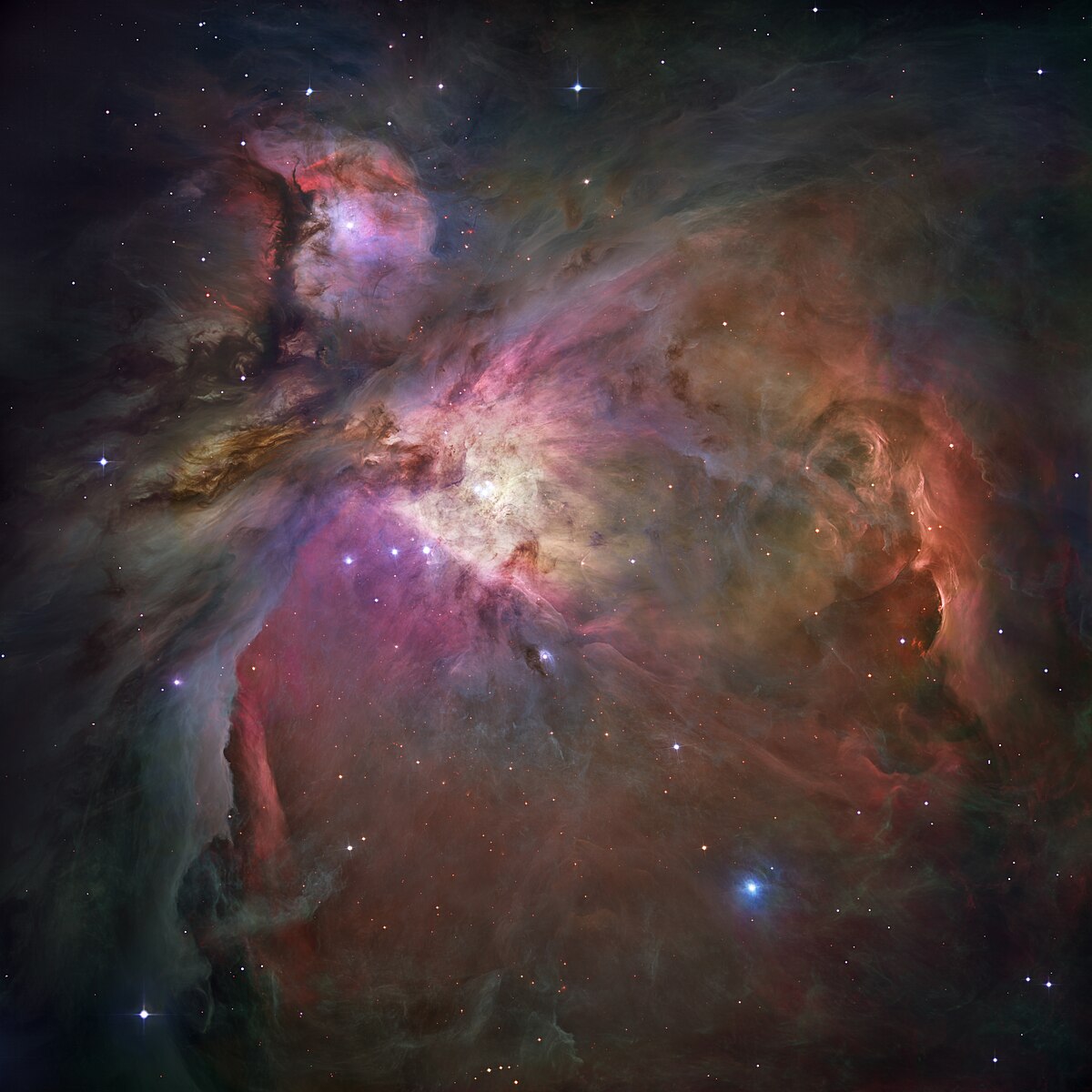
M42/M43: The Orion Nebula and De Mairan’s Nebula
Type: Emission/reflection nebula; Distance: about 1,350 light‑years; Location: Orion’s Sword (RA ~05h35m, Dec ~–05°23′).
Naked‑eye observers see a faint glowing patch; binoculars show a winged structure; small to medium telescopes reveal curving arcs, dark lanes, and a bright core around the Trapezium, a tight multiple system whose ultraviolet radiation excites the nebula. The adjacent M43 appears as a comma‑shaped glow separated by a dark lane. Under steady seeing, magnifications of 100–200× bring the Trapezium’s four bright components into sharp relief; larger apertures and excellent conditions can reveal additional, fainter members. A UHC or O III filter enhances the nebula’s contrast, especially from suburban skies.
NGC 1977: The Running Man Nebula
Type: Reflection/emission nebula; Distance: roughly the same as M42. Located just north of M42, this region surrounds several bright stars and appears as a soft, bluish reflection nebulosity in images. In small scopes, the nebulosity is subtle; focus on the embedded cluster and look for faint haze under dark skies.
NGC 1981: Open Cluster
At the north end of the Sword, NGC 1981 is a pleasing binocular cluster of bright stars. In a wide‑field eyepiece, frame it with M42 and NGC 1977 for a dramatic sweep that showcases multiple phases of star formation in one field.
M78: Reflection Nebula
Type: Reflection nebula; Distance: about 1,350 light‑years. M78 is a hazy oval patch northeast of Alnitak. In small telescopes, it appears as a soft glow with two embedded stars; larger apertures and dark skies reveal mottling and faint surrounding nebulosity. A broadband or mild UHC filter can help, but because M78 is primarily a reflection nebula, heavy filtering can dim it too much—experiment.
NGC 2024: The Flame Nebula
Type: Emission/reflection nebula; Distance: roughly 1,350 light‑years; Location: immediately east of Alnitak. Bright in long‑exposure images, the Flame’s dark lanes are visible in medium to large telescopes from very dark skies. An H‑beta or UHC filter can enhance contrast, but be mindful that Alnitak’s brilliance can flood the field; keep it just outside the eyepiece to boost visibility.
Barnard 33 and IC 434: The Horsehead Nebula
Type: Dark nebula silhouette (B33) against emission nebula (IC 434); Distance: about 1,350 light‑years. The Horsehead is a famous but challenging visual target. Under Bortle 2–3 skies with steady transparency, a 200–300 mm (8–12 inch) telescope and an H‑beta filter offer the best chance. Look for a small, inky notch on the bright IC 434 glow south of Alnitak. Patience, averted vision, and precise field placement are essential. For many observers, imaging is the more accessible path to capturing the Horsehead’s iconic profile.

Sigma Orionis: Multiple Star and Nebulosity
Near Alnitak lies Sigma Orionis, a fine multiple star system and the heart of a young cluster. In small telescopes, you’ll split several components; in larger apertures, look for faint nebulosity and dust lanes in long exposures. The region is astrophysically rich, with numerous low‑mass members and protoplanetary disks studied in detail by observatories across the spectrum.
Mintaka and Rigel: Doubles to Test Seeing
Mintaka is a wide double that splits cleanly in small scopes. Rigel’s faint companion, by contrast, demands steadier air and higher magnification; resolving it is a satisfying test of optics and atmospheric conditions.
NGC 2169: The “37” Cluster
An appealing open cluster in Orion’s raised arm, NGC 2169’s brightest stars line up to resemble the numerals “37” in small to medium telescopes. It’s a delightful outreach target and a welcome change of pace after nebula hunting.
Want to understand why so much nebulosity crowds Orion? Dive into the Orion Molecular Cloud Complex. Planning your route and field of view? See star‑hopping tips next.
Inside the Orion Molecular Cloud Complex
The Orion Molecular Cloud Complex (OMC) is a vast star‑forming region spanning hundreds of light‑years, encompassing dark molecular clouds, bright H II regions, reflection nebulae, and embedded clusters. It includes Orion A and Orion B—the giant molecular clouds that give rise to headline objects like M42/M43, the Horsehead/Flame region, and M78.
Massive stars and feedback
Young, massive O‑ and B‑type stars in the Orion OB1 association flood their surroundings with ultraviolet radiation and powerful stellar winds. These “feedback” processes carve cavities, compress nearby gas, and help trigger new rounds of star formation while dispersing natal clouds. The layering you see—from dark lanes to luminous arcs—arises from this interplay between gravity, radiation, winds, and shocks.
The Orion Nebula Cluster and proplyds
The Orion Nebula Cluster (ONC) harbors thousands of young stars, many only a few million years old. High‑resolution images reveal proplyds—protoplanetary disks irradiated by massive stars—shedding light on early planet‑forming environments. Jets and Herbig–Haro objects trace outflows from newborn stars colliding with surrounding gas, shaping the nebula’s fine structure.

Barnard’s Loop and the Superbubble context
Faint, arc‑like hydrogen emission called Barnard’s Loop sweeps around Orion in long‑exposure images, likely tied to past massive‑star activity in the region. Orion sits within a larger cavity of hot, tenuous gas often referred to as the Orion–Eridanus superbubble, a structure inflated by stellar winds and ancient supernovae. This context explains why Orion’s sky is so rich in emission: the area is a laboratory for how massive stars reshape their galactic neighborhoods.
For practical observers, the take‑home is clear: Orion’s objects are physically related across a swath of sky. That means wide‑field instruments and mosaics can tell a coherent story. For how to plan those vistas, head to star‑hopping and planning and the observing guide.
Observing Guide: Naked Eye, Binoculars, Telescopes
Orion is friendly to every level of equipment. The suggestions below balance visibility, contrast, and realism about what you can see under different skies.
Naked eye
- Identify the Belt and the quadrilateral formed by Betelgeuse, Rigel, Bellatrix, and Saiph.
- Note the faint glow in the Sword: that is M42, one of the few nebulae visible without optical aid from a dark site.
- Compare colors: Betelgeuse’s orange‑red vs. Rigel’s blue‑white offers a striking contrast.
Binoculars (7×50, 10×50, image‑stabilized)
- Scan the Sword to resolve M42’s core and curving wings; M43 appears as a small, separate puff just north of the Trapezium region.
- Take in NGC 1981 and NGC 1977 as a bright cluster–and–nebulosity duo.
- Seek out M78 as a soft oval glow northeast of Alnitak.
- From dark skies, look for the faintest hint of Barnard’s Loop in wide‑field sweeps—it is subtle visually.
Small telescopes (80–130 mm)
- Use low power (20–60×) to frame M42’s full extent; then increase to 120–200× to split the Trapezium’s primary four stars and look for fainter components in excellent seeing.
- Experiment with UHC/O III filters on M42/M43 and the Flame; avoid heavy filtering on M78 (reflection‑dominated).
- Split doubles: Mintaka is easy; try for Rigel’s companion on stable nights.
Medium to large telescopes (200–300 mm and up)
- H‑beta filters can make or break a visual observation of the Horsehead. Use charts to position IC 434 correctly and keep Alnitak just out of the field.
- Look for structure within NGC 2024’s dark lanes and the mottled background around M78.
- High magnification on the Trapezium reveals complexity in the core and tight companions in good seeing.
Filters and sky conditions
- UHC: Excellent general‑purpose nebula filter for M42/M43 and the Flame.
- O III: Enhances certain emission features in M42; useful under light pollution.
- H‑beta: Specialized; most helpful for IC 434 and the Horsehead region.
- Transparency matters more than seeing for faint nebulae; for tight doubles and the Trapezium, seeing is king.
Still mapping out your route? See star‑hopping. Curious why filters help? The physics behind emission lines is discussed in science highlights.
Star‑Hopping Routes and Practical Planning
Star‑hopping in Orion is intuitive with a few anchor points. The hops below assume a finder scope or low‑power eyepiece and average suburban to dark‑sky conditions.
Sword sweep: NGC 1981 → NGC 1977 → M42/M43
- Point your finder at the north end of the Sword to pick up NGC 1981, a loose cluster that stands out even in light pollution.
- Sweep south to the nebulous region of NGC 1977 (Running Man). In modest skies, focus on the bright stars and note the subtle haze.
- Continue to M42/M43 for the main event. Switch to a nebula filter and increase magnification as conditions allow.
Belt chase: Alnitak → Flame → Horsehead
- Center Alnitak at low power but shift it just outside the field to the east to reduce glare.
- Look for the Flame Nebula’s branching dark lanes.
- With an H‑beta filter and careful placement, seek IC 434’s subtle glow and the Horsehead’s small, notch‑like silhouette.
Reflection detour: Alnitak → M78
- From Alnitak, hop northeast to a faint, oval glow: M78.
- Use averted vision to tease out embedded stars and mottling; avoid aggressive filters.
Double‑star sampler: Mintaka → Rigel → Sigma Orionis
- Split Mintaka easily at low to moderate power.
- On a steady night, push magnification to separate Rigel’s companion.
- Explore the field around Sigma Orionis for multiple components and a rich backdrop of faint stars.
Planning tips
- Observe Orion’s nebulae when it’s highest (near the meridian) to minimize atmospheric extinction.
- Protect dark adaptation: shield stray light, use a dim red light, and give yourself 20–30 minutes.
- If imaging, plan mosaics to encompass multiple targets, e.g., a Belt panel and a Sword panel—see how structures relate as described in the OMC section.
Science Highlights: From Proplyds to Superbubbles
Orion is more than a showpiece; it is a benchmark for understanding star and planet formation, massive‑star feedback, and the life cycles of stellar nurseries.
Star formation in action
Within the OMC, cold, dense molecular gas collapses under gravity to form protostars. As they grow, accretion disks funnel material inward while bipolar jets and winds carry angular momentum away, carving cavities that glow where jets slam into gas (Herbig–Haro objects). The ONC’s proplyds are irradiated disks that offer a front‑row view of the early planet‑forming environment; their shapes and evaporation rates depend on how close they lie to massive O‑type stars.
Massive stars and their endgames
Alnitak, Alnilam, and Mintaka are massive, short‑lived stars that dominate their neighborhoods. Their intense radiation ionizes hydrogen (producing H II regions) and sculpts pillars and shells. Over millions of years, some of these stars will end their lives as supernovae, injecting heavy elements and driving shock waves that can compress nearby clouds, possibly triggering new star formation. Evidence of past massive‑star activity appears at large scales in Barnard’s Loop and the Orion–Eridanus superbubble.
Betelgeuse’s variability and the 2019–2020 dimming
Betelgeuse’s Great Dimming was widely observed and studied. The consensus points to the ejection of surface material that cooled and condensed into dust, obscuring the star from our line of sight. The episode highlights how mass loss proceeds in late‑stage massive stars and how dust forms in stellar outflows—processes central to galactic ecology. Monitoring Betelgeuse continues to refine models of supergiant atmospheres and variability.
The Orionids meteor shower
Each October, Earth crosses debris from Comet Halley, producing the Orionids. The meteor radiant appears near Orion’s club. Typical peak rates are modest, but the shower is known for fast, sometimes bright meteors. It’s a good seasonal reminder that Orion’s appearance heralds the change of the sky from autumn to winter in the north.
For observers, the scientific backdrop enriches the view: the glowing arcs of M42, the dark notch of the Horsehead, and the colors of the bright stars are all signatures of stellar birth, evolution, and feedback. If you’re deciding what to see first after this overview, jump to the deep‑sky tour.
Myth, History, and Cultural Astronomy
Orion’s striking pattern—belt, sword, and bright shoulders—makes it a recurring figure in sky lore worldwide.

Greco‑Roman tradition
In Greek myth, Orion is a mighty hunter. Stories vary: in some, he boasted he could kill any animal, leading to a scorpion (Scorpius) sent against him; in others, gods placed him in the sky. The seasonal opposition of Orion and Scorpius in the night sky echoes this rivalry—when one rises, the other sets.
Arabic star names
Many of Orion’s star names are Arabic in origin, reflecting medieval astronomical traditions: Betelgeuse is often traced to a phrase referring to the “armpit” of the giant; Rigel to the “foot.” These names entered European star catalogs and persist in modern usage.
Ancient Egypt and beyond
Orion has been associated with deities in multiple cultures; in ancient Egypt, it was linked with Osiris. Interpretations of architectural alignments to Orion are debated among scholars; what is clear is that bright, easily recognized patterns like Orion naturally became markers in ritual calendars and navigation.
East Asian asterisms
In traditional Chinese astronomy, the Belt and surrounding stars form part of the asterism known as Shen (the Three Stars). Cultural star patterns often cut the sky differently than modern constellations, but Orion’s belt stands out in many traditions.
Across continents and eras, Orion has served as a seasonal signpost, a navigational aid, and a canvas for stories that connect sky and culture.
FAQs: Quick Answers for Observers
When is the best time of night to observe the Orion Nebula?
When Orion is near the meridian (due south for northern observers, due north for southern), typically between 8 p.m. and midnight local time in mid‑winter for mid‑northern latitudes. Higher altitude means less atmosphere and better contrast. See seasonality and planning tips.
Can I see the Orion Nebula from a city?
Yes, but detail will be muted. Under urban skies, you’ll still detect M42’s bright core in binoculars or a small telescope. A UHC filter can improve contrast. For the full winged appearance and faint outer structure, darker skies are strongly preferred. Compare filter options in the observing guide.
How big of a telescope do I need to see the Horsehead Nebula?
For a realistic chance visually, an 8–12 inch telescope under very dark, transparent skies with an H‑beta filter is recommended. Even then, expect a subtle notch rather than a photographic horse profile. Many observers choose imaging for this object. The hop is detailed under Belt chase.
Will Betelgeuse explode soon?
No one can predict an exact date, but current understanding places its supernova on timescales of tens to hundreds of thousands of years. The 2019–2020 dimming was not a precursor to imminent collapse; it was likely dust obscuration after mass ejection. See science highlights for context.
What magnification should I use on M42?
Start low (20–60×) to capture the full nebula and then increase to 120–200× for detail in the core and the Trapezium. Adjust based on seeing. Filters help at low and medium powers; at very high magnification, they can dim the view too much.
Is the Orion Nebula in our galaxy?
Yes. M42 is part of the Milky Way’s Orion Arm, roughly 1,350 light‑years away. It’s a nearby star‑forming region, not a galaxy. For larger‑scale context, see the Orion Molecular Cloud Complex.
Advanced FAQs and Troubleshooting
Why do nebula filters help some targets but not others?
Emission nebulae radiate strongly at specific wavelengths (e.g., hydrogen beta, oxygen‑III), so filters that pass those lines while blocking broadband skyglow increase contrast. Reflection nebulae (like M78) scatter starlight across a broad spectrum; aggressive filtering removes both skyglow and the nebula’s own light, often rendering it too faint. See recommendations in the filters section.
How does transparency vs. seeing affect Orion targets?
Transparency governs faint, extended objects—poor transparency washes out low‑surface‑brightness features like IC 434. Seeing governs fine detail and tight splits—good seeing lets you resolve the Trapezium’s fainter stars and Rigel’s companion. Plan your target list accordingly: chase nebulae on the clearest nights, doubles on the steadiest.
What is the Orion–Eridanus superbubble and can I observe it?
It’s a vast cavity of hot, tenuous gas likely formed by stellar winds and ancient supernovae tied to the Orion OB association. Parts of its rim are visible as faint H‑alpha arcs (including Barnard’s Loop) in long‑exposure, wide‑field images. Visually, it’s extremely challenging; consider imaging or using H‑alpha‑sensitive sensors to reveal it. Context is covered under the OMC and science highlights.
What’s the safest way to navigate near Alnitak’s glare when seeking the Horsehead?
Use low power to locate the general area, then switch to an H‑beta filter and nudge Alnitak just outside the field edge. Center on the faint streak of IC 434 running south of Alnitak; the Horsehead appears as a small, dark indentation to its western edge. Dim the finder and shield stray light to maintain dark adaptation.
How do I star‑hop to NGC 2169, the “37” cluster?
From Betelgeuse, hop eastward toward Gemini along Orion’s raised arm. A detailed chart helps; once in the field, NGC 2169’s shape jumps out at moderate power. It’s compact enough to withstand suburban skies better than many nebulae.
Are there planetary nebulae or globular clusters worth seeking in Orion?
Orion is dominated by star‑forming regions rather than old populations, so globulars are absent. Small planetary nebulae exist but are less prominent than in neighboring constellations; most observers prioritize M42/M43, the Belt nebulae, and clusters like NGC 1981 and NGC 2169 within Orion’s borders.
Conclusion and Next Steps
Orion is more than a seasonal signpost. It’s a complete observing program—an accessible introduction for beginners and a deep, evolving project for seasoned skywatchers. In a single sweep you can compare stellar colors, resolve beautiful doubles, and dive into some of the closest, best‑studied nurseries of star and planet formation. As you revisit Orion across the season, challenge yourself: frame the Belt and Sword in a single, wide field; attempt the Flame on a pristine night; or test your skills on the Horsehead with an H‑beta filter.
For a richer experience, connect the dots between the eyepiece view and the astrophysics: how massive stars sculpt H II regions, how disks evolve under intense radiation, and how stellar winds and supernovae hollow out superbubbles. Then share the story—Orion’s lore, science, and beauty make it a perfect target for outreach and for inspiring new observers.
If you enjoyed this guide, explore neighboring constellations next, refine your observing toolkit, and consider keeping a log of your Orion sessions to track what changing conditions and techniques reveal each time. Clear skies!