
Table of Contents
- What Is the Orion Constellation and Why It Matters to Stargazers?
- When and Where to See Orion Across the Globe
- Brightest Stars in Orion: Betelgeuse, Rigel, and the Belt
- Deep-Sky Objects in Orion: Orion Nebula, Horsehead, and More
- Orion in Culture and Celestial Navigation
- How to Observe Orion: Naked Eye, Binoculars, and Small Telescopes
- The Orionids Meteor Shower: What to Expect
- Frequently Asked Questions
- Final Thoughts on Exploring the Orion Constellation
What Is the Orion Constellation and Why It Matters to Stargazers?
The Orion constellation is one of the most recognizable star patterns in the night sky, visible from virtually every inhabited latitude. Positioned along the celestial equator, Orion anchors the skies of the Northern Hemisphere’s winter and the Southern Hemisphere’s summer, guiding observers to nearby constellations and a wealth of deep-sky objects. For beginners, Orion is a friendly on-ramp to stargazing; for seasoned observers, it is a testbed for technique, instrumentation, and understanding stellar evolution. This guide explains how to find Orion, what to look for among its brilliant stars and nebulae, and how to make the most of the season when Orion dominates the night.

At the heart of Orion are two bright supergiants, Betelgeuse and Rigel, that frame the constellation’s shoulders and feet. The famous Belt—a striking, straight line of three stars—points to treasures across the sky and helps you navigate to the Orion Nebula and nearby deep-sky objects. The region encompasses the Orion Molecular Cloud Complex, a vast star-forming area rich with emission and reflection nebulae, dark dust lanes, and young stellar objects.
Beyond its observing appeal, Orion is a classroom for astrophysics-in-action: massive star formation, the lifecycle of supergiants, and the interplay between radiation and interstellar dust are on full display. Whether you are standing under a suburban sky with binoculars or planning a dark-sky expedition with a telescope, Orion offers something unforgettable every clear night. To plan your best observing window, see When and Where to See Orion.
When and Where to See Orion Across the Globe
Orion straddles the celestial equator, which makes it accessible from nearly all latitudes. In the Northern Hemisphere, Orion is the archetypal winter constellation, rising in the east on early evenings by late autumn and culminating high in the south during mid-winter. In the Southern Hemisphere, Orion is a hallmark of the summer sky, skirting high overhead on warm evenings and setting toward the west as the season progresses.
- Northern Hemisphere: Best evening views from roughly November through February; Orion appears low in the east in autumn nights, reaches the meridian (highest point) around January, and fades into the western evening sky by March and April.
- Southern Hemisphere: Prime viewing from December through March; Orion climbs high overhead during the height of Southern summer, offering spectacular views of the Orion Nebula.
- Equatorial regions: Orion passes almost directly overhead, giving exceptional visibility of the Belt and Sword.
Because Orion’s major stars are bright, you can see the pattern even from cities. However, the finer background stars and nebulae benefit from darker skies. If your goal is to explore the Orion Nebula (M42) and neighboring nebulae, aim for moonless nights with good transparency. A basic plan includes checking local weather forecasts for clear skies, measuring light pollution (using a Bortle scale reference if you have one), and giving yourself at least 20–30 minutes for dark adaptation once you are outside.
To quickly verify you have the right constellation: find three equally spaced stars in a short, straight line—the Belt of Orion. Below the Belt (toward the celestial equator’s south side) hangs the Sword, where a fuzzy patch marks the Orion Nebula. Extend an imaginary line through the Belt to hop to other bright markers in the sky—see Orion in Culture and Celestial Navigation for details and maps you can sketch on the fly.
Brightest Stars in Orion: Betelgeuse, Rigel, and the Belt
Orion’s silhouette is defined by several luminous stars showing striking color contrast. Their appearance gives both a visual thrill and a science lesson about stellar temperatures and lifecycles. The red-orange glow of Betelgeuse contrasts with the icy blue of Rigel, while the Belt stars add symmetry and serve as navigation aids.
Betelgeuse (Alpha Orionis)
Betelgeuse marks Orion’s right shoulder (left from our perspective). It is a red supergiant, cooler in surface temperature than blue stars but vastly larger in radius. Betelgeuse is a semiregular variable star; its brightness fluctuates over months to years. During 2019–2020, it experienced a widely reported dimming event—nicknamed the “Great Dimming”—which studies have linked to factors such as surface convection and ejected dust clouds along our line of sight. For casual observers, Betelgeuse’s hue is the star’s most obvious feature: a warm, reddish light that is easy to distinguish, even to the unaided eye.
Learning point: star color roughly correlates with temperature—redder stars are cooler than bluer ones. If you compare Betelgeuse with Rigel on a clear night, you are seeing this temperature difference directly as color.
Rigel (Beta Orionis)
Rigel marks Orion’s left foot (right from our perspective). It is a blue supergiant, hot and extremely luminous. Through steady binoculars or a small telescope, observers can sometimes split a fainter companion star near Rigel under good seeing conditions. The brilliant white-blue appearance of Rigel vividly contrasts with Betelgeuse, creating one of the sky’s most instructive color pairings.
Rigel’s brightness and location make it a wayfinding beacon. From Rigel, you can sweep northeast (toward Orion’s Belt) to localize the Belt stars in light-polluted skies, then drop down to the Sword to pick up the glow of the Orion Nebula (M42).
Bellatrix (Gamma Orionis) and Saiph (Kappa Orionis)
Bellatrix forms Orion’s left shoulder, while Saiph forms the right knee. Both are bright and help complete the quadrilateral of Orion’s outline. Their glints can be slightly subdued in urban skies, but they are still easy to locate once you center the constellation’s box-like frame.
The Belt Stars: Alnitak, Alnilam, and Mintaka
Orion’s Belt is an asterism of three nearly collinear stars: Alnitak, Alnilam, and Mintaka, from east to west. These are massive, hot, blue stars, part of an association of young, luminous stars in the Orion region. The Belt is your essential navigation tool: a short line that points the way to other bright landmarks and deep-sky targets. Remember this practical rule:
Draw a line through Orion’s Belt. To the southeast, it leads to Sirius in Canis Major; to the northwest, it guides you toward Aldebaran and the Hyades in Taurus.
Astro-note: The Belt stars are members of the broader Orion OB association, a population of hot, massive O- and B-type stars. These short-lived giants illuminate nearby gas and dust, giving rise to several well-known emission and reflection nebulae described in Deep-Sky Objects in Orion.
Double and Multiple Stars to Explore
- Mintaka (Delta Orionis): A multiple star system; under steady skies, small scopes may resolve companions.
- Sigma Orionis: A striking multiple system near the Horsehead Nebula region; a rewarding target for small to medium telescopes.
- Iota Orionis (Na’ir al Saif): A bright star in Orion’s Sword, near M42; its neighbors make for a pleasing telescopic field.
If you are new to splitting doubles, start with easier pairs like Mintaka on a steady night. Practice will help you recognize subtle separations and color contrasts. Tips on magnification and seeing conditions appear in How to Observe Orion.
Deep-Sky Objects in Orion: Orion Nebula, Horsehead, and More
Orion is a deep-sky goldmine. The constellation lies within a vast complex of molecular gas and dust where stars are actively forming. Several of the Northern winter’s most celebrated targets are nestled here, offering a mix of emission, reflection, and dark nebulae visible in binoculars and telescopes from suburban and dark-sky sites.
The Orion Nebula (Messier 42) and M43
M42, the Orion Nebula, is the brightest emission nebula visible to the naked eye from mid-latitudes. It hangs within Orion’s Sword just south of the Belt. Even small binoculars show a soft, luminous patch; a small telescope reveals sculpted gas clouds and the Trapezium, a compact multiple-star system at the nebula’s core that illuminates the surrounding gas. Under steady seeing, a 4–6 inch (100–150 mm) telescope can split the Trapezium’s four main stars, and with experience and excellent conditions, observers may glimpse additional faint components.

Immediately north of M42 is M43, a separated knot of emission divided by a dark dust lane. While M43 is fainter, it is readily apparent in small telescopes and provides a contrasting texture to M42’s larger wings of nebulosity. Observers often sketch both in a single field of view to study the brightness gradient and dark-lane structure.
Best practices for M42/M43:
- Use low to medium magnification to frame the full nebula and detect extensive faint arcs.
- Try a UHC or O III nebula filter to enhance emission contrast, especially under suburban skies.
- Spend time at the eyepiece; nebular detail improves with patience and averted vision.
Running Man Nebula (NGC 1977)
Just north of M42/M43 lies a reflection nebula complex often called the Running Man Nebula. It appears as a soft, bluish glow around young stars when photographed and can be a subtle visual target in small telescopes under dark, transparent skies. The region gives a quick lesson in the difference between emission and reflection nebulae: emission nebulae glow from ionized gas, while reflection nebulae shine by scattering starlight from dust.
Horsehead Nebula (Barnard 33) and Flame Nebula (NGC 2024)
South and east of Alnitak, observers find the remarkable Horsehead Nebula, a dark nebula silhouetted against the glowing emission background of IC 434. The Horsehead is a challenging visual object; it demands very dark skies, excellent transparency, appropriate magnification, and often an H-beta filter for best contrast. Nearby, the Flame Nebula (NGC 2024) presents a textured emission/reflection region sometimes visible in small telescopes as a bright, structured patch near Alnitak; it becomes more detailed in larger apertures and long-exposure images.
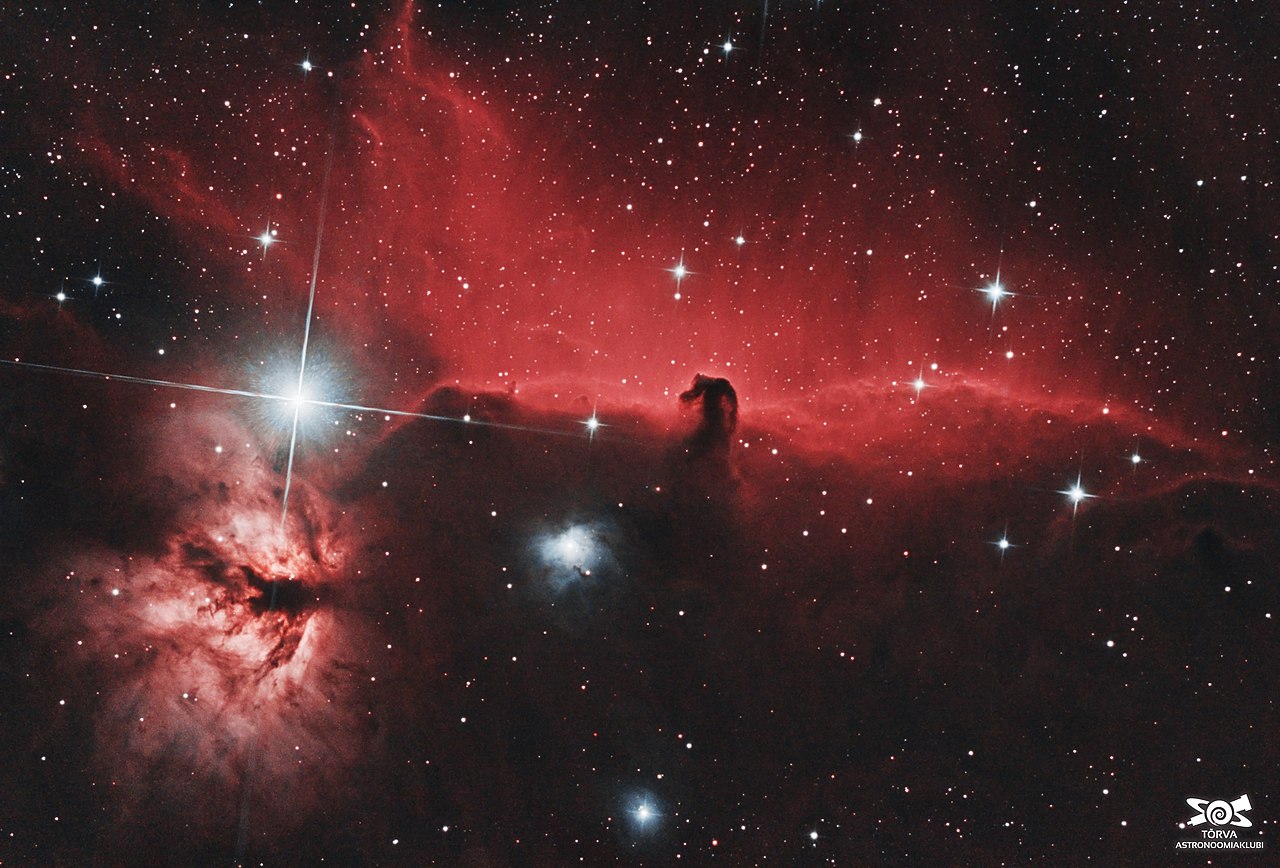
Practical tip: Center Alnitak, then nudge the field slightly south to bring IC 434 into view. Under top-tier conditions, the Horsehead’s notch-like silhouette may emerge with careful averted vision. If you are just getting started, do not be discouraged—this is an advanced visual target. Build foundational experience on M42 first (observing tips here).
Barnard’s Loop and the Orion Molecular Cloud Complex
Barnard’s Loop is an immense arc of emission surrounding much of Orion, part of the larger Orion Molecular Cloud Complex. Visually, Barnard’s Loop is difficult and usually requires very dark skies, wide fields, and sensitive imaging or intensified night-vision devices. However, understanding that this arc is part of a huge star-forming ecosystem gives context to the entire constellation: the Belt stars, the Orion Nebula, and the Horsehead region are all pieces of a stellar nursery spanning hundreds of light-years.

If you enjoy sketching, try outlining the Belt, Sword, and brighter field stars, then note any diffuse brightening you can perceive where Barnard’s Loop would be, especially under pristine skies. Complement your visual log with star charts that trace the loop; matching your notes to reference material will sharpen your ability to notice low-contrast structures.
Other Targets: De Mairan’s Nebula, Open Clusters, and More
- De Mairan’s Nebula (M43): Already noted with M42, but worth a separate sketch at moderate power to highlight the dark lane.
- NGC 1980 and NGC 1981: Open clusters near the Sword, pleasant binocular fields that frame M42 beautifully.
- Betelgeuse’s semiregular variability: Track visual magnitude changes over months; compare to nearby reference stars for a simple photometry exercise.
New to object-hopping? Begin at the Belt, drop to the Sword for M42/M43, then drift northward to NGC 1977. Later, return to Alnitak and sweep east for the Flame and south for IC 434 and B33. See How to Observe Orion for step-by-step approaches tailored to binoculars and small telescopes.
Orion in Culture and Celestial Navigation
Orion’s striking human-like shape and bright stars have inspired stories across cultures. In classical Greek tradition, Orion is a hunter, accompanied by his dogs (Canis Major and Canis Minor) and opposed by Taurus the Bull. Ancient observers used Orion’s reliable seasonal appearances as a calendar marker, heralding agricultural cycles and guiding navigation.
For practical star-hopping, Orion is a central hub. Use the Belt as a ruler and pointer to hop to several first-magnitude stars and prominent asterisms:
- To Sirius: Extend the Belt southeast to reach Sirius in Canis Major, the brightest star in the night sky. This route is a classic winter star-hop in the Northern Hemisphere.
- To Aldebaran and the Hyades: Extend the Belt northwest to find Aldebaran and the V-shaped Hyades cluster in Taurus. Continue slightly farther to spot the Pleiades (M45), an open cluster glowing to the northwest.
- To Betelgeuse/Rigel color check: Compare red-orange Betelgeuse with blue-white Rigel to practice stellar color estimation and temperature inference (see Brightest Stars in Orion).
Orientation guide from mid-northern latitudes on winter evenings:
- Locate the Belt roughly in the southern sky.
- Drop to the Sword to confirm M42’s glow.
- Trace the rectangle of Bellatrix–Betelgeuse–Saiph–Rigel to frame Orion’s body.
- Hop southeast to brilliant Sirius; swing back northwest to Aldebaran and the Hyades, then on to the Pleiades.
These pathways provide context for deep-sky tours and make Orion a springboard into a full night’s exploration of the winter sky. For observers below the equator, the geometry is similar but mirrored and rotated relative to the northern view; the Belt and Sword remain excellent guides.
How to Observe Orion: Naked Eye, Binoculars, and Small Telescopes
Observing Orion can be as simple as stepping outside and looking up, or as involved as planning a carefully filtered telescopic session. Below is a practical, tiered approach—no matter your gear, you will find rewarding targets.
Naked-Eye Observing
- Identify the pattern: Find the Belt’s three-in-a-row stars; from there, outline the four corner stars—Betelgeuse and Bellatrix above, Saiph and Rigel below.
- Color contrast: Compare Betelgeuse to Rigel for a visceral lesson in stellar temperature and spectral type.
- Sword glow: Under darker skies, look for the faint smudge of the Orion Nebula hanging in the Sword.
- Star-hopping practice: Use the Belt to hop to Sirius and Aldebaran as described in Celestial Navigation.
Binocular Observing (7×50, 8×42, 10×50)
- Frame the Belt and Sword: Sweep south from the Belt to M42. Binoculars reveal a pearly glow and surrounding stars; note how the nebula brightens with averted vision.
- Trapezium hint: At higher magnification (10× and steady support), you may sense the compact brightness of the Trapezium within M42, though individual stars usually require a telescope.
- NGC 1981 and NGC 1980: These open clusters near the Sword are attractive binocular fields that deliver structure and context around M42/M43.
- Flame Nebula region: Alnitak’s area shows complex star fields; under exceptional skies, some binocular observers report a hint of nebulosity, though a telescope is far more effective.
Steady your view by bracing your elbows or using a tripod adapter for longer sessions. Let your eyes adapt to darkness for 20–30 minutes to boost faint detail.
Small-Telescope Observing (80–150 mm aperture)
- M42/M43: Start with a low-power eyepiece (e.g., 25–32 mm) to frame the entire nebula, then step up to medium power (12–18 mm) to tease out the Trapezium and interior structure. Try UHC or O III filters to increase contrast.
- Running Man (NGC 1977): A medium-power view may reveal the reflection glow as a soft haze; dark skies and good transparency help.
- Flame (NGC 2024): Use medium power and avoid placing Alnitak at the center of the field to reduce glare. A nebula filter can help, though reflections make technique important.
- Horsehead (B33): Consider an H-beta filter and very dark skies. Use averted vision and slow panning. This is a challenging, advanced target.
- Double/multiple stars: Split Iota Ori and Sigma Ori on steady nights; test resolving power and seeing limits.

Seeing versus transparency: for nebulae, prioritize nights of high transparency (clear, dry air, minimal haze). For splitting doubles and resolving the Trapezium’s fainter members, prioritize steady seeing, when stars appear steady rather than shimmering.
Urban and Suburban Strategies
- Shield stray light: Observe from the shadow of a building, or use a simple light shield to block streetlamps.
- Filters for emission nebulae: UHC and O III filters can provide a significant boost to M42/M43 contrast in light-polluted skies.
- Choose the right time: Observe when Orion is highest (near culmination) to look through less atmosphere and light pollution.
- Log your sessions: Track what magnifications and filters work best for each target; compare with future nights to learn how conditions influence visibility.
Planning and Charting
Bring a simple printed chart or a red-light-friendly star app. Practice a compact set of coordinates and designations so catalogs feel familiar. For example:
# Handy designations for Orion targets
M42 / NGC 1976   # Orion Nebula (emission)
M43 / NGC 1982   # De Mairan's Nebula (emission)
NGC 1977         # Running Man (reflection)
NGC 2024         # Flame Nebula (emission/reflection)
IC 434 & B33     # Emission background & Horsehead dark nebula
Sigma Ori        # Multiple star near Horsehead region
Learning the nomenclature will make it easier to interpret observing guides and community reports. As you plan a session, pick two or three primary targets from Deep-Sky Objects in Orion and one or two “stretch” goals for nights of exceptional conditions.
The Orionids Meteor Shower: What to Expect
The Orionids are an annual meteor shower associated with debris from Halley’s Comet. They typically peak in the second half of October, producing swift meteors that can leave persistent trains. The shower’s radiant—the point from which meteors appear to originate—lies near Orion, but meteors can streak across any part of the sky.
- Peak activity: Usually in late October, with a typical zenithal hourly rate (ZHR) around 20 meteors per hour under dark skies. Actual rates vary year to year and by sky quality.
- Best viewing time: After local midnight to pre-dawn, when the radiant is higher and Earth faces into the meteoroid stream.
- Technique: Lie back to take in a wide field of sky. Avoid staring directly at the radiant; looking 40–60 degrees away often yields longer, more dramatic meteor paths.
Unlike telescopic targets, meteor showers reward patience and comfort. Dress warmly, bring a reclining chair, and allow a solid hour for your eyes to adapt. If the Moon is bright during the peak, you may see fewer meteors; consider watching on the nights just before and after the predicted maximum. For a deeper dive into Orion’s seasonal context, return to When and Where to See Orion.
Frequently Asked Questions
Is the Orion Nebula visible to the naked eye?
Yes—under reasonably dark skies, the Orion Nebula (M42) appears as a faint, diffuse glow in Orion’s Sword, just below the Belt. Even in suburban conditions, most observers can detect a hazy patch once they know where to look. Binoculars significantly enhance the view, showing more extent and structure. A small telescope reveals the Trapezium and the nebula’s wing-like shape. For tips on filters and magnification, see How to Observe Orion.
How do I find the Horsehead Nebula and why is it so difficult?
The Horsehead Nebula (Barnard 33) is a dark dust cloud silhouetted against the bright emission background of IC 434, near the star Alnitak at the eastern end of Orion’s Belt. It is difficult because you are trying to see a dark shape against a faint glow; it requires very dark skies, excellent transparency, careful control of glare, and often an H-beta filter to enhance contrast. Start by centering Alnitak, then nudge the field south along IC 434. Averted vision and slow panning can help the Horsehead’s notch-like profile come into view. If you are new to deep-sky observing, begin with the more forgiving targets in Deep-Sky Objects in Orion and return to the Horsehead when conditions are prime.
Final Thoughts on Exploring the Orion Constellation
Orion is more than a winter signpost—it is a living laboratory of stellar birth and evolution, a meeting ground of bright supergiants and newborn stars still wrapped in nebulous cocoons. From the warm glow of Betelgeuse to the icy light of Rigel, from the welcoming brightness of M42 to the challenging silhouette of the Horsehead, Orion offers a progression of targets that can grow with you as your skills and equipment evolve.
If you are just starting, learn the Belt and Sword, and make M42 your first deep-sky milestone. As you gain experience, push toward the Running Man, the Flame, and—on the best nights—Barnard 33’s elusive darkness. Along the way, use Orion as your navigation hub to explore Sirius, Aldebaran, the Hyades, and the Pleiades, rounding out a rich seasonal tour. Keep a log, compare nights, and share observations with your local astronomy community; the constellation will reveal more each season you return to it.

For more sky guides, deep-sky planning checklists, and instrument tips, explore our related articles across constellations and observing techniques. If you enjoyed this in-depth guide to Orion, consider subscribing to our newsletter to get fresh, research-informed stargazing content delivered right when you can use it under clear skies.