Table of Contents
- What Do Numerical Aperture and Resolution Mean in Light Microscopy?
- Magnification vs Resolution: Avoiding Empty Magnification
- How Wavelength and Color Affect Resolution and Contrast
- Illumination NA, Condensers, and Practical Resolution
- Depth of Field, Working Distance, and Field Flatness
- Digital Sampling, Pixel Size, and Nyquist Magnification
- Aberrations, Numerical Aperture, and Contrast Mechanisms
- Choosing Objective NA and Magnification for Real Samples
- Frequently Asked Questions
- Final Thoughts on Choosing the Right Numerical Aperture and Magnification
What Do Numerical Aperture and Resolution Mean in Light Microscopy?
Light microscopes turn fine structural details into visible images by collecting and focusing light. Two concepts govern how much detail can be seen: numerical aperture (NA) and resolution. These are foundational ideas in optics, and understanding them clarifies why some images look sharp and information-rich while others look large but vague.
Numerical aperture expresses how effectively an objective lens gathers light from a specimen. In object space it is defined by the refractive index of the medium between the specimen and the objective and by the half-angle of the light cone that enters the objective:
NA = n · sin(α)
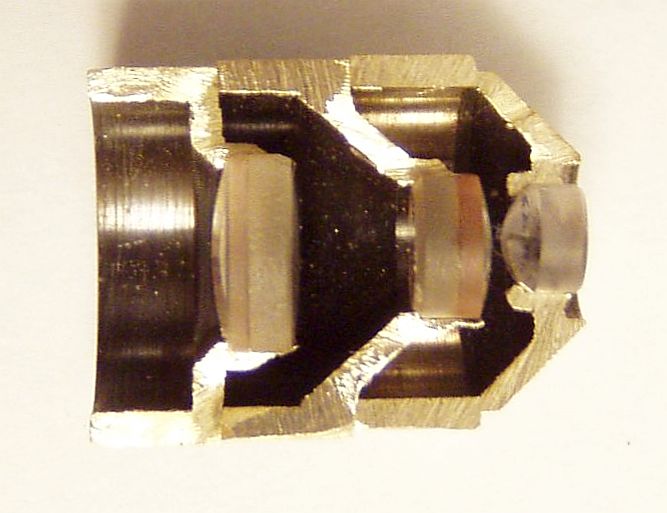
Here, n is the refractive index of the immersion medium (for example, approximately 1.0 for air; higher for specialized immersion liquids), and α is the half-angle of the largest cone of light that can enter the objective. A larger NA means the lens captures light from wider angles, improving fine-detail transfer and often increasing brightness and contrast for small features.
Resolution is the smallest distance between two points in the specimen that can be distinguished as separate in the image. Under typical incoherent widefield illumination, a widely used lateral resolution criterion is related to the Abbe or Rayleigh formulations. A common expression is:
d ≈ 0.61 · λ / NA
where d is the smallest resolvable lateral spacing in the specimen plane and λ is the wavelength of light in the medium. The key insight is that resolution improves (smaller d) when you either reduce the wavelength or increase the NA. This equation encapsulates why blue light and high‑NA objectives reveal finer detail than red light and low‑NA objectives.
Resolution also has an axial dimension (along the optical axis, often called depth or z-resolution). For conventional widefield imaging, the axial resolving capability scales approximately with λ and inversely with the square of NA. While the exact constant depends on the model and criterion used, a useful rule of thumb is that axial resolution improves strongly with increasing NA and worsens with increasing wavelength and with refractive-index mismatches.
The interplay of NA and resolution has practical consequences:
- Higher NA improves lateral and axial resolution and often increases signal collection, but typically reduces depth of field and working distance.
- Shorter wavelengths improve resolution but may reduce specimen brightness or contrast depending on dyes, absorption, and scattering, and can challenge chromatic correction.
- Immersion media with higher refractive index enable NA values above 1, which can substantially improve resolution when properly matched to coverslips and specimen geometry.
These trade‑offs set the stage for choosing objectives, illumination, and acquisition settings that produce images with genuine, interpretable detail rather than simply enlarged blur. Throughout this article we will connect NA and resolution to practical topics such as magnification choices, illumination and condenser settings, and digital sampling with cameras.
Magnification vs Resolution: Avoiding Empty Magnification
Magnification and resolution are intertwined but not interchangeable. Magnification tells you how large the image appears relative to the specimen. Resolution tells you how much fine detail is genuinely transferred into that enlarged image. If you increase magnification without also increasing resolution, you produce bigger but blurrier images—this is called empty magnification.
Microscopy systems generate total magnification by combining objective power, tube lens (in infinity-corrected systems), and eyepieces or camera projection optics. Regardless of how the scale is set, the smallest detail that can be captured is ultimately limited by NA and wavelength (see What Do Numerical Aperture and Resolution Mean in Light Microscopy?).
Consider two scenarios:
- Low NA, high magnification. Suppose you choose a high-power objective that still has a relatively low NA. The image will be large, but the diffraction-limited spot size in the specimen plane is not reduced proportionally. Details smaller than the diffraction limit remain blurred, just rendered at larger pixel counts or a larger view circle in the eyepiece.
- High NA, moderate magnification. A moderately magnifying objective with a higher NA can resolve finer details while keeping the image size reasonable. The useful detail captured at the specimen is genuinely improved.
The difference between these two situations is visible in the point spread function (PSF)—the image of a point source formed by the optical system. High NA narrows the PSF; pure magnification simply stretches the PSF on the image plane. Only when the PSF is narrowed at the specimen (via higher NA and suitable wavelength) does magnification reveal new, reliable detail rather than enlarging a blur.
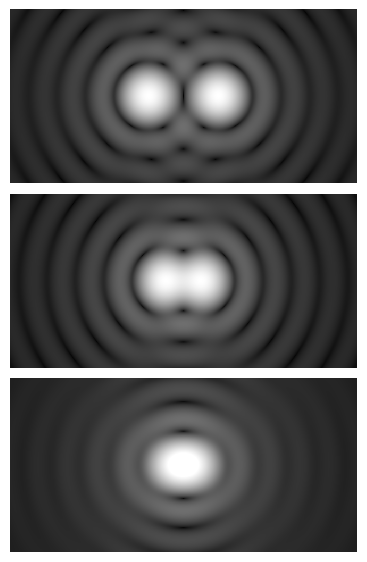
Practically, the goal is to match total magnification to the information that the objective can deliver. This matching depends on your detector sampling, which we discuss in depth in Digital Sampling, Pixel Size, and Nyquist Magnification. If you overshoot magnification relative to detector resolution and optical resolution, you spend exposure time and add noise without gaining information.
Key guidelines to avoid empty magnification:
- Prioritize NA over raw magnification when the aim is to reveal fine spatial detail. Upgrading to a higher‑NA objective of similar power can dramatically improve real image information.
- Match magnification to pixel size so that the camera samples the smallest resolvable structures adequately (see Nyquist sampling).
- Control contrast and illumination so that the fine details are not buried in noise or low contrast (more in Illumination NA, Condensers, and Practical Resolution and Aberrations, Numerical Aperture, and Contrast Mechanisms).
One final note: field of view and magnification are also related. Very high magnification shrinks the field of view on a given camera sensor or eyepiece, potentially making navigation harder. Balancing field of view against required resolution is part of sensible objective selection, elaborated in Choosing Objective NA and Magnification for Real Samples.
How Wavelength and Color Affect Resolution and Contrast
Because diffraction depends on wavelength, changing color changes the attainable resolution. In simple terms, shorter wavelengths resolve finer structure under otherwise equal conditions. This is implicit in the relation d ≈ 0.61 · λ / NA: when λ decreases, d decreases, so finer spacings can be distinguished.

However, wavelength touches more than just resolution:
- Spectral sensitivity of detectors and visual perception varies across wavelengths, altering apparent brightness and signal-to-noise ratio (SNR).
- Specimen absorption and scattering differ with wavelength, which can change contrast and penetration depth.
- Chromatic aberrations can shift focus with wavelength. Lenses are corrected to lessen this, but residual color-dependent focus shifts can subtly affect sharpness when using broad-spectrum illumination.
Most brightfield microscopes use white light. Objectives are often corrected over a specified band so that several wavelengths focus close together. The degree of correction (for example, basic achromats versus more highly corrected designs) affects how well the image stays in focus across colors. When imaging a color specimen or using a broad spectral band, a more strongly corrected objective can deliver crisper compound-color details. When using monochrome illumination tuned to a single wavelength band, chromatic errors in that band often matter less.
In fluorescence microscopy, excitation and emission bands define which wavelengths reach the specimen and the detector. Resolution then hinges on the emission wavelength that is imaged: shorter emission peaks yield finer diffraction-limited detail, assuming comparable NA and optical correction. For reflection or scattering modes, shorter wavelengths can increase surface sensitivity but may also amplify scattering, which can reduce contrast depending on the specimen microstructure.
The role of the medium also matters. The formulae for resolution apply with wavelength in the medium. Because wavelength in a medium is λ_medium = λ_vacuum / n, using an immersion medium with higher refractive index effectively shortens the wavelength in the imaging space and permits larger acceptance angles (higher NA). The combined effect boosts resolution when the system is appropriately matched (objective, coverslip, condensation, and specimen geometry all working in concert).
Practical implications for wavelength selection:
- To push lateral resolution, use shorter imaging wavelengths (blue/green bands) with a high‑NA objective, provided that the optics are corrected for those wavelengths and specimen contrast remains sufficient.
- To balance contrast and penetration, consider slightly longer wavelengths when imaging thicker or scattering specimens in transmitted light, recognizing the modest trade in nominal resolution.
- To maintain color fidelity in brightfield imaging of stained samples, use objectives with appropriate color correction so that different stain colors stay in comparable focus.
Regardless of choice, remember that wavelength is only one piece of the puzzle. Without adequate illumination geometry and condenser NA (see Illumination NA, Condensers, and Practical Resolution), the theoretical benefits of wavelength may not reach the camera or eyepiece.
Illumination NA, Condensers, and Practical Resolution
Optical resolution is not set by the objective alone. In transmitted light, illumination geometry and condenser NA help determine how well fine spatial frequencies in the specimen are excited and transferred to the image. Even in reflected-light or epi-illumination modes, the distribution of light across the pupil affects contrast and SNR for small features.
Two apertures control the critical geometry in a brightfield system:
- Field diaphragm (in the illumination path) sets the illuminated area in the specimen plane. It should be adjusted so that only the observed field is illuminated, improving contrast and reducing stray light, while leaving the image area uniformly lit.
- Aperture diaphragm (at or conjugate to the condenser’s back focal plane) sets the illumination NA, which in turn governs the angular range of illumination that interacts with the specimen.
Uniform, well-controlled illumination is classically realized via Köhler illumination. The essence is to image the field diaphragm onto the specimen plane (controlling the illuminated area) and to image the light source onto the condenser aperture (controlling angular distribution). While detailed alignment is beyond the scope here, the key concept is that Köhler arrangements decouple field uniformity from angular control, providing even lighting and flexible control of illumination NA.

Why does illumination NA matter for resolution? For a periodic specimen feature to generate contrast in brightfield, light diffracted by the structure must enter the objective in addition to the undiffracted (direct) beam. If the angular spread of illumination is too narrow, some diffracted orders may not be sufficiently excited, lowering the contrast of fine details. If it is too wide relative to the objective NA, the system may collect stray light that lowers contrast without gaining useful high-frequency information. In practice, matching the illumination NA to a significant fraction of the objective NA often provides a good balance of resolution and contrast. Exact preferences depend on specimen type and desired contrast.
Other practical illumination considerations:
- Condenser NA and objective NA should be compatible. A condenser that cannot reach the objective’s NA may limit the achievable resolution in transmitted brightfield because the specimen will not be illuminated with the high-angle rays that contribute to resolving fine detail.
- Immersion and coverslip matching. High‑NA systems are sensitive to refractive-index mismatches and coverslip thickness deviations. Objectives are designed for a specified coverslip thickness and immersion medium; significant deviations can introduce spherical aberration that softens detail and reduces effective NA.
- Pupil fill and apodization. Nonuniform filling of the objective pupil (for instance, due to lamp filament structure or fiber pattern) can imprint uneven contrast transfer. Properly configured illumination optics or diffusers in appropriate planes can help ensure even pupil illumination.
In epi-illumination (reflected light or fluorescence), the illumination and detection paths share the objective. Even here, aperture control occurs at a pupil-conjugate plane (for example, an iris near the back focal plane or an adjustable field stop), influencing the balance between resolution, contrast, and background. The same general principle applies: control the angular spectrum of illumination and the acceptance angles of detection to maintain high-frequency transfer while preserving SNR.
Illumination geometry, NA, and resolution are inseparable in practice, which is why techniques that alter the illumination or pupil shape (such as phase annuli, darkfield stops, or differential interference contrast prisms) change how certain spatial frequencies and phase relationships convert into observable contrast. We return to these ideas in Aberrations, Numerical Aperture, and Contrast Mechanisms.
Depth of Field, Working Distance, and Field Flatness
High numerical aperture sharpens detail but narrows the range of axial positions that appear sharp. Three related concepts describe the axial behavior of a microscope image:
- Depth of focus refers to the allowable shift of the image plane (in image space) for which the image remains acceptably sharp.
- Depth of field (DOF) refers to the axial range in the specimen space that appears sharp in the final image.
- Axial (z) resolution refers to how finely two separate planes along the optical axis can be discriminated.
For widefield imaging, both DOF and axial resolution diminish as NA increases. Intuitively, a high‑NA lens focuses light into a tighter lateral spot and also a narrower axial waist. This tight focus is what delivers high resolution but at the cost of a shallower in-focus range. As a result, thick or uneven specimens can look sharp only in a thin slice at any given focus setting. Stacks or extended depth‑of‑field techniques are often used to present more of a thick sample in focus, especially in educational or documentation contexts, but the underlying optical DOF still depends on NA and wavelength.
Working distance is the physical clearance between the objective’s front element and the specimen at focus. As NA increases, working distance often decreases because the lens must accept steeper rays (larger α), which geometrically forces the lens to sit closer to the specimen. Limited working distance may constrain sample mounting, protective covers, or manipulations near the objective. There are long‑working‑distance objectives that maintain clearance at the cost of NA and/or other optical compromises; the right choice depends on your specimen geometry and desired resolution (see Choosing Objective NA and Magnification for Real Samples).
Field flatness concerns whether the image stays in focus across the entire field of view. Some objectives incorporate corrections so that planes imaged at the center and edges of the field come to focus at nearly the same axial position. Without field flattening, the edges may drift out of focus when the center is sharp, which can mimic poor DOF. While field flatness is a lens design trait rather than a direct NA function, higher-NA and wide‑field imaging often make such imperfections more noticeable. Flat-field corrected objectives help maintain uniform sharpness for documentation and quantitative analysis across larger sensors.
Key takeaways for axial behavior:
- Increasing NA narrows DOF and typically reduces working distance.
- Field flatness is a property of objective and tube lens design; for wide fields or large sensors, choose optics specified for flatness if uniform focus is required.
- When imaging thick samples, a moderate NA may be preferable if your goal is to keep more of the sample acceptably sharp in a single plane, acknowledging the corresponding trade in lateral resolution.
Digital Sampling, Pixel Size, and Nyquist Magnification
Even with perfect optics, digital sampling determines how much of the available detail reaches your saved images. Cameras discretize the image into pixels, so pixel size, sensor size, and optical magnification together set the sampling rate in the specimen plane.
To faithfully capture the highest spatial frequencies transferred by the optics, digital sampling must satisfy the Nyquist criterion: sample at least twice as finely as the smallest feature you aim to resolve. In the specimen plane, if the optical system delivers a diffraction-limited lateral resolution of d, then the sampling pitch in the specimen plane should be no larger than about d / 2.
Relating this to camera pixels is straightforward. Let p be the camera’s physical pixel size (for example, in micrometers), and let M be the total optical magnification from the specimen plane to the camera sensor. The effective sampling pitch in the specimen plane is p / M. To meet Nyquist for features at the diffraction limit:
p / M ≤ d / 2
Rearranging yields a Nyquist magnification target:
M ≥ 2p / d
Substituting d ≈ 0.61 · λ / NA gives a rule that links magnification, pixel size, wavelength, and NA. It shows why the “right” magnification depends on camera pixels and wavelength, not merely on tradition. Sampling too coarsely (undersampling) aliases high-frequency detail into lower frequencies, creating spurious patterns and losing real information. Sampling much more finely than necessary (excess magnification for the pixel size and NA) does not add information; it spreads photons across more pixels, reducing per-pixel signal and potentially worsening apparent noise.
Additional sampling considerations:
- Binning effectively increases pixel size, which can raise SNR per pixel but risks undersampling fine detail if magnification is not increased accordingly.
- Sensor quantum efficiency and read noise affect SNR, but do not change the sampling pitch; they determine how cleanly you can measure the signal that the optics deliver.
- Color filter arrays (CFA) on color cameras introduce separate sampling for each color channel. Monochrome cameras with appropriate filters often capture maximum resolution per pixel because every pixel samples the same spectral band.
For precise quantitative imaging, calibrate pixel size in the specimen plane (for example, using a stage micrometer) so that measurements reflect true distances. For qualitative imaging, simply keeping the effective specimen-pixel spacing near the Nyquist pitch for your optical resolution helps avoid empty magnification and aliasing. For more about striking the right balance between magnification, NA, and sampling, see Magnification vs Resolution: Avoiding Empty Magnification and Choosing Objective NA and Magnification for Real Samples.
Aberrations, Numerical Aperture, and Contrast Mechanisms
So far we have focused on diffraction-limited performance. Real lenses also present aberrations—imperfections in how rays are brought to focus—which can broaden the PSF and reduce contrast for fine detail. A few key aberrations and their relation to NA and practical imaging are worth noting.
Common aberrations and their impacts
- Spherical aberration: Rays that strike near the lens periphery focus at different axial positions than paraxial rays. High‑NA objectives are especially sensitive to spherical aberration caused by refractive-index mismatches (for instance, from incorrect immersion media or coverslip thickness). The result is softened detail and reduced contrast at high spatial frequencies.
- Chromatic aberration: Different wavelengths focus at different axial positions (longitudinal chromatic) and/or at different magnifications (lateral chromatic). Objectives are corrected to reduce these effects over specified wavelength bands, but residual errors can still blur multi-color images.
- Field curvature and astigmatism: The image plane may be curved or have differing focus in orthogonal directions away from the center, degrading sharpness across the field at a single focus setting. Flat-field corrected designs mitigate this.
- Coma and distortion: Off-axis points can appear comet-shaped or positions can be warped, affecting both aesthetics and quantitation. These are usually well controlled in quality objectives but can become visible with large sensors or wide fields.
Aberrations alter the modulation transfer function (MTF)—a measure of how contrast at different spatial frequencies is transferred from object to image. Ideally, contrast degrades gradually as frequency approaches the cutoff set by NA and wavelength. Aberrations depress contrast more quickly, reducing the effective resolution and making sharpening or deconvolution less effective.

How NA interacts with aberrations
Higher NA collects rays at steeper angles, which is beneficial for resolution but also makes the system more sensitive to any mismatch or misalignment. For example:
- A small coverslip thickness error may barely affect a low‑NA objective but noticeably blur a high‑NA objective.
- Immersion objectives assume a particular immersion medium. Using a different medium, or allowing an air gap, introduces spherical aberration that grows rapidly with NA.
- At high NA, even modest specimen refractive-index variations can act like a weak lens, slightly distorting the wavefront and softening detail.
Thus, while NA is the path to finer resolution, it also requires better control over optical matching. Understanding this interplay helps diagnose images that look lower in contrast than expected: sometimes the issue is not focus or magnification, but wavefront error from mismatches.
Contrast mechanisms and pupil engineering
Not all specimen features produce strong intensity variations under conventional brightfield illumination. Transparent structures can be “phase objects”—they shift the phase of transmitted light without strongly absorbing. Several contrast methods rely on modifying the illumination and/or pupil to convert phase variations into intensity differences:
- Phase contrast introduces a phase shift and amplitude modulation between undiffracted and diffracted light using a phase ring in the objective and a matching annulus in the condenser. It is sensitive to subtle phase gradients, making transparent cells and fibers visible without staining.
- Darkfield uses hollow-cone illumination so that only light scattered or diffracted by the specimen enters the objective; the background remains dark. This highlights small scattering centers but requires clean optics and proper alignment to avoid stray background.
- Differential Interference Contrast (DIC) converts phase gradients into intensity differences via beam shearing and recombination. It offers high apparent resolution and relief-like contrast, especially at high NA, but requires matched optical components.
These methods underscore that illumination NA and pupil shaping are core parts of resolution and contrast, not peripheral details. They also remind us that the “best” NA for a specimen may depend on which contrast method is used: for instance, darkfield performance may be limited if the objective NA is too high relative to the darkfield stop, allowing background light into the pupil.
Signal-to-noise and photon budgeting
High resolution is only useful if fine details rise above noise. In photon-limited conditions, shot noise scales with the square root of the number of detected photons. Increasing NA can help by collecting more photons from small features, improving contrast and SNR. However, pushing NA without adequate illumination or exposure may not yield net gains if the per-pixel signal after magnification and splitting across color channels becomes too low. Balancing NA, exposure, and pixel sampling (see Digital Sampling, Pixel Size, and Nyquist Magnification) is central to producing clean, informative images.
Choosing Objective NA and Magnification for Real Samples
How should you select NA and magnification for an actual imaging task? There is no single correct answer; instead, think in terms of specimen characteristics, imaging goals, and hardware constraints. The following decision framework can help you make transparent, physics‑grounded choices.

1) Define the smallest features you need to see or measure
Start with the biological, material, or educational question you want to address. Are you trying to distinguish adjacent lines that are a micrometer apart? Estimate grain sizes? Observe cellular outlines? The smallest relevant spatial scale sets a target for optical resolution. Use the NA–wavelength–resolution relation to estimate the NA needed to reach that spatial scale, then verify that your illumination, condenser, and specimen geometry can support it.
- If you do not need the absolute finest resolution, a moderate NA may be more forgiving in DOF, working distance, and alignment.
- If the smallest structure is near the diffraction limit for your wavelength and objective NA, prioritize high‑NA optics and stable, high-contrast illumination.
2) Consider specimen thickness and refractive-index environment
Thick or refractive-index heterogeneous specimens challenge high‑NA optics due to spherical aberration and multiple scattering. If the region of interest lies deep under a coverslip or within a thick medium, an objective optimized for that configuration can help. Conversely, very thin, flat specimens near the coverslip can benefit from the higher NA of a matching immersion objective.
- For thin, flat specimens at the coverslip, higher NA can be fully leveraged, assuming immersion and coverslip match.
- For thicker, uneven specimens, a slightly lower NA may provide more DOF and tolerance to mismatch, sometimes giving a better overall image even if the theoretical resolution is lower.
3) Match magnification to camera pixel size
Once you’ve chosen an objective NA and approximate wavelength band, compute the diffraction-limited lateral resolution d. Then choose total magnification so that the effective specimen sampling pitch p / M is around d / 2. This alignment avoids empty magnification and ensures your camera makes full use of the optical detail. Details and trade‑offs are explained in Digital Sampling, Pixel Size, and Nyquist Magnification.
4) Balance field of view, working distance, and ergonomics
Very high magnification narrows the field of view for a given sensor, which can be impractical for surveying or navigating. It also tends to reduce working distance. If your task involves both scanning and detailed inspection, consider objectives that offer intermediate magnification with good NA, reserving the highest NA for critical close‑ups.
5) Choose illumination and contrast method to suit the specimen
Transparent phase objects benefit from phase contrast or DIC; high-contrast absorbing specimens may perform well in brightfield; small scatterers can shine (literally) in darkfield. Each method has its own optimal aperture settings and NA constraints. For example, phase contrast requires matched annulus/phase ring components and typically works within a specific illumination NA range. Whichever contrast method you use, ensure the condenser or epi-illumination pupil is configured so the illumination NA supports the objective NA you have selected (see Illumination NA, Condensers, and Practical Resolution).
6) Verify optical matching and minimize aberrations
Check that the objective’s specified immersion medium and coverslip thickness match your setup. Small mismatches become more consequential as NA rises. Where applicable, use objectives corrected for flatness and chromatic aberration across the wavelengths of interest to preserve detail at the field edges and across color channels.
7) Think in terms of SNR, not just resolution
Fine detail is meaningful only if you can see it above noise. High NA typically collects more photons from small features, which can help. But increasing magnification spreads signal across more pixels; exposure and illumination may need adjustment to maintain SNR. When documentation or teaching is the goal, a slightly lower NA with cleaner contrast and a broader field can sometimes produce more interpretable images than a maximum‑NA setting used at too low a signal level.
By following these steps, you treat NA and magnification as tools for information delivery, not merely for making images larger. The result is microscopy that is both physically principled and practically effective.
Frequently Asked Questions
Does increasing magnification always improve what I can see?
No. Increasing magnification without increasing resolution leads to empty magnification—larger but not sharper images. True improvement comes from raising numerical aperture and optimizing wavelength and illumination so that the optical system actually resolves smaller details. Then, set magnification and camera sampling to match that newly available detail (see Nyquist sampling).
Why do high‑NA objectives often have very short working distance?
NA increases with the sine of the half-angle of accepted rays, which geometrically requires the front lens element to be close to the specimen to capture steep rays. As NA rises, lenses are physically larger and closer to the specimen, reducing working distance. Specialized long‑working‑distance designs trade some NA and/or add optical complexity to maintain clearance. Choosing among these options depends on sample geometry and your resolution needs (see Depth of Field, Working Distance, and Field Flatness).
Final Thoughts on Choosing the Right Numerical Aperture and Magnification
Numerical aperture, resolution, wavelength, and magnification are the central levers of image quality in light microscopy. NA and wavelength set the theoretical limit on the smallest resolvable spacing; illumination geometry and condenser settings determine whether that limit is approached in practice; and camera sampling and magnification decide whether the captured data fully represent the available detail. High NA elevates genuine resolving power but narrows depth of field and demands careful optical matching. Magnification must be matched to both optical resolution and pixel size to avoid empty magnification.
When selecting optics and settings, start from the structures you need to see, then work backward: choose a suitable NA and wavelength band, align illumination to support that NA, and set magnification to achieve near‑Nyquist sampling on your camera. Keep an eye on working distance, field flatness, and SNR so that real‑world images are both sharp and interpretable. With this approach, you build images that carry quantitative information—not just visual appeal.
If you found this guide helpful and want more deep‑yet‑accessible explorations of microscopy physics and practice, subscribe to our newsletter. We regularly publish foundational explainers, technique spotlights, and application notes to help students, educators, and hobbyists get more from their microscopes.