Table of Contents
- What Does Numerical Aperture Mean in Light Microscopy?
- How Numerical Aperture Governs Resolution and Contrast
- Wavelength Dependence and Color: Why λ Matters
- Condenser NA and Coherence: The Role of Illumination Geometry
- Depth of Field vs. Depth of Focus: Two Sides of Axial Tolerance
- Immersion Media, Working Distance, and Refractive Index Trade‑offs
- Magnification, Useful Range, and the Myth of “More Is Better”
- Aberrations, Cover Glass, and Objective Corrections
- Practical Trade‑offs: Choosing Objectives by NA and Application
- Frequently Asked Questions
- Final Thoughts on Choosing the Right Numerical Aperture
What Does Numerical Aperture Mean in Light Microscopy?
Numerical aperture (NA) is one of the most important specifications printed on a microscope objective. It is a quantitative measure of the objective’s light‑gathering ability and angular acceptance. Formally, numerical aperture is defined as:

Attribution: QuodScripsiScripsi
NA = n · sin(θ)
where n is the refractive index of the medium between the specimen and the objective front lens (for example, air ≈ 1.0, water ≈ 1.33, glycerol ≈ 1.47, standard immersion oil ≈ 1.515), and θ is the half‑angle of the maximum cone of light that can enter (for objectives) or exit (for condensers) the optical system.
Intuitively, a higher NA means the objective accepts a wider cone of diffracted light from fine specimen details. Because fine structure scatters light into higher angles, an objective that captures those higher angles can reconstruct finer details in the image. That link between angular acceptance and image detail makes NA a direct driver of resolution, as we will explore in How Numerical Aperture Governs Resolution and Contrast.
NA is independent of magnification. Two objectives with the same magnification can have very different NAs and, therefore, very different resolving power and brightness. Conversely, a lower magnification objective with an unusually high NA can outperform a higher magnification lens with a low NA in terms of actual detail. This is a core concept in microscope optics and a frequent source of confusion for beginners, addressed again in Magnification, Useful Range, and the Myth of “More Is Better”.
For condensers, NA plays a complementary role: the condenser’s NA sets the angular distribution of illumination reaching the specimen. The relationship between objective NA and condenser NA is central to contrast and resolution in transmitted light imaging, discussed in depth in Condenser NA and Coherence: The Role of Illumination Geometry.
Key takeaways about NA
- NA quantifies angular light acceptance; higher NA collects higher spatial frequencies.
- NA depends on the immersion medium’s refractive index and the lens geometry.
- NA, not magnification, sets the fundamental limit on resolvable detail for a given wavelength and illumination condition.
How Numerical Aperture Governs Resolution and Contrast
Resolution describes the ability to distinguish two closely spaced points as separate. It is inherently a diffraction problem: even a perfect, aberration‑free lens spreads a point of light into an Airy pattern with a bright central disk and surrounding rings. The characteristic radius of that central disk scales with wavelength and inversely with NA. This gives rise to widely used resolution formulas.
Lateral resolution and common criteria
In practice, several criteria define the minimum resolvable spacing d between two points. Two frequently cited forms are:
- Rayleigh criterion (for collection‑limited systems such as fluorescence or when the condenser’s NA is not limiting):
d ≈ 0.61 · λ / NAobj - Abbe’s form for incoherent transmission with adequate condenser aperture:
d ≈ 0.61 · λ / (NAobj + NAcond)
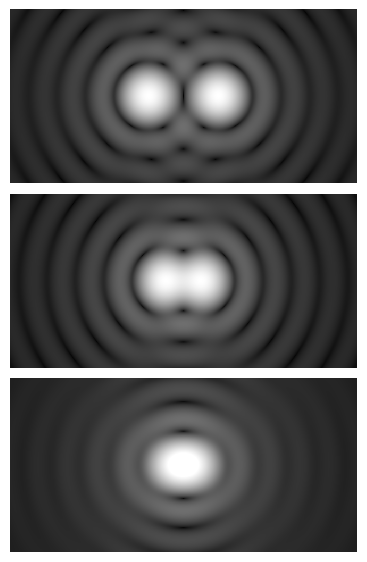
This image uses a nonlinear color scale (specifically, the fourth root) in order to better show the minima and maxima.
Attribution: Spencer Bliven
These expressions reflect different physical scenarios. In fluorescence microscopy (epi‑illumination), the specimen emits light that is collected solely by the objective, so the objective NA dominates. In brightfield transmission under well‑adjusted incoherent illumination, both the objective and condenser contribute to resolution, with the sum NAobj + NAcond appearing in Abbe’s treatment. The constants (such as 0.61) correspond to specific resolution criteria; the exact value can differ slightly with other definitions, but the dependence on λ and NA is robust.
Axial resolution
Axial or depth resolution characterizes separation along the optical axis. In widefield imaging, an approximate expression is:
Δz ∝ λ · n / NAobj2
where n is the immersion medium’s refractive index. Higher NA objectives have tighter axial PSFs (point spread functions), improving sectioning in systems that benefit from optical thinness (e.g., when near‑focus contrast is emphasized). The scaling with NA2 highlights a strong gain in axial localization with increasing NA. Note this is an order‑of‑magnitude guide; exact constants depend on the imaging modality and resolution criterion.
Contrast and the role of spatial frequencies
Alongside resolution, NA influences the modulation transfer function (MTF), which quantifies how contrast at different spatial frequencies is preserved by the imaging system. Objectives with higher NA support higher cutoff spatial frequencies and typically yield better contrast for fine details. At the same time, they may render low‑frequency shading variations differently than low‑NA objectives.
However, higher NA makes the system more sensitive to alignment, cover glass mismatch, and refractive index inhomogeneity, all of which can introduce aberrations. These complications are covered in Aberrations, Cover Glass, and Objective Corrections.
Summary: For a fixed wavelength, increasing objective NA reduces the size of the diffraction‑limited spot, increases the bandwidth of transferred detail, and strengthens contrast of the finest resolvable structures—provided illumination and specimen preparation support that detail.
Wavelength Dependence and Color: Why λ Matters
All the resolution relations include the wavelength λ. Shorter wavelengths yield smaller diffraction spots and thus better potential resolution. In transmitted white‑light imaging, shorter spectral components (blue) can carry finer detail than longer components (red). For fluorescence imaging, the emission spectrum’s effective wavelength is the relevant λ in the resolution formula.

Attribution: SiriusB
Choosing wavelengths thoughtfully
- In brightfield, blue‑biased illumination can increase apparent sharpness. This is a trade‑off with specimen absorption, color balance, and potential chromatic aberration of the optics.
- In fluorescence, the emission band of the fluorophore sets the effective λ in the resolution limit. Dyes emitting at shorter wavelengths can, in principle, support finer resolution than long‑wavelength emitters when used with the same NA.
- Chromatic corrections in objectives (achromat, fluorite/fluor, apochromat) influence how well focus and magnification are maintained across different wavelengths. See Aberrations, Cover Glass, and Objective Corrections for details.
It is also important to acknowledge that resolution formulas assume a sufficiently stable, coherent or incoherent illumination model (depending on the equation used) and high optical quality. In real instruments, chromatic residuals or specimen‑dependent refractive effects can limit performance before the theoretical cutoff is reached.
Condenser NA and Coherence: The Role of Illumination Geometry
In transmitted light microscopy, the condenser is not merely a light source delivery system—it controls the angular distribution and spatial coherence of illumination at the specimen. Together with the objective, it forms an imaging pair that determines resolution and contrast. The condenser’s NA is specified similarly to the objective’s NA and is limited by its aperture diaphragm and optical design.
Incoherent versus coherent illumination
Abbe’s theory shows that with incoherent illumination—typical of properly adjusted Köhler illumination using a sufficiently wide condenser aperture—lateral resolution scales as ~ 0.61 · λ / (NAobj + NAcond). In this regime, opening the condenser aperture to match or approach the objective NA increases the system’s passband and improves the finest resolvable detail.

Images donated as part of a GLAM collaboration with Carl Zeiss Microscopy – please contact Andy Mabbett for details.
Attribution: ZEISS Microscopy from Germany
By contrast, under coherent illumination (such as near‑collimated light or certain phase‑sensitive situations), resolution scales differently, often with a dependence closer to λ / NAobj and a distinct contrast transfer characteristic. While coherent imaging can enhance certain periodic structures via interference, it can suppress others, so interpretation requires care.
Balancing resolution and contrast with the condenser
The condenser aperture diaphragm is a practical control. Opening it increases the illumination cone (higher effective NAcond) and generally enhances resolution of fine details while reducing phase and scattering contrast for low‑frequency features. Closing it reduces the cone (lower NAcond), improving contrast for low‑contrast specimens at the expense of ultimate resolution.
These trade‑offs are common in brightfield viewing and are fully consistent with the underlying optics. For quantitative detail, revisit the interplay described in How Numerical Aperture Governs Resolution and Contrast. For axial tolerance impacts when changing NA, see Depth of Field vs. Depth of Focus.
Rule of thumb: To approach the diffraction limit in brightfield, use a condenser NA that is comparable to the objective’s NA. To boost visibility of transparent, low‑contrast specimens, reduce the condenser NA while accepting a loss in the finest detail.
Depth of Field vs. Depth of Focus: Two Sides of Axial Tolerance
Microscopists often use “depth of field” as shorthand for how much of a specimen remains acceptably sharp as the focus is moved. A distinct but related term is “depth of focus,” which describes how much axial motion is tolerated in the image space (e.g., the plane where an eyepiece focuses the intermediate image) for an acceptably sharp rendering.
Depth of field (object space)
Diffraction sets a fundamental component of depth of field. A commonly used approximate expression for the diffraction‑limited depth of field in incoherent widefield imaging is:
DOF (object) ≈ k · λ · n / NAobj2
where k is a factor that depends on the resolution criterion and coherence (often on the order of unity), λ is the wavelength, and n is the refractive index of the immersion medium. The strong 1/NA2 dependence means that high‑NA objectives inherently have very shallow depth of field. At NA ≳ 1.0, even sub‑micrometer focus shifts can be visually significant.
For coherent illumination, the proportionality factor can be about twice as large, producing a larger depth of field, but this comes with different contrast transfer characteristics than incoherent imaging, as noted in Condenser NA and Coherence.
Depth of focus (image space)
Depth of focus describes tolerance in the image plane. An approximate relationship uses a similar inverse square dependence on NA, but scaled by magnification. One insight is that higher magnification objectives (at similar NA) impose tighter axial tolerances for the image‑forming optics. In traditional viewing with eyepieces, significant defocus at the intermediate image is perceived quickly with high‑NA objectives. The key takeaway is practical: as NA increases, the focus becomes more critical on both sides of the lens.
Practical implications
- Expect shallow DOF with high‑NA oil objectives; structures above and below the focal plane will blur rapidly.
- For thick, three‑dimensional specimens, a lower NA may provide a more interpretable overview at the expense of the finest details.
- Fine focus mechanisms and stable support become more important as NA increases due to reduced axial tolerance.
The axial behavior ties into objective selection, discussed in Practical Trade‑offs: Choosing Objectives by NA and Application.
Immersion Media, Working Distance, and Refractive Index Trade‑offs
Because NA is defined as n · sin(θ), increasing the refractive index n of the immersion medium directly increases the achievable NA for a given lens geometry. This is why high‑NA objectives often require immersion with water, glycerol, or oil. Each medium brings trade‑offs in index matching, dispersion, and working distance.
Common immersion media
- Air (n ≈ 1.0): Convenient and fast. Limited NA (practically up to about 0.95 with specially designed objectives). Good for survey imaging and thick specimens with larger working distance.
- Water (n ≈ 1.33): Useful for aqueous specimens where index matching reduces spherical aberration within water‑rich samples. Enables higher NA than air at similar geometries, often with moderate working distance.
- Glycerol (n ≈ 1.47): An intermediate option for specimens in media closer to glycerol’s refractive index, helping reduce refractive mismatch through depth.
- Oil (n ≈ 1.515 for standard immersion oils): Maximizes NA in many objective designs. Good match to standard cover glass index. Provides the highest lateral resolution potential at the cost of shorter working distance and shallower DOF.

Attribution: Thebiologyprimer
Working distance and front lens geometry
Working distance is the physical distance from the objective’s front lens to the focal plane at the specimen. Higher NA objectives typically have shorter working distances because they require a wide cone of acceptance (larger θ), which, within compact optical designs, brings the front lens physically closer to the specimen. Long working distance objectives are designed to mitigate this for specific tasks, but at a given magnification, they often trade some NA to gain clearance.
Index matching and spherical aberration
Refractive index mismatches between immersion medium, cover glass, and specimen can introduce spherical aberration and defocus that worsen with depth. Index‑matched immersion objectives (e.g., water immersion for aqueous samples) can significantly improve image quality deeper into the specimen. This theme recurs in Aberrations, Cover Glass, and Objective Corrections, where cover glass thickness and correction collars are considered.
Guiding idea: Use immersion media that best match both the objective’s design and the specimen environment. This maintains the intended NA performance and minimizes aberrations.
Magnification, Useful Range, and the Myth of “More Is Better”
Magnification enlarges the image, but it does not create new detail. The usable information in a microscope image is bounded by diffraction (and aberrations), with NA and wavelength setting the finest resolvable structure. Once an image is magnified beyond the point where the blur from diffraction is already clearly sampled by your visual system, further magnification is called empty magnification.
Useful magnification
A practical rule of thumb for the human eye at the eyepiece is:
Useful total magnification range ≈ 500× to 1000× the objective NA.
For example, with an NA 0.65 objective, a total magnification in the neighborhood of 325× to 650× is usually effective for visual observation. Below that, fine detail may not be comfortably visible; above that, increased magnification mainly spreads the same blur, giving a softer image without more information.
This rule is heuristic, not a physical limit. Contrast, specimen content, and observer acuity matter. But the core idea holds: resolution is set by NA and wavelength; magnification only scales what is already there. If a high‑magnification image looks mushy, the remedy is often a higher NA, not additional magnification.
Contrast versus magnification
At the same NA, a higher magnification objective may not improve the finest resolvable spatial frequency, but it can increase the apparent visibility of small features to a viewer by spreading details over more retinal area. This perceptual benefit has limits, captured by the useful magnification range above.
For a deeper look at the physics establishing the information bandwidth, see How Numerical Aperture Governs Resolution and Contrast. For practical choices about objective selection to match your intended viewing scale, see Practical Trade‑offs: Choosing Objectives by NA and Application.
Aberrations, Cover Glass, and Objective Corrections
Real lenses deviate from the ideal due to optical aberrations. In microscopy, designers balance resolution, contrast, field flatness, chromatic correction, and working distance. Objective labels indicate correction level and intended use, which interact with NA in determining performance.
Common correction classes
- Achromat: Corrected for two wavelengths to have the same focus and typically for spherical aberration at one wavelength. Economical and widely used for routine imaging. Field curvature and chromatic residuals are greater than in higher correction classes.
- Fluorite/Fluor: Improved spherical and chromatic correction, often higher NA than achromats at the same magnification. Good contrast with better color correction—popular as a balance of performance and cost.
- Apochromat: Corrected for three or more wavelengths in focus and often for secondary spectrum and higher‑order aberrations. Frequently paired with high NA and flat‑field correction. Preferred for demanding color‑sensitive work.
- Plan (flat‑field) variants: “Plan” objectives flatten the field so that image sharpness extends toward the edges of the field of view. Plan‑achromat, plan‑fluor, and plan‑apochromat combine flatness with the respective chromatic/spherical corrections.
Cover glass thickness and correction collars
Many high‑NA objectives are designed for a specific cover glass thickness, commonly 0.17 mm (No. 1.5 coverslip) with an index around 1.52. Deviations in cover glass thickness or refractive index introduce spherical aberration that worsens with NA and with imaging depth. Correction collar objectives allow the user to adjust internal lens spacing to compensate for small variations in cover glass thickness and immersion conditions.

Attribution: PaulT (Gunther Tschuch)
- When properly adjusted, a correction collar can restore peak contrast and resolution across the field.
- Incorrect collar settings can reduce performance below that of a fixed objective at the same NA.
Field curvature and flatness
Even with excellent on‑axis correction, some objectives exhibit field curvature, where the best focus lies on a curved surface rather than a plane. Plan‑corrected objectives mitigate this so that features remain acceptably sharp across the field. While field flatness is not directly tied to NA, high‑NA plan apochromats often exemplify the most comprehensive correction suite. How this integrates with your application is discussed in Practical Trade‑offs.
Important point: Achieving the theoretical gains of higher NA presumes the objective is used with its intended coverslip thickness, immersion medium, and optical corrections.
Practical Trade‑offs: Choosing Objectives by NA and Application
Selecting the “right” objective is largely about balancing NA against field flatness, working distance, immersion compatibility, and the specimen’s optical properties. Below are practical considerations that align with the optical principles discussed above.
Consider the specimen and the task
- Transparent, low‑contrast specimens (e.g., unstained cells in aqueous media): You may prioritize contrast mechanisms and moderate NA. A condenser aperture slightly smaller than the objective’s NA can help visibility, as noted in Condenser NA and Coherence. Water immersion objectives can reduce refractive mismatch in aqueous samples.
- Fine structural detail (e.g., microfabricated features, high‑contrast line patterns): A high‑NA objective (often oil immersion) will reveal maximal line pairs per millimeter, assuming appropriate illumination as discussed in How NA Governs Resolution.
- Thick, three‑dimensional specimens: Extremely high NA may restrict the observable volume due to shallow depth of field. Moderating NA can yield a more interpretable image stack or overview, per Depth of Field vs. Depth of Focus.
Match immersion to environment
- If your sample sits under a standard coverslip in a mounting medium near the glass index, oil immersion can maximize NA and lateral resolution.
- If the sample is aqueous or prone to index mismatch with glass, water immersion reduces spherical aberration across depth, improving usable resolution even if the nominal NA is slightly lower than comparable oil objectives. This connects to the index‑matching discussion in Immersion Media, Working Distance, and Refractive Index Trade‑offs.
Balance NA and working distance
- High‑NA lenses typically have shorter working distance, which can be challenging around raised features or delicate specimens.
- Long‑working‑distance (LWD) objectives facilitate clearance but often trade absolute NA. Decide whether access or ultimate resolution is the priority.
Accounting for corrections
- For color‑critical or multi‑wavelength imaging, higher chromatic correction (fluorite or apochromat) helps ensure focus and magnification consistency across colors, tying back to Wavelength Dependence and Color.
- For wide, flat fields, plan‑corrected objectives maintain edge sharpness. If you notice corners going soft even when the center is crisp, field curvature or astigmatism may be the cause.
Condenser pairing
- To realize the full benefit of a high‑NA objective in transmitted light, use a condenser with sufficient NA and adjust the condenser aperture accordingly, per Condenser NA and Coherence.
- To emphasize overall visibility for low‑contrast samples, a modest reduction in condenser NA improves contrast at the expense of ultimate resolution, as previously noted.
Ultimately, objective selection is a matter of system balance. Reviewing the interconnected topics—NA, wavelength, condenser setting, immersion, and aberration control—will help you make a choice that aligns with the physics and the specimen’s needs.
Frequently Asked Questions
Is a 100× oil objective always higher resolution than a 60× dry objective?
Not necessarily. Resolution depends on NA and wavelength, not magnification. A 60× dry objective with a relatively high NA (e.g., around 0.85–0.95 in some designs) can outperform a 100× objective with lower NA. However, many 100× oil objectives typically have very high NA (often ≥ 1.25), enabling finer resolution than most dry objectives. The deciding factor is NA, not the numerical magnification alone. The discussion in How Numerical Aperture Governs Resolution and Contrast covers this in detail.
Why does reducing the condenser aperture increase contrast but reduce fine detail?
Closing the condenser aperture decreases the illumination cone, reducing NAcond and increasing spatial coherence. This enhances contrast for phase variations and gentle gradients, which helps visibility in low‑contrast specimens. However, from Abbe’s treatment for incoherent imaging, the highest resolvable spatial frequency depends on NAobj + NAcond. Reducing NAcond narrows the passband, attenuating the finest detail. You can revisit the underlying trade‑off in Condenser NA and Coherence.
Final Thoughts on Choosing the Right Numerical Aperture
Numerical aperture is the central lever that links the physical limits of diffraction to the real‑world experience of detail and contrast at the eyepiece. Higher NA gathers wider angles of diffracted light, shrinking the diffraction‑limited spot and extending the range of spatial frequencies conveyed by the objective. Yet NA does not act in isolation: wavelength, condenser settings, immersion medium, objective corrections, and specimen properties intertwine to set the achievable image quality.
For most observers, the most effective path to sharper, more informative images is to align these elements thoughtfully. Use wavelengths and illumination geometries that support your object of interest; choose immersion media that match the optical path; select objectives whose NA and corrections suit both the specimen and the desired field flatness and working distance. Remember that magnification is a presentation choice, not a source of new information: once you have reached the useful range, more power mainly spreads the same blur.
As you put these principles into practice, you reinforce a consistent theme across the sections above—from the definition of NA to aberration control and objective selection: the microscope is a system. Optimizing it requires understanding how each component contributes to image formation and how trade‑offs must be navigated for your specific questions.
If you found this deep dive helpful, consider subscribing to our newsletter to receive weekly, technically rigorous articles on microscope fundamentals, instrument types, accessories, and applications. Explore more topics to continue building an intuition for how light, lenses, and specimens interact—so you can make informed, physics‑grounded choices at the bench and beyond.