Table of Contents
- What Is Numerical Aperture in Microscopy?
- How Numerical Aperture Governs Resolution and Detail
- NA, Image Brightness, and Etendue Conservation
- Depth of Field and Depth of Focus Dependence on NA
- Condenser NA, Illumination Coherence, and Contrast
- Immersion Media, Refractive Index, and High‑NA Objectives
- Matching NA to Samples, Wavelengths, and Modalities
- Common Misconceptions About Numerical Aperture
- Worked Examples and Quick Calculations
- NA, Cameras, and Sampling: Pixel Size and Nyquist
- Frequently Asked Questions
- Final Thoughts on Choosing Objective NA
What Is Numerical Aperture in Microscopy?
Numerical aperture (NA) is a fundamental optical parameter that sets the performance envelope of a microscope objective and, in transmitted light systems, of the condenser as well. It quantifies the cone of light that an optical element can accept or deliver, and it directly influences resolution, brightness, and depth of field. For an objective or condenser immersed in a medium with refractive index n, the NA is defined as:

NA = n · sin(θ)
Here, θ is the half-angle of the widest cone of rays that can enter (objective) or exit (condenser) the optical element from the specimen side. Because sin(θ) is bounded by 1, the maximum NA equals the refractive index of the immersion medium, assuming the optical design supports such a cone. With air between specimen and lens (n ≈ 1.00), practical objective NAs are limited to values under ~1.0. Using immersion media with higher refractive indices, such as water (~1.33), glycerol (~1.47), or specialized immersion oils (~1.515 near the D-line in the visible spectrum), enables NA values greater than 1.0.
In a compound microscope, two NA values matter in transmitted imaging modes:
- Objective NA: Controls the collection of diffracted light from the specimen and thus largely determines the finest resolvable detail, image brightness in many modalities (notably fluorescence), and depth of field.
- Condenser NA: Controls the illumination cone incident on the specimen in transmitted-light techniques (e.g., brightfield). It strongly affects resolution, contrast, and the effective coherence of illumination. As a rule of thumb, matching or approaching the objective’s NA with the condenser (under Köhler illumination conditions) supports the highest achievable resolution in brightfield. See Condenser NA, Illumination Coherence, and Contrast for details.
NA is not magnification. High magnification with low NA only enlarges blur; high NA is what actually resolves finer spatial detail. The rest of this article unpacks how NA threads through the core performance metrics of optical microscopy, how immersion media enable higher NA, and how to choose NA appropriately for your samples and imaging goals.
How Numerical Aperture Governs Resolution and Detail
The smallest features a microscope can resolve are limited by diffraction, not solely by lens perfection. NA sits at the center of diffraction-limited resolution. In common widefield (incoherent) imaging, two widely cited criteria describe lateral (x–y) resolution: the Rayleigh criterion and the Abbe limit. Each gives similar scales but arises from slightly different definitions.
Rayleigh criterion (point resolution)
When two point-like emitters are imaged incoherently, they are considered just-resolved if the principal maximum of one Airy pattern coincides with the first minimum of the other. For light of wavelength λ (in the specimen medium of refractive index n) and an objective of NA, the lateral Rayleigh resolution Δr_R is approximately:
Δr_R ≈ 0.61 · λ / NA
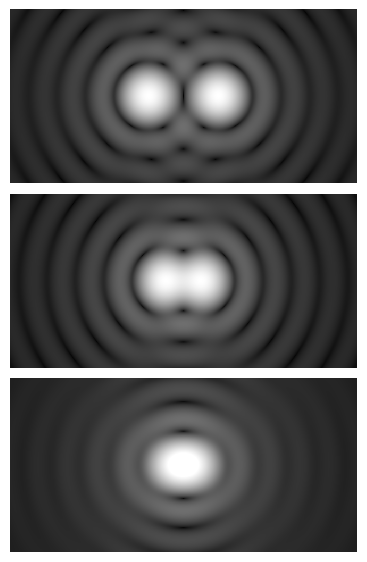
This value is proportional to wavelength and inversely proportional to NA. Shorter wavelengths and higher NA improve resolution. The Airy radius, the distance from the center of the point-spread function (PSF) to its first dark ring, is 0.61 λ/NA as well. Imaging systems that acquire incoherent intensity information (typical brightfield, epifluorescence) follow this scaling closely.
Abbe limit (periodic structure resolution)
For periodic patterns (e.g., line gratings), the Abbe limit sets the smallest resolvable period p as roughly:
p_Abbe ≈ λ / (2 · NA)
Abbe’s analysis focuses on the capture of diffracted orders by the objective. At least the 0th and one ±1 order must be collected to form an image with periodic detail. This expression is especially relevant in coherent or partially coherent illumination, where the condenser NA and the degree of coherence matter. Matching the condenser NA to approach the objective NA tends to maximize resolution in brightfield (see Condenser NA and Illumination).
Axial resolution (z-direction)
Diffraction also sets the axial resolution or optical sectioning capability. In widefield, the commonly used approximate axial resolution (distance between planes that can be discriminated) is proportional to λ and inversely proportional to NA²:
Δz_widefield ≈ 2 · n · λ / NA²
Here, n is the refractive index of the imaging medium at the specimen. This quadratic dependence on NA reflects the fact that a higher-NA lens both narrows the lateral PSF and tightens the focus axially, reducing the volume over which light is spread.
Wavelength dependence and chromatic considerations
All of the formulas above scale with wavelength. Blue light (shorter λ) resolves finer detail than red light (longer λ) for the same NA. In fluorescence, effective λ is the emission wavelength, which is typically longer than the excitation wavelength. Many objectives are corrected across parts of the visible spectrum, but resolution still varies modestly across colors because of the λ term. Objectives designated for ultraviolet or near-infrared use account for refractive index dispersion and coatings appropriate to those bands, but the functional dependence on NA and λ remains consistent.
Key takeaway: For widefield imaging, lateral resolution scales as ~
λ / NAand axial resolution scales as ~n λ / NA². NA is the main optical lever for resolving power; magnification follows, it does not lead.
NA, Image Brightness, and Etendue Conservation
Besides resolution, NA influences image brightness. Two complementary ideas help explain how: (1) the solid angle of light collection, and (2) conservation of optical throughput, often expressed via etendue or the Lagrange invariant.
Collection efficiency and solid angle
For isotropic emission from a point within a homogeneous medium of index n, an objective of half-angle θ captures a fraction of the total emission proportional to its accepted solid angle. The fractional collection (neglecting interface losses) is:
η = (1 - cos θ) / 2, where θ = arcsin(NA / n)
For small-to-moderate NA relative to n, the Taylor expansion cos θ ≈ 1 - θ²/2 yields η ≈ (θ²)/4 ≈ (NA²)/(4 n²). This shows a roughly quadratic increase of collection efficiency with NA in fluorescence and other emission-limited modalities. Practically, moving from NA 0.7 to NA 1.4 can increase the captured fluorescence signal by a factor on the order of 4 (since (1.4/0.7)² = 4), absent other losses.
Illumination brightness in transmitted light
In brightfield and other transmitted-light modes, the condenser NA controls how much illumination solid angle reaches the specimen. Under Köhler illumination, raising the condenser NA increases illumination brightness and supports higher-resolution transfer up to the objective’s NA. However, once the condenser NA approaches the objective NA, further increases do not improve resolution and may reduce contrast in low-relief samples. Proper matching is key.
Etendue and the role of magnification
Optical systems conserve etendue (throughput), the product of area and solid angle in a refractive medium, often expressed as G ∝ A · n² · Ω. This conservation implies trade-offs among field size, NA, and magnification. Image irradiance on a sensor scales roughly with (NA / M)² for an ideal system, where M is objective magnification. In other words, if you keep NA fixed and increase magnification, the image becomes dimmer on a per-pixel basis because the same light is spread over a larger image.
In fluorescence especially, both the excitation and emission pathways are influenced by NA. A higher-NA objective can deliver a larger range of incident angles to the specimen (if the condenser or epi-illumination supports it) and collect more emission. This typically improves signal but narrows depth of field (see Depth of Field), calling for careful exposure and sampling choices (see Cameras and Sampling).
Depth of Field and Depth of Focus Dependence on NA
NA powerfully shapes the three-dimensional character of imaging: how thin the in-focus slab is within the specimen (depth of field), and how tolerant the system is to focus shift at the sensor (depth of focus). Though related, these are distinct concepts that live on opposite sides of the lens.
Depth of field (object space)
Depth of field (DOF) describes the axial thickness in the specimen over which features appear acceptably sharp. For a diffraction-limited widefield system focusing into a medium of refractive index n, the diffraction-limited component of DOF scales approximately as:
DOF_diffraction ≈ 2 · n · λ / NA²
The NA² in the denominator means high-NA objectives have very shallow DOF. In many practical cases, there is an additional term related to the detector or display resolving power (sometimes called the circle-of-confusion term), which increases DOF modestly when sampling is coarse. A simplified form that combines diffraction and sampling contributions can be written as:
DOF ≈ 2 · n · λ / NA² + 2 · n · e / (M · NA)
where e is the effective resolution element at the sensor (e.g., pixel size), projected to object space by M. The first term dominates at high NA with fine sampling. The second term becomes relevant when pixels are large or magnification is low (see Sampling).
Depth of focus (image space)
Depth of focus refers to the allowable defocus range at the sensor where the image remains acceptably sharp. It depends on the imaging-side f-number of the objective. For microscope objectives, the effective f-number is approximately N ≈ M / (2 · NA). A commonly used diffraction-limited estimate of image-side depth of focus is:
DoFocus ≈ ± 2 · λ · N² ≈ ± λ · M² / (2 · NA²)
This relation explains why higher magnification at the same NA tightens focus tolerance at the camera: the M² factor shrinks the axial latitude at the sensor. Stable mounts, precise focus drives, and, when needed, fine axial sampling are therefore important companions to high-NA, high-M objectives.
Quick intuition: Double the NA and, very roughly, lateral resolution improves by 2× while the diffraction-limited DOF shrinks by ~4×. This is why high-NA lenses produce crisp detail but require careful focusing and often thinner specimens or optical sectioning.
Condenser NA, Illumination Coherence, and Contrast
In transmitted-light techniques, the condenser is the illumination counterpart to the objective. Its NA sets the angular distribution of light arriving at the specimen, shaping resolution, contrast, and the effective coherence of illumination.

Matching NA for brightfield resolution
For brightfield under Köhler illumination, a good starting point is to set the condenser NA in the neighborhood of the objective NA, commonly a fraction like 70–100% depending on specimen and preference for contrast versus resolution. When the condenser NA is too low relative to the objective NA, high spatial frequencies present in the specimen are not sufficiently illuminated and thus cannot be transferred. When it is too high, glare and reduced phase contrast can make low-relief specimens look flat. Balancing these effects aligns with the Abbe view of resolution from diffracted orders and the role of the illumination cone.
Coherence considerations
Illumination coherence affects image formation. A small condenser aperture (low condenser NA) increases spatial coherence, which can boost phase-like contrast of thin, low-absorption features but tends to exaggerate diffraction fringes and reduce ultimate resolution. Opening the condenser aperture (higher NA) reduces spatial coherence, supporting higher resolution and smoother intensity renderings but may lower inherent contrast on weakly absorbing samples. This trade-off connects directly to the periodic resolution discussion in How NA Governs Resolution.
Other modalities that depend on condenser NA
Several contrast techniques (e.g., oblique illumination, Rheinberg, and certain darkfield implementations) depend critically on condenser NA and apertures. While the objective NA bounds the detection side, the condenser NA steers which spatial frequencies are launched into the specimen. Proper alignment and diaphragm settings are therefore not mere housekeeping; they are central to achieving the spatial-frequency support that your objective NA can, in principle, transfer.
Immersion Media, Refractive Index, and High‑NA Objectives
NA depends on both the acceptance angle and the refractive index of the medium between the objective front lens and the specimen. Because NA = n · sin θ, raising n increases the maximum attainable NA without demanding impractically large θ. This is the motivation for immersion objectives.

Common immersion media
- Air (n ≈ 1.00): Used for low-to-moderate NA objectives. Convenient and compatible with uncovered specimens, but limited in ultimate NA.
- Water (n ≈ 1.33): Well-matched to aqueous specimens and live cells embedded in water-based media. Reduces spherical aberration when focusing deeper into water-rich samples because it reduces refractive index mismatch at the interface.
- Glycerol (n ≈ 1.47): Intermediate between water and oil. Often used to better match the refractive index of thick, cleared, or glycerol-mounted specimens, mitigating spherical aberration at depth.
- Immersion oil (commonly n ≈ 1.515 at visible wavelengths): Designed to match standard cover glass refractive index and support the highest NAs in routine widefield and fluorescence applications near room temperature.
Coverslip thickness and spherical aberration
High-NA objectives are sensitive to the refractive index and thickness of the glass they image through. Most high-NA objectives are specified for a particular cover glass thickness (e.g., 0.17 mm, often denoted 170 µm or #1.5). Deviating from the specified thickness or refractive index introduces spherical aberration, which broadens the PSF and degrades both resolution and contrast. Some objectives include a correction collar to compensate over a range of cover glass thicknesses and specimen depths.

NA greater than 1.0 and total internal reflection
It is perfectly consistent with physics to have NA > 1 because the definition uses the refractive index of the immersion medium. When the specimen and front lens are coupled through a medium of n > 1, the maximum half-angle θ can approach arcsin(1), and thus NA can approach n. However, if there is a refractive index mismatch at an interface between the specimen and the immersion medium, high-angle rays may suffer refraction or total internal reflection, limiting the effective NA. Careful selection of immersion media compatible with the specimen and coverslip helps preserve the designed high-NA performance.
For practical guidance on which NA to use in different contexts, see Matching NA to Samples, Wavelengths, and Modalities.
Matching NA to Samples, Wavelengths, and Modalities
Choosing objective NA is about balancing resolution, brightness, working distance, field flatness, and tolerance to aberrations introduced by the specimen and mounting medium. Here are principles to help you navigate these trade-offs for a variety of educational and hobbyist contexts.
Sample thickness and refractive index structure
- Thin, near-planar specimens under coverslips: If your specimen is thin and well mounted under a standard cover glass, high-NA oil objectives often deliver the finest detail with minimal aberration when the coverslip specification matches the objective. For aqueous samples, high-NA water immersion objectives can reduce spherical aberration and improve axial resolution.
- Thicker, refractively heterogeneous specimens: High NA is more sensitive to index mismatch and scattering. For thicker samples, a slightly lower NA can produce more usable images by trading some resolution for greater DOF and reduced aberration sensitivity, especially if you cannot match immersion medium to specimen index.
Wavelength and spectral bands
- Shorter wavelengths resolve finer details at a given NA due to the
λfactor. However, some optical materials exhibit higher loss or dispersion at shorter wavelengths, and specimens may be more light-sensitive at these bands. - Emission bands in fluorescence: Resolution scales with the emission wavelength, not excitation. If you switch between fluorophores, expect modest changes in resolution and adjust sampling accordingly (see Pixel Size and Nyquist).
Contrast mechanisms and coherence
- Brightfield: Matching condenser NA to objective NA promotes resolution. Slightly reducing condenser NA can enhance contrast in low-relief samples at the cost of fine detail.
- Fluorescence: High NA strongly benefits both signal collection and resolution. Objectives optimized for fluorescence typically prioritize high transmission and minimal autofluorescence.
- Reflected-light (epi) imaging: Similar NA principles apply; reflectivity and surface curvature of the specimen affect apparent contrast, and high-NA epi-illumination improves lateral resolution.
Working distance and field considerations
Higher NA often comes with shorter working distance (WD) and smaller field numbers. If your specimens are uneven, thick, or enclosed (e.g., in a slide well), ensure the objective’s WD accommodates the geometry. For survey work over large fields, a moderate NA with good field flatness can be more practical than a very high NA optimized for a small, high-resolution field.
Stability and focusing demands
As NA increases, the axial range over which the image is sharp diminishes rapidly (see Depth of Field). This amplifies the need for precise focusing mechanisms and stable sample mounting. If your setup or environment is subject to vibration or temperature drift, a moderate NA may yield more consistent results.
Common Misconceptions About Numerical Aperture
Numerical aperture is widely referenced, but several misconceptions can lead to confusion or misapplication. Clarifying these points helps you make better choices about objectives, condensers, and imaging parameters.
- “Magnification determines resolution.” False. Resolution is governed primarily by NA and wavelength. Magnification only enlarges the image; if NA is low, higher magnification increases blur size without revealing more detail. See Resolution.
- “NA values add directly between condenser and objective.” Misleading. Objective NA and condenser NA serve different roles. You do not sum them. The objective NA sets the detection side bandwidth; the condenser NA sets illumination bandwidth and coherence. Matching them for brightfield supports maximum resolvable spatial frequency, but they are not arithmetically combined.
- “NA > 1 violates physics.” Incorrect. NA is defined with the refractive index of the immersion medium. With oil or water immersion,
NA > 1is both common and physically consistent. See Immersion Media. - “Shorter wavelengths are always better.” Not necessarily. While shorter
λimproves resolution at fixed NA, other factors—specimen sensitivity, optical transmission, scattering, and chromatic aberration—also matter. Practical imaging quality is a balance. - “Any coverslip works with high-NA oil objectives.” Risky. High-NA objectives are designed for specific cover glass thickness and refractive index. Mismatch introduces spherical aberration that degrades resolution and contrast. Use the specified coverslip class and consider objectives with correction collars when variability is expected (see Immersion).
- “Fully opening the condenser aperture always improves the image.” Sometimes it reduces contrast, especially with low-relief specimens. A slightly reduced condenser NA can improve visibility of features at the cost of some high-frequency transfer. Optimize based on your sample (see Condenser NA and Contrast).
Worked Examples and Quick Calculations
The relationships among NA, wavelength, resolution, and depth can be made concrete with a few calculations. These examples use common approximations suitable for planning and educational understanding.
Example 1: Lateral resolution at different NAs
Suppose you are imaging with green light at λ = 550 nm (0.55 µm). Using the Rayleigh criterion:
- NA = 0.65 (air objective):
Δr_R ≈ 0.61 × 0.55 µm / 0.65 ≈ 0.516 µm - NA = 1.00 (air limit):
Δr_R ≈ 0.61 × 0.55 µm / 1.00 ≈ 0.336 µm - NA = 1.40 (oil immersion):
Δr_R ≈ 0.61 × 0.55 µm / 1.40 ≈ 0.240 µm
Moving from NA 0.65 to 1.40 improves lateral resolution by a factor of about 0.516/0.240 ≈ 2.15.
Example 2: Axial resolution in widefield
Using the approximate axial resolution Δz ≈ 2 n λ / NA², assume an immersion oil index n = 1.515 and λ = 550 nm:
- NA = 1.00:
Δz ≈ 2 × 1.515 × 0.55 µm / (1.00)² ≈ 1.67 µm - NA = 1.40:
Δz ≈ 2 × 1.515 × 0.55 µm / (1.40)² ≈ 0.85 µm
Higher NA notably tightens axial resolution, which improves optical sectioning in widefield stacks and benefits deconvolution results when sampling is appropriate.
Example 3: Fluorescence collection efficiency
Consider isotropic emission within an immersion medium of n = 1.33 (water). For a water-immersion objective with NA = 1.00, the half-angle is θ = arcsin(NA/n) = arcsin(1.00/1.33) ≈ 48.75°. The captured fraction is η = (1 - cos θ)/2 ≈ (1 - 0.66)/2 ≈ 0.17, or 17% (ignoring interface and coating losses). If you move to NA = 1.20: θ = arcsin(1.20/1.33) ≈ 64.16°, η ≈ (1 - 0.44)/2 ≈ 0.28, or 28%. This underscores the sensitivity of emission collection to NA.
Example 4: Depth of focus at the camera
With λ = 550 nm, NA = 1.40, and magnification M = 60×, the depth of focus estimate is:
DoFocus ≈ ± λ · M² / (2 · NA²) ≈ ± 0.55 µm × 3600 / (2 × 1.96) ≈ ± 505 µm
This value is the tolerance at the image plane, i.e., how much the camera can move axially and maintain acceptable sharpness. It is not the object-space DOF; it reflects the geometry at high magnification. The object-space DOF for the same system (from the earlier example) is below a micron.
Quick-planning snippets
The following snippets show how one might codify planning calculations in a general-purpose scripting language. They are not prescriptions, but they illustrate how to tie NA, wavelength, and sampling together.
# Given: wavelength (lambda in micrometers), NA, refractive index n, magnification M
# Returns: Rayleigh lateral resolution, axial widefield resolution, and image-side depth of focus

def microscopy_metrics(lam_um, NA, n, M):
    rayleigh_xy = 0.61 * lam_um / NA
    axial_wf = 2.0 * n * lam_um / (NA**2)
    depth_of_focus_image = lam_um * (M**2) / (2.0 * (NA**2))
    return rayleigh_xy, axial_wf, depth_of_focus_image

# Example usage (λ=0.55 µm, NA=1.4, n=1.515, M=60)
xy, z, dof_img = microscopy_metrics(0.55, 1.4, 1.515, 60)
print(xy, z, dof_img)
To include the effect of sampling at object space, you can incorporate pixel size p (µm) at the sensor and compute the projected sampling interval at the specimen as p / M. For Nyquist sampling guidance, see NA, Cameras, and Sampling.
NA, Cameras, and Sampling: Pixel Size and Nyquist
Resolution predicted by NA and wavelength must be supported by adequate sampling at the camera. If pixels are too large relative to the finest resolvable detail, the image will be undersampled—fine structure will alias, and you will not realize the optical resolution benefit of high NA.
Sampling limits for incoherent imaging
For widefield incoherent imaging, the optical transfer function has a spatial-frequency cutoff around f_c ≈ 2 · NA / λ (in line pairs per micrometer if λ is in micrometers). To satisfy the Nyquist criterion, the sampling interval at the specimen must be at most half the period corresponding to f_c:
Δx_sample ≤ 1 / (2 · f_c) = λ / (4 · NA)
Equivalently, the camera’s pixel size p divided by magnification M (i.e., p/M) should be:
p / M ≤ λ / (4 · NA)
Many practitioners aim somewhat finer (e.g., 2–3 samples across the Airy radius 0.61 λ/NA), which corresponds to p/M ≈ (0.2–0.3) · λ/NA. This oversampling improves deconvolution performance and reduces interpolation error but increases data volume and may decrease per-pixel SNR for a given exposure.
Worked sampling example
Suppose NA = 1.40, λ = 550 nm, and you have a camera with p = 6.5 µm pixels. What magnification M meets Nyquist?
From p/M ≤ λ/(4NA), the right-hand side is 0.55 µm / (4 × 1.40) ≈ 0.098 µm. Solving 6.5 µm / M ≤ 0.098 µm gives M ≥ 66.3×. A 60× objective would slightly undersample at 550 nm; a 100× objective would meet the criterion with margin. Alternatively, inserting an optically appropriate 1.5× auxiliary magnifier with the 60× objective would also satisfy Nyquist at the given wavelength.
Trade-offs: field, SNR, and exposure
Finer sampling (higher M or smaller p) reduces the field of view and distributes signal photons across more pixels, which can impact per-pixel SNR if the total collected light and exposure time are held constant. High NA can help offset this by increasing photon collection (see Brightness), but at the cost of shallower DOF and stricter focus tolerances. Balancing NA, magnification, pixel size, and exposure is therefore central to practical image quality.
Color channels and sampling
If you image at multiple wavelengths (e.g., RGB or different fluorophores), the Nyquist condition varies slightly because λ changes. To maintain consistent sampling across channels, plan for the shortest wavelength you intend to image, which has the highest cutoff spatial frequency. This avoids undersampling in the blue channel, for instance, when using the same hardware configuration.
Frequently Asked Questions
Is higher NA always better?
Higher NA improves resolution and, in many modalities, boosts signal collection. However, the trade-offs are real: shallower depth of field, higher sensitivity to spherical aberration from refractive index mismatch, often shorter working distance, and stricter requirements for sampling and focus stability. For thin, well-mounted specimens and fluorescence, higher NA is frequently advantageous. For thick, scattering, or uneven samples, a moderate NA may produce more interpretable images and a more forgiving workflow. See Matching NA to Samples.
Can I use an oil-immersion objective without oil?
Using an oil-immersion objective dry (without the specified immersion medium) significantly degrades performance. The objective is designed assuming a particular refractive index and coverslip configuration at its front aperture. Without the intended immersion medium, the acceptance cone is mismatched and spherical aberration increases, reducing resolution and contrast. To achieve the labeled NA and corrected imaging, use the immersion medium and coverslip specification the objective was designed for. For aqueous samples where oil is not appropriate, consider water- or glycerol-immersion objectives designed for those conditions. See Immersion Media.
Final Thoughts on Choosing Objective NA

Numerical aperture is the central optical statistic for microscopes. It determines the finest detail your system can transfer, how bright the image can be in emission-limited modalities, and how thin the in-focus slab is within your specimen. The essential scalings are straightforward but powerful: lateral resolution ~λ/NA and axial resolution ~n λ/NA². The condenser’s NA complements the objective—particularly in transmitted light—by setting the illumination cone and effective coherence (details here).
When planning a setup or selecting an objective, consider:
- The specimen’s thickness, refractive index environment, and susceptibility to aberrations (guiding your choice among air, water, glycerol, or oil; see Immersion Media).
- Your imaging wavelength(s) and the sampling strategy at the camera, aligning pixels and magnification with Nyquist (Cameras and Sampling).
- The balance between ultimate resolution and practical contrast, depth of field, and working distance (Matching NA to Samples).
By grounding choices in NA and its relationships, you avoid the trap of chasing magnification without resolving power and instead build systems that deliver crisp, information-rich images. If you found this deep dive useful, consider subscribing to our newsletter to receive future fundamentals, technique primers, and practical microscopy insights straight to your inbox.