Table of Contents
- What Is Numerical Aperture in Microscopy?
- Resolution vs. Magnification: The Abbe and Rayleigh Criteria
- How Contrast and Coherence Influence What You Resolve
- Objective Lens Parameters: NA, Immersion, Working Distance, and Field
- Choosing Objective NA for Real Samples and Modalities
- Measurement, Calibration, and Digital Sampling
- Common Misconceptions About NA, Magnification, and Resolution
- Frequently Asked Questions
- Final Thoughts on Choosing the Right Numerical Aperture
What Is Numerical Aperture in Microscopy?
Attribution: Rama
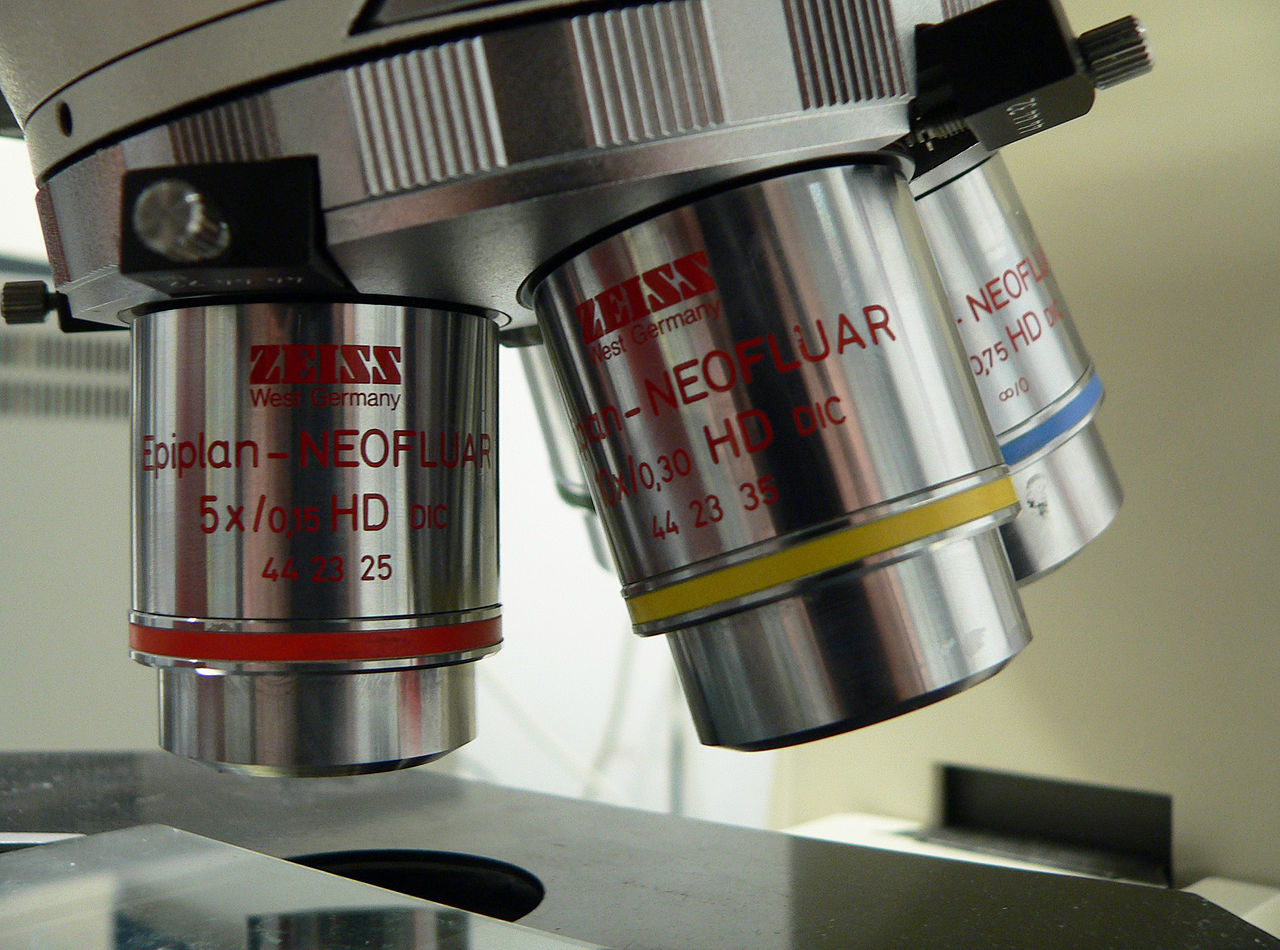
Numerical aperture (NA) is a core property of microscope optics that sets the stage for how much detail you can see, how bright your images appear, and how thin your focal slice becomes. If you remember only one number about a microscope objective, make it the NA. It captures how widely the lens accepts or emits light and, by extension, how finely it can resolve structure.
Formally, the numerical aperture of an objective is defined as:
NA = n sin(θ)
Attribution: Ice Boy Tell
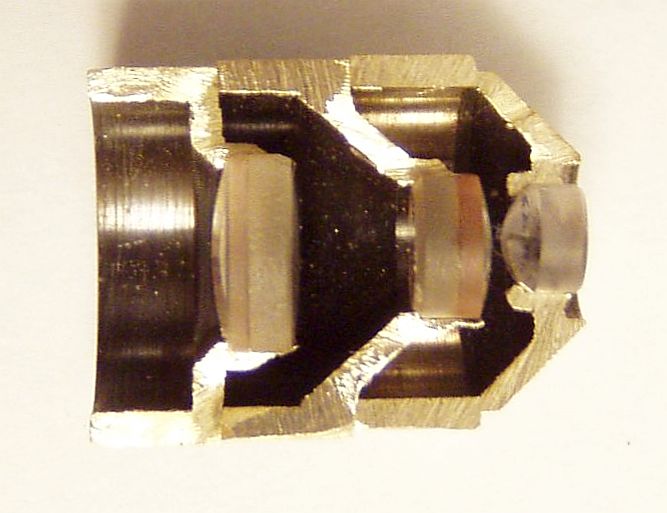
where n is the refractive index of the medium between the specimen and the objective’s front lens (air, water, glycerol, or immersion oil) and θ is half the angular extent of the objective’s collection cone. A larger NA means the lens accepts light at steeper angles, capturing higher spatial frequencies (finer details) and more light.
Two immediate consequences follow from this definition:
- Higher refractive index allows higher NA. Oil immersion objectives (with oil at ~1.515 refractive index) can reach NAs noticeably larger than air objectives (air is ~1.00), enabling finer resolution.
- Higher collection angles improve resolution. As θ increases, sin(θ) increases, raising NA. Geometrically, this means the lens gathers light from a wider cone above the specimen.
In transmitted light microscopy, there is a second NA worth noting: the condenser NA, which describes the illumination cone arriving at the sample. While this article focuses on objective NA, the condenser NA also influences contrast and the maximum spatial frequencies that can be transferred in brightfield imaging. For the highest detail in brightfield, the condenser NA should be comparable to the objective NA, then fine-tuned using the condenser aperture diaphragm for the desired contrast. We expand on how coherence and contrast interact with resolution in How Contrast and Coherence Influence What You Resolve.
Acceptance cone (half-angle θ)

        \ | /
         \|/
          *   <-- specimen plane
         /|\
        / | \

NA = n sin(θ)
Because NA directly governs lateral and axial resolution, and influences image brightness and depth of field, it sits at the center of nearly every practical decision you’ll make about microscope objectives. The sections that follow connect this single parameter to resolution limits, contrast, sampling, and real-world trade-offs.
Resolution vs. Magnification: The Abbe and Rayleigh Criteria
Magnification tells you how large the image appears. Resolution tells you how close two points can be while still appearing distinct. In microscopy, resolution—not magnification—governs the smallest usable detail. NA and wavelength determine resolution; magnification only scales the resolved detail up to a comfortable viewing or sampling size. This section clarifies the standard criteria that link NA to the finest resolvable detail.
Abbe’s diffraction limit for periodic structures
For incoherent widefield imaging (common in brightfield and fluorescence), the Abbe limit for lateral resolution of periodic structures can be written as:
d ≈ λ / (2 NA)
Here, d is the smallest resolvable period (distance from one line to the next in a grating-like pattern), and λ is the wavelength of light in the medium. As NA increases, d decreases, and finer spatial periods can be resolved.
For coherent imaging of amplitude objects, the cutoff shifts, and the smallest resolvable period becomes on the order of λ / NA, reflecting the different transfer of spatial frequencies under coherent illumination. Many practical systems operate under partial coherence, so quantitative limits depend on the specifics of the illumination and detection.
Rayleigh criterion for point-like objects
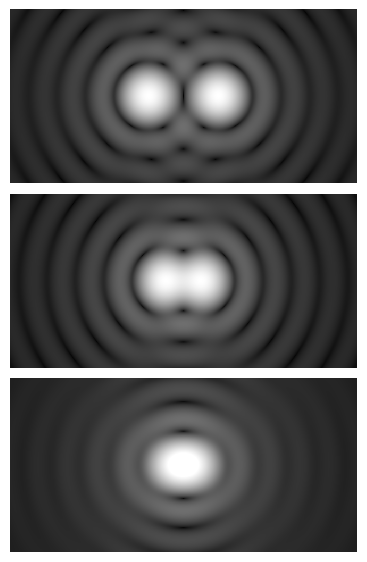
When considering point-like emitters or small features, the Rayleigh criterion provides a widely used rule of thumb for lateral resolution in incoherent imaging:
δ ≈ 0.61 λ / NA
Attribution: Spencer Bliven
The factor 0.61 arises from the first minimum of the Airy pattern. This expression is consistent with the Abbe limit in giving tighter resolution with larger NA and shorter wavelength. Note that the precise constant depends on the chosen resolution criterion (Rayleigh, Sparrow, full-width at half-maximum), but the proportionality to λ / NA is the key takeaway.
Axial (depth) resolution and depth of field
Axial resolution refers to how finely you can separate structures along the optical axis. In widefield microscopy, a common scaling relation is:
δz ∝ n λ / NA2
where n is the refractive index of the immersion medium. The specific constant depends on the imaging modality and criterion, but the inverse square dependence on NA is the crucial point: axial resolution improves very rapidly as NA increases. This same inverse square relationship informs depth of field (the thickness of the specimen that appears in acceptable focus). As NA increases, depth of field decreases, giving thinner optical sections but demanding more careful focus control.
Magnification’s supporting role
Magnification does not change the diffraction limit; it simply scales the image. Too little total magnification wastes your objective’s resolution (details are present in the light but not sampled finely enough), while too much magnification yields an image that is larger but not more detailed—so-called “empty magnification.” For digital imaging, “just-enough magnification” is the amount that projects the diffraction-limited detail onto camera pixels at or above the Nyquist sampling requirement. We work through this calculation in Measurement, Calibration, and Digital Sampling.
In summary, if you want more detail, increase NA or use shorter wavelengths; if you need a bigger image, increase magnification. Confusing these two levers is one of the most common pitfalls in practical microscopy.
How Contrast and Coherence Influence What You Resolve
Resolution criteria assume you can detect small differences between adjacent features—i.e., that you have contrast. NA sets the cutoff in spatial frequencies your optics can pass, but the visibility of those frequencies depends on illumination coherence, specimen properties, and the imaging modality. This section sketches how coherence and contrast mechanisms interact with the diffraction limit.
Coherence and the optical transfer function
Incoherent imaging (typical for fluorescence and most brightfield setups with diffused illumination) has a higher cutoff spatial frequency than coherent imaging. Qualitatively:
- Incoherent imaging transfers spatial frequencies up to roughly 2 NA / λ, consistent with the Abbe limit d ≈ λ / (2 NA).
- Coherent imaging transfers spatial frequencies up to roughly NA / λ, meaning its cutoff is about half that of the incoherent case.
This difference arises from the way intensities (incoherent) or fields (coherent) combine. In practice, many systems operate in partial coherence. As you adjust the condenser aperture in brightfield, you move between more coherent (smaller aperture) and more incoherent (larger aperture) illumination. A wide condenser aperture increases resolution potential but can reduce edge contrast, while a smaller aperture increases contrast at the expense of the highest spatial frequencies. Matching condenser NA to objective NA, then fine-tuning, is standard practice in brightfield.

Images donated as part of a GLAM collaboration with Carl Zeiss Microscopy – please contact Andy Mabbett for details.
Attribution: ZEISS Microscopy
The optical transfer function (OTF) and its magnitude, the modulation transfer function (MTF), quantify how spatial frequencies are transmitted by the system. Even below the cutoff, contrast declines with increasing spatial frequency. As a result, features that are nominally “resolvable” by the cutoff criterion may appear low in contrast or noisy unless exposure or detection sensitivity is adequate.
Phase objects and contrast techniques
Many biological specimens are nearly transparent and primarily shift the phase of transmitted light. Techniques such as phase contrast and differential interference contrast (DIC) convert phase gradients into intensity differences, dramatically improving visibility without changing NA. These methods largely preserve the underlying diffraction limit set by NA and wavelength. They enhance detectability (contrast), not the fundamental cutoff frequency. When comparing images across modalities, keep in mind that improved contrast can make details appear sharper even though the diffraction limit is unchanged.
Fluorescence emission and collection efficiency
In epifluorescence, the specimen emits light isotropically (within the refractive index constraints). The objective both focuses excitation light onto the specimen and collects emitted photons. The fraction of isotropic emission collected increases with NA; for small collection angles, the collected fraction scales approximately with NA2 relative to the refractive index. This makes high-NA objectives especially valuable for dim fluorophores: they improve both resolution and signal collection efficiency, albeit with a thinner depth of field.
Keep in mind that fluorescence signal is also influenced by excitation intensity, fluorophore properties, filter transmission, and detector sensitivity. NA is just one part—though a very important one—of that chain.
Objective Lens Parameters: NA, Immersion, Working Distance, and Field
www.micro-shop.zeiss.com/
Attribution: ZEISS Microscopy
Choosing an objective is about finding the right bundle of trade-offs. NA interacts with immersion medium, working distance, chromatic correction, field flatness, and cover glass tolerance. Understanding this cluster of specifications helps you pick the lens that actually suits your specimen and modality.
Immersion medium and refractive index
- Air objectives use n ≈ 1.00. They are convenient and compatible with most dry samples. Maximum NA is limited by the refractive index of air.
- Water immersion objectives use n ≈ 1.33. They reduce refractive index mismatch for aqueous specimens, improving axial resolution and reducing spherical aberration in thick, water-based samples.
- Glycerol immersion objectives use n ≈ 1.47. They help bridge the index gap between water and oil, useful for specimens mounted in media near that index.
- Oil immersion objectives use n ≈ 1.515 (typical immersion oil). They enable the highest NA values for high-resolution imaging of thin specimens under #1.5 cover glasses.
Changing immersion medium changes both the achievable NA and how the system tolerates refractive index mismatches. Don’t treat immersion as an afterthought; it is integral to the optical design.
Working distance and NA trade-offs
Working distance (WD) is the physical gap between the front lens and the specimen at focus. As a rule of thumb:
- Higher NA often means shorter working distance. Collecting steep rays requires the front lens to be close to the specimen.
- Long working distance objectives can be invaluable for thick samples or when clearance is needed, but WD typically increases as NA decreases at a given magnification.
Balance WD against your sample geometry. If you need to image through a microfluidic device or a thick coverslip stack, a lower NA but longer WD objective may outperform a higher NA lens that cannot reach the focal plane without collision or aberration penalties.
Chromatic and field corrections
- Chromatic correction handles different wavelengths focusing at slightly different planes. Common tiers include achromat, fluorite (semi-apochromat), and apochromat designs, with increasing chromatic correction across the visible range.
- Field flatness is addressed by “Plan” objectives, which correct field curvature so the image is sharp across the field of view. This is especially important for large sensors.
These design features don’t change the NA, but they affect how well the lens delivers performance across colors and across the entire field. A high-NA lens with poor field flatness may be exquisite at the center but disappointing at the edges on a large camera sensor.
Cover glass thickness and correction collars
Many high-NA objectives are designed for a specific cover glass thickness (often 0.17 mm, commonly labeled as #1.5). Deviating from the designed thickness or refractive index can introduce spherical aberration, degrading resolution and contrast—particularly in the axial direction. Some objectives include a correction collar that lets you adjust for cover glass deviations and specimen depths. If your specimen or mounting medium is atypical, a collar can be the difference between theoretical and real performance.
Field number and total field of view
On eyepiece-based systems, the field number (FN) describes the diameter of the image at the intermediate image plane. In camera-based systems, sensor size (and relay optics if present) sets the field of view. Neither FN nor sensor size changes the diffraction limit, but they influence how much of the specimen you see at once and the sampling density across that field. See Measurement, Calibration, and Digital Sampling for guidance on matching field coverage to pixel sampling.
Choosing Objective NA for Real Samples and Modalities
Selecting NA is ultimately about matching optical performance to specimen and modality. The right choice balances resolution, signal, depth, and practical constraints like working distance and immersion.
Brightfield and stained specimens
For well-stained thin sections, higher NA improves resolution and contrast of fine structures. A high-NA oil objective designed for cover glass imaging will reveal the smallest details, provided the condenser NA is appropriately opened and the system is well aligned. For thicker or uneven samples, consider slightly lower NA to gain depth of field and tolerance to specimen height variations.
Unstained, phase-rich samples
For transparent specimens (e.g., live cells in aqueous media), contrast techniques like phase contrast or DIC are highly effective. NA still sets the diffraction-limited resolution, but the modality makes phase features visible. Water immersion objectives can reduce refractive index mismatches in aqueous preparations, improving axial resolution and reducing blur from spherical aberrations as you focus deeper.
Epifluorescence imaging
Signal collection benefits strongly from higher NA since more emitted photons are gathered. If your fluorophores are dim or you need short exposures, a high-NA objective can be decisive. Oil immersion objectives offer high NA for thin, coverglass-mounted samples. For live, aqueous specimens, water immersion can be advantageous due to index matching, even if the NA is somewhat lower than the highest oil objectives. If you image deeper into cleared or index-matched tissues, objectives designed for the appropriate refractive index can substantially improve resolution and contrast at depth.
Thick samples and 3D structures
High NA gives thin optical sections but at the cost of a shallow depth of field and susceptibility to aberrations if the sample or mount deviates from the design conditions. In thick, scattering samples, there is a practical limit to the useful NA because high-angle rays suffer more from aberrations and scattering. Moderate NA can sometimes yield better overall image quality across depth. When your experiment requires large depth coverage, a lower NA objective with longer working distance may be optimal.
Low-light or low-contrast samples
Even in non-fluorescent modalities, high NA tends to increase image irradiance at the detector for a given source luminance and optical configuration, because the lens accepts more light from each point in the specimen. The exact scaling depends on the system, but the qualitative trend is clear: at the same exposure conditions, higher NA generally helps signal-to-noise, particularly for small features. Keep in mind that increased NA also tightens focus, so slight misfocus can undo the gain.
Matching NA to practical constraints
- Sample safety and handling. If immersion contact risks disturbing the sample, an air objective may be safer even if its NA is lower.
- Working distance. If you need to image through thick holders or microfluidic devices, ensure the objective can physically reach focus without collision.
- Mounting media. Try to match the objective’s design index and cover glass thickness to your mounting conditions or use a correction collar to compensate.
- Budget and versatility. In many educational or multi-user settings, a well-corrected, moderate-NA objective can cover most tasks effectively.
As you weigh these factors, revisit the theory in Resolution vs. Magnification: The Abbe and Rayleigh Criteria and the practicalities in Objective Lens Parameters to make a choice grounded in both physics and workflow.
Measurement, Calibration, and Digital Sampling
Modern microscopy often ends at a digital sensor. To preserve the resolution your NA allows, the detector must sample the optical image densely enough, and measurements must be calibrated against known scales. This section provides a practical roadmap.
Calibrating pixel size at the specimen plane
Your camera has a physical pixel pitch (e.g., 3.45 µm). Through the objective and tube lens, each camera pixel corresponds to some distance at the specimen. The effective pixel size at the specimen is approximately:
peff = pcam / Mtotal
where Mtotal is the total lateral magnification from specimen to sensor. If your system uses an infinity-corrected objective with a specified magnification (e.g., 20×) and a tube lens of the manufacturer’s standard focal length, then the objective’s labeled magnification usually equals the magnification at the sensor. If you use a different tube lens focal length or additional relay optics, compute the actual magnification accordingly.
To calibrate measurements, image a stage micrometer or a calibration slide with known spacing and determine how many pixels correspond to a known distance. This empirical calibration accounts for any relay optics and provides a reliable pixel-to-micron conversion factor. Recalibrate whenever you change objectives or optical components that affect magnification.
Nyquist sampling of diffraction-limited detail
To faithfully capture the finest detail your optics provide, the camera should sample at least twice the highest spatial frequency in the image (Nyquist criterion). For a diffraction-limited system governed by the Rayleigh criterion, a practical guideline is to aim for approximately 2–3 pixels across the smallest resolvable feature.
Using the Rayleigh expression for lateral resolution δ ≈ 0.61 λ / NA, one convenient approach is:
- Estimate δ from your wavelength and NA.
- Choose peff ≤ δ / 2 (Nyquist) or, more conservatively, peff ≈ δ / 3 for better sampling.
- Compute the needed total magnification: Mtotal = pcam / peff.
Here is a small calculation example that follows these steps:
# Example: Determine M_total to sample at ~3 pixels per resolution element
# Given: camera pixel = 3.45 µm, NA = 0.95, wavelength = 550 nm

lambda_um = 0.55       # µm
NA = 0.95
p_cam = 3.45           # µm

# Rayleigh lateral resolution (approx.)
delta = 0.61 * lambda_um / NA  # µm

# Target p_eff ~ delta / 3 for comfortable sampling
p_eff_target = delta / 3

# Required magnification
M_total = p_cam / p_eff_target
print(M_total)
If you run the numbers above, you’ll find that as NA increases (smaller δ), you must increase total magnification to keep peff small enough. Conversely, if the camera has smaller physical pixels, you can achieve proper sampling at lower magnification. The goal is to avoid both undersampling (loss of high-frequency information) and oversampling (large images with no added detail and potentially lower signal per pixel).
Field coverage and mosaics
High-NA, high-magnification objectives see a smaller field of view at the specimen, which can be limiting for large samples. If you need both fine detail and broad coverage, consider acquiring multiple fields and stitching them into a mosaic. The calibration you established above must be consistent across tiles for accurate measurements. Because focus tolerances tighten at high NA, ensure each tile is well focused and that mechanical drift is minimized during mosaic acquisition.
Measurement accuracy and uncertainty
When you report measurements, include the calibration scale and an estimate of uncertainty. Sources of uncertainty include pixel interpolation, edge detection thresholds, optical aberrations, and focus variation across depth. Taking multiple measurements and reporting a mean with a standard deviation can provide a clearer picture of the measurement’s reliability.
Common Misconceptions About NA, Magnification, and Resolution
Even experienced users occasionally conflate terms or overlook practical constraints. Clearing up these misconceptions will streamline your instrument setup and data interpretation.
“More magnification means more detail.”
Magnification without corresponding NA does not improve resolution; it simply enlarges the blur. If your NA sets δ ≈ 0.5 µm, increasing magnification beyond what is required for proper sampling cannot reveal 0.2 µm features. Focus on NA to gain true detail, and use magnification to match the detector’s sampling needs.
“Oil immersion is always better.”
Oil immersion enables higher NA on thin, coverglass-mounted samples and can deliver excellent resolution. However, if your specimen is aqueous and thick, index mismatch between the sample and the immersion can introduce spherical aberration as you focus deeper. Water or glycerol immersion objectives may yield better effective resolution in such cases, even if their nominal NA is lower, because they maintain image quality deeper into the sample.
“The condenser doesn’t matter.”
In transmitted light imaging, condenser NA influences resolution and contrast. To exploit your objective’s full resolution in brightfield, set the condenser aperture close to the objective NA and then adjust slightly for desired contrast. A condenser that is too closed sacrifices high spatial frequencies; too open can reduce image contrast. While this is not about accessories per se, it is fundamental to achieving diffraction-limited performance, as discussed in How Contrast and Coherence Influence What You Resolve.
“High NA always means brighter images.”
Higher NA generally collects more light from each point in the specimen, which can increase signal at the detector. However, the perceived brightness also depends on exposure, detector sensitivity, illumination, and how magnification spreads light across pixels. The net effect is often favorable to high NA, but brightness is a system-level outcome, not a single-parameter guarantee.
“Depth of field is a fixed property.”
Depth of field decreases strongly with NA, but it is also influenced by detection aperture, pixel size, and acceptable blur criteria. Changing the sampling or the definition of what counts as “in focus” changes the numerical DOF. Treat DOF estimates as guidelines tailored to your imaging goals and tolerances.
“Objective NA tells me everything.”
NA is central, but not sufficient. Working distance, chromatic correction, field flatness, and cover glass tolerance are essential for achieving performance in practice. A high-NA lens with inadequate correction or insufficient working distance for your sample may underperform a more modest lens that suits the specimen and mount better. Revisit the shopping checklist in Objective Lens Parameters when selecting objectives.
Frequently Asked Questions
How do I decide between air, water, glycerol, and oil immersion?
Use the immersion medium that best matches your specimen’s refractive environment and imaging goals. Oil immersion supports the highest NA for thin samples under standard cover glasses, enabling maximal lateral resolution. Water immersion reduces index mismatch for aqueous specimens, often improving axial resolution and contrast when imaging deeper into live samples. Glycerol immersion strikes a middle ground for specimens mounted near that refractive index. If your sample is thick or index-mismatched relative to the objective’s design, a medium-matched objective can outperform a nominally higher-NA alternative by reducing aberrations at depth. Align your choice with the specimen’s mounting medium, desired imaging depth, and required working distance. See Objective Lens Parameters and Choosing Objective NA for Real Samples and Modalities for more context.
What total magnification should I use with my camera?
Compute the effective pixel size at the specimen, peff = pcam / Mtotal, and compare it to the diffraction-limited feature size δ ≈ 0.61 λ / NA (for incoherent imaging). Aim for peff ≤ δ / 2 (Nyquist), or peff ≈ δ / 3 for a comfortable margin. Increase total magnification if peff is too large; decrease it if you are dramatically oversampling (which may reduce per-pixel signal). This approach ties magnification to the actual optical limit set by NA and wavelength. Detailed steps appear in Measurement, Calibration, and Digital Sampling.
Final Thoughts on Choosing the Right Numerical Aperture
Numerical aperture is the keystone of optical microscopy. It determines the finest lateral and axial detail you can resolve, shapes depth of field, and contributes to signal collection. Magnification then scales that resolved detail to your eyes or camera. Most practical decisions—immersion medium, working distance, chromatic and field corrections, and condenser settings—flow from a clear understanding of NA and its consequences.
To choose the right objective for a given experiment, start with the physics: estimate the required resolution from NA and wavelength, and ensure your camera samples that detail adequately. Next, reconcile those needs with your specimen’s geometry and refractive environment—whether that points to oil for thin, coverglass-mounted samples, water for live aqueous specimens, or glycerol for intermediate conditions. Finally, verify that working distance, field flatness, and cover glass tolerance align with how you will actually use the lens.
If you keep NA at the center of your decisions and let magnification follow from sampling requirements, you will consistently extract more real information from your microscope. For more weekly deep dives into optical fundamentals, explore related topics and subscribe to our newsletter so you never miss an article.

Attribution: Kiran Foster