What Numerical Aperture and Resolution Mean in Optical Microscopy
n
When people ask how much a microscope can “magnify,” what they often really want to know is how much detail it can resolve. Magnification makes features look larger; resolution determines whether two nearby points appear as one blur or as separate details. In optical microscopy, lateral resolution is limited primarily by the numerical aperture (NA) of the objective and the wavelength of light used for imaging. Understanding NA and how it relates to resolution is the foundation for making good optical choices and avoiding “empty magnification.”
n
Numerical aperture (NA) is defined as NA = n · sin(θ), where n is the refractive index of the immersion medium between the front lens of the objective and the specimen (air ≈ 1.00, water ≈ 1.33, standard immersion oil ≈ 1.515 at room temperature), and θ is half the angular acceptance of the objective. A larger NA means the objective gathers light over a wider cone of angles and captures higher spatial frequencies (finer details) from the specimen.
n
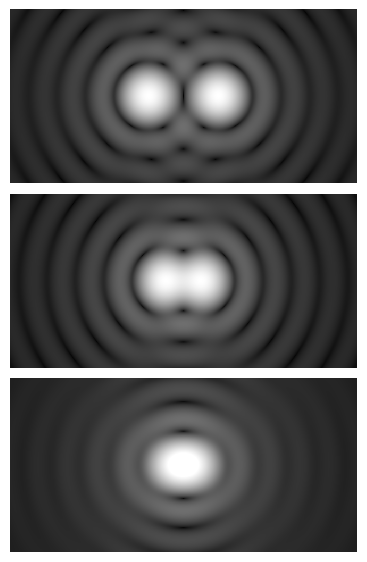
Two classical formulas quantify the diffraction-limited lateral resolution of a widefield microscope:
n nAttribution: Spencer Bliven. Two airy disks at various spacings: (top) twice the distance to the first minimum, (middle) exactly the distance to the first minimum (the Rayleigh criterion), and (bottom) half the distance. This image uses a nonlinear color scale (specifically, the fourth root) in order to better show the minima and maxima.n
nn
Both are widely used. The numerical constants (0.61 vs 0.5) differ because they describe slightly different criteria and object types, but they tell the same qualitative story: improving resolution requires either decreasing the wavelength (e.g., imaging in the blue/green instead of red) or increasing NA. This is also reflected in the optical transfer function (OTF): for incoherent imaging, the spatial frequency cut-off is approximately f_c ≈ 2 · NA / λ. Frequencies above this cut-off cannot be transferred by the system, which means they are fundamentally unresolvable without techniques that alter the effective transfer function (e.g., structured illumination or other super-resolution methods).
n
A few immediate implications flow from these definitions:
n
n
Magnification does not create resolution. Without sufficient NA, increasing magnification only enlarges a blurred image—a phenomenon known as empty magnification. See the discussion in How Magnification and Pixel Sampling Determine Visible Detail for how to choose useful magnification.
n
Condenser NA matters in transmitted-light modes like brightfield. To realize the objective’s full resolving power, the illumination cone needs to support comparable spatial frequencies. This is covered in Wavelength, Illumination, and Condenser Aperture for Real Resolution.
n
Immersion media and refractive index matching influence both NA and aberrations. Using oil with an oil-immersion objective, or water with a water-immersion objective, is not a convenience—it is integral to how the lens is designed to achieve its specified NA. See Immersion Media, Refractive Index, and Cover Glass Thickness.
n
n
Lateral resolution is only part of the story. The axial (depth) resolution and depth of focus also depend on NA and wavelength. In widefield imaging, the axial resolution roughly scales as ~ 2 · n · λ / NA², which shows why high-NA objectives not only resolve more detail laterally but also have a thinner focal slice and shallower depth of field. That trade-off is addressed again in Field of View, Parfocality, and Working Distance Trade‑offs.
nn
How Magnification and Pixel Sampling Determine Visible Detail
n
It is easy to dial up more magnification with higher-power objectives or additional optics, but unless the optical system captures the necessary high spatial frequencies (i.e., has sufficient NA), the extra magnification just spreads the same blur over more pixels. To derive true benefits from magnification, you must also match the sampling scale of your detector (camera or the human eye with an eyepiece) to the diffraction-limited detail of the image.
n
Magnification versus resolution
n
In a classical compound microscope, the objective forms a magnified intermediate image that is further magnified by the tube lens and viewed through an eyepiece or projected onto a camera sensor. The key point: the objective’s NA and the illumination wavelength set the smallest details that exist in that intermediate image. Additional magnification can make those details larger and more comfortable to see or sample, but cannot introduce new resolvable content.
nn
n nAttribution: Anaqreon. Real Airy disk created by passing a laser beam through a pinhole aperturen
nn
The well-known guideline for visual observation is that useful total magnification is on the order of 500× to 1000× per millimeter of objective NA. For example, with an NA 0.65 objective, a total magnification around 325× to 650× is typically productive for the human eye. Much higher magnification generally provides little additional information, especially in brightfield. This range is a rule of thumb rather than a limit; the essential idea is to avoid driving magnification dramatically beyond what the optics can resolve.
n
Pixel sampling, Nyquist criterion, and effective pixel size
n
When using a digital camera, the spatial sampling of the sensor must be fine enough to capture the optical detail formed by the objective. The Nyquist sampling criterion requires at least two samples across the smallest resolvable feature to represent it without aliasing. In practice, many microscopists target approximately 2–3 pixels per diffraction-limited full-width at half maximum (FWHM) or per Rayleigh diameter, balancing resolution capture against noise and file size.
n
Two steps get you from sensor pixels to sampling at the specimen:
n
n
Compute effective pixel size at the specimen: p_eff = p_sensor / M_total, where p_sensor is the camera’s pixel pitch and M_total is the total magnification from the specimen to the sensor (objective × tube lens ratio and any intermediate optics). For eyepiece projection or relay systems, use the actual optical magnification between the specimen and sensor.
n
Compare to diffraction-limited resolution: If you use the Rayleigh estimate, the sampling guideline is p_eff ≤ (0.61 · λ / NA) / 2 for Nyquist sampling. Using the Abbe limit, p_eff ≤ (λ / (2 · NA)) / 2. Either way, the key is that p_eff should be significantly smaller than the optical resolution limit.
n
n
As a concrete illustration, suppose you image in green light at λ = 0.55 µm with an NA 1.3 oil objective. The Rayleigh lateral resolution is approximately 0.61 · 0.55 / 1.3 ≈ 0.258 µm. To Nyquist-sample that, you would aim for p_eff ≲ 0.13 µm at the specimen plane. If your sensor pixel pitch is 6.5 µm, you would want approximately 50× magnification to reach 6.5 µm / 50 ≈ 0.13 µm per pixel at the specimen. That level of magnification is typically provided by a 50× objective with an appropriate tube lens, or by combining a slightly lower-power objective with additional relay optics. If you use a much higher total magnification with the same NA, you will oversample (more than two pixels per feature); oversampling can modestly help with interpolation and post-processing but will not create new information above the optical cut-off frequency.
n
Eyepieces, field number, and human vision
n
For visual observation, you do not compute Nyquist—but the human eye still samples finite detail. The field number (FN) of an eyepiece defines the diameter of the intermediate image it can accommodate (in millimeters), and the specimen field of view diameter is approximately FOV ≈ FN / M_objective for finite conjugate systems. For infinity-corrected systems, the effective field of view depends on the tube lens focal length as well, but the practical relationship is similar: higher objective magnification narrows the field, while larger FN eyepieces broaden it. The eye resolves most comfortably when the image detail at the retina is neither too small to discriminate nor so large that it spills across the fovea without adding information. That is the origin of the practical magnification ranges described above.
n
Infinity systems and tube lenses
n
Most modern compound microscopes use infinity-corrected objectives, which produce a collimated beam that is brought to focus by a tube lens. The manufacturer specifies an objective’s nominal magnification for a particular tube lens focal length. Using a different tube lens changes the effective objective magnification according to M_eff = f_tube / f_obj (where f_obj is the objective focal length that corresponds to the nominal magnification at the design tube lens). Practically, this means that changing the tube lens alters magnification but not the objective NA. Any recalculation of sampling should be based on the resulting total magnification to the detector while remembering that resolution remains capped by NA and wavelength.
Wavelength, Illumination, and Condenser Aperture for Real Resolution
n
Why wavelength matters
n
From the resolution formulas in What Numerical Aperture and Resolution Mean in Optical Microscopy, lowering the wavelength λ boosts resolution proportionally. If all else is equal, imaging in blue-green yields finer detail than in red. In practice, pick a wavelength or filter band that your sample can tolerate and that your optics efficiently transmit. Chromatic aberration correction (discussed in Objective Types, Aberration Correction, and Field Flatness) also plays a role; high-end apochromats maintain focus and color registration over a broader spectrum than basic achromats.
nn
n nAttribution: SiriusB. Airy disk and pattern from diffracted white light (D65 spectrum). The color stimuli have been calculated in the CIE 1931 color space and then converted into sRGB. Apart from the sRGB definition there is a moderate additional gamma correction of 0.8 to enhance brightness in the outer rings. This may cause a slight but acceptable distortion in colours, however.n
nn
Köhler illumination and partial coherence
n
Köhler illumination is the standard method for obtaining uniform, bright, and controllable illumination. It images the lamp (or LED emitter) to the condenser aperture plane and the field diaphragm to the specimen plane, decoupling field homogeneity from angular illumination. With Köhler illumination, you can independently adjust the field diaphragm (controlling the illuminated area and stray light) and the condenser aperture diaphragm (controlling the illumination NA and therefore the degree of coherence and contrast).
nn
n nAttribution: ZEISS Microscopy from Germany. Ask your ZEISS account manager for a lab poster! You’ll find more knowledge brochures and materials on our website www.zeiss.com/microscopy Images donated as part of a GLAM collaboration with Carl Zeiss Microscopy – please contact Andy Mabbett for details.n
nn
Brightfield microscopes typically operate in a regime of partial coherence, but an intuitive guideline is robust and widely used: opening the condenser aperture to match the objective’s NA maximizes resolution but may lower contrast; closing it increases contrast but reduces resolution. Many practitioners set the condenser aperture to roughly 70–80% of the objective NA for a balanced compromise. If you require the finest detail in brightfield, ensure that the condenser can reach close to the objective NA and that it is centered and adjusted under Köhler.
n
n
Condenser NA and resolution
n
In transmitted light, the condenser NA defines the angular range of illumination. If it is too small, the high spatial frequencies generated by the specimen (e.g., fine periodic structures) will not be launched into the objective’s acceptance cone, limiting effective resolution even if the objective’s NA is high. Conversely, a high-NA condenser without proper alignment can wash out contrast and invite stray light. The lesson: treat the condenser as an equal partner to the objective when striving for true resolution.
n
Source spectrum and filters
n
Depending on the light source, the spectral distribution can be broad (halogen), line-like (mercury or metal-halide lines), or tailored (LEDs with specific emission peaks). Filters (bandpass, neutral density, polarizers) can improve contrast and control exposure. Since λ directly enters the resolution limit, choosing a shorter-wavelength bandpass filter in brightfield can make fine detail more distinct—so long as your optics and sample tolerate it. For fluorescence, excitation and emission filters are set by fluorophore spectra; the objective NA still caps the collected emission detail, and axial/lateral resolution in widefield fluorescence follows the same principles discussed throughout this article.
n
Reflected light (epi) considerations
n
In reflected-light microscopy, the illumination path shares the objective. The concept of condenser NA is replaced by the objective’s own NA, but the degree of coherence can still differ based on the source and beam conditioning. Bright, uniform, well-collimated epi-illumination helps reveal surface textures and high-frequency detail, just as Köhler does in transmission. Polarization elements for reflected DIC or polarizing microscopy introduce their own constraints and should be aligned according to the manufacturer’s specifications to avoid loss of resolution or contrast.
Immersion Media, Refractive Index, and Cover Glass Thickness
n
High-resolution microscopy demands control over the optical path from specimen to objective. Two ubiquitous but sometimes underestimated variables are the refractive index of the immersion medium and the thickness and refractive index of the cover glass.
n
Immersion media and NA
n
Because NA = n · sin(θ), a higher refractive index medium allows a larger NA for a given cone angle. That is why high-NA objectives are commonly designed as oil immersion lenses: with n ≈ 1.515, oil allows NAs above 1.0 (e.g., 1.25–1.45). Air objectives are limited to n ≈ 1.00 and thus NA ≲ 1.0 even for very large half-angles; typical high-NA air objectives reach around 0.90–0.95. Water-immersion objectives (n ≈ 1.33) and glycerol-immersion variants (n ≈ 1.47) serve specialized purposes, such as live-cell imaging in aqueous media or imaging through media with specific refractive indices to reduce spherical aberration.
nn
n nAttribution: Thebiologyprimer. Principle of immersion microscopy. At high magnification power, light waves refract off the glass in the microscope slide and slip cover. Immersion oil has a high refractive index, minimizing this refraction allowing light to enter the objective in a straight line. This increases resolution of the specimen.n
nn
Key points for immersion practice:
n
n
Always use the immersion medium the objective was designed for. A 100× oil-immersion lens relies on oil to reach its specified NA and to minimize spherical aberration caused by index mismatch. Using it dry degrades both resolution and contrast. Using oil with a dry objective will damage image quality and can damage the objective.
n
Match immersion with your sample environment. Water-immersion objectives are advantageous when the sample is in aqueous media, reducing refractive index mismatch between the specimen region and the objective, which helps maintain contrast and axial resolution at depth.
n
Maintain cleanliness. Residual oil films trap dust, reduce contrast, and scatter light. Clean objective fronts and coverslips with the appropriate lens-safe solvents and techniques recommended by the manufacturer.
n
n
Cover glass thickness and correction collars
n
High-NA objectives that image through a coverslip are typically corrected for a standard cover glass thickness around 0.17 mm (often labeled as #1.5 or #1.5H) and for a specific refractive index of the glass. Deviations in cover thickness or material can introduce spherical aberration, which broadens the point spread function and reduces both contrast and resolution. Many high-NA objectives include a correction collar that lets you adjust for actual cover thickness within a specified range; the adjustment is best performed on a sample with fine detail or using a calibration slide while observing for peak contrast at high NA.
n
Keep in mind:
n
n
Using a cover glass that is substantially too thick or too thin for the objective’s design can degrade resolution significantly at high NA.
n
For oil immersion systems, the path often assumes oil between the cover glass and objective front lens; omitting oil or using a mismatched immersion fluid will affect both NA and aberration correction.
n
In long-working-distance objectives or systems designed to image through windows or dishes of known thickness, consult the objective markings for the specified window/coverslip thickness and medium.
n
n
Refractive index mismatch and depth
n
As you image deeper into a specimen, refractive index mismatches between layers (e.g., cover glass, mounting medium, tissue, immersion medium) compound spherical aberration and reduce effective resolution and brightness. Even in widefield, this effect becomes noticeable at tens of micrometers for high NA imaging. Choosing immersion media and coverslips that closely match the optical design reduces these artifacts. Water-immersion objectives are often preferred for live, aqueous samples precisely because they mitigate cumulative aberrations with depth.
nn
Contrast Mechanisms vs. Spatial Resolution: Brightfield, Phase Contrast, DIC, and Darkfield
n
Many microscopy modes do not directly change the diffraction-limited resolution, but they change contrast in ways that make certain spatial frequencies easier to see. Understanding what each mode does helps set realistic expectations and guides which adjustments you should make elsewhere (e.g., condenser aperture in Wavelength, Illumination, and Condenser Aperture for Real Resolution) to support resolution.
n
Brightfield
n
Brightfield forms an image from transmitted light attenuated or refracted by the specimen. It is conceptually the baseline for incoherent imaging. Resolution is capped by the objective NA and wavelength, with effective realization depending on condenser NA and alignment. Many brightfield images benefit from a slightly stopped-down condenser to enhance contrast at the expense of a small resolution loss. For fine detail, open the condenser closer to the objective NA while maintaining Köhler alignment.
n
Phase contrast
n
Phase contrast converts phase shifts (which the eye cannot detect directly) into intensity differences by inserting a phase ring in the objective back focal plane and a matching annulus in the condenser. It dramatically improves the visibility of transparent, unstained specimens. While phase contrast does not raise the diffraction limit, it can make high spatial frequencies more apparent by increasing contrast where brightfield would show little. The requirement to match the objective phase ring and condenser annulus means that misalignment or mismatched components will reduce both contrast and effective resolution.
n
Differential interference contrast (DIC)
n
DIC uses polarization optics and prisms to shear and interfere two laterally displaced wavefronts, transforming phase gradients into intensity gradients. DIC yields crisp, relief-like images of transparent structures and is excellent for detecting edges and fine textures. The lateral resolution limit is still governed by NA and wavelength. Optimizing DIC performance requires correct orientation and alignment of polarizers and Wollaston/Nomarski prisms, stable Köhler illumination, and careful control of shear bias.
n
Darkfield
n
Darkfield blocks the unscattered, directly transmitted beam and images only light scattered by the specimen. Fine particles and edges appear bright against a dark background. The need for high angular illumination in high-NA darkfield puts demands on the condenser or specialized condensers (e.g., oil darkfield). Darkfield does not change the diffraction-limited resolution, but it can improve detectability of small features by suppressing background. Proper centering and cleanliness are essential; scattered dust in the optical path is very visible in darkfield.
n
Reflected-light contrast modes
n
In epi-illumination, variants like reflected DIC, polarization contrast, and differential phase contrast modify contrast and sensitivity to edges or birefringence. Just as with transmission modes, they alter visibility, not the theoretical resolution set by NA and wavelength. Keep in mind that reflective samples often have complex bidirectional reflectance distributions; minimizing flare and optimizing polarization can markedly improve micro-contrast.
nn
Objective Types, Aberration Correction, and Field Flatness
n
Objectives are the heart of an optical microscope. While NA and magnification headline the specifications, the aberration corrections and field characteristics matter just as much for obtaining crisp, high-resolution images across the field of view.
n
Chromatic and spherical corrections
n
n
Achromat objectives correct primary chromatic aberration for two wavelengths (commonly in the blue and red) and bring a third closer to focus. They also correct spherical aberration at one color. Achromats provide solid performance for routine brightfield but can show color fringing and defocus between colors in polychromatic light.
n
Fluorite (semi-apochromat) objectives improve both chromatic and spherical corrections compared to achromats, offering better contrast and higher NA at the same magnification. They are well suited for fluorescence and demanding transmitted-light work.
n
Apochromat objectives correct chromatic aberration at three or more wavelengths and often refine spherical aberration across the spectrum. They are typically available at higher NA for a given magnification and maintain color registration and focus over a broader spectral band, which is beneficial for multi-color imaging and high-resolution work.
n
n
Plan designations (e.g., Plan Achromat, Plan Apochromat) indicate field flattening corrections to deliver a flat image across the specified field number. Without plan correction, the edges of the field may focus at a different plane than the center (field curvature), which is especially noticeable with large-format cameras.
n
Objective back focal plane and phase annuli
n
Some contrast techniques (phase contrast, DIC) place elements at or near the objective back focal plane. The precise location and alignment affect contrast and throughput but do not alter the diffraction-limited resolution. For phase contrast, the match between the condenser annulus and objective phase ring is essential. If you switch objectives, also switch the condenser annulus to the appropriate setting and re-center it under Köhler illumination to maintain both resolution and contrast.
n
Working distance, NA, and design trade-offs
n
Higher NA usually means a shorter working distance and a thinner coverslip tolerance window, especially at high magnifications. Long-working-distance objectives are designed for clearance (e.g., for micromanipulation or imaging through thicker windows), but achieving long distance and high NA simultaneously is challenging. As a result, many long-working-distance lenses have somewhat lower NA than their short-distance counterparts at the same magnification. These trade-offs are revisited in Field of View, Parfocality, and Working Distance Trade‑offs.
nn
Field of View, Parfocality, and Working Distance Trade‑offs
n
Resolution is only part of what makes an image “good.” Even when NA and wavelength set an excellent theoretical limit, field size, uniformity, and depth can shape what you actually see and record.
n
Field of view (FOV)
n
Under eyepieces, the specimen field diameter scales roughly as FOV ≈ FN / M_objective. With cameras, the field captured depends on the sensor size and the optical magnification. Large sensors paired with plan-corrected optics cover more area without losing edge sharpness. However, at high NA and magnification, the usable field can be limited by vignetting or off-axis aberrations if the optics are not well-matched across the field. If you find edges softer than the center, consider plan-corrected objectives and ensure all elements (tube lens, camera port, any reducers) are designed to cover your sensor format.
n
Depth of field and axial sectioning
n
As NA increases, depth of field (DOF) decreases, and axial resolution improves: the focal slice becomes thinner. In widefield brightfield or fluorescence, a frequently used approximation for axial resolution is on the order of ~ 2 · n · λ / NA² in the specimen space, emphasizing the steep dependence on NA. Practically, this means:
n
n
High-NA objectives demand more precise focusing and are more sensitive to sample tilt and cover glass variation.
n
High-NA imaging benefits from vibration isolation and mechanical stability.
n
Stack acquisition (z-stacks) may be needed to capture 3D structure, but deconvolution does not alter the underlying cut-off frequencies; it can restore contrast and sharpen features within those limits.
n
n
Parfocality and parfocal distance
n
Well-matched objective sets maintain parfocality, meaning that when you switch magnifications, the specimen remains in focus or close to it. True parfocality depends on the mechanical standard and on maintaining correct tube length or tube lens geometry. If your images are consistently out of focus when switching objectives, verify that intermediate optics are seated properly, correction collars are not mis-set, and that the camera port spacing is correct.
n
Ergonomics and throughput vs. resolution
n
Sometimes the “best” resolution is not the most useful. For surveys and screening, a lower NA with a larger field and more depth of field can be more efficient. Once a region of interest is located, switch to higher NA to examine fine detail. This workflow also aligns with sampling efficiency discussed in How Magnification and Pixel Sampling Determine Visible Detail: collect the field at a coarse scale, then refine at a scale commensurate with diffraction-limited detail.
nn
Common Misconceptions and Practical Tuning Tips
n
Even experienced users encounter pitfalls that sap resolution or waste magnification. The following clarifications and tips can help you get the most from your optics.
n
Misconception 1: “More magnification equals more detail.”
n
Without sufficient NA, additional magnification simply enlarges blur. Ensure that your effective pixel size at the specimen satisfies Nyquist for the optical resolution limit, as described in How Magnification and Pixel Sampling Determine Visible Detail. If you are using eyepieces, stay within a practical range of total magnification relative to NA.
n
Misconception 2: “Any condenser setting works as long as it is bright.”
n
Condenser NA is integral to realized resolution in transmitted light. Under Köhler illumination, adjust the condenser aperture to support your desired spatial frequencies—often around 70–80% of the objective NA for a balance of contrast and resolution, or closer to the objective NA when you need maximum resolution. See Wavelength, Illumination, and Condenser Aperture for Real Resolution.
At high NA, cover glass thickness and refractive index mismatches introduce spherical aberration that widens the point spread function and reduces contrast. Use the correct coverslips and, if available, adjust the objective’s correction collar on a fine-structure specimen. Read more in Immersion Media, Refractive Index, and Cover Glass Thickness.
n
Misconception 4: “Phase contrast and DIC increase resolution.”
n
These modes improve visibility by converting phase information into intensity contrast, but the diffraction-limited resolution is still governed by NA and wavelength. That said, because they emphasize edges and gradients, they can make the appearance of detail crisper. Ensure proper alignment and matched components to avoid losing contrast.
n
Misconception 5: “All objectives with the same magnification behave the same.”
n
Two 40× objectives may differ dramatically in NA, chromatic correction, planarity, and working distance. When resolution matters, NA and correction class (achromat, fluorite, apochromat; plan vs non-plan) carry at least as much weight as magnification. See Objective Types, Aberration Correction, and Field Flatness for guidance.
n
Practical tuning checklist
n
n
Align Köhler illumination: center and focus the condenser; set the field diaphragm to just circumscribe the field of view.
n
Set condenser aperture to suit your resolution/contrast needs and objective NA.
n
Match immersion medium to the objective; clean optical surfaces to minimize scatter and flare.
n
Use correct coverslips; adjust correction collars for sample-induced aberrations where applicable.
Stabilize the setup: minimize vibration, secure the specimen, and allow thermal equilibration to reduce focus drift—especially crucial at high NA.
n
nn
Frequently Asked Questions
n
How should I set the condenser aperture to maximize resolution without losing all contrast?
n
Under Köhler illumination in brightfield, start by opening the condenser aperture to about 70–80% of the objective NA. This typically gives a good compromise between contrast and resolution. To push resolution, open the aperture further toward the objective NA, while keeping an eye on micro-contrast and glare. Ensure the condenser is centered and that the field diaphragm is adjusted to the field of view to control stray light. For dark specimens, modestly reducing the aperture can improve contrast even if it shaves a little off the theoretical maximum resolution. The optimal setting depends on specimen scattering and absorption; adjust while observing fine features and overall noise.
n
Why does my 100× oil objective look soft even when I focus carefully?
n
Several common causes degrade apparent resolution at high NA:
n
n
Immersion issues: too little oil, air bubbles in the oil, or the wrong immersion medium reduce effective NA and introduce aberrations.
n
Cover glass mismatch: a cover that is too thick or thin (or made from the wrong glass) causes spherical aberration. If your objective has a correction collar, adjust it while watching fine detail or use a calibration slide.
n
Condenser NA too low or misaligned: the illumination cone may not support high spatial frequencies—open and center the condenser under Köhler.
n
Contamination: dust or oil film on the objective front lens or coverslip scatters light and lowers contrast, which looks like softness.
Mechanical stability: vibration or drift becomes obvious at high NA. Stabilize the stand and allow the system to thermally settle.
n
nn
Final Thoughts on Choosing the Right Resolution and NA Strategy
n
For optical microscopes, resolution is governed by a compact set of principles that reward careful attention to the whole optical chain. The takeaways:
n
n
Resolution is set by NA and wavelength: use high-NA objectives with appropriately short wavelengths when your sample and optics allow. Remember δ ≈ 0.61 · λ / NA and d ≈ λ / (2 · NA) as practical guides.n n nAttribution: QuodScripsiScripsi. Microscope objective marking (Zeiss oil immersion objective CP-Achromat 100x/1.25): “CP-Achromat” describes the type of objective with regard to the correction of optical aberrations. An achromat is an optical system consisting of at least two lenses that reduces chromatic aberration (color errors for light of different wavelengths). The “C” is used for achromatic lenses that produce good image contrast. The “P” stands for “plan” (flat) and indicates that the optical field curvature that occurs with simple lenses has been corrected, so that flat specimens are imaged sharply in the center and at the edges simultaneously. “100x” indicates that the optical magnification factor of the intermediate image is 100 (with a suitable tube lens). “1,25 Oil” (with a German decimal separator = comma) indicates the numerical aperture 1.25 (a measure of spatial resolution) achieved with immersion oil. Only with oil immersion, the objective provides a good image. The infinity symbol shows that the objective lens was designed for microscopes with an infinity beam path. “0,17” indicates that coverslips with a thickness of 0.17 mm must be used.n
n
n
Illumination matters: in transmitted-light setups, condenser NA and Köhler illumination are essential to realizing the objective’s theoretical performance. In epi-illumination, uniform, well-conditioned light and proper polarization where applicable are equally critical.
n
Magnification must match sampling: for cameras, choose magnification to bring the effective pixel size near the Nyquist criterion for your optical resolution. For visual work, stay within useful magnification ranges for your NA.
n
Control the medium and interfaces: use the correct immersion medium; match coverslip thickness and refractive index; adjust correction collars when available.
n
Optimize for the task: select contrast mechanisms to improve visibility, and pick field size and depth of field appropriate to your workflow. Move between survey and detail views deliberately.
n
n
Putting these pieces together turns “magnified” into “resolved.” Whether you are a student learning the ropes or a hobbyist refining technique, return to the fundamentals: NA, wavelength, illumination, and sampling. Mastering them pays dividends across brightfield, phase contrast, DIC, fluorescence, and reflected-light imaging. If you found this breakdown helpful, explore more of our optics primers and consider subscribing to our newsletter for future deep dives into microscope fundamentals, types, accessories, and applications.
Learn how numerical aperture, wavelength, illumination, and magnification set true microscope resolution. Practical tips on NA, sampling, and condenser setup.
Learn how to choose and use microscope cameras and adapters: sensor and pixel size, C‑mounts, relay optics, software workflow, and troubleshooting tips.
Understand how numerical aperture sets microscope resolution, how magnification relates, and how wavelength and illumination affect detail and contrast.
Stay In Touch
Be the first to know about new articles and receive our FREE e-book

 n
n n
n n
n n
n n
n n
n