
Table of Contents
- What Is the Orion Constellation? Position, Season, and Significance
- The Bright Stars of Orion: Betelgeuse, Rigel, and the Belt
- Inside the Orion Nebula (M42): A Nearby Stellar Nursery
- The Orion Molecular Cloud Complex: Barnard’s Loop, Horsehead, and Flame
- How to Observe Orion: Seasons, Sky Maps, and Naked-Eye Asterisms
- Double Stars and Variable Stars in Orion You Can Actually See
- Astrophotography Tips for Capturing Orion’s Nebulae and Belt
- Cultural History of Orion: From Ancient Myth to Modern Catalogs
- What Orion Teaches Us About Star Formation and Stellar Evolution
- Planning an Orion Observing Night: Equipment, Lists, and Safety
- Frequently Asked Questions
- Final Thoughts on Exploring the Orion Constellation
What Is the Orion Constellation? Position, Season, and Significance
The constellation Orion is one of the sky’s most recognizable patterns, famed for its bright stars and spectacular nebulae. Straddling the celestial equator, Orion is visible from practically every inhabited latitude on Earth. Its prominent three-star belt cuts across the midsection of the Hunter, making Orion a reliable seasonal marker and a star-hopping gateway to nearby constellations and deep-sky objects.

In the modern International Astronomical Union (IAU) scheme of 88 constellations, Orion spans roughly 594 square degrees, making it among the larger and most dense in terms of bright stars. Because it lies near the Milky Way’s plane and fronting an enormous star-forming complex, Orion’s field is richly populated with clusters, emission and reflection nebulae, dark dust lanes, and young stellar objects.
Key points to orient yourself to Orion’s position and seasonality:
- Latitude reach: Because its central declination is close to 0°, Orion is visible from both hemispheres. In mid-northern latitudes it climbs high in the winter sky; in the south it dominates the summer evenings.
- Best months: In the Northern Hemisphere, the evening appearance peaks from December through February, lingering into early spring. In the Southern Hemisphere, Orion is prominent in the summer months.
- Neighboring constellations: Taurus to the northwest, Gemini to the northeast, Lepus and Canis Major to the south, and Eridanus snaking nearby. These neighbors guide star-hops to objects like the Pleiades (M45) in Taurus or Sirius in Canis Major.
Beyond its silhouette, Orion is astronomically significant because it fronts the Orion Molecular Cloud Complex, one of the nearest and best-studied stellar nurseries. For observers, it’s a treasury spanning all experience levels: naked-eye asterisms, binocular showpieces, small-scope double stars, and challenging nebulae for advanced imagers. As you read on, use the internal links to jump to specifics—for instance, if you’re after the great nebula, go directly to Inside the Orion Nebula (M42). If you want practical guidance, see How to Observe Orion and Astrophotography Tips.
The Bright Stars of Orion: Betelgeuse, Rigel, and the Belt
Orion’s stars are a master class in stellar evolution, from an aging red supergiant to hot blue-white giants and supergiants that flood nearby gas with ultraviolet radiation.
Betelgeuse (Alpha Orionis): The Evolving Red Supergiant
Betelgeuse, the reddish star marking Orion’s right shoulder (left side as we face the constellation), is a massive red supergiant in a late evolutionary stage. It’s irregularly variable, meaning its brightness changes over weeks to months due to complex pulsations and surface activity. Over the past decade, Betelgeuse made headlines for a pronounced “great dimming,” which observations linked to a combination of surface changes and dust ejection along our line of sight.
What makes Betelgeuse a teaching tool is the way it illustrates stellar aging: massive stars burn through their nuclear fuel rapidly, swell into supergiants, and eventually end their lives in spectacular supernovae. Although Betelgeuse will someday explode, the timescale is astronomical—likely on the order of tens of thousands of years or more. When it happens, it will be a bright event but not dangerous to Earth.
Rigel (Beta Orionis): Blue-White Luminous Beacon
Rigel, the bright blue-white star marking Orion’s opposite foot from Betelgeuse, is a hot, luminous supergiant. It emits tremendous ultraviolet flux that illuminates nearby dust, including the Witch Head Nebula (IC 2118) in Eridanus. Through small telescopes under steady seeing, Rigel reveals a faint companion star, making it a satisfying double for beginners with moderate aperture and patience. See suggestions for splitting Rigel in Double Stars and Variable Stars.
The Belt: Alnitak, Alnilam, and Mintaka
Orion’s Belt is the famous straight line of three bright stars at the Hunter’s waist. They are massive, hot O- and B-type stars at great distances, embedded in a region dense with gas and dust. The belt directs observers to several nearby treasures:
- Alnitak (Zeta Ori): The easternmost belt star, adjacent to the Flame Nebula and the silhouette of the Horsehead Nebula against IC 434. Its intense radiation powers local emission glow.
- Alnilam (Epsilon Ori): The central belt star is a luminous blue supergiant. Wide-field images often show reflection and emission glow in its vicinity.
- Mintaka (Delta Ori): The westernmost belt star, a multiple system. Under good conditions, Mintaka’s duplicity can sometimes be hinted at with small instruments.
Other Key Stars: Bellatrix, Saiph, and Meissa
- Bellatrix (Gamma Ori): A blue giant forming Orion’s other shoulder. Historically known as the Amazon Star in some traditions, it’s a bright, easily located anchor for star-hopping.
- Saiph (Kappa Ori): The southeastern knee of Orion, another hot blue star that, together with Rigel, balances Betelgeuse and Bellatrix.
- Meissa (Lambda Ori): At the center of the “head” of Orion, Meissa is associated with a ring of nebulosity known as the Lambda Orionis ring, marking past star formation and feedback effects.
These stars collectively help you triangulate deep-sky objects. For example, a line from Rigel through Saiph angles toward the bright, greenish-gray glow of M42. A sweep near Alnitak reveals the Flame and Horsehead Nebulae in wide-field images or with specialized filters.
Inside the Orion Nebula (M42): A Nearby Stellar Nursery
The Orion Nebula, cataloged as Messier 42 (M42), is a vast emission nebula and one of the closest active star-forming regions to Earth. It’s visible to the naked eye as a diffuse patch below Orion’s Belt, forming the middle of the Hunter’s Sword. In binoculars and small telescopes, M42 is a revelation: a curdled, wing-like cloud with intricate structure and a bright core featuring the Trapezium Cluster.

The Trapezium Cluster
At M42’s heart lies the Trapezium, a tight grouping of young, massive stars whose radiation ionizes the surrounding gas, making the nebula glow. In good seeing, even small telescopes can resolve the four main Trapezium stars into a distinctive shape, with additional fainter members appearing in larger apertures under stable conditions. The Trapezium’s intense winds carve cavities, sculpting the nebula’s filaments and arcs seen in photographs.
Proplyds and Stellar Birth
High-resolution imaging has revealed protoplanetary disks—proplyds—within the Orion Nebula. These are young stars surrounded by disks of gas and dust where planetary systems may form. Ionizing radiation from massive neighbors erodes and photoevaporates these disks’ outer layers, giving us a direct view of feedback processes shaping nascent planetary systems.
M43, NGC 1977, and the Running Man
- M43 (De Mairan’s Nebula): A bright knot just north of M42, separated by a dark dust lane, M43 is physically part of the larger Orion Nebula complex but appears distinct visually.
- NGC 1977: A nearby reflection nebula that, along with adjacent nebulosity, forms the “Running Man” in wide-field images—an outline produced by dark lanes silhouetted against blue reflection light.
Observing M42 Visually
You can enjoy M42 from dark suburbs with binoculars, but a telescope shows more:
- Low magnification (20–60×): Best for framing the entire nebula and recognizing its seagull-like wings. A narrowband or UHC filter enhances contrast by transmitting key emission lines while blocking light pollution.
- Moderate magnification (80–150×): Brings out filaments in the bright core. On very steady nights, try to split additional Trapezium members.
- High magnification (200×+): Can help tease out detail in the core if seeing supports it, but the nebula’s low surface brightness typically benefits from lower powers and averted vision.
For imaging considerations—dynamic range, HDR stacking, and filter choices—jump to Astrophotography Tips. If your night is short, spend time here: M42 offers a rare combination of brightness and scientific richness that satisfies beginners and experts alike.
The Orion Molecular Cloud Complex: Barnard’s Loop, Horsehead, and Flame
Beyond M42 lies an enormous structure of gas, dust, and young stars known collectively as the Orion Molecular Cloud Complex (OMC). This region spans hundreds of light-years and includes well-known sights that challenge imagers and reward careful visual observers.
Barnard’s Loop
Barnard’s Loop is a colossal arc of emission nebula wrapping around much of Orion. It is exceptionally faint visually and typically captured in wide-field astrophotography with hydrogen-alpha sensitivity. The Loop traces shock fronts and ionization driven by past stellar feedback, including winds and supernovae from massive stars in the Orion OB association. On exceptionally dark, clear nights with suitable filters, experienced observers may glimpse segments as very diffuse glows.
The Horsehead Nebula (Barnard 33) and IC 434
Adjacent to Alnitak, the Horsehead Nebula is a small dark nebula backlit by the emission glow of IC 434. Visually, it’s a challenging target, often requiring large telescopes, excellent transparency, and a hydrogen-beta (Hβ) filter to improve contrast. In photographs, the Horsehead’s silhouette is unmistakable, a chess-knight profile protruding into a pink-red gas curtain.
The Flame Nebula (NGC 2024)
Near Alnitak as well, the Flame Nebula is an emission and reflection complex, crisscrossed by dark dust lanes that create a flamelike appearance. Moderate telescopes and nebula filters can reveal a softly glowing patch; imaging brings out the dramatic dark ridges and embedded star cluster.
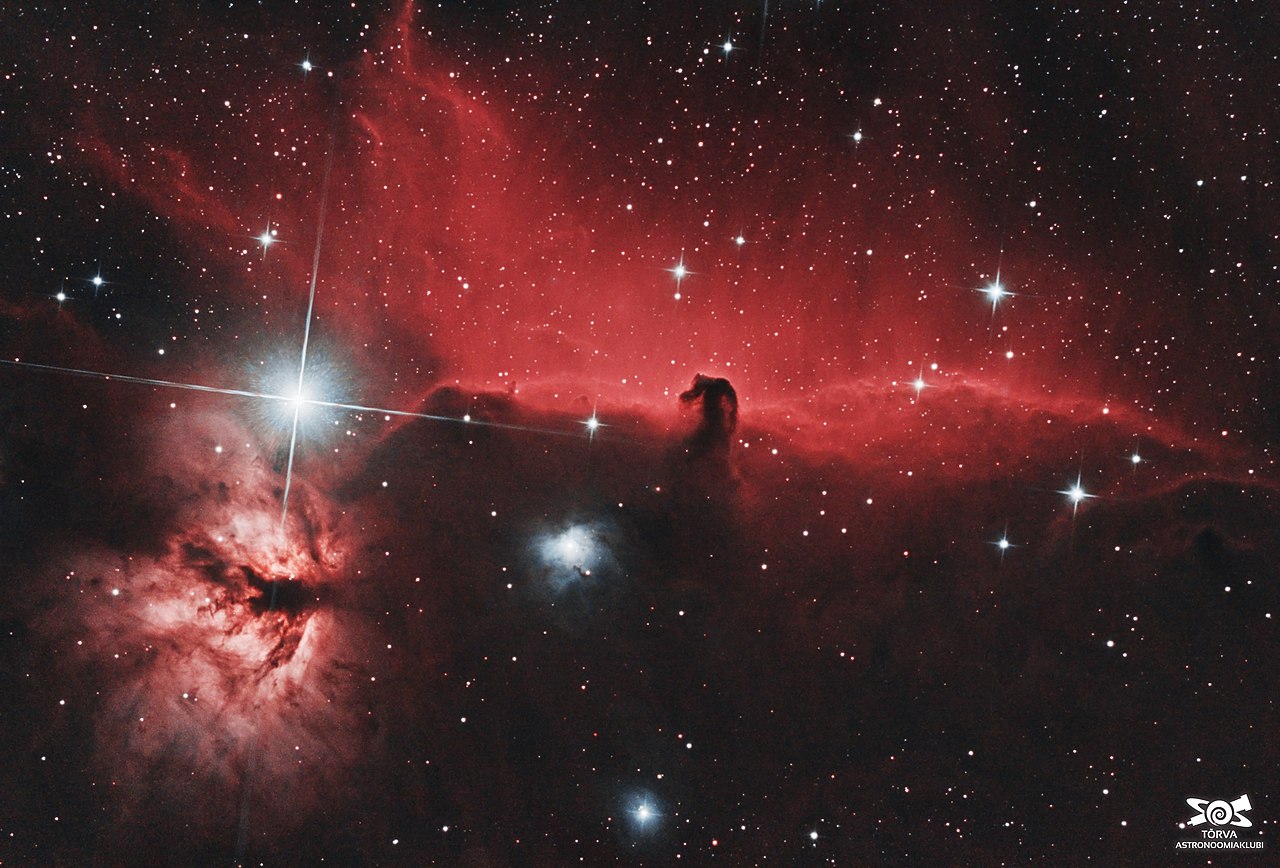
Reflection Nebulae and Dust
Orion is laced with reflection nebulae—clouds of dust scattering starlight into a blue tint. The Witch Head Nebula near Rigel and numerous fainter patches near the belt and sword are best recorded with long exposures under very dark skies. These structures showcase the interplay of dust, gas, and starlight that defines the OMC’s layered architecture.
To plan an imaging session that captures the belt stars with both Flame and Horsehead in one frame, see focal length and framing advice under Astrophotography Tips. For a visual tour that strings multiple targets into a single sweep, use the star-hopping advice in How to Observe Orion.
How to Observe Orion: Seasons, Sky Maps, and Naked-Eye Asterisms
Observing Orion starts with orienting yourself to its simple but striking asterisms, then working inward to discover fainter targets with binoculars or a telescope. Because Orion sits near the celestial equator, it climbs high for most observers, reducing atmospheric distortion and improving detail on steady nights.
Seasonal Guide
- Northern Hemisphere: Orion rises in the east on autumn evenings, dominates the sky through winter, and sets in the west by spring. Prime observing occurs from roughly November to February.
- Southern Hemisphere: Orion is a centerpiece of the summer sky. Visibility is excellent from late spring through mid-summer evenings.
- Timing tip: Orion transits (culminates at its highest) near local midnight around December–January. Plan your most critical views of fine structure, like the Trapezium, near transit for best seeing.
Naked-Eye Star-Hopping
- Find the Belt: Three stars in a short, straight line. From dark skies, a downward line of faint stars leads to the Sword and the soft patch of M42.
- Look left-right contrast: The red-orange tint of Betelgeuse contrasts with the blue-white Rigel. This color difference is a great teaching moment about stellar temperatures.
- Pointer lines: Extend the belt southwest to find Sirius in Canis Major (the brightest nighttime star). Extend northeast to locate the Hyades and Pleiades in Taurus.
Binocular and Small-Telescope Targets
- M42/M43: The must-see showpiece. A UHC filter improves contrast even in small apertures.
- NGC 1981: An open cluster just above the Sword; a rewarding stop before diving into the bright nebula below.
- σ (Sigma) Orionis region: A multiple star system and a small cluster near Alnitak. Good for low-to-moderate magnification.
- Mintaka double: Under steady skies, even binoculars sometimes hint at elongation; small scopes can split it at modest power.
Intermediate to Advanced Targets
- Rigel’s companion: Requires steady seeing and moderate aperture; the magnitude difference can make the split subtle.
- Flame Nebula: Visible in medium to large telescopes with filters and dark skies; its structure is better through photography.
- Horsehead Nebula: A high-contrast target best sought with an Hβ filter and large aperture under pristine skies.
For detailed technique on coaxing faint nebulosity out of bright backgrounds, see the filter and exposure guidance in Astrophotography Tips. If double stars entice you, jump to Double Stars and Variable Stars for splitting strategies.
Double Stars and Variable Stars in Orion You Can Actually See
Orion teems with doubles and variables suitable for learners and seasoned observers. These targets teach seeing skills, instrumental limits, and astrophysics all at once.
Accessible Double and Multiple Stars
- Rigel (β Orionis): Brilliant primary with a faint companion. Use moderate magnification on a steady night; try masking the aperture slightly or using higher power to suppress glare if needed.
- Mintaka (δ Orionis): A multiple system with components accessible to small telescopes. Start with low power to center the system, then increase magnification.
- σ Orionis: A scenic multiple star assembly embedded in a sparse cluster. Excellent for comparing star colors and brightness differences.
- Meissa (λ Orionis): The head of Orion offers a double to test medium-aperture performance.
Variable Stars You Can Track
- Betelgeuse: A semiregular variable with noticeable changes over months. Recording its brightness using nearby comparison stars is a rewarding citizen-science exercise. The 2019–2020 dimming event highlighted the complex interplay of pulsation and dust.
- U Orionis and other Miras: Orion hosts long-period variables that wax and wane over many months. While they may be too faint at minimum for small binoculars, charted maxima provide fine targets for small telescopes.
Tips for double-star observing:
- Allow your telescope to thermally equilibrate; tubes at different temperatures from ambient can create poor images.
- Use magnification judiciously; too little fails to separate, too much magnifies seeing turbulence.
- Practice averted vision and patience. Let moments of good seeing reveal the companion.
To fold these doubles into a broader sky tour, see the seasonal plan in How to Observe Orion and the equipment considerations in Planning an Orion Observing Night.
Astrophotography Tips for Capturing Orion’s Nebulae and Belt
Orion offers a lifetime of imaging projects, from beginner-friendly wide-field compositions to narrowband mosaics that map shock fronts and dust lanes. Because the region blends bright and faint structures, technique and planning are crucial.
Wide-Field Projects (14–50 mm)
- Targets: Constellation portraits showing Orion’s outline, Barnard’s Loop, the Belt and Sword, and adjacent constellations.
- Approach: Use a fast lens (f/1.4–f/2.8 stopped down 1–2 stops for sharpness). Track the sky with a star tracker to allow longer exposures without trailing.
- Integration: Capture many sub-exposures to accumulate signal for faint hydrogen emission. Dual-band or Hα filters can help in light-polluted areas, though they demand longer exposures and careful focusing.
Medium-Field Projects (85–200 mm)
- Targets: The Belt with Flame and Horsehead, the Running Man plus M42/M43, or the Lambda Orionis ring.
- Framing: Plan compositions to avoid star bloat from bright belt stars. Slightly shorter exposures prevent clipping stellar cores while stacking brings out faint nebulae.
- Filters: Multi-bandpass filters (e.g., Hα/OIII) help isolate emission features, especially under urban skies. For broadband color, shoot under dark conditions and consider light pollution suppression filters carefully to avoid color shifts.
Narrow-Field Projects (300–1500 mm and beyond)
- Targets: High-resolution cores of M42 and M43, dark lanes within the Flame, and fine structure in IC 434 around the Horsehead.
- Dynamic Range Strategy: M42’s core saturates easily. Use high dynamic range (HDR) stacking: combine short subs for the Trapezium region with longer subs for faint wings.
- Guiding: Autoguiding is often necessary for longer focal lengths. Calibrate carefully and dither to suppress fixed pattern noise.

Acquisition and Processing Essentials
- Focus: Use live view or a Bahtinov mask. For narrowband, re-focus between filters if your optics are not parfocal.
- Calibration frames: Darks, flats, and bias frames are critical for clean data, especially with large gradients from bright stars.
- Color management: Keep star colors natural; avoid excessive saturation that crushes subtle reflection hues. Reduce magenta halos around bright stars using targeted color correction.
- Noise and detail: Apply gentle noise reduction before sharpening. Mask bright nebula cores to prevent oversharpening artifacts.
- Composition: Consider rule-of-thirds placements. For example, offset M42 from the frame’s center to capture NGC 1977 above it.
Finally, be patient with Orion’s dynamic range. Bright cores and faint arcs in the same field reward careful exposure planning and multi-scale processing. For on-site framing, scout with planetarium software beforehand and compare with the sky-hopping notes in How to Observe Orion.
Cultural History of Orion: From Ancient Myth to Modern Catalogs
Orion’s striking shape has inspired stories across cultures and eras.
- Greek myth: Orion is the great hunter, entwined with tales involving Artemis and the scorpion that eventually becomes Scorpius. In some versions, the gods place Orion and his hounds (Canis Major and Canis Minor) in the sky.
- Ancient Egypt: Orion was associated with Osiris, the god of the afterlife. Texts and art reflect a link between bright stars in Orion and Egyptian cosmology. Discussions about architectural alignments exist in popular literature; scholars debate the interpretations, so treat specific alignment claims cautiously.
- Mesoamerican traditions: Some sources describe Orion’s Belt as the “Three Hearthstones,” a cosmic hearth motif, with the Orion Nebula region associated with a central fire. The details vary among cultures and periods, but the belt’s three-star pattern is a recurring anchor.
- Arabic star names: Many of Orion’s stars bear names rooted in Arabic astronomical tradition—Betelgeuse, Rigel, Mintaka, Alnilam, and Alnitak among them—reflecting medieval scholars’ influence on star catalogs.
Modern catalogs, from Flamsteed and Bayer designations to the Messier and New General Catalogue (NGC), formalize how we reference Orion’s treasures. Today, observers and researchers use standardized coordinates, spectral types, and photometric measurements, linking a heritage of skywatching to contemporary astrophysics. If you plan to keep an observing log, consider adding a notes section for historical lore—it can enrich outreach sessions and public star parties. See a simple log template under Planning an Orion Observing Night.
What Orion Teaches Us About Star Formation and Stellar Evolution
Orion is a premier laboratory for understanding how stars are born, evolve, and shape their surroundings. Its proximity and variety of environments—from dense molecular cores to feedback-carved bubbles—provide multi-wavelength insights spanning radio to X-rays.
The Orion OB1 Association
Massive, hot O- and B-type stars in Orion form a loose association, commonly grouped into sub-associations of different ages and locations across the constellation. This gradient in ages helps astronomers trace the timeline of star formation events and how successive generations can be triggered by feedback—shocks and radiation—from earlier massive stars.
Protoplanetary Disks Under Duress
Proplyds in the Orion Nebula vividly demonstrate how intense ultraviolet radiation sculpts nascent planetary systems. Photoevaporation strips outer disk layers, potentially affecting the mass budget and composition of future planets. Observations at optical, infrared, and radio wavelengths reveal disk structure, jets, and accretion signatures, making Orion a touchstone for planet-formation theory.
Feedback and the Orion–Eridanus Superbubble
Large-scale structures, including arcs and shells around Orion, appear tied to a superbubble—a cavity in the interstellar medium inflated by stellar winds and supernovae. This bubble compresses surrounding gas in places, encouraging new star formation, while clearing out other regions and revealing the intricate web of filaments that underlie molecular clouds.

Initial Mass Function and Cluster Demographics
Young clusters and associations in Orion, with members from brown dwarfs to massive supergiants, help astronomers test the initial mass function (IMF)—the distribution of masses at birth. By counting and characterizing stars across a wide mass range, researchers probe whether the IMF is universal or varies with environment.
Jets, Shocks, and Herbig–Haro Objects
Protostars in Orion eject jets that collide with the surrounding medium, lighting up as Herbig–Haro objects. These shock-excited knots trace outflows and help measure mass-loss rates and the momentum feedback that young stars inject into their natal clouds.
For observers and imagers, the science enriches the experience: behind the glow and silhouette of the Horsehead stands a narrative of gravity, radiation, turbulence, and time. As you step through Orion’s fields, you’re witnessing a galactic ecosystem at work.
Planning an Orion Observing Night: Equipment, Lists, and Safety
A successful Orion session marries planning with flexibility. Winter skies in the north and summer nights in the south can be crisp and clear but also cold or dewy. Thoughtful preparation ensures you spend your precious clear hours at the eyepiece rather than troubleshooting.
Equipment Checklist
- Optics: Binoculars (7×50, 10×50) for wide sweeps; a small to medium telescope (80–200 mm aperture) for nebula detail and double stars.
- Mount: Stable alt-az for casual viewing; equatorial or tracking mount for imaging. Ensure all fasteners are snug and balance is correct.
- Filters: UHC or narrowband for emission nebulae; Hβ for the Horsehead; light-pollution reduction filters for urban viewing.
- Eyepieces: A low-power wide-field (e.g., 25–40 mm), a mid-power (10–15 mm), and a high-power (4–8 mm) for doubles and core detail.
- Finder aids: A zero-power finder and a magnifying finder help with star-hopping around the Belt and Sword.
- Dew control: Dew heaters or shields; a battery pack to run them all night.
- Comfort: Warm clothing, hand warmers, a reclining chair, and a red-light headlamp to preserve night vision.
Session Planning
- Target list: Prioritize must-see objects early—M42, Rigel’s companion, and the Flame region—then add optional deep cuts if time and conditions permit.
- Transit timing: Schedule critical views around objects’ highest altitude. Use planetarium apps to predict when Orion’s core rides the meridian.
- Backup plan: If transparency is mediocre, switch to double stars and brighter clusters. Save faint nebulae for the clearest nights.
- Safety: Watch for frost and slippery surfaces in winter; hydrate and protect electronics from condensation.
Sample Observing Log Template
Keeping consistent notes sharpens observing skills. Try a compact log like this:
Target: M42 (Orion Nebula) / Trapezium Cluster
Date/Time (UTC): 2026-01-14 03:00
Location: 43.7°N, 79.4°W, Bortle 5
Instrument: 150 mm Newtonian, 30 mm eyepiece (40×), UHC filter
Seeing/Transparency: 3/5, 4/5
Notes: Bright core with winged structure. Trapezium A-D cleanly split.
Averted vision reveals mottling along inner nebula. Slight greenish cast.
Next: Switch to 10 mm (120×) to attempt E and F components.
Adapt the template for doubles, adding estimated position angles and separations if you practice measurements. For imaging, record exposure times, gains/ISOs, and filter choices alongside temperature and humidity.
Frequently Asked Questions
Will Betelgeuse explode soon?
Betelgeuse is a red supergiant nearing the end of its life, and it will eventually undergo a core-collapse supernova. However, “soon” in astronomical terms spans long timescales. Current understanding suggests the explosion is unlikely in our lifetimes; estimates run to tens of thousands of years or more. When it does occur, it will be a spectacular sight, likely visible even in daylight, but it poses no known threat to Earth at Betelgeuse’s distance.
Why does the Orion Nebula look gray instead of colorful to my eyes?
Human night vision relies largely on rod cells, which are sensitive to low light but do not perceive color. The Orion Nebula’s surface brightness is below the threshold for activating cone cells strongly, so visually it appears grayish or pale green at best. Long-exposure photography accumulates light over time and across color channels, revealing the reds of hydrogen emission and blues of reflection that are too faint to see in real time.
Final Thoughts on Exploring the Orion Constellation
Orion is a seasonal gift that keeps giving. Its bright stars welcome newcomers; its nebulae, clusters, and dark lanes challenge veterans; and its role in modern astrophysics makes every observation a window into stellar birth and evolution. Start with the naked-eye Belt and Sword, linger at M42’s glowing core, then roam outward to the Flame and elusive Horsehead. Try splitting Rigel, and, if you image, experiment with HDR techniques to balance bright and faint structures.
As you plan this season’s nights under Orion, consider building an observing project—sketch the nebula over several sessions, log Betelgeuse’s brightness monthly, or compose a multi-panel mosaic of the Belt region. If you enjoyed this in-depth guide, explore related topics across the sky and subscribe to our newsletter for future articles, observing alerts, and advanced tutorials tailored to each new season.
