Table of Contents
- What Do Numerical Aperture and Resolution Mean in Microscopy?
- How Diffraction Limits Resolution: Abbe and Rayleigh Criteria
- The Role of Illumination Wavelength and Coherence
- Depth of Field and Depth of Focus: What Changes When NA Changes
- Immersion Objectives, Refractive Index Matching, and Spherical Aberration
- Working Distance, Cover Glass Thickness, and Practical Trade-offs
- Sampling, Magnification, and Camera Pixel Size: Getting the Most From Resolution
- Contrast Mechanisms and Their Relationship to NA and Resolution
- Frequently Asked Questions
- Final Thoughts on Choosing the Right NA and Resolution Strategy
What Do Numerical Aperture and Resolution Mean in Microscopy?
In optical microscopy, two ideas dominate nearly every decision you make about optics, specimens, and imaging: numerical aperture (NA) and resolution. These terms are frequently quoted on objective barrels and in catalog listings, yet their physical meaning and practical impact are often misunderstood. This section lays the foundation for the rest of the article so that later topics—like immersion media, depth of field, and sampling—have a clear context.
Numerical aperture (NA) quantifies the light-gathering and resolving power of an objective (or condenser) in a single number. Formally,
NA = n × sin(θ)

where n is the refractive index of the medium between the front lens of the objective and the specimen (for example, air, water, oil, or silicone) and θ is half of the objective’s maximum acceptance angle for light from the specimen. Larger NA means the objective can collect light from a wider cone of angles, capturing finer spatial detail and delivering higher resolving power.
Resolution describes the smallest separation between features in a specimen that can be distinguished as separate in the image, rather than merging into a single blur. In practice, there are several resolution criteria developed from diffraction theory and image formation models, but they all embed the same essential relationships:
- Resolution improves (i.e., the smallest resolvable distance decreases) as NA increases.
- Resolution improves as wavelength decreases (blue light resolves more finely than red light, all else being equal).
- Resolution depends on the optical system and imaging conditions (illumination coherence, aberrations, and alignment such as illumination conditions and refractive-index matching).
It is crucial to emphasize that magnification is not resolution. Magnification makes structures appear larger, but it does not necessarily reveal more detail. An objective can produce a highly magnified image that still looks blurry if the system’s resolution limit has been reached. In contrast, a higher-NA objective may resolve finer details even at similar or lower magnification.
Key idea: For most practical purposes in brightfield and related transmitted light methods, lateral resolution (in the specimen plane) scales roughly with
λ/NA. If you remember one relationship, remember this one.
With these fundamentals, we can explore how diffraction shapes the finest details you can see and how everyday choices—illumination wavelength, immersion media, cover glass thickness, and sampling—tie back to numerical aperture and resolution.
How Diffraction Limits Resolution: Abbe and Rayleigh Criteria

Even a perfect lens—free of aberrations and perfectly aligned—cannot form infinitely sharp images. Light behaves as a wave, so any finite aperture spreads light into diffraction patterns. This spreading sets a fundamental limit on how closely spaced two point sources can be while still appearing as the familiar pair of distinct peaks rather than a single blur. The classical theory of optical resolution in microscopy stems from this wave nature.
Abbe’s formulation: resolving periodic structure
Ernst Abbe analyzed imaging of periodic structures, such as line gratings, and deduced that the objective must capture at least the zero and first diffracted orders from the specimen to reconstruct the periodic pattern. From this, a widely used expression for the smallest resolvable period (lateral resolution in the specimen plane) emerges:
d_{Abbe} ≈ λ / (2 × NA)
Here, d_{Abbe} is the minimum feature spacing for which the periodic structure remains resolvable, λ is the wavelength in the medium (often approximated by the vacuum wavelength for quick estimates), and NA is the objective numerical aperture. This expression captures two intuitions that recur throughout this article:
- To see finer structure, use shorter wavelengths.
- To see finer structure, collect higher-angle diffracted light with higher NA.
Rayleigh criterion: resolving two point sources
The Rayleigh criterion focuses on the resolvability of two point-like objects (e.g., two small fluorescent beads). It defines the separation at which the first dark minimum of one point spread function (PSF) coincides with the central maximum of the other. For a circular aperture, this leads to the familiar approximation for lateral resolution:
d_{Rayleigh} ≈ 0.61 × λ / NA
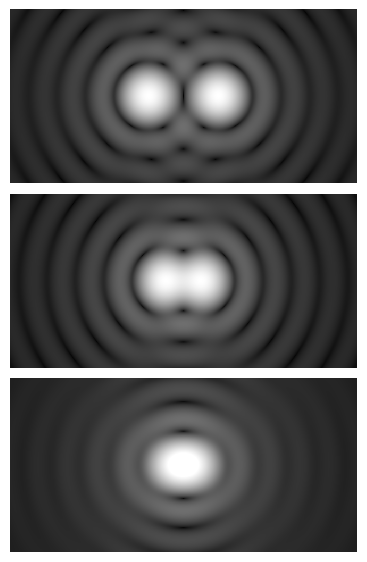
This image uses a nonlinear color scale (specifically, the fourth root) in order to better show the minima and maxima. — Spencer Bliven
Note that 0.61 is a constant deriving from the first zero of the Bessel function describing the Airy pattern for a circular aperture. Although derived for ideal conditions, the Rayleigh criterion remains a concrete and widely cited yardstick for practical microscopy. The resolution fundamentals described earlier apply equally well here: lower wavelength and higher NA both reduce d_{Rayleigh}, thus improving resolution.
Axial resolution and optical sectioning
Whereas lateral resolution concerns x–y detail in the specimen plane, axial resolution (along z, into the specimen thickness) determines how well you can distinguish structures that lie above and below each other. In widefield (non-confocal) microscopy, axial resolution depends strongly on NA and the specimen’s refractive index and scales approximately as:
d_z ∝ (n × λ) / (NA^2)
Here, n is the refractive index of the immersion medium. The crucial takeaway is the square dependence on NA in the denominator: increasing NA not only improves lateral resolution but also tightens axial resolution (and, as we will see in Depth of Field, reduces the thickness over which the specimen appears in focus). Different resolution criteria and imaging modalities—such as confocal microscopy or structured illumination—have their own constants and improvements, but the proportionalities with λ, n, and NA remain guiding principles.
Why both Abbe and Rayleigh still matter
Abbe’s and Rayleigh’s approaches address different, idealized questions (periodic patterns versus isolated points). Real specimens often contain a mixture of textures: periodic features (e.g., striations) and discrete structures (e.g., organelles or micro-objects). Using both viewpoints strengthens your intuition for what an objective can reveal and helps you set realistic expectations about what resolution truly means across diverse samples.
The Role of Illumination Wavelength and Coherence
Illumination is more than just a light source. Its wavelength content and spatial coherence influence contrast and resolution, as does the microscope’s method of relaying illumination to the specimen. Because the expressions in Diffraction Limits depend on λ, how you illuminate directly constrains what you can resolve.
Why shorter wavelengths help
Both Abbe and Rayleigh relationships show lateral resolution scaling with λ; halving the wavelength (e.g., moving from deep red to blue) roughly halves the ray-optical resolution limit, assuming the same NA and imaging conditions. In transmitted-light microscopy, selecting a bluer portion of the spectrum increases resolving power but may reduce brightness or increase absorption/photodamage for certain specimens. In fluorescence microscopy, the emission wavelength, not the excitation wavelength, typically sets the resolution limit in the detected image, because that is the light forming the image at the camera or eyepiece.
Illumination coherence and contrast
Illumination can be more or less spatially coherent. Highly coherent light (e.g., from a laser) tends to produce stronger interference effects and speckle, while partially coherent illumination (typical of a condenser focused appropriately) balances contrast and resolution for many brightfield applications. Two classical arrangements in transmitted light are often discussed:
- Critical illumination: the filament or LED die is imaged directly onto the specimen plane. While simple, it can transfer the inhomogeneities of the source into the image and is less favored for quantitative imaging.
- Köhler illumination: the source is imaged at the condenser aperture, not the specimen, producing spatially uniform, controllable illumination across the field. Köhler improves evenness and allows you to control condenser aperture to match objective NA, optimizing contrast and resolution.

Ask your ZEISS account manager for a lab poster! You’ll find more knowledge brochures and materials on our website www.zeiss.com/microscopy
Images donated as part of a GLAM collaboration with Carl Zeiss Microscopy – please contact Andy Mabbett for details.
— ZEISS Microscopy from GermanyWhen using Köhler illumination, partially closing the condenser diaphragm increases contrast but can reduce resolution by effectively lowering the illumination NA. Matching the condenser aperture to the objective NA typically provides a good balance; in practice, users tune it slightly depending on the specimen’s spatial frequencies and desired contrast.
Chromatic considerations
Objectives are corrected over particular wavelength bands (e.g., achromat, fluorite, and apochromat designs offer increasing levels of chromatic and spherical correction). If you switch to substantially shorter or longer wavelengths than the objective’s correction range, residual aberrations can degrade resolution and contrast. This is a reminder that diffraction limits are not the only limits; residual aberrations, misalignment, and specimen-induced aberrations can blur detail even before you reach the theoretical diffraction boundary.
Depth of Field and Depth of Focus: What Changes When NA Changes
Depth-related concepts in microscopy are often misunderstood. Two terms sound similar but describe different spaces:
- Depth of field (DOF): the range in object space over which the specimen appears acceptably sharp in the image.
- Depth of focus: the tolerance in image space for the detector or film to move while the image remains acceptably sharp.
While related, they address different practical questions. DOF answers, “How thick a layer of the specimen looks in focus at once?” Depth of focus answers, “How sensitive is the imaging sensor position to focus errors?”
How NA affects DOF and axial resolution
As NA increases, both axial resolution improves and depth of field typically decreases. The scaling expressed earlier for axial resolution, d_z ∝ (n × λ)/NA^2, highlights the strong NA dependence along z. The same inverse-square relationship governs the diffraction-limited component of DOF. Practically, a high-NA oil-immersion objective provides thin optical sectioning but requires more precise focusing and often more stable mechanical support because the in-focus region is very shallow.
Conversely, low-NA objectives provide a larger DOF, which can be helpful for viewing thicker or uneven specimens in educational or industrial inspections where crisp axial sectioning is less critical.
Other contributors to DOF
The total DOF also contains a geometrical or tolerance component. Imaging systems define an “acceptable blur” criterion—effectively, how much the image point can spread before it is judged out of focus. In camera-based microscopy, pixel size and display magnification contribute to this criterion. This is why sampling and pixel size matter even for discussions of depth: large display magnifications and small pixels reveal defocus more readily, tightening what qualifies as “acceptably sharp.”
Practical implications
- High-NA, thin DOF: Expect to refocus more frequently across uneven specimens. Mechanical stability, vibration isolation, and precise focusing become more important.
- Low-NA, thick DOF: Useful for surveying, quick scans, or tall microstructures. However, lateral and axial resolution are reduced, and fine details may blend.
- Extended focus techniques: For static specimens, computational focus stacking can synthetically extend DOF by combining multiple focal planes. While useful, this does not circumvent the fundamental trade-off between DOF and resolution—rather, it mosaics information from several focal depths.
Keep in mind that the depth of focus in image space also shrinks with higher NA, tightening tolerance on sensor placement and objective-to-sensor spacing. If your system allows camera position adjustments, small errors become more consequential at high NA.
Immersion Objectives, Refractive Index Matching, and Spherical Aberration
Because NA is proportional to the refractive index of the imaging medium (NA = n × sin θ), moving from air (refractive index ~1.00) to immersion media with higher refractive index enables larger NA values. This is why the highest-NA objectives are almost always immersion designs. Beyond enlarging NA, immersion media also help mitigate refractive index mismatch, which otherwise introduces aberrations—particularly spherical aberration—when imaging through cover glasses and aqueous specimens.

Common immersion media and typical use cases
- Air (n ~ 1.00): Convenient and fast, but NA is limited. Air objectives are common at low to moderate magnifications and NA values.
- Water (n ~ 1.33): Closer to the refractive index of many biological samples and buffers. Water immersion can reduce spherical aberration for thicker aqueous specimens compared to oil, especially when focusing deep.
- Oil (n ~ 1.515, typical microscopy immersion oils): Optimized to match standard cover glass refractive index. Oil immersion objectives achieve very high NA and excellent correction when imaging near the cover glass.
- Silicone oil (n ~ 1.40): Intermediate refractive index with favorable mechanical and thermal properties for long time-lapse imaging. Often chosen to balance spherical aberration when imaging into aqueous samples with reduced sensitivity to temperature-induced refractive index changes.
Exact refractive indices vary by formulation and temperature, but these ranges motivate a central theme: match the immersion medium and objective to the specimen environment and imaging depth.
Refractive index mismatch and spherical aberration
If light transitions between materials of different refractive indices at non-normal incidence (for example, passing from immersion oil through a cover glass into an aqueous sample), refraction alters the converging wavefront. The result at high NA is spherical aberration: peripheral rays focus at a different axial position than paraxial rays. Spherical aberration reduces contrast and blurs fine details, effectively lowering usable resolution even if the nominal NA is high.
Two practical strategies mitigate this:
- Use the intended cover glass thickness and mounting medium. Many high-NA objectives are designed for cover glasses around 0.17 mm thickness. Deviations can degrade performance.
- Use objectives with correction collars if imaging conditions vary. A correction collar allows small adjustments to compensate for cover glass thickness or temperature-induced index changes, reducing spherical aberration.
When focusing deeper into aqueous specimens (tens of micrometers or more), a water immersion or silicone immersion objective may maintain sharper images because their immersion indices better match the sample environment. For near-surface imaging through a standard cover glass, oil immersion objectives provide outstanding lateral resolution thanks to their very high NA. The best choice depends on your desired axial sectioning, imaging depth, and specimen composition.
Condenser NA and illumination matching
Resolution in transmitted light is not solely determined by objective NA. The condenser numerical aperture sets the range of illumination angles incident on the specimen. To fully exploit a high-NA objective in brightfield, the condenser should be capable of providing comparable NA in illumination and be adjusted accordingly (e.g., using Köhler illumination). If the condenser aperture is too small, the effective illumination NA is reduced, limiting the highest spatial frequencies that contribute to image formation. See The Role of Illumination Wavelength and Coherence for more on aligning illumination with objective capabilities.
Working Distance, Cover Glass Thickness, and Practical Trade-offs
Objective selection is always a balance among NA, magnification, working distance, and correction type. Working distance (WD) is the clearance between the front lens of the objective and the specimen when focused. High-NA objectives usually have short WD; long-working-distance designs typically trade away some NA at a given magnification to gain space for bulky samples or tooling.
Working distance versus NA
Achieving very high NA requires capturing high-angle rays, which geometrically pushes the front lens closer to the specimen. This means that oil-immersion, high-NA objectives often have sub-millimeter working distances. In contrast, lower-NA or long-working-distance objectives preserve safety clearance but sacrifice some resolving power and light collection. For tasks like inspecting thick materials, micromanipulation, or observing live organisms in chambers with covers, that extra clearance can be critical even if it reduces maximum resolution.
Cover glass thickness and labels
Objective inscriptions often indicate an intended cover glass thickness, commonly around 0.17 mm (sometimes written as “0.17”). This standard corresponds to a widely used cover glass type. Deviating significantly from the intended thickness drives spherical aberration even at moderate NA, so part of “getting the most from your optics” is to pair objectives with the correct cover glass and mounting arrangements. If your specimen mounting varies, a correction-collar objective allows manual adjustments to compensate for thickness differences.

Mechanical stability and focusing
At high NA with very small DOF (see Depth of Field), extremely small axial movements shift the specimen out of focus. Stable stages, low-vibration mounting, and temperature control all help preserve the focus position. It is not uncommon for advanced setups to incorporate drift compensation or closed-loop focusing, especially for time-lapse imaging. Even without such systems, understanding why high NA “feels touchy” at the fine focus knob helps you work more calmly and deliberately.
Specimen mounting choices that affect resolution
Resolution is not only a function of glass and metal; it is also a function of how the specimen itself is prepared and placed. Consider:
- Minimize uneven thickness that forces frequent refocusing and defeats thin DOF advantages.
- Choose compatible mounting media to reduce index mismatch and improve contrast.
- Keep the specimen close to the cover glass if using high-NA oil immersion, where many objectives are optimized for near-surface imaging.
These practices do not replace good optics but ensure that the optics you have can reach their designed performance envelopes.
Sampling, Magnification, and Camera Pixel Size: Getting the Most From Resolution
Resolution in object space must be adequately sampled in image space to be recorded faithfully. For visual observation, the human eye and eyepiece pairing sets the effective sampling. For digital imaging, the camera pixel size and total magnification determine how finely the image is digitized. The key concept is the Nyquist sampling criterion: to represent a spatial frequency without aliasing, you need to sample it at least twice per period (and often a bit more in practice for robust measurements).
From objective to camera pixel size at the specimen
A camera has a physical pixel size (for example, several micrometers per pixel). The objective and any intermediate optics project the specimen onto the sensor. The effective pixel size at the specimen equals the camera pixel size divided by the total magnification from specimen to sensor. For example, if a camera has 6.5 µm pixels and the total magnification at the sensor is 100×, each pixel corresponds to approximately 0.065 µm (65 nm) in the specimen plane.
To sample the diffraction-limited details, the effective pixel size should be small enough to record at least two samples across the smallest resolvable feature. Using the Rayleigh approximation for lateral resolution (d ≈ 0.61 λ/NA), a common practical guideline is to aim for an effective pixel size of about one-half to one-third of d. This satisfies Nyquist and allows some overhead for processing and measurement.
Worked example (order-of-magnitude)
Suppose you image at an emission wavelength of approximately 550 nm with a high-NA objective (e.g., NA ~ 1.4). The Rayleigh lateral resolution estimate is:
d ≈ 0.61 × 0.55 µm / 1.4 ≈ 0.24 µm
Nyquist sampling calls for pixels at about half this size in the specimen, ~0.12 µm (120 nm) or smaller. If your camera has 6.5 µm pixels, you would want total magnification that maps 6.5 µm to ~0.12 µm at the specimen, i.e., on the order of 50–60× at the sensor or higher. Many modern systems include intermediate magnification changers to tune effective sampling without changing the objective, especially for fixed-pixel-size sensors.
This example illustrates the concept rather than prescribing a universal configuration. The exact numbers will vary with wavelength, NA, and sensor characteristics. However, the main lesson holds: match sampling to optical resolution. Oversampling beyond what the optics can resolve yields larger files with no new detail. Undersampling discards information the optics could otherwise deliver.
Magnification is not a cure for low NA
It bears repeating that boosting magnification without adequate NA does not recover lost resolution. If the lens cannot resolve two features separately due to limited NA or aberrations, enlarging the blur does not create detail. In practice, pair your objective NA and total magnification so that sampling neither bottlenecks nor wastes optical performance.
Display scaling and perceptual sharpness
Although sampling and Nyquist are mathematical, perceived sharpness also depends on display magnification and viewing distance. A dataset that looks crisp on a moderate display enlargement may show aliasing or blur when displayed at extreme zoom. This is not a contradiction; it is simply the same data viewed under different perceptual conditions. Know your use case and optimize sampling, NA, and magnification accordingly.
Contrast Mechanisms and Their Relationship to NA and Resolution
Contrast is the engine of visibility: if two features do not differ in intensity or phase in a way the microscope can convert to brightness differences, resolution is moot. Several contrast mechanisms coexist with the resolution story told so far. While a full review of contrast methods is beyond scope, understanding their basic relationship to NA and resolution helps you make coherent choices.
Brightfield and darkfield
- Brightfield forms images primarily from amplitude (absorption or scattering) differences under transmitted illumination. Resolution depends on both objective NA and the effective illumination NA provided by the condenser. Closing the condenser diaphragm boosts contrast but, past a point, suppresses high spatial frequencies and reduces resolution.
- Darkfield blocks the central illumination, sending only oblique rays through the specimen. Only light scattered by the specimen enters the objective, making fine structures bright on a dark background. The objective NA must be lower than the illumination NA for pure darkfield. While darkfield can reveal high-frequency details with striking contrast, it is sensitive to alignment and stray scatter, and quantitative interpretation can be challenging.
Phase contrast and differential interference contrast (DIC)
- Phase contrast translates specimen-induced phase shifts into intensity differences using phase rings in the condenser and objective. Resolution is influenced by the underlying NA of the objective; the phase plates themselves do not increase the diffraction-limited resolution. However, phase contrast can make near-threshold details stand out by enhancing contrast for transparent samples.
- DIC converts optical path gradients into intensity differences, producing high-contrast, relief-like images of transparent samples. As with phase contrast, the diffraction-limited resolution remains tied to NA and wavelength, but perceptual detail improves because edges are emphasized and noise is suppressed by the interference-based detection scheme.
Polarization and anisotropy
Polarized light microscopy exploits specimen birefringence. While NA and wavelength still govern the diffraction limit, polarized optics produce contrast based on anisotropic phase delays. This is invaluable for materials science and crystalline biological structures. As with other methods, matching the condenser and objective NA within the constraints of the polarization optics helps you approach the native resolution limits.
Fluorescence imaging
In epifluorescence, the emission wavelength typically sets the resolution limit in the recorded image. High-NA objectives are particularly beneficial because they both collect more emission photons (improving signal-to-noise) and sharpen the PSF. Optical sectioning modalities like confocal microscopy and related techniques can improve axial resolution and reject out-of-focus blur compared to widefield, but their ultimate lateral resolution remains bounded by the same λ/NA proportionalities described in Diffraction Limits (with different constants depending on the modality and detection pinhole size).
Across these techniques, one theme is consistent: contrast and resolution are intertwined but distinct. High NA helps you reach fine diffraction-limited detail, but you still need a contrast mechanism that makes those details visible against background variations and noise.
Frequently Asked Questions
Is higher magnification always better than higher NA?
No. Higher magnification without adequate NA enlarges the same blur and does not create new detail. Resolution depends fundamentally on λ/NA-type relationships, not on magnification alone. The best practice is to match magnification to the camera’s pixel size so that you sample the finest details the NA can resolve, as discussed in Sampling, Magnification, and Camera Pixel Size.
Does blue light always give better resolution?
Shorter wavelengths improve the diffraction-limited resolution for a given NA, so blue light can, in principle, resolve finer details. However, practical factors moderate this simple picture: objective correction ranges, specimen absorption and autofluorescence, and potential photodamage can make very short wavelengths less suitable in some cases. Additionally, if the optical system is not corrected or aligned for those wavelengths, aberrations may offset the theoretical gain. See The Role of Illumination Wavelength and Coherence for context.
Final Thoughts on Choosing the Right NA and Resolution Strategy
Numerical aperture is the fulcrum on which resolution, depth of field, and light collection balance. The most reliable way to reason about microscopes is to ground your thinking in a few durable relationships:
- NA sets the scale of resolvable detail: smaller
λ/NAmeans finer lateral resolution; axial resolution scales even more strongly with1/NA^2. - Immersion mediums and index matching matter: they enable high NA and curb spherical aberration, particularly when imaging through cover glasses and into aqueous samples (see Immersion Objectives).
- Köhler illumination and condenser NA influence contrast and the effective spatial frequencies that reach the image (see Illumination and Coherence).
- Sampling must track optical resolution: choose magnification and pixel size so that you meet or exceed Nyquist for the finest details your optics can deliver (see Sampling and Pixel Size).
- Practical constraints—working distance, cover glass thickness, mechanical stability—are not afterthoughts; they often make the difference between theoretical limits and real images (see Working Distance and Trade-offs).
Ultimately, selecting an objective and configuring your microscope is an exercise in harmonizing these elements with your specimen and questions. If you need the thinnest optical section and finest detail near a cover glass, a high-NA oil immersion lens with careful index matching and Köhler illumination is compelling. If you need to image deeper into aqueous samples with less sensitivity to mismatch, water or silicone immersion may balance axial performance and stability. If you need more working distance or survey views of thick samples, a lower-NA objective provides a comfortable depth of field and operating clearance.
As you refine your setups, return to the core ideas introduced in What Do Numerical Aperture and Resolution Mean? and reinforced throughout the sections on Diffraction Limits, Depth of Field, and Sampling. These principles are robust across specimens and platforms, and they will continue to guide good decisions as your microscopy becomes more ambitious.
If you enjoyed this deep dive and want more practical, technically accurate explorations of microscopy, consider subscribing to our newsletter. We publish weekly articles on optics, contrast, sampling, and accessories to help students, educators, and hobbyists get the most from their microscopes.