Table of Contents
- What Is Numerical Aperture in Microscopy?
- Resolution, Diffraction, and Practical Limits
- Magnification vs. Detail: Avoiding Empty Magnification
- Illumination, Contrast, and the Role of the Condenser
- Coverslips, Immersion Media, and Refractive Index Mismatch
- Sampling, Pixel Size, and Digital Resolution
- Choosing Objectives by NA, Working Distance, and Field
- Troubleshooting Poor Resolution and Contrast
- Frequently Asked Questions
- Final Thoughts on Getting Beyond Magnification
What Is Numerical Aperture in Microscopy?
When people first approach optical microscopy, they often focus on magnification: 10×, 40×, 100×. Yet magnification alone does not determine how much detail you can actually see. The property that governs the ability of a microscope to gather light and resolve fine detail is the numerical aperture (NA). Understanding NA connects the physics of light collection, contrast, and resolution into a practical framework that puts you in control of image quality.
Numerical aperture is defined as:
NA = n · sin(θ)

Artist: QuodScripsiScripsi
where n is the refractive index of the medium between the specimen and the objective front lens (typically air, water, or oil), and θ is half the angular aperture of the objective. Higher NA means the objective accepts light over a larger range of angles, improving both light-gathering capability and potential resolving power.
In transmitted light microscopy, there is also a numerical aperture associated with the condenser, the lens system that focuses illumination onto the specimen. The condenser NA controls the angular distribution of the light entering the specimen. Pairing objective NA with appropriate condenser aperture and illumination is essential for optimizing contrast and resolution.
Acceptance cone and illumination cone
Two cones matter in brightfield microscopy:
- Objective acceptance cone: Defined by the objective’s NA; sets how much diffracted light from fine specimen features can be captured.
- Illumination cone (condenser): Defined by the condenser’s NA and the aperture diaphragm; controls spatial frequencies injected into the specimen and influences contrast.
In simple terms, a higher objective NA increases the range of diffracted rays the system can collect, and an appropriately large condenser NA provides the angular diversity of illumination necessary to form high-contrast images of fine structures.
Why immersion media matter
Because NA depends on n, switching from air to water or oil can significantly raise NA. Common objective classes include:
- Air objectives: Typically NA ≤ 0.95. Easy to use, longer working distance, but limited NA by the refractive index of air (n ≈ 1.00).
- Water immersion objectives: NA up to around 1.2; useful when imaging aqueous specimens to reduce refractive index mismatch.
- Oil immersion objectives: NA up to around 1.40–1.49 depending on design; provide highest light-gathering and resolving power when used with suitable immersion oil.
To achieve the rated performance, the immersion medium’s refractive index should match the objective’s design. Even small mismatches can introduce spherical aberration that reduces contrast and resolution, a point revisited in Coverslips, Immersion Media, and Refractive Index Mismatch.
NA and light throughput
High NA is not only about resolution; it also increases light throughput. For a given exposure time, a higher-NA objective collects more light, improving the signal-to-noise ratio. This is crucial for low-light applications such as fluorescence, though in fluorescence the effective resolution relates to the emitted wavelength and the objective’s NA, as detailed in Resolution, Diffraction, and Practical Limits.
Resolution, Diffraction, and Practical Limits
Even a perfect lens is limited by diffraction. When a point of light is imaged through a circular aperture (like an objective pupil), it spreads into an Airy pattern rather than a single point. The size of this pattern sets a fundamental limit to how closely two points can be distinguished—this is the diffraction-limited resolution.
Rayleigh criterion and lateral resolution
In standard widefield imaging with incoherent illumination (typical for brightfield and fluorescence), a widely used criterion for the minimum resolvable distance between two point sources is the Rayleigh criterion:
d ≈ 0.61 · λ / NA
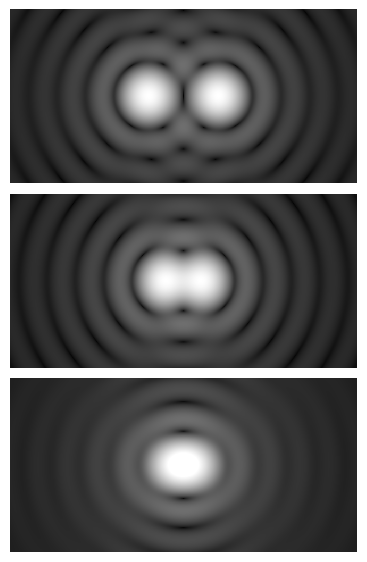
This image uses a nonlinear color scale (specifically, the fourth root) in order to better show the minima and maxima.
Artist: Spencer Bliven
Here, λ is the wavelength of light relevant to image formation. In transmitted white-light brightfield, a representative wavelength in the green region (around 550 nm) is often used for back-of-the-envelope estimates. In fluorescence, use the emission wavelength of the fluorophore of interest when estimating lateral resolution.
Another commonly cited measure is the full width at half maximum (FWHM) of the point spread function (PSF):
FWHM (lateral) ≈ 0.51 · λ / NA
These relations highlight how raising NA or using shorter wavelengths both improve theoretical resolving power.
Axial resolution and depth of field
Axial (z-direction) resolution is generally poorer than lateral resolution in widefield microscopes. A commonly used approximation for the axial Rayleigh criterion in widefield fluorescence is:
dz ≈ 2 · n · λ / NA²
where n is the refractive index of the immersion medium. Small changes in NA have a large impact on axial resolution because of the squared dependence in the denominator.
Depth of field (DOF) and depth of focus are related but distinct. DOF refers to the axial distance in the specimen that appears acceptably sharp; depth of focus refers to the axial tolerance on the image side (camera or eyepiece) where the image remains acceptably sharp. A practical takeaway is that as NA increases, DOF decreases, making focus more critical and sample flatness (and coverslip quality) more important. See Coverslips, Immersion Media, and Refractive Index Mismatch for why small geometric or refractive index errors become more noticeable at high NA.
Condenser NA and coherence considerations in transmitted light
In transmitted brightfield, the objective NA is not the whole story. The condenser NA and the coherence of illumination influence how resolution and contrast are realized:
- Incoherent or partially coherent illumination (common under Köhler illumination) often leads practitioners to estimate lateral resolution using
d ≈ 0.61 · λ / NA_obj, where NA_obj is the objective’s NA. - Under more coherent illumination (e.g., when the condenser aperture is significantly closed), the effective passband reflects contributions from both the objective and condenser. A frequently cited form for the cutoff-limited resolution in coherent imaging is approximately
d ≈ λ / (NA_obj + NA_cond), showing that raising the condenser NA can improve resolution when illumination is coherent.
In practice, most brightfield microscopes are aligned for Köhler illumination with a condenser aperture set to a fraction of the objective NA for a balance between contrast and resolution. Matching or slightly underfilling the objective pupil with the condenser’s illumination improves contrast without sacrificing too much resolving power. We expand on this in Illumination, Contrast, and the Role of the Condenser.
Resolution vs. detectability
Even when two features are closer than the nominal diffraction limit, they may still affect image intensity and be partially distinguished through careful contrast enhancement, deconvolution, or alternative contrast methods (phase contrast, DIC). However, such distinctions do not change the fundamental diffraction limit—they improve detectability or interpretability, not the underlying optical cutoff set by NA and λ.
Key idea: Resolution is governed by wavelength and numerical aperture. Illumination conditions and contrast methods determine how much of that theoretical performance you realize in practice.
Magnification vs. Detail: Avoiding Empty Magnification

Artist: Ernst Leitz (Firm)
It’s tempting to equate higher magnification with seeing more. But if the optical system cannot transfer higher spatial frequencies due to a limited NA, then increasing magnification just spreads the same information over more pixels or a larger field in the eyepieces—this is empty magnification.
Useful magnification range
A practical heuristic widely used by microscopists is that useful total magnification generally lies between roughly 500× and 1000× the objective’s NA. For example:
- With NA = 0.65, useful total magnification might lie around 325× to 650× and can extend up to approximately 650× to 650× (or even 650×–650×?); more broadly, the range is commonly expressed as 500×–1000× NA, i.e., about 325× to 650× for NA 0.65. Beyond that, further magnification tends to be visually empty unless done for display or measurement convenience.
- With NA = 1.30, useful total magnification often lies around 650× to 1300×.
This guideline balances the human visual system’s acuity and typical camera sampling limits with the microscope’s optical transfer. The exact upper end depends on viewing conditions and the imaging sensor, but the takeaway remains: optimize NA first, then choose magnification to sample and display available detail without over-enlarging.
Where magnification still matters
Magnification is still essential for practical reasons:
- Matching the camera sensor: The total magnification at the camera should be chosen to meet sampling criteria (see Sampling, Pixel Size, and Digital Resolution).
- Comfortable visual inspection: Eyepiece magnification and tube length determine the perceived size; modest increases can aid inspection without adding optical detail.
- Field of view: Objective magnification sets field size; sometimes you choose a lower magnification with higher NA (if available) to balance resolution and context.
But remember: if you want to reveal finer structures, the lever to pull is usually NA (and wavelength), not magnification alone. If you are tempted to increase magnification to see more detail, check the objective’s NA, verify illumination alignment, and ensure sufficient digital sampling.
Illumination, Contrast, and the Role of the Condenser
Illumination quality is as important as objective quality. In transmitted light microscopy, Köhler illumination is the gold standard for providing uniform, well-controlled light at the specimen plane. While detailed alignment procedures vary by instrument, the essential ideas are straightforward and highly instructive.
Köhler illumination in concept
Köhler illumination decouples the image of the light source from the image of the specimen. In this scheme:

Images donated as part of a GLAM collaboration with Carl Zeiss Microscopy – please contact Andy Mabbett for details.
Artist: ZEISS Microscopy
- The field diaphragm is imaged onto the specimen plane, defining the illuminated field area and reducing stray light.
- The aperture diaphragm (near the condenser) is imaged into the objective back focal plane, controlling the angular distribution of illumination reaching the specimen.
This arrangement provides even illumination across the field and allows you to adjust contrast and resolution trade-offs via the aperture diaphragm without changing field coverage. For detailed benefits of matching aperture to objective NA, see What Is Numerical Aperture in Microscopy?.
Setting condenser aperture for contrast and resolution
The condenser aperture diaphragm sets the illumination NA. A common practice is to open it to around 60–80% of the objective’s NA for brightfield. This provides a good balance:
- More open diaphragm (higher illumination NA): Higher resolution potential and lower contrast; images can look softer if the specimen is weakly absorbing or scattering.
- More closed diaphragm (lower illumination NA): Higher contrast but increased diffraction and potential loss of high spatial frequencies; uneven illumination and dust shadows may become more apparent.
Your choice depends on specimen properties. Transparent, low-contrast samples often benefit from slightly reduced illumination NA to enhance contrast, while fine-detail work on higher-contrast samples benefits from a higher illumination NA to approach the objective’s resolution limit. Revisit the coherence discussion in Resolution, Diffraction, and Practical Limits to understand how this affects theoretical limits.
Field diaphragm and stray light control
Adjust the field diaphragm to slightly undersize the field of view. This reduces stray light, boosts contrast, and minimizes glare. It also helps localize the illuminated area when hunting for small regions of interest.
Illumination for specialized contrast methods
Contrast modalities impose different illumination requirements:
- Phase contrast: Requires matching phase annuli in the condenser and objective; the illumination is annular rather than full-aperture. NA remains important for resolution, but contrast becomes highly dependent on correct annulus alignment.
- Differential interference contrast (DIC): Uses polarized and sheared beams; preserves high-resolution information well and can work effectively with high NA.
- Darkfield: Employs a hollow cone of light with inner and outer NA bounds; the objective collects only scattered light. The effective resolution depends on both objective NA and the illumination cone geometry.
Each method modifies how spatial frequencies are transferred; none overturn the physical dependence of resolution on NA and wavelength, but they can substantially improve visibility of features by manipulating phase and amplitude contrast.
Coverslips, Immersion Media, and Refractive Index Mismatch
High-NA imaging is unforgiving of small optical errors. Two frequent culprits are coverslip thickness deviations and refractive index mismatches between immersion media and the specimen environment.
Coverslip thickness and spherical aberration
Many high-NA objectives are designed for samples mounted under a standard coverslip, typically specified as approximately 0.17 mm thickness (often labeled No. 1.5). Deviations from the design thickness introduce spherical aberration, degrading contrast and resolution, especially off-axis.
A few practical considerations:
- Use the design coverslip thickness: Check the objective inscription for the intended thickness. Some objectives include a correction collar to compensate for small deviations.
- Keep the specimen near the coverslip: Imaging deeper into a sample increases the effect of refractive index mismatch and spherical aberration, particularly for high NA objectives.
- Flatness and cleanliness matter: Warped or contaminated coverslips produce uneven aberrations and stray light; clean, flat glass supports better imaging.
Immersion medium and refractive index mismatch
Immersion objectives rely on a specific refractive index for best performance. Using the recommended immersion oil with oil objectives, or water with water-immersion designs, reduces refractive index discontinuities at interfaces. Mismatches cause refraction at boundaries that the objective’s correction does not expect, leading to loss of high-angle rays and increased blur.

Artist: Thebiologyprimer
For transmitted brightfield and DIC, the medium between the objective and coverslip should be consistent with the objective design. In fluorescence, mismatches not only blur spatial detail but can also reduce collection efficiency by deflecting emitted photons away from the high-angle acceptance cone set by the NA.
Working distance and NA trade-offs
High NA often comes with reduced working distance (the space between the objective front lens and the specimen at focus). This imposes mechanical constraints: thicker specimens or taller sample holders may collide with the objective. If your application requires more clearance, you may choose a slightly lower NA to gain working distance, as discussed in Choosing Objectives by NA, Working Distance, and Field.
Sampling, Pixel Size, and Digital Resolution
Even if your optics can resolve fine detail, the camera must sample the image adequately to represent those details. Digital sampling is governed by the Nyquist criterion, which, in this context, states that the sampling interval should be small enough to capture the highest spatial frequencies transferred by the optics.
Effective pixel size at the specimen plane
The camera’s physical pixel size (p_camera) projects to the specimen plane according to the total magnification (M) between the specimen and the camera sensor:
p_effective = p_camera / M
To avoid undersampling, a common rule is to make p_effective on the order of one-half to one-third of the expected optical resolution d (lateral). For diffraction-limited widefield imaging with incoherent illumination, a practical target is:
p_effective ≈ (0.5 to 0.33) · d ≈ (0.5 to 0.33) · (0.61 · λ / NA)
This ensures that the finest resolvable features are sampled by at least two to three pixels across their width, reducing aliasing and preserving contrast.
Choosing magnification for the camera
Given a fixed camera pixel size, you can choose tube lenses, relay optics, or objective magnification to meet sampling goals. For example, if your camera pixels are relatively large, you may need higher total magnification to avoid undersampling. Conversely, if your pixels are very small, you may be oversampling; this avoids aliasing but can reduce light per pixel and may not yield more spatial information if the optics are the limiting factor.
- Undersampling: Aliasing, jagged edges, loss of fine detail, and over-optimistic measurement of line pairs.
- Oversampling: Smooth images with reduced noise per unit area at the cost of lower photon flux per pixel and larger data files; spatial information does not increase beyond the optical limit.
To check whether you are in the right regime, estimate the optical resolution using diffraction formulas and compute p_effective. Adjust magnification or pixel binning accordingly.
Dynamic range, exposure, and SNR
Spatial resolution is not the only metric of image quality. Adequate signal-to-noise ratio (SNR) and dynamic range are required to exploit the available resolution. At a fixed illumination, higher NA collects more light, which can improve SNR for the same exposure time. You can also average multiple frames to reduce noise at the expense of temporal resolution.
Tip: Balance pixel size, exposure time, and magnification to keep the camera operating in a linear regime without saturation. Proper illumination setup (see Illumination, Contrast, and the Role of the Condenser) reduces glare and improves contrast, supporting better quantitative imaging.
Modulation transfer function (MTF) and practical contrast
The optical transfer of contrast at different spatial frequencies is described by the modulation transfer function (MTF). Near the cutoff frequency, contrast falls even if resolution in the Rayleigh sense is technically achieved. Cameras with higher quantum efficiency and lower read noise can help preserve contrast at the highest resolvable frequencies by allowing shorter exposures or lower illumination levels, but they do not change the optical cutoff, which is still determined by NA and wavelength.
Choosing Objectives by NA, Working Distance, and Field

Artist: PaulT (Gunther Tschuch)
Selecting an objective is a multidimensional decision that balances NA, magnification, working distance, field flatness, chromatic correction, and cost. Focusing on a few key criteria can streamline the choice.
NA and intended contrast modality
- Brightfield/DIC: Consider moderate to high NA depending on the specimen’s feature size. Ensure the condenser can provide a matching illumination NA, as covered in Illumination, Contrast, and the Role of the Condenser.
- Phase contrast: Objectives are matched to phase rings; ensure compatibility across magnifications. NA remains central to resolution.
- Fluorescence: High-NA objectives capture more emitted photons and increase resolution at emission wavelengths. Objectives optimized for fluorescence often have coatings and glass types selected to reduce autofluorescence and stray light.
Chromatic and field corrections
Objectives vary in color correction and field flatness:
- Achromat: Corrects chromatic aberration for two wavelengths and spherical aberration for one; sufficient for many brightfield tasks.
- Plan achromat: Adds field flattening to keep the image sharp across the field of view—useful for documentation and multi-region analysis.
- Apochromat (and plan apochromat): Tighter chromatic correction across more wavelengths and improved spherical correction; often chosen for demanding color-critical brightfield or multi-color fluorescence.
Better correction aids contrast and sharpness but does not change the fundamental cutoff set by NA and wavelength. However, by reducing aberrations, well-corrected optics help you get closer to the theoretical limits discussed in Resolution, Diffraction, and Practical Limits.
Working distance and specimen geometry
Short working distances often accompany high NA. If you image thick samples, petri dishes, microfluidic chips, or mounted specimens with coverslips of varying thickness, ensure the objective’s working distance and correction collar (if present) match your setup. For inverted microscopes with culture vessels, objectives designed for thicker bottoms or specific substrate materials can reduce aberrations.
Field of view and sampling strategy
Choose magnification to provide enough context without sacrificing resolution. Sometimes a lower magnification objective with relatively high NA (for its class) can outperform a higher magnification objective with lower NA when detail and context must be balanced. Always verify that the resulting camera sampling meets Nyquist criteria.
Troubleshooting Poor Resolution and Contrast
If images look soft, noisy, or low in contrast, use a structured approach to isolate the problem and recover expected performance.
Check optical cleanliness and mechanical stability
- Clean optics: Dust, oil smears, or residue on the objective, condenser, or eyepieces degrade contrast and can scatter light. Use appropriate lens tissue and solvent as recommended by optics manufacturers.
- Stability: Vibration and drift blur fine detail. Ensure the microscope is on a stable surface and minimize environmental disturbances.
Verify coverslip, immersion, and focus
- Coverslip thickness: Use the design thickness (often ~0.17 mm) and ensure specimens are close to the coverslip for high-NA work. See Coverslips, Immersion, and Refractive Index Mismatch.
- Immersion medium: Use the correct medium for the objective (air, water, or oil). Eliminate air bubbles at the interface.
- Precise focusing: Higher NA narrows depth of field. Use fine focus and consider focus aids for critical work.
Align and adjust illumination
- Field diaphragm: Center and set it to just bound the field of view to reduce stray light.
- Aperture diaphragm: Open to a fraction (often 60–80%) of the objective NA for brightfield. Adjust as needed to trade contrast for resolution, as explained in Illumination, Contrast, and the Role of the Condenser.
- Condenser centering and focus: Misalignment produces uneven illumination and lowers contrast.
Consider camera sampling and exposure
- Sampling: Compute
p_effective = p_camera / Mand compare to the optical resolutiond. Adjust tube lens or objective magnification if needed; see Sampling, Pixel Size, and Digital Resolution. - Exposure and SNR: Increase exposure or illumination (within safe limits for the sample) to reduce noise. Avoid saturation.
Assess specimen preparation and mounting
- Even mounting: Tilt or uneven pressure can create focus gradients and aberrations.
- Refractive index environment: Large mismatches between specimen medium and immersion introduce aberrations. Consider media closer to the immersion medium’s index when possible and appropriate for the sample.
Systematically check from fundamentals (NA, wavelength, sampling) to practical factors (cleanliness, alignment, preparation). Most resolution issues trace back to one or two fixable causes.
Frequently Asked Questions
Is higher numerical aperture always better?
Higher NA increases potential resolution and light collection, but it is not universally “better” for every situation. High NA usually reduces working distance and depth of field, demands stricter control of coverslip thickness and immersion media, and can be more sensitive to alignment and sample flatness. If you need more clearance or a larger depth of field, a slightly lower NA may perform better for your specific specimen. The optimal choice balances NA with practical constraints, as outlined in Choosing Objectives by NA, Working Distance, and Field.
Which wavelength should I use in calculations?
Use a wavelength appropriate to your imaging modality. In brightfield with white light, a representative green wavelength (around 550 nm) is often used for rough estimates because the eye is most sensitive there and many optical designs are optimized for this region. In fluorescence, use the emission wavelength of the fluorophore of interest for lateral resolution estimates. Always remember that these are approximations; actual performance depends on the full spectrum and the system’s optical transfer, as discussed in Resolution, Diffraction, and Practical Limits.
Final Thoughts on Getting Beyond Magnification
When it comes to seeing more with a light microscope, the most powerful levers are clear: numerical aperture and wavelength set the diffraction-limited resolution. Illumination quality and condenser settings determine how much of that potential is realized in practice. Properly chosen magnification then ensures that the available detail is sampled and displayed without waste or aliasing. On top of these fundamentals, careful attention to coverslip thickness, immersion media, and mechanical stability removes barriers that often mask the system’s true capabilities.
If your images are falling short, step through the chain systematically. Confirm your objective’s NA and intended coverslip thickness; align illumination; adjust the condenser aperture to balance contrast and resolution; and verify that your camera sampling meets Nyquist. These steps, grounded in the physics summarized in What Is Numerical Aperture in Microscopy? and Resolution, Diffraction, and Practical Limits, will consistently raise the quality of your results.
For future deep dives into topics like axial resolution engineering, partial coherence in transmitted light, and strategies for balancing field of view with sampling on modern sensors, consider subscribing to our newsletter. You’ll receive practical, physics-consistent articles that help you build a robust, intuitive understanding of optical microscopy—one concept at a time.