Table of Contents
- What Do Resolution, Magnification, and Numerical Aperture Mean?
- How Diffraction Sets the Microscopic Resolution Limit
- Numerical Aperture: Definition, Trade-offs, and Measurement
- Choosing Magnification That Matches Resolution and Sensor
- Illumination and Contrast Mechanisms That Influence Effective Resolution
- Sampling, Pixel Size, and Nyquist Criteria in Digital Microscopy
- Objective Types and Immersion Media: Air, Water, Oil, and Glycerol
- Depth of Field, Field of View, and Working Distance Trade-offs
- Practical Calculations: From NA to Expected Detail
- Common Misconceptions and How to Avoid Empty Magnification
- Frequently Asked Questions
- Final Thoughts on Choosing the Right Resolution and Magnification
What Do Resolution, Magnification, and Numerical Aperture Mean?
In everyday use, it is tempting to treat magnification as a proxy for image detail. Yet in optical microscopy, the feature size you can actually distinguish is controlled primarily by resolution, which depends on numerical aperture (NA) and wavelength. To get the most from any microscope—whether for education, hobby investigation, or serious imaging—you need to understand how these terms relate and where each one matters.
Artist: SiriusB
Let’s define the essentials clearly and in physically correct terms:
- Magnification is the ratio of the image size to the object size. In a compound microscope, the overall magnification is the product of the objective magnification and the eyepiece (or the tube lens and camera optics in an imaging setup). Magnification does not create new detail; it only scales what the optical system has already resolved.
- Resolution is the smallest separation at which two points can be reliably distinguished as separate. In a widefield, diffraction-limited microscope, lateral (x–y) resolution is closely approximated by the Rayleigh criterion
d ≈ 0.61 λ / NA, whereλis the wavelength in the medium andNAis the numerical aperture of the objective (and, for transmitted light, influenced by the condenser NA as well). Smaller values ofdindicate finer resolution. - Numerical Aperture (NA) quantifies the light-gathering and resolving power of an optical system:
NA = n \sin θ, wherenis the refractive index of the imaging medium (air, water, oil, etc.) andθis the half-angle of the widest cone of light that can enter or exit the lens. Higher NA means the lens captures steeper rays and more spatial frequencies, producing finer detail and better contrast at high spatial frequencies.
From these definitions, a vital principle follows: resolution improves primarily by increasing NA and/or decreasing wavelength. Magnification, by contrast, should be selected to match the resolved detail to your detector (eyes or camera). Excessive magnification beyond what the NA can support produces only larger, blurrier features—known as empty magnification. We revisit how to choose magnification that fits your setup in Choosing Magnification That Matches Resolution and Sensor.
Equally important: resolution in transmitted brightfield is realized fully only when the condenser provides sufficient illumination NA to fill the objective pupil. A stopped-down condenser behaves like a reduction in system NA and therefore coarsens resolution. You will find practical guidance on illumination and condenser NA matching in Illumination and Contrast Mechanisms.
How Diffraction Sets the Microscopic Resolution Limit

Artist: Anaqreon
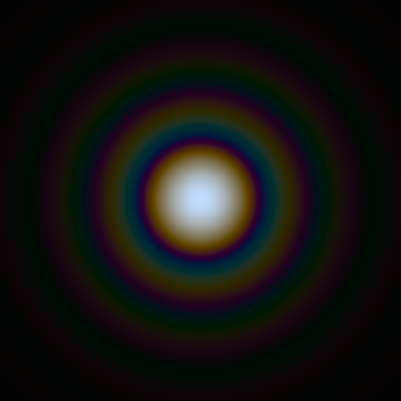
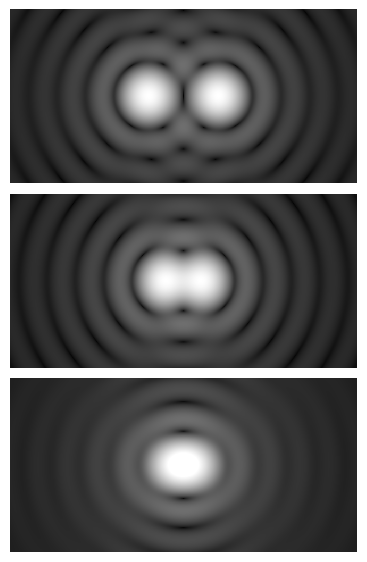
Light behaves as a wave, so even a perfect lens cannot focus to an infinitely small point. A point object forms a diffraction pattern in the image plane called the Airy pattern: a bright central disk surrounded by concentric rings. The radius of the central disk depends on wavelength and NA, and the overlap of adjacent Airy disks defines the resolution threshold.
Abbe and Rayleigh criteria
Two commonly cited criteria for lateral (x–y) resolution in incoherent imaging are:
- Abbe limit (spatial frequency point of view): the highest transmissible spatial frequency is proportional to
NA / λ, leading to a resolution on the order of~ 0.5 λ / NA. - Rayleigh criterion (peak-separation criterion): two equally bright point sources are just resolved when the maximum of one Airy pattern coincides with the first minimum of the other, giving
d ≈ 0.61 λ / NA.
Artist: Spencer Bliven (Quantum7)
Both describe the same underlying physics. The exact numerical factor (0.5 vs. 0.61) reflects different definitions of “just resolved.” In practice, sample contrast, noise, and post-processing influence whether you perceive two features as separate—so these formulas are guidelines for the best-case, diffraction-limited scenario.
Axial resolution and out-of-focus blur
In a 3D sample, axial (z) resolution is coarser than lateral resolution. For widefield imaging, a common approximation is:
- Axial resolution:
Δz ≈ 2 n λ / NA²(approximate, widefield, incoherent conditions).
Here n is the refractive index of the medium between the coverslip and the objective. This relation shows two trends: shorter wavelengths and higher NA improve axial resolution, and the dependence on NA is stronger than in the lateral case (inversely proportional to NA² instead of NA). Axial resolution matters whenever you need optical sectioning or when out-of-focus light degrades contrast. Techniques like confocal scanning and structured illumination can suppress out-of-focus contributions to improve effective sectioning, but the fundamental diffraction relations still govern the finest resolvable features for a given wavelength and NA.
Wavelength choice and color channels
Resolution depends on the emission or detected wavelength. In fluorescence, resolution is tied to the emission band (often longer than the excitation), while in transmitted brightfield it is tied to the illumination wavelength passing the detector or visual system. Because d scales with λ, imaging at shorter wavelengths yields finer resolution. However, practical constraints—spectral properties of samples, detector sensitivity, absorption, scattering, and chromatic aberrations—often set useful bounds. Green light around 540–560 nm is frequently used for estimates because many detectors and optics are well optimized there, but your true resolution follows your actual detected spectrum.
Key takeaway: In diffraction-limited optical microscopy, resolution is fundamentally limited by wavelength and numerical aperture. Magnification must be chosen to display the resolved detail, not to create it.
Numerical Aperture: Definition, Trade-offs, and Measurement
Numerical aperture captures how aggressively a lens gathers light from steep angles. The definition is simple yet powerful:
NA = n \sin θ
where θ is the half-angle of the maximum cone of light entering the objective from the specimen, and n is the refractive index of the medium between the objective front lens and the specimen (commonly air, water, glycerol, or oil). A higher NA collects higher spatial frequencies of the object, improving both resolution and image contrast at fine detail.
What NA tells you in practice
- Resolution: As discussed in How Diffraction Sets the Microscopic Resolution Limit, smaller
0.61 λ / NAmeans finer resolvable spacing. Doubling NA halves the diffraction-limited spot size at a fixed wavelength. - Brightness: In brightfield imaging, signal intensity at the detector generally increases with NA because the objective captures more light. In epi-fluorescence, detection NA also governs how many emitted photons you collect, which is especially important for dim samples.
- Depth of field: Higher NA decreases the depth of field. This can be beneficial for sectioning thin planes but challenging when you want everything in focus. See Depth of Field, Field of View, and Working Distance Trade-offs.
- Working distance and tolerance: High-NA objectives typically have shorter working distances and tighter tolerance for coverslip thickness and refractive-index mismatch.
Objective NA and condenser NA
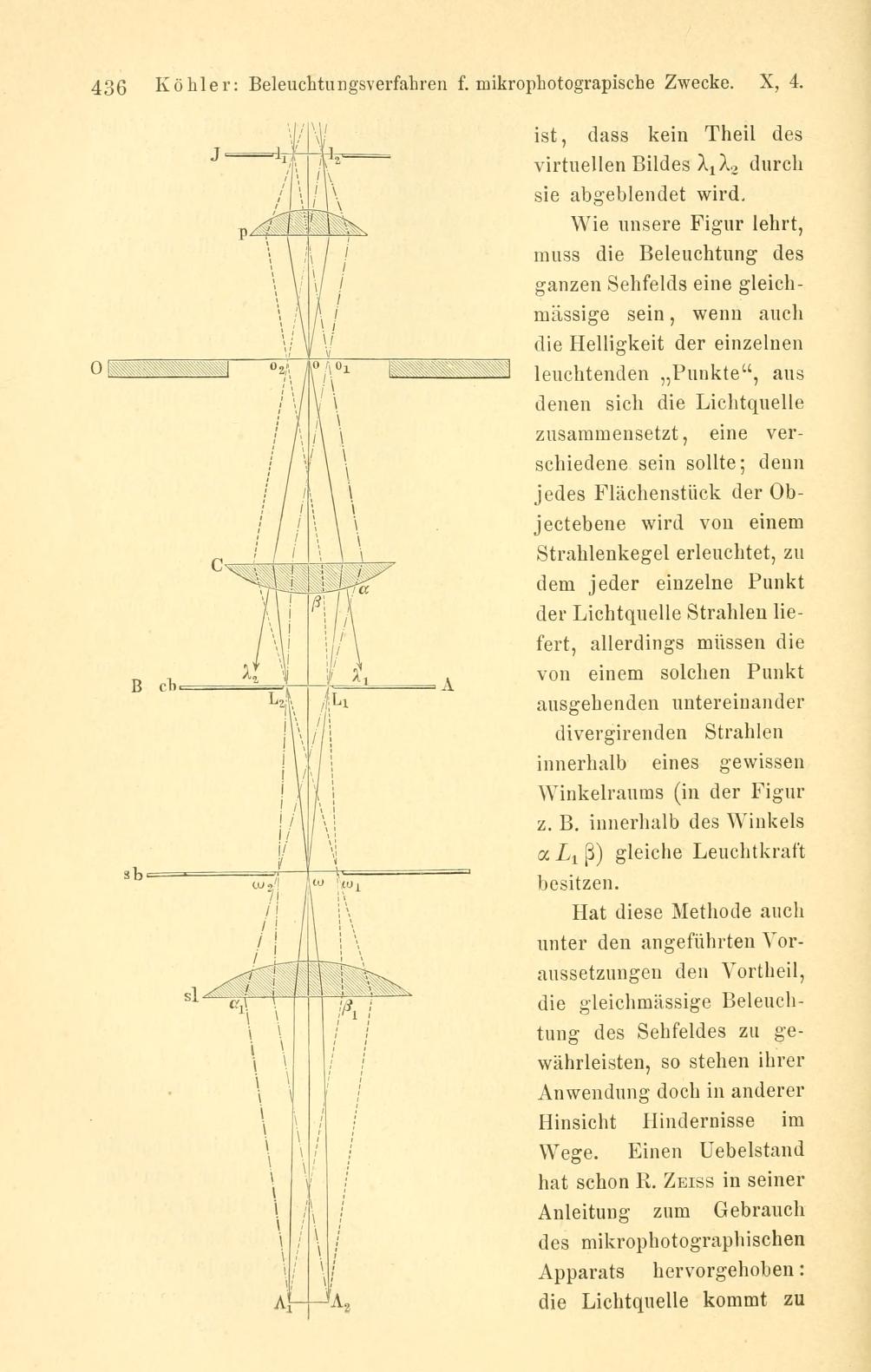
In transmitted-light modes like brightfield and phase contrast, the condenser NA should be adjusted to supply an illumination cone that fills or nearly fills the objective pupil. If the condenser aperture is stopped down too far, the effective system resolution is reduced, and image contrast at high spatial frequencies suffers. In many practical guides, a conservative rule of thumb is to match condenser NA to the objective NA (or slightly lower to modulate contrast). Working in Köhler illumination helps ensure that the condenser and objective are correctly aligned and that aperture diaphragms are set appropriately for the chosen objective.
How NA is specified and checked
- Engraving: Objectives list magnification and NA (e.g., “40× / 0.75”). The NA corresponds to the design medium and geometry.
- Immersion labeling: Objectives intended for non-air use are marked (e.g., oil, water, glycerol), and many also list the design coverslip thickness (often 0.17 mm) and correction collar range if present.
- Practical verification: While end users rarely measure NA directly, you can assess whether your setup delivers expected performance by imaging a calibrated resolution target and comparing the finest visible feature spacing with theoretical expectations at the relevant wavelength. Underperformance can indicate misalignment, wrong condenser setting, or sample-induced aberrations.

Artist: Happie1Soul
Trade-offs and choosing NA
Select NA based on your scientific or educational goal, balancing resolution, brightness, DOF, and working distance:
- High-NA objectives yield superior resolution and light collection but demand careful sample preparation (flatness, coverslip quality, correct immersion), have shallower DOF, and often cost more.
- Moderate-NA objectives are versatile, offering a balance of resolution, DOF, and ease of use for a broad range of samples.
- Low-NA objectives provide large fields of view and generous working distances, valuable for scanning, navigation, and viewing larger specimens—but they cannot resolve very fine features.
Because resolution is so strongly tied to NA, any plan to “see more detail” should start by evaluating the maximum practical NA for your specimens and imaging conditions. Magnification and camera choices then follow, as we discuss in Choosing Magnification That Matches Resolution and Sensor and Sampling, Pixel Size, and Nyquist Criteria.
Choosing Magnification That Matches Resolution and Sensor
Magnification is indispensable—after all, you need to expand tiny details until they are visible to your eye or adequately sampled by a camera. But too much magnification wastes light and field of view, while too little fails to display resolved detail. The art is to choose magnification that matches the optical resolution set by NA and wavelength to the detector sampling and to human perception at typical viewing distances.
For visual observation (eyepieces)
Human visual acuity typically resolves about 1 arcminute of visual angle under good conditions. Traditionally, the useful magnification range for visual observation with a diffraction-limited objective is often cited between about 500× to 1000× the objective NA. This range ensures the Airy disk is expanded sufficiently to be seen as a resolved spot without becoming an overmagnified blur. While individual perception varies, this rule of thumb helps avoid empty magnification at the eyepiece.
- Example: With an NA 0.65 objective, useful visual magnification might be in the ballpark of 325× to 650× total. Exceeding that can be comfortable for viewing but does not add real detail.
For digital imaging (cameras)
Digital sampling imposes a different constraint: pixels must be small enough (in object space) to sample the diffraction-limited details. The relevant metric is the effective pixel size at the specimen, which depends on the physical pixel pitch on the sensor and the system magnification between the specimen and the sensor.
- Effective pixel size at specimen
= sensor pixel size / (objective magnification × camera adapter magnification)for infinity-corrected systems with a standard tube lens, assuming the adapter scales directly. - The Nyquist sampling criterion suggests sampling the smallest resolvable detail with at least two pixels. A practical guideline is to choose an effective pixel size about one-half to one-third of the expected optical resolution
d. This ensures sufficient sampling for faithful reconstruction and basic deconvolution.
We expand on Nyquist, pixel pitch, and camera coupling in Sampling, Pixel Size, and Nyquist Criteria, including worked examples that link NA, wavelength, and magnification to optimal pixel size.
Balancing field of view and signal-to-noise
Higher magnification spreads the same photon budget over more pixels, reducing signal-to-noise per pixel if exposure time and illumination stay constant. Conversely, lower magnification concentrates photons, but may undersample fine detail. Choose magnification that preserves SNR for your target features while meeting sampling criteria. This balancing act is especially important in low-light imaging (e.g., weak fluorescence), where you may accept slightly coarser sampling to keep noise manageable.
Ultimately, magnification is a display and sampling parameter. It cannot improve the diffraction-limited resolution set by NA and wavelength. Start with NA; then select magnification to serve the optics and the detector.
Illumination and Contrast Mechanisms That Influence Effective Resolution
Even with high NA and ideal optics, the ability to discern fine details depends on image contrast and noise. Illumination geometry and contrast methods shape the transfer of spatial frequencies and the visibility of features.
Brightfield and Köhler illumination
In transmitted brightfield, setting up Köhler illumination aligns illumination conjugate planes and allows you to adjust the aperture diaphragm (controls condenser NA) independently of the field diaphragm (controls illuminated area). Properly opening the condenser aperture to approximately match the objective NA ensures that high-angle rays fill the objective pupil. This preserves the objective’s designed resolution and yields even, high-contrast illumination across the field.

Artist: ZEISS Microscopy
- Stopping down the condenser aperture increases depth of field and central contrast but reduces the system’s ability to pass high spatial frequencies, thus lowering resolution.
- Opening too far can reduce contrast due to stray light and glare, and may exacerbate sample-induced scattering.
Darkfield
Darkfield blocks the central illumination and delivers only oblique rays that miss the objective unless they are scattered by fine structures. This boosts the visibility of small, high-frequency features that scatter strongly, making them appear bright against a dark background. Darkfield can reveal details near or slightly below the brightfield contrast threshold, but it does not change the fundamental diffraction-limited resolution set by NA and wavelength. It is a contrast mechanism, not a super-resolution technique.
Phase contrast
Phase contrast converts phase shifts (due to refractive index or thickness variations) into intensity differences. It is ideal for transparent, unstained samples. The phase annulus in the condenser and the phase plate in the objective must be matched. While phase contrast increases visibility of weakly absorbing structures, it can introduce halos around features and slightly alter the effective transfer of spatial frequencies. The ultimate resolution limit remains governed by NA and λ.
Differential interference contrast (DIC)
DIC uses polarized light and sheared beams to convert small optical path differences into intensity gradients, producing a quasi-3D relief appearance. DIC enhances edge contrast and can make fine structures more apparent, especially at high NA. Nevertheless, it does not circumvent the diffraction-imposed cutoff; rather, it reallocates contrast in the spatial-frequency domain to emphasize gradients.
Epi-illumination and fluorescence
In epi-fluorescence, excitation and emission paths share the objective. Resolution in fluorescence is based on the emission wavelength and detection NA. Filters and dichroics must be matched to fluorophore spectra to maximize signal and minimize bleed-through. Because fluorescence is often photon-limited, a high-NA objective can substantially improve SNR by collecting more emitted photons. High NA also narrows the point spread function, improving localization of structures for a given wavelength.
Regardless of the mode, success depends on using an illumination aperture that suits your objective NA and contrast method. When in doubt, revisit Köhler alignment, as correct illumination is a prerequisite to realizing the theoretical resolution implied by your objective’s NA. For a reminder of those relationships, see Numerical Aperture: Definition, Trade-offs, and Measurement.
Sampling, Pixel Size, and Nyquist Criteria in Digital Microscopy
When you capture images with a camera, the detector samples the optical image into discrete pixels. If the pixel sampling is too coarse relative to the optical resolution, high-frequency details will be aliased or lost; if it is too fine, you may waste SNR and storage without adding recoverable information.
Nyquist sampling for diffraction-limited imaging
For a system with lateral resolution d, the Nyquist criterion advises sampling with a pixel pitch in object space of at most d / 2. A practical target is often 2–3 pixels across the full width of the diffraction-limited spot (e.g., the Airy disk core), which accommodates modest post-processing and helps avoid undersampling near the cutoff frequency.
- If
d = 0.36 μm, then aim for an effective pixel size around0.12–0.18 μmat the specimen. - Going much smaller than
d / 3seldom adds information unless you plan advanced deconvolution with excellent SNR, in which case oversampling can aid algorithms at the cost of photon efficiency.
Relating sensor pixels to object space
To compute effective pixel size, divide the physical sensor pixel pitch by the total magnification between the specimen and the sensor. For example, with a 3.45 μm pixel camera and a 40× objective on a 1× tube/adapter, the effective pixel is about 3.45 μm / 40 ≈ 0.086 μm. If you interpose a 0.5× camera adapter, the effective pixel doubles to about 0.172 μm. Choosing the adapter is therefore part of matching sampling to optical resolution, as discussed in Choosing Magnification.
Beware of binning and scaling
On-sensor binning or digital resampling changes the effective pixel size. Binning increases SNR per pixel by combining charge but coarsens sampling. Digital zooming does not improve sampling; it merely scales the image. Always base your sampling plan on the actual physical pixel spacing at the specimen.
Aliasing and MTF
Even when Nyquist is satisfied, contrast near the optical cutoff is weak. The modulation transfer function (MTF) of a diffraction-limited system rolls off with spatial frequency, and detector MTF (including pixel aperture) further attenuates contrast. Proper sampling prevents aliasing but cannot guarantee strong contrast at the finest details if the optical MTF is already low. Increasing NA and optimizing illumination can raise contrast at those spatial frequencies, improving the detectability of the smallest features your optics can theoretically resolve.
Objective Types and Immersion Media: Air, Water, Oil, and Glycerol
The choice of immersion medium affects NA, aberrations, and working distance. Because NA = n \sin θ, increasing the refractive index n of the medium in front of the objective can raise the NA for a given cone angle. However, the medium must also be matched to sample geometry and refractive indices to minimize aberrations.
Air objectives
- Medium: Air (
n ≈ 1.00). - Pros: No immersion handling; convenient; good for general use and larger working distances.
- Cons: Limited maximum NA compared to immersion objectives; sensitivity to refractive mismatch at high NA near the air–glass interface.
- Use cases: Surveying, low-to-moderate magnifications, educational setups, and specimens where immersion liquids are impractical.
Water-immersion objectives
- Medium: Water (
n ≈ 1.33). - Pros: Better refractive index match to aqueous samples; can reduce spherical aberration for thicker water-based specimens; enables higher NA than air with similar cone angles.
- Cons: Requires careful handling; evaporation during long sessions; generally shorter working distance at very high NA than air counterparts.
- Use cases: Live, aqueous specimens; thick hydrated samples where oil would introduce mismatch and aberration.
Oil-immersion objectives
- Medium: Immersion oil (
n ≈ 1.515near the D line), chosen to match coverslip glass. - Pros: Enables very high NA (commonly ≥ 1.30) by allowing steep collection angles and good index matching to glass; excellent for high-resolution work on thin specimens mounted under standard coverslips.
- Cons: Requires coverslip of correct thickness and cleanliness; potential for spherical aberration if sample or mounting differs substantially; careful cleanup needed.
- Use cases: Highest resolution imaging on thin, coverslipped samples; detailed fluorescence imaging where photon collection and resolution are at a premium.
Glycerol-immersion and correction collars
- Medium: Glycerol or glycerol-water mixtures (
nbetween water and oil). - Pros: Intermediate index can mitigate aberrations in specimens whose average refractive index lies between water and glass; some objectives include correction collars to compensate for coverslip thickness variations or immersion mismatch.
- Cons: Requires familiarity with the correct medium and careful adjustment; not as common as oil or water objectives.
- Use cases: Thicker or index-mismatched samples where water or oil each present compromises.
Choosing an immersion medium is inseparable from choosing NA and the sample configuration. An objective designed for oil with a 0.17 mm coverslip expects that specific optical path. Deviations can introduce aberrations that broaden the point spread function and degrade resolution, even if the engraved NA is high. When in doubt, consult the objective’s specification markings, keep to the designed coverslip thickness, and use the indicated medium. If your sample deviates from those assumptions, a water or glycerol objective with an appropriate correction collar can often deliver better real-world resolution than a nominally higher-NA lens used under mismatched conditions.
Depth of Field, Field of View, and Working Distance Trade-offs
Three geometric factors—depth of field (DOF), field of view (FOV), and working distance—shape your user experience and limit what you can image with a given objective. These factors interact with resolution and NA in predictable ways.
Depth of field vs. NA
In a diffraction-limited system, a commonly used approximation for DOF shows an inverse square dependence on NA: higher NA produces shallower DOF. A simple form is
DOF ≈ 2 n λ / NA² (order-of-magnitude estimate),
mirroring the axial resolution scaling discussed in How Diffraction Sets the Microscopic Resolution Limit. The exact DOF also depends on imaging geometry, the acceptable circle of confusion (related to pixel size or visual acuity), and refractive indices. Practically, if you increase NA to resolve finer details, expect a thinner in-focus slab. This is an advantage for optical sectioning but can make thick or uneven specimens challenging to keep entirely sharp in a single image.
Field of view vs. magnification
Field of view is largely determined by the microscope’s field number (for eyepieces) and the size of the camera sensor for digital imaging. Since FOV scales inversely with total magnification, higher magnification narrows the observable area. If you need to overview large specimens, begin with a lower magnification and NA, then switch to higher NA to study regions of interest. Remember to adjust condenser NA as you change objectives to maintain appropriate illumination, as explained in Illumination and Contrast.
Working distance
Working distance is the clearance between the front lens of the objective and the specimen when in focus. High-NA objectives commonly have shorter working distances because bringing rays at steeper angles to focus requires a front element close to the coverslip. Long-working-distance designs exist but usually sacrifice some NA and may introduce additional optical complexity. If you must image thick or irregular specimens, choose objectives that balance working distance with sufficient NA for your resolution goals.
Putting it together
- For maximum resolved detail in thin, coverslipped samples: favor a high-NA oil objective, accept shallow DOF, and choose magnification to meet Nyquist for your camera.
- For live, thick, or aqueous samples: consider water-immersion objectives to reduce aberration, with NA as high as practical while maintaining working distance.
- For survey and navigation: a low-NA air objective gives generous FOV and DOF for context before switching to a higher-NA lens.
Practical Calculations: From NA to Expected Detail
Let’s walk through realistic, numerically consistent examples to link NA, wavelength, and magnification to the details you can expect to resolve and how to set camera sampling accordingly.
Example 1: Moderate NA in green light for brightfield
Suppose you use a 40× air objective with NA 0.65 to view stained tissue in brightfield. Assume your detection is centered around λ = 550 nm (green).
- Lateral resolution (Rayleigh):
d ≈ 0.61 × 0.55 μm / 0.65 ≈ 0.516 μm. - Axial resolution (approx., widefield, air):
Δz ≈ 2 × 1.0 × 0.55 μm / 0.65² ≈ 2.60 μm.
If you attach a camera with 3.45 μm pixels and no intermediate magnification (i.e., 1× camera adapter in an infinity system), the effective pixel size at the specimen is approximately 3.45 μm / 40 = 0.086 μm. This samples ~ 0.52 μm features with roughly 6 pixels across, which comfortably meets Nyquist. You could even use a 0.5× camera adapter to gain field of view; then the effective pixel size would be about 0.172 μm, leaving ~3 pixels per 0.52 μm feature—still acceptable for many purposes.
To realize the full resolution, set your condenser aperture to match the objective NA as closely as practical using Köhler illumination (see Illumination and Contrast).
Example 2: High-NA oil immersion for fluorescence
Now consider a 60× oil-immersion objective with NA 1.40 imaging a green-emitting fluorophore around λ = 520 nm. Assuming proper index matching and a #1.5 coverslip:
- Lateral resolution (Rayleigh):
d ≈ 0.61 × 0.52 μm / 1.40 ≈ 0.226 μm. - Axial resolution (approx., widefield, oil): Using
n ≈ 1.515,Δz ≈ 2 × 1.515 × 0.52 μm / 1.40² ≈ 0.80 μm.
With a 6.5 μm pixel sCMOS camera and 1× coupling, the effective pixel size is 6.5 μm / 60 ≈ 0.108 μm. This gives roughly two pixels per ~0.226 μm feature, meeting Nyquist at the diffraction limit. If your sample is dim, you might consider a 0.7× adapter to raise photon flux per pixel, giving an effective pixel of ~0.154 μm with still reasonable sampling (~1.5 pixels per d). Whether this is acceptable depends on your contrast requirements and downstream analysis.
Example 3: Water immersion for live, thick samples
For a 40× water-immersion objective with NA 1.0 imaging at λ = 560 nm (orange-green emission):
- Lateral resolution:
d ≈ 0.61 × 0.56 μm / 1.0 ≈ 0.342 μm. - Axial resolution (approx., widefield, water):
Δz ≈ 2 × 1.33 × 0.56 μm / 1.0² ≈ 1.49 μm.
With a 4.8 μm pixel camera at 1×, the effective pixel size is 4.8 μm / 40 = 0.12 μm. Sampling is strong (~3 pixels per d). More importantly, a water-immersion objective reduces spherical aberration in aqueous specimens compared to oil, helping you approach the theoretical resolution in practice. This illustrates that a slightly lower NA water lens can outperform a higher NA oil lens if the latter is used under refractive mismatch.
How to use these estimates
- Choose a realistic detection wavelength for your mode (emission for fluorescence; illumination/detection band for brightfield).
- Compute
dandΔzusing the above approximations. - Select magnification and camera coupling so that the effective pixel is about
d/2tod/3. - Verify condenser NA and alignment in transmitted modes to avoid inadvertent resolution loss.
These steps keep your system balanced—optics, illumination, and sampling working together—so that you see what your NA truly permits.
Common Misconceptions and How to Avoid Empty Magnification
Because microscopy terminology is compact but subtle, a few misconceptions persist. Clearing them up helps you design better experiments and avoid frustration.
“Higher magnification gives better resolution.”
Incorrect. Resolution is set primarily by NA and wavelength, not magnification. Magnification should be chosen to display and sample resolved detail. As shown in Practical Calculations, you can oversample or undersample, but you cannot overcome the diffraction limit by turning a magnification knob.
“NA is only about brightness.”
Incomplete. While high NA increases photon collection, its defining virtue is improved resolution through acceptance of higher-angle rays. NA directly enters the diffraction-limited resolution equations; brightness is a welcome side effect for signal-starved modalities.
“The objective NA alone determines resolution in brightfield.”
Misleading. In transmitted brightfield and related modes, the condenser NA must be set to supply sufficient illumination angles. If the condenser aperture is stopped down, the effective passband of spatial frequencies narrows and the image loses fine detail contrast. Use Köhler illumination and match condenser NA to the objective (see Illumination and Contrast).
“Shorter wavelength always means better results.”
Context-dependent. While resolution improves at shorter wavelengths, sample absorption, scattering, and chromatic aberrations can worsen. Detectors may be less efficient at the extremes. Balance wavelength choice with sample properties and optical performance.
“If I use a camera with tiny pixels, I’ll see more.”
Not necessarily. You must project the image with sufficient magnification so that the effective pixel at the specimen meets Nyquist relative to the optical resolution. Tiny pixels without matching magnification just undersample the diffraction-limited spot, leading to aliasing or no practical gain in resolvable detail. See Sampling, Pixel Size, and Nyquist.
“Any coverslip will do.”
Risky. High-NA objectives are designed for specific coverslip thickness (often 0.17 mm) and immersion media. Deviations introduce spherical aberration that softens images and reduces contrast. If your sample geometry varies, use objectives with correction collars or immersion media tuned to your specimen (see Objective Types and Immersion Media).
Frequently Asked Questions
How do I know if I’m using empty magnification?
Check whether increasing the total magnification reveals finer separations between features or just makes the same blur larger. If detail boundaries do not sharpen with more magnification, you have likely exceeded what your NA and wavelength permit. For cameras, compute the effective pixel size at the specimen and compare it to d ≈ 0.61 λ / NA. If the effective pixel is already ~d/2 or smaller, adding magnification without increasing NA will not reveal new detail.
Does confocal microscopy change the resolution equations?
Confocal microscopy uses spatial pinholes to reject out-of-focus light, improving sectioning and contrast in thick samples. It can slightly narrow the effective point spread function laterally and axially compared to widefield under ideal conditions, but the fundamental role of NA and wavelength still governs the achievable spatial detail in a diffraction-limited regime. The exact gains depend on pinhole size, illumination/detection pathways, and sample properties. Even in confocal systems, matching sampling to the optical resolution and maintaining alignment remain essential.
Final Thoughts on Choosing the Right Resolution and Magnification
Optical microscopy is at its best when numerical aperture, wavelength, magnification, illumination, and sampling are aligned. Start from physics: diffraction defines what is possible, with NA and λ setting the resolution scale. Then make pragmatic choices—illumination geometry, condenser aperture, immersion medium, and coverslip control—to deliver that resolution at the specimen. Finally, set magnification and pixel sampling to render the resolved detail clearly without sacrificing SNR or field of view.
Artist: ZEISS Microscopy
Keep these core practices in mind:
- Prioritize NA for true gains in resolution; use shorter detection wavelengths when appropriate.
- Match condenser NA to the objective in transmitted modes and maintain Köhler illumination.
- Select immersion media and coverslips to minimize aberrations for your specimen.
- Choose magnification and camera coupling to meet Nyquist sampling for the diffraction limit you have.
- Favor clean, stable alignments and verify performance using calibrated targets when possible.
With these fundamentals, you will avoid empty magnification and extract the finest detail your optics can genuinely resolve. If you enjoyed this deep dive into resolution, NA, and magnification, consider subscribing to our newsletter to get future fundamentals, techniques, and practical guides delivered weekly. Explore related topics in illumination, objective design, and sampling strategies to broaden your mastery of microscopy.