
Table of Contents
- What Is Milky Way Astrophotography?
- Essential Gear for Milky Way Photos
- Planning, Conditions, and Timing
- Exposure Settings, 500/NPF Rules, and Noise
- Focusing Techniques at Night
- Polar Alignment Basics for Star Trackers
- Shooting Techniques: Stacking, Panoramas, and Blends
- Calibration Frames and Noise Management
- Post-Processing Workflow for Milky Way Images
- Troubleshooting and Common Mistakes
- Ethics, Access, and Safety in the Field
- Frequently Asked Questions
- Final Thoughts on Choosing the Right Milky Way Astrophotography Setup
What Is Milky Way Astrophotography?
Milky Way astrophotography is the practice of photographing our galaxy’s luminous band of stars, dust, and nebulae from Earth’s surface. In wide-field form, it typically uses a camera and a wide or ultra‑wide lens to capture the Galactic Center and surrounding star fields set against a terrestrial foreground. Unlike imaging small galaxies or nebulae with long focal lengths, wide-field Milky Way photos emphasize composition, night-sky planning, and careful noise control.

Artist: Poljua
The bright, textured heart of the galaxy—the Galactic Center—resides in the constellation Sagittarius. Depending on your latitude, it appears above the horizon at different times of year and night. To capture it crisply, you must plan around Moon phase, weather, and light pollution, and then dial in exposure settings that balance sharp stars against noise and dynamic range. If you add a tracking mount, you can lengthen exposures without star trailing, but that raises new considerations like polar alignment and sky‑foreground blending.
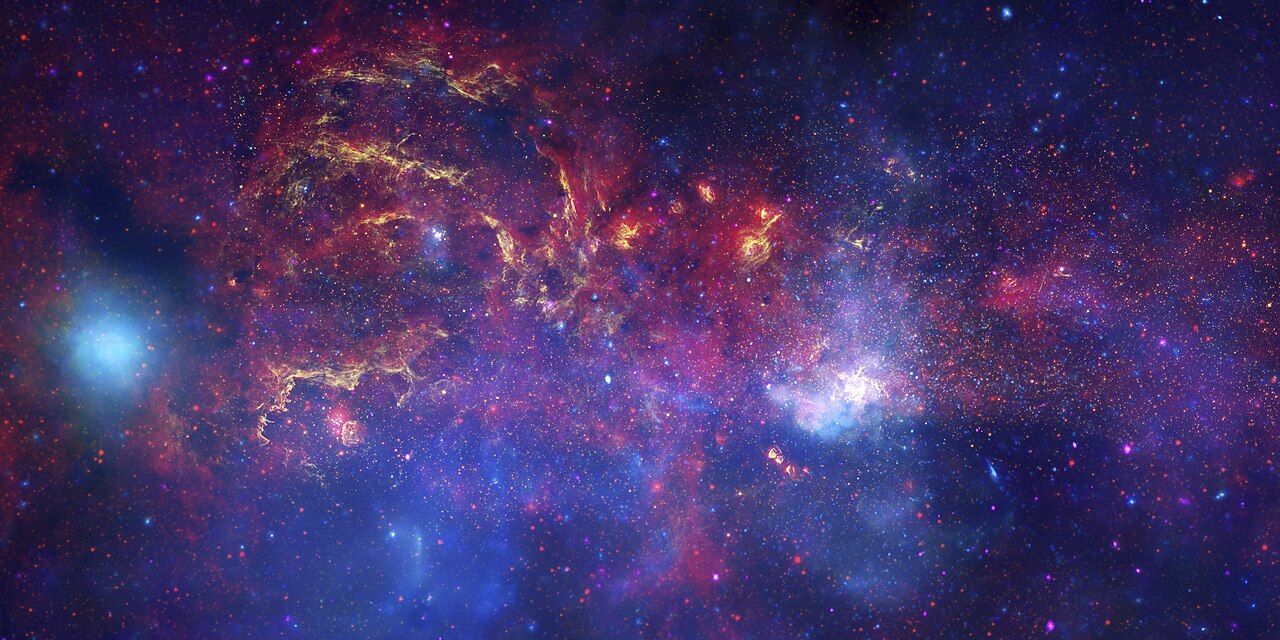
Artist: NASA/JPL-Caltech/ESA/CXC/STScI
This guide takes you end‑to‑end: choosing gear, planning sessions, picking exposure settings (including the 500 and NPF rules), achieving critical focus, aligning a star tracker, shooting stacks and panoramas, using calibration frames, and processing your data. Along the way, you’ll learn to avoid common pitfalls and to adopt a field workflow that’s dependable and repeatable.
Essential Gear for Milky Way Photos
You can start with minimal equipment—a camera, a fast wide lens, and a steady tripod—and grow from there. The goal is to maximize signal (starlight) and minimize noise, without sacrificing sharpness or composition.
Camera: DSLR or Mirrorless
- Sensor format: Both full‑frame and APS‑C work well. Full‑frame sensors usually offer lower noise and wider fields for the same focal length; APS‑C gives added reach and often lower cost.
- Sensor performance: Look for good high‑ISO performance and a wide dynamic range at ISO 800–3200. Modern mirrorless bodies typically offer excellent live view magnification for focusing and in‑body stabilization (which you should disable on a tripod).
- RAW capability: Always shoot RAW. That preserves linear data and richer color depth for stacking and post‑processing.
Lenses: Fast, Wide, and Controlled
- Focal length: 14–24 mm (full‑frame) or 10–16 mm (APS‑C) for sweeping sky and foreground context. For tracked sky mosaics, 24–50 mm can reveal more Milky Way structure.
- Speed: Fast apertures help—f/1.4 to f/2.8 is common. Stopping down 1–2 stops often improves corner sharpness and coma control. For example, a 24 mm f/1.8 lens might perform best at f/2–f/2.8.
- Optical quality: Look for lenses with low coma and astigmatism. Stars should be round near the edges when slightly stopped down.
Tripod and Head
- Stability: A rigid carbon fiber or aluminum tripod prevents blur from wind or handling. Extend legs minimally and hang a weight from the center to damp vibrations.
- Head: A simple ball head works; for panoramas, a leveling base or panoramic head helps maintain consistent horizons.
Star Tracker (Optional but Powerful)
- Purpose: A compact equatorial star tracker rotates your camera opposite Earth’s rotation, allowing longer exposures with pinpoint stars. This dramatically improves signal‑to‑noise ratio (SNR).
- Examples: Portable trackers often support payloads of 2–5 kg with adjustable speeds (sidereal, lunar). They typically include a polar scope. Read your manual thoroughly before field use.
- Trade‑offs: Tracking complicates foreground capture and requires polar alignment. Many photographers blend a tracked sky with a separate untracked foreground.
Intervalometer and Power
- Intervalometer: Enables automated sequences and consistent spacing for stacking or panoramas. Some cameras have built‑in interval shooting.
- Power: Spare batteries and a USB power bank are essential on cold nights (batteries drain faster in low temperatures).
Filters and Accessories
- Light pollution filters: Broadband filters can slightly improve contrast in light‑polluted areas, but they are not a substitute for dark skies and can affect color balance.
- Dew control: A lens warmer powered by USB prevents condensation on humid nights.
- Focusing aids: A Bahtinov mask sized for your lens hood can help nail focus. See Focusing Techniques at Night.

Bahtinov mask example
Artist: Axleottal
- Red headlamp: Preserves night vision while adjusting gear and consulting star charts.
Planning, Conditions, and Timing
Capturing the Milky Way is as much about preparation as it is about exposure. The darker the sky and the cleaner the air, the better your odds of recording fine dust lanes and vibrant star fields.
Dark Skies and the Bortle Scale
- Bortle Scale: A scale from 1 (pristine dark) to 9 (inner city) describing sky brightness. Aim for Bortle 1–4 if possible; the Galactic Center pops, and faint details become accessible.
- Light domes: Even at dark sites, nearby towns create light domes near the horizon. Compose to avoid them or use them creatively as faint glows behind silhouettes.
Moon Phase and Lunar Altitude
- New Moon windows: The best time is around New Moon, when the sky is darkest. For a balanced landscape, a thin crescent setting early can softly light the foreground.
- Lunar altitude: Moon below the horizon yields maximum sky contrast. Planning apps can show when the Moon sets relative to the Galactic Center rise.
Season and Visibility of the Galactic Center
- Latitude dependence: From mid‑northern latitudes, the Galactic Center is prominent from late spring to early autumn, peaking near local midnight in midsummer.
- Azimuth and altitude: Early in the season it rises low in the southeast; later it sweeps higher to the south. Plan compositions using virtual sky charts.
- Panorama foresight: If you intend a multi‑row panorama, verify you have adequate sky and foreground overlap and a roughly level base.

Artist: Jim slater307
Weather, Transparency, and Seeing
- Transparency: Clarity of the air; lower haze and aerosols increase contrast. Seek nights with low humidity and no smoke or dust.
- Seeing: Atmospheric steadiness; more critical for high magnification, but steadier air helps preserve small star profiles.
- Cloud forecasts: Favor thin high‑cloud forecasts of near‑zero. Even faint cirrus scatters urban glow and dims the Milky Way.
Composition Scouting and Foreground Planning
- Daytime scouting: Visit locations in daylight to identify leading lines, silhouettes, and safe access. Note hazards and private property boundaries.
- Azimuth planning: Use a compass or planning app to visualize where the Milky Way core will align with your foreground on a given date and time.
- Panorama foresight: If you intend a multi‑row panorama, verify you have adequate sky and foreground overlap and a roughly level base.
Field note: A well‑planned composition can compensate for mediocre gear. In contrast, the best equipment can’t rescue a poor sky or an awkward foreground.
Exposure Settings, 500/NPF Rules, and Noise
Choosing exposure settings is a balancing act among sharpness, brightness, and noise. Without a tracker, Earth’s rotation will blur stars if your shutter is too long. Two heuristics—the 500 Rule and the NPF Rule—offer starting points for maximum shutter time before visible trailing.
The 500 Rule (Simple, Conservative Starting Point)
The 500 Rule estimates the longest shutter in seconds without obvious star trails:
Max shutter (s) ≈ 500 / (focal_length_mm × crop_factor)
- Example (full‑frame, 20 mm): 500 / 20 ≈ 25 s
- Example (APS‑C 1.5×, 16 mm): 500 / (16 × 1.5) ≈ 20.8 s
Pros: Easy mental math. Cons: Can still produce slight trailing on modern high‑resolution sensors, especially near the celestial equator. It also ignores pixel size.
The NPF Rule (More Accurate)
The NPF Rule considers pixel pitch and aperture. One common form is:
Max shutter (s) ≈ (35 × aperture + 30 × pixel_pitch) / (focal_length)
Where pixel_pitch is in micrometers (µm) and focal_length is in millimeters. This yields shorter times than the 500 Rule for high‑resolution sensors, often producing crisper stars.
You can find your camera’s pixel pitch from manufacturer specs or by dividing sensor width by pixel count across that dimension. Many planning apps calculate NPF automatically.
ISO, Aperture, and Histogram Targets
- Aperture: Start wide open, then stop down 1 stop if corners are soft. Example: f/1.8 to f/2.2 or f/2.8 to f/3.2 for edge improvement.
- ISO: Choose ISO to place the histogram peak about 20–30% from the left edge in a RAW exposure. On many cameras, ISO 1600–6400 works without severe highlight clipping. Test your body; some offer best dynamic range near ISO 800–1600.
- Shutter: Apply the 500 or NPF time; err slightly shorter to be safe, especially if stars are near the celestial equator where apparent motion is fastest.
Example starting point for a full‑frame 24 mm f/1.8 lens under dark skies:
Mode: Manual (RAW)
Aperture: f/2.2
Shutter: 13–15 s (NPF) or ~20 s (500 Rule)
ISO: 3200
White balance: 3800–4200 K (for preview only; RAW WB is adjustable)
Focus: Manual, at infinity (see focusing section)
Noise, SNR, and the Case for Stacking
Noise decreases with stacking. If you average N exposures, random noise reduces by about the square root of N, while signal (stars) adds linearly. For example, stacking 16 frames ideally cuts random noise by 4×. That’s why stacking and/or tracking are transformative for clean Milky Way results.
Beware of heat: Long sequences warm the sensor, increasing thermal noise and hot pixels. Allow cool‑down breaks and consider calibration frames like darks.
Focusing Techniques at Night
Critical focus is non‑negotiable. Autofocus usually fails on the night sky, so switch to manual focus and use one of the techniques below.
Live View Magnification
- Find a bright star or a distant light. Magnify the live view to its maximum factor.
- Slowly rack focus until the star is as small and sharp as possible.
- Refine by nudging back and forth; slight movements matter at fast apertures.
Bahtinov Mask
- A Bahtinov mask produces a diffraction pattern with an easily centered spike when focus is correct.
- Place the mask over the lens hood, aim at a bright star, magnify live view, adjust until the central spike is centered, then carefully remove the mask.

Artist: Axleottal
Infinity Mark Caveats
- Many modern lenses focus past infinity. Don’t trust the hard stop or the infinity symbol without testing.
- Mark an accurate infinity position with tape after daytime tests on a distant object.
Focus Stability
- Tape your focus ring once set to prevent drift.
- Recheck focus periodically, especially after temperature changes or lens bumps.
Polar Alignment Basics for Star Trackers
A star tracker counters Earth’s rotation so you can extend exposures dramatically. To avoid trails on tracked shots, you must align the tracker’s right ascension axis with the celestial pole.
Understanding the Celestial Pole
- Northern Hemisphere: Polaris sits near the North Celestial Pole. A polar scope reticle typically shows a small circle offset from center; you place Polaris at a specific clock position on that circle according to date and time.
- Southern Hemisphere: There is no bright pole star. Alignment uses asterisms (e.g., Octans) and reticle marks. Many trackers and apps provide helpers for southern alignment.
Basic Alignment Workflow
- Level the tripod precisely. A misleveled base complicates altitude and azimuth adjustments.
- Roughly point the tracker toward your celestial pole (north or south), using a compass adjusted for local declination.
- Look through the polar scope and adjust altitude/azimuth to place Polaris (or the southern asterism) at the reticle’s indicated position for your time and date.
- Re‑tighten everything gently and verify the position hasn’t shifted.
Refinement and Field Checks
- Drift checks: Take a short tracked test exposure at 1–2 minutes with a 50 mm lens. If stars elongate east‑west, tweak azimuth; if they elongate north‑south, tweak altitude.
- Payload balance: Balance the camera and lens on the tracker’s RA axis; imbalance strains the motor and can cause guiding errors.
After alignment, remember that tracked sky frames usually require a separate, untracked foreground if you plan to blend the two. See Shooting Techniques for details.
Shooting Techniques: Stacking, Panoramas, and Blends
How you capture data dictates how clean and detailed your final image can be. Here are practical methods that scale from tripod‑only to tracked mosaics.
Unguided Stacking (Tripod Only)
- Settings: Use your best non‑trailed shutter (from 500/NPF rules), a wide aperture, and ISO that yields a usable histogram.
- Sequence: Shoot 16–64 frames of the same composition. Keep intervals short to maintain sky position.
- Alignment: Later, star‑align the frames in stacking software. Foreground will blur in aligned stacks; you can mask in a single sharp foreground exposure.
Tracked Sky, Untracked Foreground
- Sky: After polar alignment, capture 30–120 s exposures at lower ISO (e.g., 800–1600) for cleaner data. Collect many frames for stacking.
- Foreground: Turn off tracking, take several foreground exposures to reduce noise (e.g., multiple shorter frames for averaging) and ensure sharp terrestrial detail.
- Blend: In processing, stack the sky separately, stack or average the foreground if needed, then blend with careful masking and edge management.
Panoramas and Mosaics
- Overlap: Use 30–40% overlap between frames. Keep consistent exposure and white balance.
- Leveling: A leveled base simplifies stitching. Consider a nodal slide for complex foregrounds to minimize parallax.
- Tracked panoramas: Shoot a tracked sky mosaic first (multiple tiles), then an untracked panorama of the foreground with identical vantage. Stitch sky and land separately before blending.
Time Blends and Blue‑Hour Foregrounds
- Blue hour: Capture foreground detail at twilight, then return for the Milky Way. Keep camera position fixed to ease blending.
- Ethical labeling: If you blend across times, note it clearly when sharing. Transparency helps preserve trust in the genre.
Dithering and Sequencing
- Dithering: Very small pointing shifts between frames (manually nudge or recompose slightly) help average out pattern noise and hot pixels in stacks.
- Cadence: Alternate sky, calibration, and quick focus checks. A lightweight field script helps:
1) Polar align (if tracked)
2) Focus at 10× live view; tape ring
3) Shoot 32–64 light frames (sky)
4) Shoot 8–16 darks at same temp/ISO/shutter
5) Optional: flats and biases after session
6) Foreground sequence (untracked)
7) Backup data immediately
Calibration Frames and Noise Management
Calibration frames help remove sensor artifacts, optical vignetting, and dust shadows. While optional for simple single‑frame landscapes, they become valuable as you push faint details through stacking and stretching.
Light Frames
Your actual sky exposures. Capture as many as practical with consistent settings. More lights generally mean lower noise in the final stack.
Dark Frames
- What: Exposures with the same shutter, ISO, and temperature as your lights, but with the lens cap on.
- Why: Map thermal signal and hot pixels so stacking software can subtract them.
- How many: 8–20 often suffices for wide‑field work; more gives smoother dark noise modeling.
Flat Frames
- What: Short exposures of an evenly illuminated field (e.g., tablet or sky flats) at the same focus and aperture as your lights.
- Why: Correct vignetting and dust motes, which become obvious after stretching.
- Tips: Do not change focus or aperture between lights and flats; even small changes alter vignetting and dust patterns.
Bias (or Flat‑Dark) Frames
- What: The shortest possible exposures at the same ISO as your lights, cap on. Alternatively, use flat‑darks (same as flats but capped and matching their exposure) in place of biases.
- Why: Model read noise and offset for flat calibration, depending on your stacking software’s recommendations.
Practical Noise‑Reduction Strategies
- Stack more lights: The most reliable way to reduce random noise.
- Cool down: Allow short breaks to limit sensor heating. Avoid leaving live view on for long stretches.
- ISO discipline: Set ISO based on histogram, not habit. Excessive ISO clips highlights without adding real signal.
- Optical cleanliness: Keep front elements clean; dust lit by nearby lights can glow and complicate flats.
Post-Processing Workflow for Milky Way Images
Processing brings out the Milky Way’s contrast and color while keeping stars tight and the foreground natural. Work non‑destructively and in 16‑bit when possible.
Stacking Software
- DeepSkyStacker (Windows): Star‑aligns and averages or integrates light frames with calibration frames. Good for untracked or tracked wide‑fields.
- Sequator (Windows): Can align stars while freezing the foreground, useful for simple landscapes without separate masking.
- Siril (cross‑platform): Powerful preprocessing, registration, and stacking, with background extraction and color calibration tools.
Export the stacked result as a 16‑bit TIFF for further editing.
Global Adjustments: Neutral and Balanced
- White balance: Aim for neutral star colors—yellowish core, bluish outer regions—without pushing magenta/green tints too far.
- Tone curve: Use a gentle S‑curve to lift the Milky Way band while protecting highlights. Avoid crushing blacks; detail hides in the shadows.
- Contrast and clarity: Apply sparingly. Too much clarity exaggerates noise and halos around stars.
Background Extraction and Gradients
- Gradients: Light pollution and airglow create color and brightness gradients. Use background extraction tools to even the field before heavy stretching.
- Vignetting: Flats help, but residual vignetting can be corrected with radial gradients or lens profiles.
Star Control
- Star size: Moderate star reduction can emphasize Milky Way dust lanes. Avoid over‑reduction that produces dark rings or a plastic look.
- Color preservation: Protect bright star colors when adjusting saturation. A mask targeting the Milky Way band helps isolate adjustments.
Noise Reduction and Sharpening
- Noise reduction: Apply in two passes—first on the sky background at a larger radius, then finely on residual chroma noise.
- Sharpening: Apply selectively to dust lanes and foreground textures. Sharpening stars often creates halos.
Blending Sky and Foreground
- Masking: If you captured tracked sky and untracked ground, mask along the horizon with a soft brush. Pay attention to trees, ridgelines, and fine details.
- Color harmony: Match color temperature between sky and land to avoid obvious seams. Subtle split‑toning can unify the image.
Troubleshooting and Common Mistakes
Even seasoned astrophotographers contend with hiccups. Here are frequent issues and fixes.
Stars Are Blurry or Comet‑Shaped
- Focus slip: Recheck manual focus and tape the ring. Temperature drops can shift focus slightly.
- Coma/astigmatism: Stop down one stop to tighten corners. Consider a higher‑quality lens if edge aberrations persist.
- Vibration: Use a 2‑second timer or remote release; shield the camera from wind.
Star Trailing
- Exposure too long: Shorten the shutter based on NPF or 500 Rule (see exposure section).
- Poor polar alignment: If tracking, refine altitude/azimuth and ensure solid tripod footing.
Excessive Noise
- Too few frames: Stack more lights. Noise falls with the square root of frame count.
- Underexposure: Raise ISO to reach a healthy histogram without clipping highlights.
- Overheating: Give the sensor breaks or shoot on cooler nights. Use dark frames to map thermal signal.
Banding and Pattern Noise
- Dither: Introduce tiny re‑frame shifts between shots to decorrelate fixed‑pattern noise.
- Different ISO: If severe, test alternate ISO settings; some cameras suppress banding better at certain ISOs.
Color Casts and Green/Magenta Tints
- Light pollution: Aggressive sodium/LED spectra can tint images. Neutralize with careful white balance and background extraction.
- Filter side effects: Some pollution filters alter star colors; correct with selective hue/saturation tweaks.
Blending Artifacts Along the Horizon
- Misalignment: If the camera moved, parallax will complicate blending. Consider simpler compositions or a nodal slide next time.
- Edge halos: Use feathered masks and match exposure/white balance before blending.
Ethics, Access, and Safety in the Field
A responsible astrophotography practice respects places, wildlife, and other night‑sky observers.
- Access: Observe posted signs and local regulations. Get permissions where required.
- Leave No Trace: Pack out what you pack in. Avoid trampling fragile terrain, especially cryptobiotic soils in deserts or alpine vegetation.
- Light discipline: Keep lights dim and red. Don’t illuminate dark‑sky sites with bright panels unless necessary and agreed upon by your group.
- Wildlife and neighbors: Avoid nesting sites, livestock areas, and private residences. Sound carries far at night; be considerate.
- Safety: Bring layers, water, navigation, and a charged phone. Share your plan with someone. Beware cliffs, tides, and weather changes.
Frequently Asked Questions
Do I really need a star tracker for Milky Way astrophotography?
No. Many striking Milky Way landscapes are shot from a fixed tripod using short exposures and stacking to reduce noise. A tracker expands your options by enabling longer exposures and lower ISO for the sky, producing cleaner, higher‑resolution results—especially at longer focal lengths. If you use a tracker, you’ll likely capture the foreground separately without tracking and blend in post. See Polar Alignment Basics and Shooting Techniques for workflows.
What’s the best ISO for Milky Way photos?
There is no universal best ISO. Choose ISO to place the sky’s histogram peak roughly 20–30% from the left in RAW, without clipping highlights like airglow or bright stars. On many cameras, that falls between ISO 800 and 6400 depending on aperture, shutter, and sky brightness. Conduct tests with your camera to identify the cleanest ISO that still exposes adequately. Refer to Exposure Settings for guidelines.
Final Thoughts on Choosing the Right Milky Way Astrophotography Setup
Milky Way astrophotography rewards intention: the right night, a thoughtful composition, and an exposure plan matched to your equipment. Start simple: a sturdy tripod, a fast 14–24 mm lens, and a camera that shoots clean RAW files. Master fundamentals like focus, exposure limits, and sky planning. Then add complexity deliberately: stacking first, a star tracker next, and later panoramas or tracked mosaics with careful polar alignment and post‑processing.
Keep notes after every outing—what worked, what failed, and what to try next. Over time, you’ll build a reliable field routine and a processing style that brings out the Milky Way’s delicate dust lanes without sacrificing natural color and star texture.
If you enjoyed this deep‑dive, explore more of our night‑sky guides and consider subscribing to our newsletter. You’ll get fresh tutorials, planning tips, and equipment insights delivered ahead of the next clear, moonless night—because the galaxy isn’t going anywhere, and the best time to plan your next image is now.

Artist: NASA/JPL-Caltech