Table of Contents
- What Is Knullf6hler Illumination in Light Microscopy?
- Understanding Conjugate Planes, Pupils, and Ray Paths
- Step-by-Step Alignment: How to Set Up Knullf6hler Illumination
- Field vs Aperture Diaphragm: Roles, Effects, and Best Practices
- Resolution, Contrast, and Depth of Field Under Knullf6hler Lighting
- Matching Condenser Numerical Aperture to Objectives
- Special Cases: Low Power, Phase Contrast, and DIC Considerations
- Troubleshooting Uneven Illumination and Artifacts
- Knullf6hler vs Critical Illumination: When Each Makes Sense
- Frequently Asked Questions
- Final Thoughts on Mastering Knullf6hler Illumination
What Is Knullf6hler Illumination in Light Microscopy?
Knullf6hler illumination is a foundational brightfield technique that delivers uniform, glare-free lighting across the field of view while maximizing useful contrast and resolution. It does this by decoupling the image of the light source from the image of the specimen. Instead of projecting the light source (for example, a filament or LED emitter) directly onto the sample, the optical train images the illumination aperture into the objectivenull27s pupil and the field diaphragm onto the specimen plane. The result is even field brightness and control over the numerical aperture (NA) of illumination.

Artist: ZEISS Microscopy from Germany
In practice, Knullf6hler illumination requires coordinated use of:
- A collector lens that captures and conditions the light source.
- A field diaphragm that sets the illuminated area at the specimen plane.
- A condenser (often with a top lens) that focuses parallel bundles of light onto the specimen and defines the position of conjugate planes.
- An aperture diaphragm (condenser iris) that sets the illumination NA and therefore influences resolution, contrast, and depth of field.
When properly aligned, Knullf6hler illumination provides these benefits:
- Uniform field illumination with minimal hotspots, gradients, and vignetting.
- Independent control of illuminated area (field diaphragm) versus illumination NA (aperture diaphragm).
- Optimized contrast and resolution for brightfield imaging by matching illumination NA to the objectivenull27s capabilities.
- Reproducible conditions across objectives and sessions, critical for consistent observations or comparative studies.
Knullf6hler illumination is not limited to halogen lamps; it applies equally to LED-based microscopes. Regardless of the light source, the same geometric optics principles and alignment steps apply. If younull27re new to Knullf6hler, the best way to understand it is to connect its conjugate planes to the practical alignment sequence and then fine-tune contrast using the two diaphragms.
Understanding Conjugate Planes, Pupils, and Ray Paths
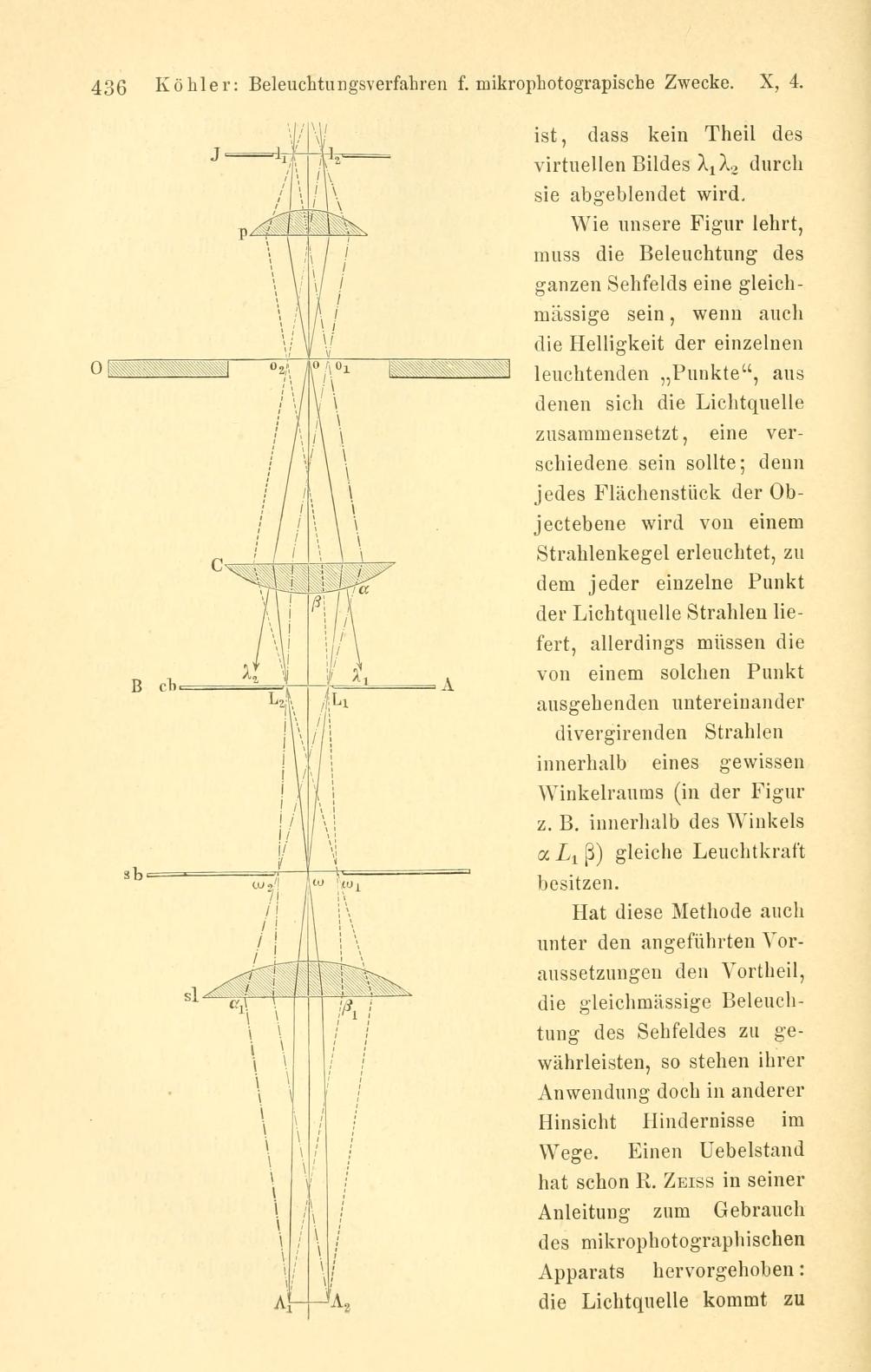
Microscope illumination is more predictable when you track two interleaved stacks of conjugate planes: the field planes (spatial images) and the aperture planes (pupil images). In Knullf6hler illumination, the imaging system is arranged so that the sample is conjugate to the field diaphragm, while the light source is conjugate to the objectivenull27s back focal plane via the condenser aperture.
Field (image) conjugate planes
- Field diaphragm
- Specimen plane
- Intermediate image plane (at the eyepiece entrance)
- Retina or camera sensor plane
These planes contain images of the specimen and the image of the field diaphragm. When you focus the condenser until you see the field diaphragm edges sharply at the specimen plane, you are aligning these field conjugates. Opening the field diaphragm then increases the illuminated area without altering numerical aperture.
Aperture (pupil) conjugate planes
- Light source (filament or LED emitter region, after the collector lens)
- Condenser aperture diaphragm (iris at the condenser)
- Back focal plane (pupil) of the objective
- Pupil of the eye or entrance pupil of a camera
These planes contain images of the illumination source and aperture. Adjusting the condenser aperture diaphragm primarily affects this stack, changing the angular distribution of rays that illuminate the specimen. That angular distribution defines the illumination NA and thus influences resolution and contrast transfer.
Key distinction: The field diaphragm controls the size of the illuminated area on the specimen. The aperture diaphragm controls the illumination NA (cone angle) that reaches the specimen and objective pupil. They are independent controls acting in different conjugate planes.
Ray paths and what you see

Artist: Internet Archive Book Images
- Field diaphragm in focus: When you close the field diaphragm and focus/center it with the condenser, its blades appear sharp at the specimen plane. This ensures proper imaging of the field stop onto the specimen and sets the foundation for uniformity.
- Objective back focal plane: If you inspect the objectivenull27s pupil with a phase telescope or Bertrand lens, you see the condenser aperture image. Opening or closing the condenser iris changes the visible pupil fill.
- Uniformity cues: Off-center or out-of-focus field diaphragm edges signal misalignment of field conjugates; uneven pupil fill indicates aperture-conjugate misalignment.
This conjugate framework will guide every step in the setup procedure and help pinpoint causes of illumination artifacts.
Step-by-Step Alignment: How to Set Up Knullf6hler Illumination
The following method outlines a standard Knullf6hler alignment for brightfield. It assumes a transmitted-light compound microscope with a collector lens, adjustable field diaphragm, condenser with aperture diaphragm, and centering controls. Adaptations for low-power or specialized contrast methods are covered in Special Cases.

Artist: Carpenter, William Benjamin, 1813-1885; Dallinger, W. H. (William Henry), 1842-1909
1) Start with safe defaults
- Select an intermediate objective (for example, a 10nulld7 or 20nulld7). Lower-power objectives make initial alignment easier due to larger fields of view and tolerance to misalignment.
- Focus on a specimen with recognizable features and moderate contrast.
- Ensure the condenser is in place, roughly centered, and close to the underside of the stage (typical starting height).
- Open the condenser aperture diaphragm a medium amount; fully open or fully closed makes subsequent steps less obvious.
- Make sure the field diaphragm can be closed down to a small opening.
2) Close and focus the field diaphragm
- Close the field diaphragm until you see a small polygonal or circular stop at the center of the field of view.
- Adjust the condenser height until the edges of the field diaphragm appear sharp at the specimen plane. If the edges are fuzzy, you are not at the correct conjugate focus.
The sharpness of the field diaphragm at the specimen confirms that the condenser is focused so that the field diaphragm is imaged onto the sample plane. This is the heart of Knullf6hler: the field stop is conjugate with the specimen, not the light source.
3) Center the field diaphragm image
- Use the condenser centering screws (or centering translation) to bring the field diaphragm image to the center of the field of view.
- Recheck sharpness while centering; a small tweak of condenser height may be needed after centering.
Tip: Your goal is symmetrical spacing between the diaphragm edge and the field center. Off-center illumination causes gradients and vignetting, especially noticeable at the periphery.
4) Open the field diaphragm just beyond the field of view
- Gradually open the field diaphragm until its edges retreat just outside the visible field (disappearing from view).
- This limits stray light and glare by blocking illumination outside the imaged field while maintaining full coverage.
Many users leave the field diaphragm too wide, which increases flare and reduces contrast. The best practice is to set it just beyond the field boundary and adjust when objectives change.
5) Adjust the condenser aperture diaphragm for illumination NA
- Open or close the aperture diaphragm to control the illumination cone angle that reaches the specimen.
- As a general guideline for brightfield, set the condenser aperture to a fraction of the objectivenull27s NA (often around 0.7null2d1.0 of the objective NA) to balance resolution and contrast.
Why this range? A wider aperture (higher illumination NA) increases resolution and brightness but can reduce relief contrast and depth of field. A narrower aperture increases contrast and depth of field but reduces resolution and can introduce diffraction blur. The optimal setting depends on the objective, specimen transparency, and desired contrast. See the trade-offs discussed in Resolution, Contrast, and Depth of Field and Matching Condenser NA.
6) Verify and iterate when changing objectives
- Each objective has a different field number coverage and NA. After switching, revisit steps 2null2d5 quickly: focus/center the field diaphragm and adjust the aperture diaphragm to suit the objective NA.
- For very low-power or very high-NA objectives, additional adjustments such as flipping the condenser top lens may be required. See Special Cases.
Once you practice this sequence, Knullf6hler alignment becomes rapid and intuitive. If the image is ever uneven, dim, or low contrast, return to this checklist or visit Troubleshooting.
Field vs Aperture Diaphragm: Roles, Effects, and Best Practices
These two diaphragms are the controls you will adjust most frequently. They operate in different conjugate planes and affect the image in distinct ways.
Field diaphragm (illumination area)

Artist: QuodScripsiScripsi
- Function: Sets the diameter of the illuminated region on the specimen.
- Conjugates: Specimen plane, intermediate image plane, and detector/eye plane.
- Effects: Too wide introduces stray light and glare, reducing contrast. Too narrow clips the field of view and can increase apparent vignetting.
Best practice: After centering and focusing, open the field diaphragm just beyond the visible field edge. Recheck after changing objectives to keep edge glare low and uniformity high.
Aperture diaphragm (illumination NA)
- Function: Sets the illumination numerical aperture by limiting the angular spread of rays entering the condenser.
- Conjugates: Objective back focal plane, condenser aperture plane, and source pupil.
- Effects:
- Open (higher NA): Higher resolution and brightness; lower depth of field and lower relief contrast.
- Closed (lower NA): Higher depth of field and increased contrast of low-spatial-frequency features; lower resolution with increased diffraction blur.
The aperture diaphragm is often marked with approximate NA values. Matching it to the objectivenull27s NA (or a deliberate fraction of it) produces predictable results. For quantitative imaging, keep notes of diaphragm settings and specimen types to reproduce the same conditions later.
To understand exactly why aperture affects image quality, see Resolution, Contrast, and Depth of Field.
Resolution, Contrast, and Depth of Field Under Knullf6hler Lighting
Knullf6hler illumination itself does not magically increase resolution; rather, it enables the objective to reach its designed performance by providing even, well-controlled illumination with the appropriate illumination NA. The key variables are numerical aperture (NA), wavelength of light, and how the condenser aperture is set relative to the objective.
Resolution and NA
In incoherent brightfield imaging, lateral resolution (Rayleigh criterion) is commonly approximated as:
d u2248 0.61 u03bb / NA_{obj}
where u03bb is the wavelength and NA_{obj} is the objective numerical aperture. The objective NA is the primary determinant of resolution. However, the illumination NA also matters for transferring fine spatial frequencies. If illumination NA is set too low, high spatial frequencies in the specimen are weakly excited and contrast at small structures drops.
A useful parameter is the coherence factor u03c3, defined as the ratio of illumination NA to objective NA:
u03c3 = NA_{ill} / NA_{obj}
- With u03c3 u2192 0 (nearly coherent, very small illumination NA), image contrast becomes sensitive to phase and can exhibit edge enhancement, but resolution of fine detail is suppressed by diffraction.
- With u03c3 u2248 0.7u002d1.0 (typical brightfield), high spatial frequencies are better transferred, supporting the objectivenull27s resolution capability.
- With u03c3 u003e 1 (illumination NA exceeds objective NA), the objective limits overall resolution, while the broader illumination can improve uniformity and reduce coherence artifacts.
Thus, for Knullf6hler, the aperture diaphragm primarily sets NA_{ill} and thus u03c3. Matching or slightly underfilling the objective pupil is a common choice in brightfield for detail visibility.
Contrast and stray light
Contrast in brightfield depends on specimen absorption and scattering, plus the microscopenull27s suppression of stray light. Knullf6hler helps by:
- Imaging the field diaphragm to the specimen plane, so off-field light is blocked and does not wash out the image.
- Allowing the aperture diaphragm to tune the angular distribution of illumination, which changes phase-to-intensity conversion and the modulation transfer for different spatial frequencies.
Overly open apertures can let in stray light via dust and lens edge scatter, reducing micro-contrast. Conversely, overly closed apertures increase diffraction and lower fine-detail contrast. The sweet spot is specimen- and objective-dependent; you can verify by slowly adjusting the iris while monitoring visibility of known features.
Depth of field and diffraction blur
As the illumination NA increases, depth of field (DOF) decreases. While exact DOF depends on several factors, a simple wave-optical term for DOF scales approximately as:
DOF u221d u03bb / NA^2
This means doubling NA reduces DOF by roughly a factor of four. Narrowing the aperture diaphragm increases DOF but at the cost of resolution. Knullf6hler illumination provides a stable platform to make this trade-off consciously rather than as a side effect of uneven or uncontrolled lighting.
For practical guidance on choosing illumination NA for each objective, see Matching Condenser NA.
Matching Condenser Numerical Aperture to Objectives
The condensernull27s job in Knullf6hler is twofold: to image the field diaphragm onto the specimen and to provide an adjustable illumination NA via the aperture diaphragm. To fully support an objectivenull27s resolution capability in brightfield, the condenser system should allow an illumination NA that is comparable to the objective NA. Two practical considerations follow:
1) Illumination NA should be sufficient
- If the condensernull27s maximum usable NA is significantly lower than the objective NA, fine detail contrast will suffer because high spatial frequencies are weakly illuminated. Even if the objective is high-NA, the system may behave as if it were lower-NA due to under-illumination.
- As a rule of thumb for brightfield, aim for
NA_{ill}on the same order asNA_{obj}. Many users picku03c3(illumination-to-objective NA ratio) in the 0.7null2d1.0 range for general-purpose imaging, then adjust slightly for contrast preference.
2) Objective and condenser compatibility

Artist: Carpenter, William Benjamin, 1813-1885; Dallinger, W. H. (William Henry), 1842-1909
- High-NA oil objectives: These typically require a high-NA condenser, often with oil contact at the condenser top lens to maintain high
NA_{ill}. If the condenser remains dry with an air gap, effective illumination NA may be reduced, limiting performance. - Low-NA and long working distance objectives: These pair with lower condenser NA and often require removing or swinging out the condensernull27s top lens to avoid over-focusing and to increase the illuminated field size. See Special Cases.
3) Confirming pupil fill
If your microscope includes a phase telescope or Bertrand lens, inspect the objective back focal plane while adjusting the condenser aperture. Ideally, the illumination should fill the pupil to the desired fraction (for example, approximately 70null2d100% of its diameter for brightfield). This direct observation is the most reliable way to set NA_{ill} relative to NA_{obj}.
When pupil inspection tools are unavailable, you can still tune the aperture diaphragm empirically: slowly open the iris while observing fine features until increasing it further yields no visible improvement in detail; then close slightly to boost contrast if needed. Maintain proper Knullf6hler alignment during this process.
Special Cases: Low Power, Phase Contrast, and DIC Considerations
Real-world microscopy often extends beyond standard brightfield with mid-NA objectives. Here are adjustments for common scenarios that still respect Knullf6hler principles.
Low-power objectives (e.g., 2nulld7null2d5nulld7)
- Condenser top lens: Many condensers include a flip-out or removable top lens. For very low magnification, swing out or remove this lens to avoid over-focusing and to expand the illuminated field diameter.
- Field diaphragm: You may need to reopen the field diaphragm more than usual to cover the wide field of view, but still keep it just beyond the field edge to limit stray light.
- Aperture diaphragm: Because objective NA is low, you may not notice dramatic changes with the condenser iris. Still, keep it sufficiently open to avoid dim, grainy images; close slightly for increased relief contrast on thick specimens.
High-NA dry and oil objectives
- Condenser NA and immersion: To achieve high illumination NA, the condenser top lens may need immersion (e.g., with oil) for the highest-NA objectives. Without proper coupling, total internal reflection at the glass-air interface can limit illumination NA.
- Stray light sensitivity: High-NA imaging is sensitive to flare and dust. Keep the field diaphragm as tight as practical and ensure optical surfaces are clean.
Phase contrast objectives
- Condenser annulus: In phase contrast, the condenser iris is replaced or supplemented by a phase annulus matched to the objectivenull27s phase ring. The alignment goal is to superimpose the condenser annulus and objective phase ring in the pupil plane.
- Procedure: You still align Knullf6hler by using the field diaphragm focus and centering. Then, with a phase telescope or Bertrand lens, center the phase annulus with its ring. Do not use the aperture diaphragm in the usual way; use the proper annulus for each objective.
- Illumination NA: The effective illumination NA is set by the annulus geometry, not the standard iris. As such, the usual brightfield trade-offs governed by the aperture diaphragm are replaced by the phase ring/annulus pairing.
Differential interference contrast (DIC)
- Prisms and polarizers: DIC inserts prisms into the illumination and imaging paths. Perform basic Knullf6hler alignment in brightfield first (with prisms out), then engage DIC components and make fine adjustments according to the systemnull27s instructions.
- Aperture considerations: DIC often benefits from moderate pupil fill. Avoid overly closing the aperture, which can impair the interference contrast and increase diffraction effects.
Oblique illumination and darkfield stops
- Oblique: Intentional decentering or sector stops modify the angular illumination distribution. Establish Knullf6hler first for even baseline illumination, then apply the oblique element and re-optimize.
- Darkfield: Darkfield condensers or stops require excluding the direct (central) rays. Knullf6hler alignment of field conjugates remains important to minimize stray light; however, the aperture diaphragm is not used in the usual way.
Across all these methods, keep the logic of conjugate planes in mind and refer to Conjugate Planes and Diaphragm Roles to understand which control affects which image property.
Troubleshooting Uneven Illumination and Artifacts
Even with Knullf6hler, issues can appear. The following troubleshooting guide maps symptoms to likely causes in either the field or aperture conjugate stacks. Use it to quickly restore uniform, high-contrast illumination.
Symptom: Bright center with dim corners (vignetting)
- Field diaphragm too narrow: Open it slightly until edges move outside the visible field.
- Condenser off-center: Re-center using the condensernull27s centering screws while the field diaphragm is closed.
- Condenser too low/high: Refocus the condenser so the field diaphragm edge is sharp at the specimen plane, then reopen the diaphragm.
- Condenser top lens position: For low-power objectives, flip out the top lens to expand the illuminated field; for higher power, ensure it is correctly in place.
Symptom: Uneven gradient across the field
- Source or collector misalignment: If your microscope allows lamp or collector positioning, center the source and verify the collector lens is seated. Many LED stands have fixed alignment, but older halogen stands may require centering.
- Dirty optics: Dust on the condenser front lens, slide surfaces, or the collector can scatter light unevenly. Clean carefully with appropriate technique and materials.
- Off-axis condenser: Re-center with field diaphragm closed, then reopen.
Symptom: Glare, washed-out contrast
- Field diaphragm too wide: Close it to just beyond the field edge to block off-field stray light.
- Aperture diaphragm too open: Close slightly to reduce flare and increase micro-contrast.
- Internal reflections: Check for improper condenser lens position, missing or uncoated accessories in the optical path, or contaminants on glass surfaces.
Symptom: Image too dim
- Aperture diaphragm too closed: Open to increase illumination NA and brightness.
- Field diaphragm too closed: Open to expand the illuminated area (ensure it still remains outside the field edge).
- Condenser focus error: If the field diaphragm edge looks blurry when closed, adjust condenser height until it is sharp.
Symptom: Dust shadows or irregular specks
- Field-conjugate dust: Dust on the specimen, cover glass, or field diaphragm plane produces in-focus or near-focus specks that move with the slide.
- Aperture-conjugate dust: Dust near the condenser aperture or source pupil may appear as defocused blobs that change subtly with the aperture setting. Cleaning the condenser front lens and the collector is often effective.
Symptom: Inconsistent results when changing objectives
- Skipped re-alignment: Each objective change can alter field coverage and optimal
NA_{ill}. Quickly revisit the Knullf6hler steps. - Condenser top lens not matched: Flip the top lens appropriately for low vs high magnification objectives as in Special Cases.
Systematically checking the field diaphragm focus/centering first, then adjusting the aperture diaphragm, resolves most issues. If problems persist, verify that all standard components are present (collector lens installed, correct condenser type, no unintended diffusers), and consult the microscopenull27s optical diagram.
Knullf6hler vs Critical Illumination: When Each Makes Sense
Knullf6hler illumination arranges the optics so that the light source is imaged into the objective pupil (aperture plane) and not at the specimen, whereas the field diaphragm is imaged at the specimen. In contrast, critical illumination images the light source directly onto the specimen plane. Understanding the difference clarifies why Knullf6hler is usually preferred for brightfield.
Artist: ZEISS Microscopy from Germany
Knullf6hler illumination
- Uniformity: Excellent, because the source nonuniformities are averaged across the pupil and not projected onto the specimen.
- Control: Independent control of illuminated area (field diaphragm) and illumination NA (aperture diaphragm).
- Use cases: Standard brightfield imaging, quantitative measurements that require reproducible and even illumination, high-NA work.
Critical illumination
- Uniformity: Limited by the light source homogeneity. Filament texture or LED emitter structure can imprint on the specimen, causing hotspots or patterns.
- Simplicity: Fewer components and simpler alignment in some systems, historically common in basic microscopes.
- Use cases: Very low magnification where uniformity demands are relaxed; simple educational scopes without full Knullf6hler components; situations where a condensernull27s focusing and centering controls are unavailable.
For most modern tasks, Knullf6hler offers superior control and consistency. However, understanding critical illumination can help diagnose why a basic system produces source-texture artifacts and why upgrading to Knullf6hler components improves results. For practical setup differences, compare the steps in Knullf6hler alignment to the absence of a focused/centered field diaphragm in critical illumination.
Frequently Asked Questions
Do I need Knullf6hler illumination for low-power objectives?
While the benefits are less dramatic at very low magnification, Knullf6hler still helps stabilize contrast and reduce glare. Low-NA objectives have wide fields and large depth of field, so minor nonuniformities may be less obvious. Even so, focus and center the field diaphragm, and consider flipping out the condensernull27s top lens as described in Special Cases. Keeping illumination even and well-bounded improves visibility of subtle features and makes images more consistent across objectives.
How should I set the condenser aperture relative to objective NA?
A widely used starting point in brightfield is to set the illumination NA (by the condenser aperture diaphragm) to a fraction of the objective NA, often around 0.7null2d1.0. This balances resolution, contrast, and brightness for many specimens. If fine detail seems muted, open slightly; if the image looks washed out with low relief contrast, close slightly. If available, check the objective pupil with a phase telescope and fill it to the desired fraction directly. For more context, see Resolution, Contrast, and Depth of Field and Matching Condenser NA.
Final Thoughts on Mastering Knullf6hler Illumination
Knullf6hler illumination is the gateway to consistent, high-quality brightfield microscopy. By separating field and aperture conjugates, it equips you with two independent controls: the field diaphragm to bound and homogenize the illuminated area, and the aperture diaphragm to tune illumination NA and thereby shape resolution, contrast, and depth of field. The setup procedurenull27s core stepsnull2dnull2dfocusing and centering the field diaphragm, then optimizing the aperturenull2dnull2dprovide a repeatable workflow that carries across objectives and even across microscopes.
As you practice, connect what you see to the underlying optics: sharpen and center the field stop to unify the field conjugates, and watch the objectivenull27s pupil (or its effects) while setting illumination NA. Use the troubleshooting checklist in Troubleshooting to quickly resolve gradients, glare, and vignetting. For specialized methods like phase contrast or DIC, start with Knullf6hler in brightfield, then engage the method-specific optics, as summarized under Special Cases.
If this guide clarified Knullf6hler illumination for you, consider exploring our other fundamentals on numerical aperture, contrast mechanisms, and condenser design. Subscribe to our newsletter to receive the next microscope fundamentals article, practical alignment tips, and deep dives into contrast techniques right in your inbox.