
Table of Contents
- What Is Dark Matter in Astrophysics?
- Observational Evidence for Dark Matter
- How Dark Matter Shapes Cosmic Structure
- Leading Dark Matter Candidates and Properties
- Alternatives to Particle Dark Matter (Modified Gravity and More)
- How Scientists Search for Dark Matter: Direct, Indirect, and Colliders
- Axion Dark Matter Experiments and Techniques
- Small‑Scale Challenges to Lambda‑CDM and Proposed Resolutions
- From Surveys to Simulations: Turning Data Into Insight
- How to Read Papers and Track Dark Matter Research
- Frequently Asked Questions
- Final Thoughts on Understanding Dark Matter
What Is Dark Matter in Astrophysics?
Dark matter is the name scientists give to an invisible form of matter that appears to outweigh all visible stars, gas, and dust in the Universe. It does not emit or absorb light in the ways ordinary matter does, but its gravity shapes the motions of galaxies, bends light from distant sources, and seeds cosmic structure on the largest scales. In the standard cosmological model (often called Lambda‑CDM), dark matter makes up most of the matter content of the Universe and a substantial fraction of the total cosmic energy budget.

While ordinary (baryonic) matter is familiar—protons, neutrons, electrons—dark matter has not yet been directly detected via non‑gravitational interactions. Nevertheless, multiple lines of observational evidence point to its presence. In broad strokes:
- It interacts gravitationally, shaping galaxy rotation curves and stabilizing galaxy clusters.
- It is “cold” or at least “non‑relativistic” by the time structure forms, allowing it to clump on galactic scales.
- It does not strongly interact with light, so we observe it primarily through its gravitational effects.
As we will see in Observational Evidence for Dark Matter, the case for dark matter does not rely on a single dataset but on a web of mutually reinforcing observations ranging from galaxy dynamics to precise maps of the cosmic microwave background.
Working definition: Dark matter is matter that gravitates like mass but is electromagnetically dark—no ordinary emission, absorption, or scattering of light has yet been convincingly observed from it.
Dark matter is not the same thing as dark energy. Dark energy is a separate component that drives the accelerated expansion of the Universe. Dark matter, by contrast, pulls things together via gravity and plays a central role in structure formation.
Observational Evidence for Dark Matter
The evidence for dark matter is diverse and has grown steadily over decades. No single observation is considered decisive by itself; instead, the case rests on many independent probes that point to the same conclusion: there’s more gravitating mass than we can account for with ordinary matter. Here are the key pillars of evidence:
1) Galaxy Rotation Curves
When astronomers measure how fast stars and gas orbit in spiral galaxies, they find the speeds remain roughly constant—or even slightly increase—far from the galactic center. If most of the mass were in the luminous disk, those speeds would drop with distance (like planets in the Solar System). The flat rotation curves indicate a massive, extended halo of matter that is not seen in starlight.

Rotation curves are among the earliest and most iconic pieces of evidence pointing to dark matter halos. They are observed across many galaxies, and the phenomenon is not limited to any special class of spirals.
2) Galaxy Clusters: Dynamics, X‑ray Gas, and Lensing
Galaxy clusters—the largest gravitationally bound systems known—show a longstanding mass discrepancy. Using galaxy velocities and the virial theorem, scientists infer much more mass than can be accounted for by starlight. X‑ray observations of the hot intracluster gas also demand strong gravitational confinement. On top of that, gravitational lensing (the bending of light by mass) reveals that clusters contain far more mass than visible baryons alone.
In certain merging clusters, a spatial separation between most of the baryonic matter (often dominated by luminous hot gas) and the mass concentration inferred from lensing maps is observed. This morphology suggests that a dominant mass component passed through the collision with minimal interaction—consistent with collisionless dark matter.

3) Gravitational Lensing: Strong, Weak, and Microlensing
Einstein’s general relativity predicts that mass bends spacetime, deflecting light. Astronomers leverage this to map mass distributions using lensing. In strong lensing, background galaxies are distorted into arcs and multiple images; in weak lensing, subtle statistical distortions in the shapes of many background galaxies trace the intervening mass field. Weak lensing mass maps typically show vast structures whose mass exceeds the visible contribution by large factors.
Microlensing surveys, meanwhile, have largely limited the possibility that dark matter consists entirely of massive compact objects like faint stars or black holes over key mass ranges. While some compact objects certainly exist, they do not appear to account for the full dark matter budget.
4) Cosmic Microwave Background (CMB) Anisotropies
The CMB—relic radiation from about 380,000 years after the Big Bang—carries a detailed imprint of the early Universe’s contents. The pattern of acoustic peaks in the CMB power spectrum requires a significant component of non‑baryonic matter to fit the data. Precise measurements support a Universe in which dark matter contributes substantially to the total energy density, alongside ordinary matter and dark energy.

5) Large‑Scale Structure and Baryon Acoustic Oscillations
The distribution of galaxies on large scales, as revealed by redshift surveys, matches the predictions of gravitational growth seeded by cold dark matter fluctuations. Observations of baryon acoustic oscillations (BAO)—a characteristic scale imprinted in the galaxy distribution—further support the standard cosmological model that includes cold dark matter.
6) Dwarf Galaxies and Mass‑to‑Light Ratios
Many dwarf galaxies are dominated by dark matter. Stellar velocity dispersions in these systems typically indicate mass‑to‑light ratios far exceeding what is expected from stars alone. Dwarf spheroidal galaxies orbiting the Milky Way are a notable example where dark matter seems to dominate the gravitational potential.
These lines of evidence—galaxy dynamics, cluster mass profiles, lensing, the CMB, and the cosmic web—form a coherent picture that points strongly toward a dark matter component. For additional discussion of how these observations connect to growth of structure, see How Dark Matter Shapes Cosmic Structure.
How Dark Matter Shapes Cosmic Structure
Dark matter is a key player in the formation of structure, from the earliest density fluctuations to the vast filaments and voids observed today. Because it interacts predominantly via gravity and is not slowed by electromagnetic interactions, dark matter collapses into halos efficiently as the Universe expands and cools.
Seeds of Structure in the Early Universe
Quantum fluctuations stretched to macroscopic scales during inflation (according to many models) provide the initial seeds. After recombination, small overdensities begin to accrete more matter. Dark matter—being pressureless compared to the baryon‑photon plasma—starts to clump earlier, forming gravitational wells into which baryonic gas later falls, leading to star formation and galaxies.
Bottom‑Up Growth and the Cosmic Web
In the cold dark matter paradigm, structure grows in a “bottom‑up” hierarchy: small halos form first and merge over time into larger systems. This process gives rise to a cosmic web of filaments, nodes (clusters), and sheets. Numerical simulations illustrate how dark matter halos host galaxies, with subhalos orbiting within bigger halos, analogous to satellites of larger galaxies.
Halo Profiles and Rotation Curves
Simulations of collisionless cold dark matter often produce halos with characteristic density profiles. The inner density slope and the detailed shape of the profile have been active areas of research, especially when comparing to observed rotation curves and stellar kinematics. Baryonic feedback processes—such as energy injection from supernovae or active galactic nuclei—can reshape both baryons and dark matter on small scales, complicating direct comparisons.
To visualize why dark matter makes rotation curves flatter, consider a simplified calculation. If mass were concentrated in the luminous disk, orbital speed would fall with radius as v(r) ∝ 1/√r. But adding a roughly spherical dark matter halo whose enclosed mass M(r) continues to rise with radius can keep v(r) closer to constant:
# Quick demonstration (conceptual): flat rotation curves
# v(r) = sqrt(G * M(r) / r)
# If M(r) ∝ r (as in a roughly isothermal halo), v(r) ≈ constant.

import numpy as np
G = 4.302e-6  # kpc (km/s)^2 / Msun (astrophysical G)
r = np.logspace(-1, 1.2, 100)  # kpc
M_disk = 5e10 * (1 - np.exp(-r/3.))  # toy luminous disk
M_halo = 1e10 * r                   # toy halo with M(r) ∝ r
v_disk = np.sqrt(G * M_disk / r)
v_halo = np.sqrt(G * M_halo / r)
v_tot = np.sqrt(v_disk**2 + v_halo**2)
The code uses toy functions, but the key idea is that if the halo’s enclosed mass keeps growing with radius, the total rotation curve vtot(r) can remain flat or only gently decline. For an overview of candidate particles that could realize such halos, see Leading Dark Matter Candidates and Properties.
Leading Dark Matter Candidates and Properties
What is dark matter made of? Several broad classes of candidates have been studied. While none are confirmed, each makes distinct predictions for how dark matter behaves in the early Universe and in experiments today.
Weakly Interacting Massive Particles (WIMPs)
WIMPs are hypothetical particles that interact via the weak force (or even more weakly) and have masses typically in the GeV–TeV range. A compelling feature is the “thermal freeze‑out” mechanism: a particle with weak‑scale interactions naturally leaves a relic abundance of the right order of magnitude to match dark matter. This coincidence is sometimes called the “WIMP miracle.”
WIMPs are searched for via three main approaches: nuclear recoils in underground detectors, annihilation or decay products in astrophysical data, and missing energy signals at colliders. As discussed in How Scientists Search for Dark Matter, leading experiments have not yet found a definitive signal and have placed stringent limits on WIMP properties.
Axions and Axion‑Like Particles (ALPs)
Axions were originally proposed to solve the strong CP problem in quantum chromodynamics. If produced non‑thermally in the early Universe, they can form a cold dark matter condensate. Axion‑like particles, meanwhile, appear in many extensions of the Standard Model. Axions/ALPs are typically very light and can convert into photons in magnetic fields, which motivates resonant cavity experiments and other techniques. See Axion Dark Matter Experiments and Techniques for details on how they are searched for.
Sterile Neutrinos
Sterile neutrinos, if they exist, would not interact via the weak force like normal neutrinos but could mix with them. Depending on their mass and production mechanism, they can behave as warm or cold dark matter. Some models predict X‑ray lines from decays, which motivates careful searches in astrophysical data. Current observations have not produced a universally accepted sterile neutrino signal.
Massive Compact Halo Objects (MACHOs) and Primordial Black Holes (PBHs)
Compact astrophysical objects were once considered as a major constituent of dark matter. Microlensing surveys, however, have constrained many mass ranges. Primordial black holes—hypothetical black holes formed in the early Universe—remain a topic of investigation. Observations, including microlensing and other astrophysical constraints, limit the possibility that PBHs make up all the dark matter across broad mass ranges. Some windows remain subjects of active research.
Self‑Interacting Dark Matter (SIDM)
Self‑interacting dark matter posits that dark matter particles scatter off one another with a modest cross section. Such interactions could redistribute energy and angular momentum in halos, potentially alleviating some small‑scale tensions (see Small‑Scale Challenges). Models must be consistent with cluster‑scale constraints and cosmological observations.
Warm and Ultra‑Light Dark Matter
Warm dark matter (WDM) particles have non‑negligible thermal velocities at early times, suppressing the formation of small structures. Observations of the Lyman‑alpha forest and the abundance of small galaxies constrain WDM particle properties. Ultra‑light (or “fuzzy”) dark matter envisions extremely light bosons whose de Broglie wavelength is astrophysically significant; this can also suppress small‑scale structure and alter halo cores. Astrophysical data place lower bounds on the particle mass to avoid excessive suppression.
As experiments and observations improve, parameter space for these candidates continues to be mapped. None are ruled out in totality, and the landscape remains open—part of what makes the dark matter problem so scientifically exciting.
Alternatives to Particle Dark Matter (Modified Gravity and More)
Given that dark matter has not yet been directly detected, alternative explanations have been proposed. The most prominent are modifications to gravity that aim to reproduce galaxy rotation curves and other phenomena without invoking unseen matter.
Modified Newtonian Dynamics (MOND) and Relativistic Extensions
MOND posits a change to Newton’s law at very low accelerations, producing flat rotation curves without halos. It can fit many galaxy rotation curves with fewer parameters. However, reproducing the full suite of cosmological observations—including the CMB and large‑scale structure—requires a fully relativistic theory. Some extensions attempt this, but consistently matching all data sets remains challenging.
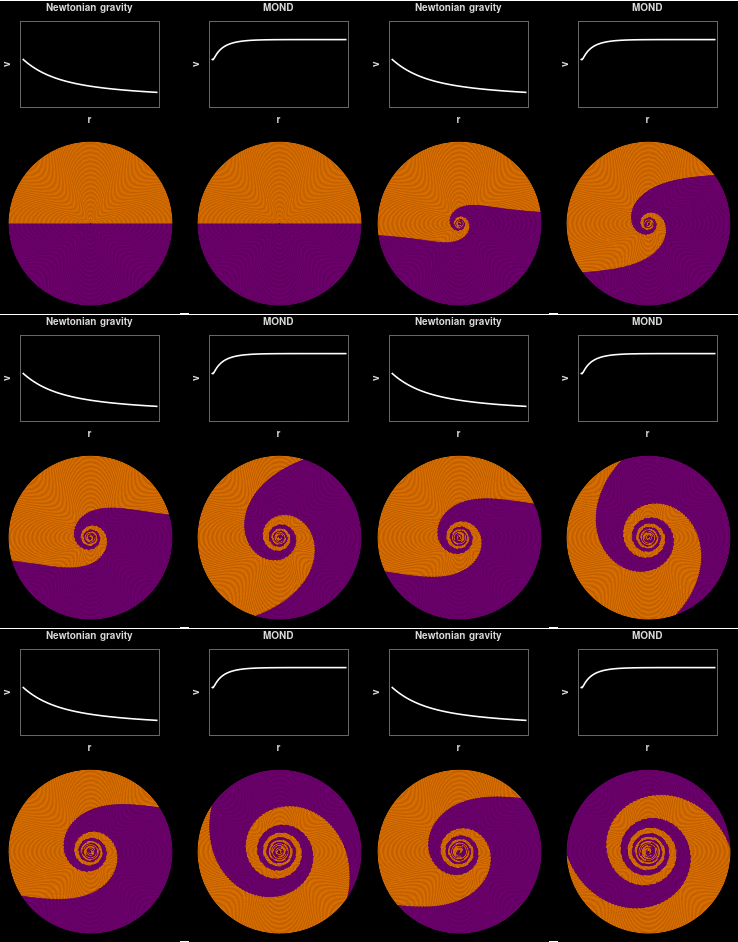
The observed behaviour is explained by assuming that Newton’s second law (F=m a) is modified for very small values of a. Artist: Jacopo Bertolotti.
Tests via Gravitational Lensing and the CMB
Any alternative must account for gravitational lensing, cluster dynamics, and the CMB acoustic peaks. The combination of these data sets tends to favor a dark matter component in standard gravity. That said, modified gravity remains an active area of research, and hybrid models that include both new gravitational physics and some form of dark matter have been explored.
In practice, most cosmological analyses today work within general relativity plus a dark matter component, while keeping an eye on tests that might reveal deviations. For how data are used to constrain these frameworks, see From Surveys to Simulations.
How Scientists Search for Dark Matter: Direct, Indirect, and Colliders
Even though gravitational evidence is strong, the gold standard for identifying dark matter would be a laboratory detection of dark matter particles or a conclusive astrophysical signal that reveals their non‑gravitational properties. Three complementary approaches are pursued worldwide:
1) Direct Detection
Direct detection experiments aim to observe the tiny recoils of nuclei (or, in some concepts, electrons) when a passing dark matter particle scatters in a detector. Because background signals (from radioactivity or cosmic rays) can mimic or overwhelm the tiny recoil signals, these experiments are placed deep underground and use sophisticated shielding and background rejection techniques.
Technologies include:
- Dual‑phase liquid xenon time projection chambers, which provide position reconstruction and discrimination between nuclear and electronic recoils.
- Cryogenic solid‑state detectors using phonon and ionization readouts, optimized for low‑mass dark matter and exquisite energy thresholds.
- Noble liquid argon detectors with strong pulse‑shape discrimination characteristics.
As of the mid‑2020s, large liquid xenon experiments have set leading upper limits on WIMP‑nucleon scattering cross sections across a wide mass range, with argon and cryogenic detectors providing complementary coverage, especially at lower masses. Some experiments search for annual modulation—a potential seasonal variation in signal rate due to Earth’s motion through the galactic halo. While one long‑running experiment reported a modulation, other detectors operating with similar or overlapping target materials have not confirmed a consistent signal.
2) Indirect Detection
If dark matter can annihilate or decay into Standard Model particles, those products—gamma rays, neutrinos, positrons, antiprotons—could be detectable. Targets include:
- Dwarf spheroidal galaxies: high dark matter density and low astrophysical background make them prime targets for gamma‑ray searches.
- The Galactic center: potentially strong signal, but with complex astrophysical emissions to disentangle.
- Galaxy clusters and the extragalactic gamma‑ray background: provide cumulative constraints.
- The Sun and Earth: if dark matter accumulates by scattering, neutrino telescopes can search for annihilation products.
To date, indirect searches have not yielded a universally accepted dark matter signal, but they have set important constraints. Intriguing hints occasionally arise and are carefully scrutinized against astrophysical explanations.
3) Collider Searches
Particle colliders can produce dark matter candidates if they couple to Standard Model particles. Because dark matter would pass through detectors unseen, the signature is often missing transverse energy accompanied by visible particles (e.g., a jet or photon). Collider searches probe couplings that are different from those in direct detection, providing a complementary window into the parameter space. So far, no conclusive dark matter signal has emerged from collider experiments.
Collectively, these three strategies cover a broad swath of models. Even null results are informative, tightening constraints and guiding theory. For axion‑specific strategies, see Axion Dark Matter Experiments and Techniques.
Axion Dark Matter Experiments and Techniques
Axions and axion‑like particles motivate a distinct set of experiments built around their coupling to photons and, in some models, to electrons or nucleons. Because axions are expected to be extremely light and form a coherent field, resonant techniques can dramatically boost sensitivity. Here are the main approaches:
Resonant Microwave Cavities (Haloscopes)
In a strong magnetic field, axions can convert to photons. Resonant cavities tuned to the axion mass enhance the conversion rate, allowing ultra‑sensitive radiofrequency receivers to search for a narrow spectral line. These experiments methodically scan through frequency bands, chasing the small axion signal amid thermal noise. State‑of‑the‑art setups have reached the sensitivity to probe well‑motivated axion models over selected mass ranges in the microelectronvolt regime.
Dielectric Haloscopes and Open Resonators
Dielectric stacks or open resonators can extend sensitivity to higher masses where traditional cavities become impractically small. By carefully arranging dielectric materials in a magnetic field, one can coherently enhance axion‑photon conversion over a wider bandwidth, enabling efficient scanning.
NMR‑like and LC Circuit Techniques
At very low masses, the axion field oscillates slowly, and NMR‑like or lumped‑element resonator techniques can probe axion couplings to electrons or nucleons. These experiments often rely on exquisitely quiet magnetic environments and quantum‑limited sensors to reduce noise.
Broadband and Novel Sensors
Quantum technologies—such as Josephson parametric amplifiers, squeezed vacuum states, and single‑photon detectors—play a crucial role in pushing sensitivity toward the quantum noise limit. Novel broadband concepts aim to cover large mass ranges more rapidly, complementing resonant scans.
Axion experiments are synergistic with astrophysical bounds (e.g., from stellar cooling) and cosmological considerations. Together, they carve out accessible parameter space. Progress is steady, and techniques continue to mature.
Small‑Scale Challenges to Lambda‑CDM and Proposed Resolutions
While the Lambda‑CDM model succeeds on large scales, several tensions have been discussed at small scales. These are not definitive falsifications but rather prompts to refine our understanding of galaxy formation and, potentially, dark matter physics.
The Cusp‑Core Problem
Numerical simulations of collisionless cold dark matter often predict a steep increase in density toward halo centers (“cusps”), whereas observations of some dwarf and low‑surface‑brightness galaxies prefer shallower inner density profiles (“cores”). One proposed resolution is that baryonic processes—such as repeated bursty star formation and supernova feedback—can alter the central potential and redistribute dark matter. Self‑interacting dark matter is another possibility that could produce cores under certain conditions.
Missing Satellites and Too‑Big‑To‑Fail
Early simulations predicted many more subhalos than the number of observed satellite galaxies around the Milky Way. As observational sensitivity has improved, more faint satellites have been discovered, narrowing the gap. Additionally, not all subhalos are expected to host visible galaxies; reionization and feedback can suppress star formation in small halos. The “too‑big‑to‑fail” issue—where the most massive simulated subhalos seemed denser than the brightest observed satellites—has prompted further modeling of baryonic effects and reexamination of halo properties.
Planes of Satellites and Anisotropies
Some galaxies show their satellites aligned in apparent planar structures, which can be surprising in a purely isotropic subhalo distribution. The statistical significance and interpretation of these features continue to be studied, taking into account selection effects, dynamics, and the role of accretion along cosmic filaments.
Collectively, these challenges emphasize that robust predictions at small scales require careful inclusion of baryonic physics and high‑resolution simulations. Alternative dark matter models—warm, self‑interacting, or ultra‑light—remain of interest, but must be evaluated against the full body of data across multiple scales. For how surveys and simulations meet in practice, see From Surveys to Simulations.
From Surveys to Simulations: Turning Data Into Insight
Modern cosmology is data‑rich. Wide‑field surveys map billions of galaxies, track weak gravitational lensing shear, and chart the cosmic expansion history. These observations are compared with theory using sophisticated simulations and statistical inference.
Survey Inputs
- Galaxy redshift surveys: measure the three‑dimensional distribution of galaxies and BAO features.
- Weak lensing surveys: infer the projected mass distribution via small distortions in galaxy shapes.
- CMB experiments: provide precision cosmological parameters and initial conditions.
- Time‑domain surveys: discover transients and variable sources; also valuable for microlensing constraints relevant to compact dark matter.
Simulations: N‑body and Hydrodynamics
To interpret survey data, researchers run N‑body simulations that evolve dark matter under gravity from early conditions to the present day. Hydrodynamical simulations add baryons, star formation, feedback, and black hole physics, aiming to reproduce galaxy populations and observables more realistically. Simulations also test alternative dark matter scenarios—warm or self‑interacting models—by altering particle properties and comparing predictions to data.
Statistical Inference and Systematics
Cosmological analyses rely heavily on Bayesian inference, forward modeling, and careful treatment of systematics. Examples include intrinsic alignments in weak lensing, selection effects in galaxy samples, and uncertainties in the galaxy–halo connection. Cross‑correlating different probes—e.g., galaxy clustering with lensing—can mitigate degeneracies and bolster robustness.
Increasingly, machine learning assists in emulation (fast approximations to simulations), parameter estimation, and anomaly detection. Nonetheless, interpretability and control of biases remain central concerns.
How to Read Papers and Track Dark Matter Research
Given the breadth of the field, it can be challenging to navigate dark matter research. Here are practical steps to stay current and critically informed:
Start with Review Articles and White Papers
Reviews synthesize large literatures and provide context for individual results. They often include balanced discussions of competing models and up‑to‑date references. Reading a review can help you frame a new claim within the broader landscape.
Identify the Observable and the Assumptions
When reading an experimental or observational paper, focus on the key observable (e.g., recoil spectrum, gamma‑ray flux, lensing shear) and the main assumptions. How is the background modeled? What astrophysical uncertainties could mimic the signal? What are the dominant systematic errors?
Look for Cross‑Checks and Independent Confirmations
Dark matter claims should withstand cross‑checks with independent datasets or different methods. For instance, a potential gamma‑ray excess should be tested against multiwavelength data and compared across multiple targets. A direct detection hint should be examined in other target materials or by experiments with different backgrounds.
Follow Experiment Papers and Results Conferences
Major collaborations regularly release results at conferences and in preprints. Even null results are scientifically valuable—they shrink the viable parameter space and guide future searches. Keep an eye on progress across multiple fronts: direct detection, indirect searches, collider constraints, and astrophysical probes.
For specific experimental techniques targeting axions, refer back to Axion Dark Matter Experiments and Techniques. For the cosmological context into which experimental constraints feed, see From Surveys to Simulations.
Frequently Asked Questions
Is dark matter just a placeholder for ignorance?
Dark matter is a hypothesis motivated by a broad array of observations. It is not an arbitrary fudge factor: the same dark matter component explains galaxy rotation curves, gravitational lensing, cluster dynamics, the cosmic microwave background, and large‑scale structure simultaneously. While the particle nature remains unknown, the gravitational evidence for an unseen mass component is strong and internally consistent. Alternative theories that modify gravity must reproduce the full range of data—lensing, CMB peaks, and structure growth—which is challenging. The dark matter hypothesis remains the leading framework because it best accounts for the totality of observations with a coherent physical picture.
Could ordinary objects like faint stars or black holes make up the dark matter?
Compact astrophysical objects exist, but multiple lines of evidence indicate they cannot make up all of the dark matter over broad mass ranges. Microlensing surveys have constrained the abundance of faint stars, brown dwarfs, and many classes of compact objects. Primordial black holes are still studied, but astrophysical observations limit their contribution across many mass windows. Additionally, the CMB and big‑bang nucleosynthesis constrain the total amount of ordinary (baryonic) matter, leaving insufficient room for all of the dark matter to be baryonic compact objects.
Final Thoughts on Understanding Dark Matter
Dark matter is one of the most compelling scientific puzzles of our time. Multiple independent observations—galaxy dynamics, gravitational lensing, the cosmic microwave background, and the large‑scale distribution of galaxies—converge on the need for a dominant non‑luminous matter component. Yet the particle identity remains elusive. That tension is not a weakness but a call to deeper inquiry.

The search strategy is necessarily multi‑pronged. Direct detection experiments push toward lower backgrounds and sharper discrimination, scanning ever more of the WIMP parameter space and exploring low‑mass candidates with novel technologies. Indirect searches refine their sensitivity to potential annihilation or decay signals while carefully modeling astrophysical backgrounds. Collider experiments probe complementary interactions. Parallel efforts target axions and axion‑like particles using resonant and broadband methods, tapping quantum‑limited sensors that were science fiction just a few decades ago.
On the astrophysical side, wide‑field surveys map the cosmic web and lensing shear with unprecedented precision. Hydrodynamical simulations incorporate complex feedback to bridge dark matter theory and the luminous galaxies we see. Small‑scale tensions, meanwhile, sharpen our questions: are they windows into new dark matter physics, or into the messy, fascinating baryonic processes of galaxy formation?
The path forward is clear: keep measuring, keep cross‑checking, and keep integrating insights across disciplines. If dark matter is a new particle, a landmark detection could happen in the lab or in the sky. If gravity itself needs revision, robust evidence must show up consistently across many datasets. Either way, the payoff is profound—a deeper understanding of what the Universe is made of and how structure came to be.
Thank you for reading. If you found this deep dive helpful, explore more of our articles across astrophysics and astronomy, and subscribe to our newsletter to get future research explainers, observing guides, and data‑driven updates delivered to your inbox.